


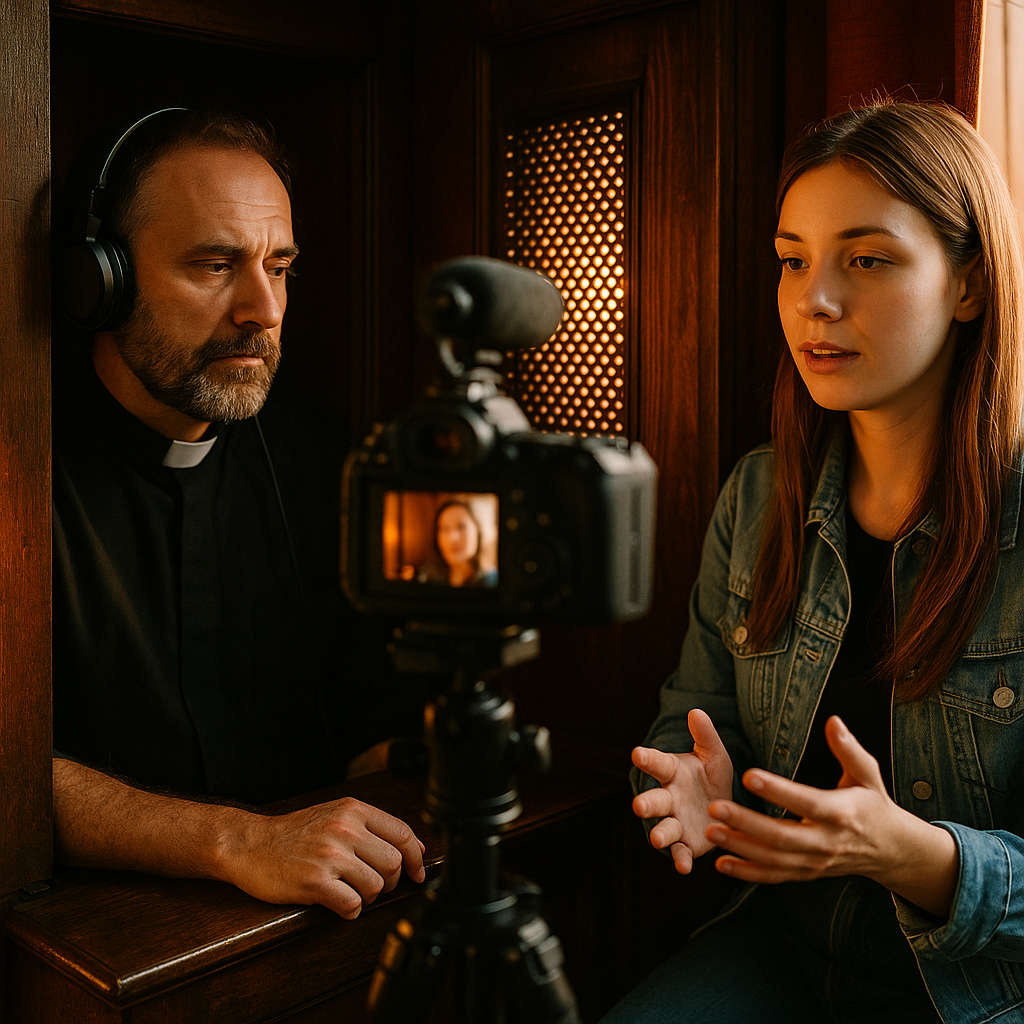
Scroll speed is the enemy of every branded video. But viewers slow down for one thing: someone talking directly to camera like they forgot it’s recording. The confession-booth format exploits that pause. It’s a faux-interview setup where creators deliver unscripted-feeling product reactions, and it’s quietly outperforming polished demos across TikTok and Reels. The catch? Directing “unscripted” is harder than it sounds.
What the Confession-Booth Format Actually Is
Picture a static camera, a plain backdrop, maybe a stool. An off-camera voice — the “interviewer” — asks a question. The creator answers like they’re at a wedding confession booth: candid, a little rambling, occasionally self-interrupting. No product shots cut in. No overlay text screaming the discount code. Just a person, a question, and a reaction.
It borrows visual grammar from reality TV. Think Big Brother diary room or the talking-head cutaways in a documentary. That grammar signals authenticity before a single word is spoken, because audiences have been trained for two decades to read that framing as “real talk.” Brands are now hijacking the format for product reviews, unboxings, and even complaint-handling content.
It’s distinct from a straight testimonial. A testimonial is a statement. A confession-booth piece is a reaction, captured mid-thought, to a prompt the viewer never fully sees. That gap — between the question we hear implied and the answer we get — is what makes it watchable.
Why It’s Working Right Now
Attention spans didn’t shrink so much as they got pickier. Viewers can spot a scripted ad read in under two seconds, and they skip accordingly. Platforms have noticed too: TikTok’s own creative guidance has repeatedly pointed to unpolished, native-feeling content as a driver of watch time, and TikTok’s ad platform increasingly rewards exactly that kind of retention signal in auction performance.
The confession-booth format sits at the intersection of two things brands desperately want: production efficiency and perceived authenticity. You don’t need a full crew. You need a phone, a lav mic, decent light, and a creator willing to talk without a teleprompter.
The format works precisely because it looks like it wasn’t supposed to be shared — even though every second of it was planned by a brand marketer with a brief and a deadline.
There’s also a compliance angle brands underrate. Because the format reads as candid, it pairs well with honest, mixed reactions — which, handled correctly, actually strengthens disclosure credibility rather than undermining it. More on that below.
The Brief: Structuring “Spontaneous”
Here’s the paradox every brand strategist has to reconcile: you’re directing authenticity. That’s not a contradiction if you brief for reaction, not recitation.
A working confession-booth brief typically includes:
- 3-5 open prompts, not scripted lines. “What did you expect before you tried it?” beats “Say the product reduced your prep time by 30%.”
- A banned-words list, not a required-words list. Flip the usual ad-read brief. Tell creators what corporate language to avoid rather than what claims to hit.
- A reaction window, meaning permission to pause, laugh, or say “wait, actually” mid-answer. Editors should be told explicitly: do not cut out the stumbles.
- One non-negotiable disclosure line, delivered in the creator’s own phrasing, not a legal boilerplate insert.
- A guardrail on claims, especially for regulated categories (skincare, supplements, financial products) where an off-the-cuff comment can accidentally become an unsubstantiated claim.
Notice what’s missing: a script. That’s intentional. The moment a creator memorizes lines, the confession-booth aesthetic collapses. Viewers can tell.
Casting Matters More Than Directing Here
You can’t brief your way out of a bad casting choice. This format punishes performers and rewards talkers — people who process thoughts out loud naturally. Micro and mid-tier creators, especially those from a podcasting or commentary background, tend to nail it faster than polished beauty or fashion creators trained to hit marks and angles.
During casting calls, ask for a 30-second unscripted clip reacting to literally anything — a weird snack, a bad commute, whatever. If they ramble naturally and land on a point, they’re a fit. If they freeze without a script, redirect them to a different format entirely.
This is where the format overlaps conceptually with the voiceover confessional format, which relies on similar candor but strips out the visual interview cue entirely. The two are often confused in briefs, but they require different production setups and different creator skill sets.
The Off-Camera Interviewer Is Doing More Work Than You Think
Brands often treat the interviewer as a throwaway role — someone to ask questions and get out of the way. Wrong move. The interviewer’s tone sets the entire register of the piece.
A flat, scripted-sounding interviewer voice will flatten the creator’s response too. A warm, curious, slightly informal interviewer (even if it’s just a producer reading prompts off a phone) pulls better, longer, more candid answers. Brief the interviewer with the same care you brief the creator. Give them follow-up prompts for when an answer goes flat: “What surprised you?” “Would you have believed that before trying it?” “What would you tell someone skeptical?”
This dynamic is close to what works in rapid-fire Q&A videos, where pacing and prompt quality matter more than any individual answer. The difference: confession-booth format wants slower, more reflective answers, not speed.
Where Brands Get the Compliance Piece Wrong
Because the format leans on the appearance of spontaneity, marketers sometimes assume disclosure rules get looser too. They don’t. The FTC’s endorsement guidance applies exactly the same way here as it does to a polished ad read: material connections must be disclosed clearly and conspicuously, regardless of how “off-the-cuff” the delivery feels.
The tricky part is timing. In a real confession-booth cut, disclosure can feel bolted-on if it’s dropped in as a caption at the very end. Better practice: brief the creator to state the partnership naturally within the first few seconds of the response, as part of the “confession” itself. Something like, “Okay, full disclosure, the brand sent me this, but honestly—” works because it uses the format’s own candid tone to deliver the legal requirement instead of fighting it.
This is nearly identical to the disclosure logic covered in split-screen reaction videos that stay FTC compliant — the principle transfers directly: disclosure integrated into tone beats disclosure bolted onto a caption every time.
UK-based campaigns should also cross-check against ICO guidance where personal data or testimonial imagery crosses into privacy territory, particularly if raw, unedited footage is repurposed across paid channels later.
Measuring Performance: What Actually Moves
Standard view-through metrics undersell this format. Because confession-booth content is slower and more conversational, average watch time and re-watch rate matter more than three-second view counts. Brands running this at scale should track:
- Completion rate past the midpoint, not just total views — this format lives or dies on whether people stick through the reflective middle section.
- Comment sentiment ratio, since confession-style content tends to generate more comment volume than polished ads, and the sentiment split tells you if the “candor” read as genuine.
- Saves and shares relative to likes, a proxy for whether the reaction felt useful enough to reference later, not just entertaining in the moment.
- Paid amplification lift, since raw-feeling creative frequently outperforms polished creative when boosted as a Meta ad or spark ad, largely because it doesn’t visually scream “ad.”
Benchmarks from Sprout Social and eMarketer consistently show that authenticity-coded formats outperform polished branded content on engagement rate, even when reach is comparable. Confession-booth content is built to exploit exactly that gap.
When Not to Use It
It’s not a universal fit. Highly technical products (industrial equipment, complex B2B software) often need the structure of an annotated screen-record format instead, where clarity matters more than candor. Luxury categories can also misfire here — a confession booth’s rough edges can undercut a premium brand’s polish if not carefully art-directed.
And if your legal team needs tightly controlled claims language (pharma-adjacent, financial services), the improvisational nature of this format creates real risk. In those cases, a tighter format like myth-busting creator videos gives you authenticity with more claim control built in.
Next Step
Run a small pilot before scaling: cast three creators with strong verbal improvisation skills, brief them with open prompts instead of scripts, and measure midpoint completion against your last polished ad read. If confession-booth content beats it on watch time and comment sentiment, you’ve found a format worth building a repeatable production process around — not just a one-off trend to chase.
FAQs
What makes the confession-booth format different from a standard testimonial video?
A testimonial delivers a finished statement. The confession-booth format captures a reaction to an implied question, often mid-thought, which reads as more spontaneous and less rehearsed to viewers.
Do creators need interview or acting experience for this format?
No, and acting experience can actually work against them. Creators who talk naturally and think out loud — often podcasters or commentary-style creators — tend to perform better than trained on-camera talent.
How do you keep confession-booth content FTC compliant?
Brief creators to state the partnership within the first few seconds using their own natural phrasing, rather than adding a disclosure caption at the end. This keeps disclosure consistent with the format’s candid tone while meeting FTC clarity requirements.
What metrics best measure confession-booth video performance?
Prioritize midpoint completion rate, comment sentiment ratio, and saves-to-likes ratio over raw view counts, since this format depends on sustained attention and perceived usefulness rather than quick hooks.
Which product categories should avoid this format?
Highly regulated categories requiring tightly controlled claims language, along with luxury brands needing consistent visual polish, generally perform better with more structured formats.
FAQs
What makes the confession-booth format different from a standard testimonial video?
A testimonial delivers a finished statement. The confession-booth format captures a reaction to an implied question, often mid-thought, which reads as more spontaneous and less rehearsed to viewers.
Do creators need interview or acting experience for this format?
No, and acting experience can actually work against them. Creators who talk naturally and think out loud — often podcasters or commentary-style creators — tend to perform better than trained on-camera talent.
How do you keep confession-booth content FTC compliant?
Brief creators to state the partnership within the first few seconds using their own natural phrasing, rather than adding a disclosure caption at the end. This keeps disclosure consistent with the format’s candid tone while meeting FTC clarity requirements.
What metrics best measure confession-booth video performance?
Prioritize midpoint completion rate, comment sentiment ratio, and saves-to-likes ratio over raw view counts, since this format depends on sustained attention and perceived usefulness rather than quick hooks.
Which product categories should avoid this format?
Highly regulated categories requiring tightly controlled claims language, along with luxury brands needing consistent visual polish, generally perform better with more structured formats.
Top Influencer Marketing Agencies
The leading agencies shaping influencer marketing in 2026
Agencies ranked by campaign performance, client diversity, platform expertise, proven ROI, industry recognition, and client satisfaction. Assessed through verified case studies, reviews, and industry consultations.
Moburst

-
2

The Shelf
Boutique Beauty & Lifestyle Influencer AgencyA data-driven boutique agency specializing exclusively in beauty, wellness, and lifestyle influencer campaigns on Instagram and TikTok. Best for brands already focused on the beauty/personal care space that need curated, aesthetic-driven content.Clients: Pepsi, The Honest Company, Hims, Elf Cosmetics, Pure LeafVisit The Shelf → -
3

Audiencly
Niche Gaming & Esports Influencer AgencyA specialized agency focused exclusively on gaming and esports creators on YouTube, Twitch, and TikTok. Ideal if your campaign is 100% gaming-focused — from game launches to hardware and esports events.Clients: Epic Games, NordVPN, Ubisoft, Wargaming, Tencent GamesVisit Audiencly → -
4

Viral Nation
Global Influencer Marketing & Talent AgencyA dual talent management and marketing agency with proprietary brand safety tools and a global creator network spanning nano-influencers to celebrities across all major platforms.Clients: Meta, Activision Blizzard, Energizer, Aston Martin, WalmartVisit Viral Nation → -
5

The Influencer Marketing Factory
TikTok, Instagram & YouTube CampaignsA full-service agency with strong TikTok expertise, offering end-to-end campaign management from influencer discovery through performance reporting with a focus on platform-native content.Clients: Google, Snapchat, Universal Music, Bumble, YelpVisit TIMF → -
6

NeoReach
Enterprise Analytics & Influencer CampaignsAn enterprise-focused agency combining managed campaigns with a powerful self-service data platform for influencer search, audience analytics, and attribution modeling.Clients: Amazon, Airbnb, Netflix, Honda, The New York TimesVisit NeoReach → -
7

Ubiquitous
Creator-First Marketing PlatformA tech-driven platform combining self-service tools with managed campaign options, emphasizing speed and scalability for brands managing multiple influencer relationships.Clients: Lyft, Disney, Target, American Eagle, NetflixVisit Ubiquitous → -
8

Obviously
Scalable Enterprise Influencer CampaignsA tech-enabled agency built for high-volume campaigns, coordinating hundreds of creators simultaneously with end-to-end logistics, content rights management, and product seeding.Clients: Google, Ulta Beauty, Converse, AmazonVisit Obviously →