


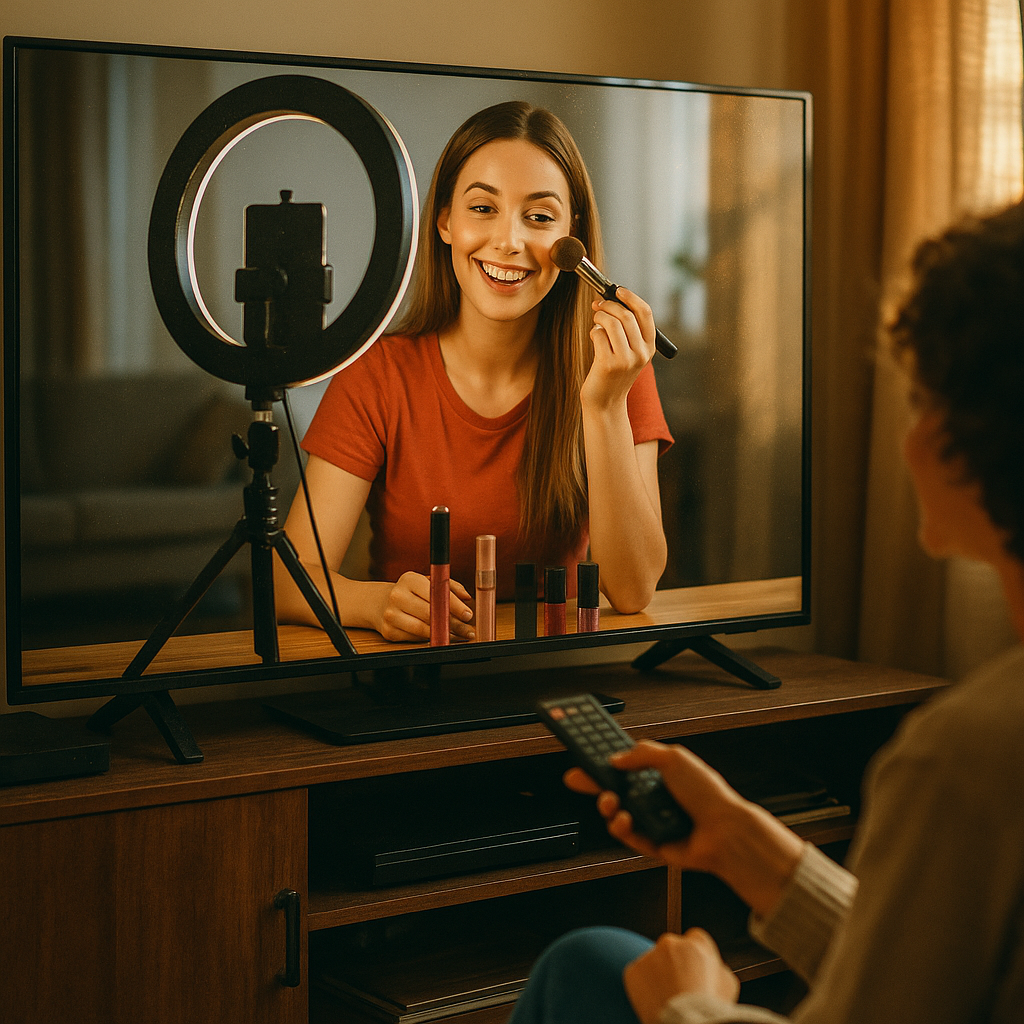
Connected TV now reaches over 90% of U.S. households, yet fewer than 15% of influencer programs are built with CTV delivery specifications in mind. That gap is your competitive window. The Connected TV creator distribution model is not a future-state concept — brands that are moving now are locking in production efficiencies, audience reach, and ad inventory relationships that will be exponentially harder to access once the platform consolidation shakes out.
Why CTV Is No Longer a Separate Channel
Platform consolidation is accelerating faster than most media plans account for. Roku, Amazon Fire TV, Samsung Ads Platform, and Google TV are not simply distribution endpoints — they are now full-stack advertising ecosystems with audience targeting, purchase intent data, and increasingly, native creator content rails. YouTube’s CTV presence alone accounts for over 1 billion hours of daily watch time on living room screens, according to Statista. The living room is not a premium video silo anymore. It is a creator content surface.
The brands figuring this out are not waiting for their media agencies to present a CTV line item. They are redesigning how they brief, shoot, and license creator content from the ground up.
What “Designed for CTV” Actually Means in a Creator Brief
This is where most brand teams stall. CTV delivery specifications are not simply about aspect ratio or resolution. The full specification set includes:
- Aspect ratio: 16:9 horizontal (the inverse of short-form vertical), which means a single-session shoot designed only for 9:16 has zero CTV utility
- Resolution: Minimum 1920×1080, with 4K assets increasingly requested by premium inventory buyers
- Audio specs: Stereo or 5.1 mixes, loudness normalized to -24 LKFS for broadcast-adjacent environments
- Safe zones: Title-safe and action-safe framing conventions that differ substantially from mobile-first creative
- Duration: 15, 30, and 60-second cuts, with 15s performing strongest in non-skippable CTV ad formats
- Supers and graphics: Legible at 10-foot viewing distance, not thumb-scroll distance
The practical implication: if your creator is shooting vertical content on a gimbal in their bedroom, you are producing content that is fundamentally incompatible with CTV delivery without expensive post-production rework. The fix happens at the brief stage, not the editing stage.
For brands already running multi-platform creator shoots, adding a CTV cut to the session is not a significant production lift. It requires planning, not budget.
The Consolidation Window: What’s Actually Closing
Platform consolidation refers to the period during which streaming platforms, AVOD (ad-supported video on demand) services, and smart TV operating systems are still actively competing for advertising partners, content supply, and audience data relationships. During consolidation windows, early movers get preferential access to ad inventory, beta features, and audience targeting capabilities that become pay-to-play once the ecosystem matures.
Brands that established YouTube Masthead relationships in 2016 and 2017 are still benefiting from CPM advantages that new entrants simply cannot replicate. The CTV consolidation window operates on the same logic, and it is closing faster than most media plans acknowledge.
The platforms currently competing hardest for creator-brand inventory include Roku’s OneView DSP, Amazon’s streaming TV ad suite, Peacock, Pluto TV, Tubi, and Samsung Ads. Each has active brand partnership programs with favorable terms for brands willing to bring quality content supply. That favorability is not permanent.
According to eMarketer, AVOD ad spending is projected to outpace traditional linear TV ad spending within this decade. The brands populating that inventory pipeline with creator-originated content now are building a structural advantage.
Rethinking the UGC Repurposing Pipeline
The most operationally efficient version of this model is not about creating separate CTV campaigns. It is about integrating CTV delivery requirements into your existing UGC repurposing pipeline so that CTV-ready assets emerge naturally from creator production sessions.
Here is what that looks like in practice. A mid-size DTC brand briefs three creators for a product launch. Instead of a purely vertical shoot brief, the creative director specifies a dual-capture setup: vertical 9:16 for Reels and TikTok, horizontal 16:9 for CTV and YouTube pre-roll. Lighting and background requirements are elevated to broadcast standards. Audio is captured clean with a lavalier, not just on-camera. The creator delivers six asset variants instead of three.
The incremental cost per creator session: roughly 20-30% depending on production support. The asset utility: approximately triple. That math closes quickly at any meaningful media spend level.
Rights clearance matters here too. CTV distribution often triggers different licensing requirements than social platform delivery. Before repurposing any creator or UGC asset to a connected TV environment, confirm your usage rights explicitly cover broadcast-adjacent distribution. The FTC’s disclosure guidance also applies to CTV placements, and disclosure mechanics in a non-skippable 30-second ad differ from a caption disclosure on Instagram. Build this into your creator brief compliance workflow before you scale.
Which Brands Are Already Doing This Well
Athletic Greens (AG1) ran creator-originated content on Roku inventory as part of a broader direct-response CTV test, treating their established YouTube creator partnerships as the content source and the streaming environment as a reach extension layer. The creative did not feel like a TV ad. That was the point.
Fashion and beauty brands are increasingly treating their creator aesthetic as a broadcast format, delivering authentic-feeling content into premium CTV placements that audiences are trained to skip past when they look like traditional advertising. The authenticity differential is the performance driver.
The underlying pattern: brands succeeding with the CTV creator model are not trying to make creator content look like TV ads. They are making CTV placements feel like creator content. The production specifications serve the delivery channel; the creative philosophy serves the audience relationship.
Building the Operational Infrastructure
Execution at scale requires three operational components that most influencer programs currently lack.
First, a CTV-aware creative brief template. Your standard creator brief likely specifies hook timing, platform, and call-to-action. Add a CTV delivery section that covers framing, resolution, audio, and safe zone requirements. Reference the Google Ads video specification standards and Roku’s advertising creative guidelines as your baseline. For episodic content, review how others are structuring episodic YouTube brand series briefs — the structural logic transfers directly to CTV formats.
Second, a rights and licensing framework built for multi-channel delivery. Creator contracts need explicit CTV distribution rights language. “Digital” does not automatically cover connected TV in all licensing interpretations. Work with your legal team to define the delivery channel taxonomy clearly.
Third, a measurement framework that connects CTV delivery to downstream outcomes. The attribution challenge in CTV is real. Pixel-based attribution is limited in the living room environment. Brands are using a combination of geo-based incrementality testing, household-level match panels via platforms like marketing analytics tools, and platform-native measurement (Roku’s Attribution Manager, Amazon’s Brand Lift studies) to close the loop. Build the measurement plan before you spend, not after.
The brands that will own CTV creator inventory in 2028 and beyond are the ones building their operational infrastructure in the next 18 months. Waiting for the channel to “prove itself” is the same bet that kept brands off YouTube pre-roll until CPMs tripled.
The next move is straightforward: audit your last three creator campaigns and identify every asset that could have delivered into a CTV environment with modified production specifications. That gap analysis is your brief for what to build next.
Frequently Asked Questions
What are the core production specifications for CTV-ready creator content?
CTV-ready creator content requires 16:9 aspect ratio (minimum 1920×1080, preferably 4K), stereo or 5.1 audio normalized to -24 LKFS, title-safe and action-safe framing for 10-foot viewing distance, and cuts in 15, 30, and 60-second durations. Graphics and supers must be legible on large screens, not optimized for mobile thumb-scroll viewing.
Do existing creator contracts typically cover CTV distribution?
Not automatically. “Digital” or “online” usage rights language in creator contracts does not reliably cover connected TV or broadcast-adjacent distribution environments. Brands should explicitly negotiate and define CTV distribution rights, including any streaming platform categories (AVOD, SVOD ad tiers, smart TV OS placements), in creator and UGC licensing agreements before distribution begins.
How does FTC disclosure work for influencer content on CTV platforms?
The FTC’s endorsement guidelines apply to all advertising placements, including CTV. For non-skippable or limited-skip CTV ad formats, disclosure must appear clearly within the viewable portion of the ad, typically as an on-screen super at the beginning of the spot. Caption-based or description-based disclosures used on social platforms are not sufficient for CTV delivery.
What is the best way to measure CTV campaign effectiveness for creator content?
CTV attribution relies on a combination of methods since traditional pixel tracking is limited in living room environments. Effective approaches include geo-based incrementality testing, household-level match panels, platform-native tools like Roku Attribution Manager or Amazon Brand Lift studies, and post-campaign brand lift surveys. Build the measurement framework before the campaign launches, not retroactively.
Which AVOD platforms should brands prioritize for creator content distribution?
The highest-priority platforms for most brands are Roku (via the OneView DSP), Amazon Streaming TV (via Amazon DSP), YouTube on CTV, and Samsung Ads Platform. Tubi and Pluto TV offer strong reach with cost-efficient CPMs and are particularly competitive during the current consolidation window. Platform selection should be driven by audience match, not platform familiarity.
Top Influencer Marketing Agencies
The leading agencies shaping influencer marketing in 2026
Agencies ranked by campaign performance, client diversity, platform expertise, proven ROI, industry recognition, and client satisfaction. Assessed through verified case studies, reviews, and industry consultations.
Moburst

-
2

The Shelf
Boutique Beauty & Lifestyle Influencer AgencyA data-driven boutique agency specializing exclusively in beauty, wellness, and lifestyle influencer campaigns on Instagram and TikTok. Best for brands already focused on the beauty/personal care space that need curated, aesthetic-driven content.Clients: Pepsi, The Honest Company, Hims, Elf Cosmetics, Pure LeafVisit The Shelf → -
3

Audiencly
Niche Gaming & Esports Influencer AgencyA specialized agency focused exclusively on gaming and esports creators on YouTube, Twitch, and TikTok. Ideal if your campaign is 100% gaming-focused — from game launches to hardware and esports events.Clients: Epic Games, NordVPN, Ubisoft, Wargaming, Tencent GamesVisit Audiencly → -
4

Viral Nation
Global Influencer Marketing & Talent AgencyA dual talent management and marketing agency with proprietary brand safety tools and a global creator network spanning nano-influencers to celebrities across all major platforms.Clients: Meta, Activision Blizzard, Energizer, Aston Martin, WalmartVisit Viral Nation → -
5

The Influencer Marketing Factory
TikTok, Instagram & YouTube CampaignsA full-service agency with strong TikTok expertise, offering end-to-end campaign management from influencer discovery through performance reporting with a focus on platform-native content.Clients: Google, Snapchat, Universal Music, Bumble, YelpVisit TIMF → -
6

NeoReach
Enterprise Analytics & Influencer CampaignsAn enterprise-focused agency combining managed campaigns with a powerful self-service data platform for influencer search, audience analytics, and attribution modeling.Clients: Amazon, Airbnb, Netflix, Honda, The New York TimesVisit NeoReach → -
7

Ubiquitous
Creator-First Marketing PlatformA tech-driven platform combining self-service tools with managed campaign options, emphasizing speed and scalability for brands managing multiple influencer relationships.Clients: Lyft, Disney, Target, American Eagle, NetflixVisit Ubiquitous → -
8

Obviously
Scalable Enterprise Influencer CampaignsA tech-enabled agency built for high-volume campaigns, coordinating hundreds of creators simultaneously with end-to-end logistics, content rights management, and product seeding.Clients: Google, Ulta Beauty, Converse, AmazonVisit Obviously →