


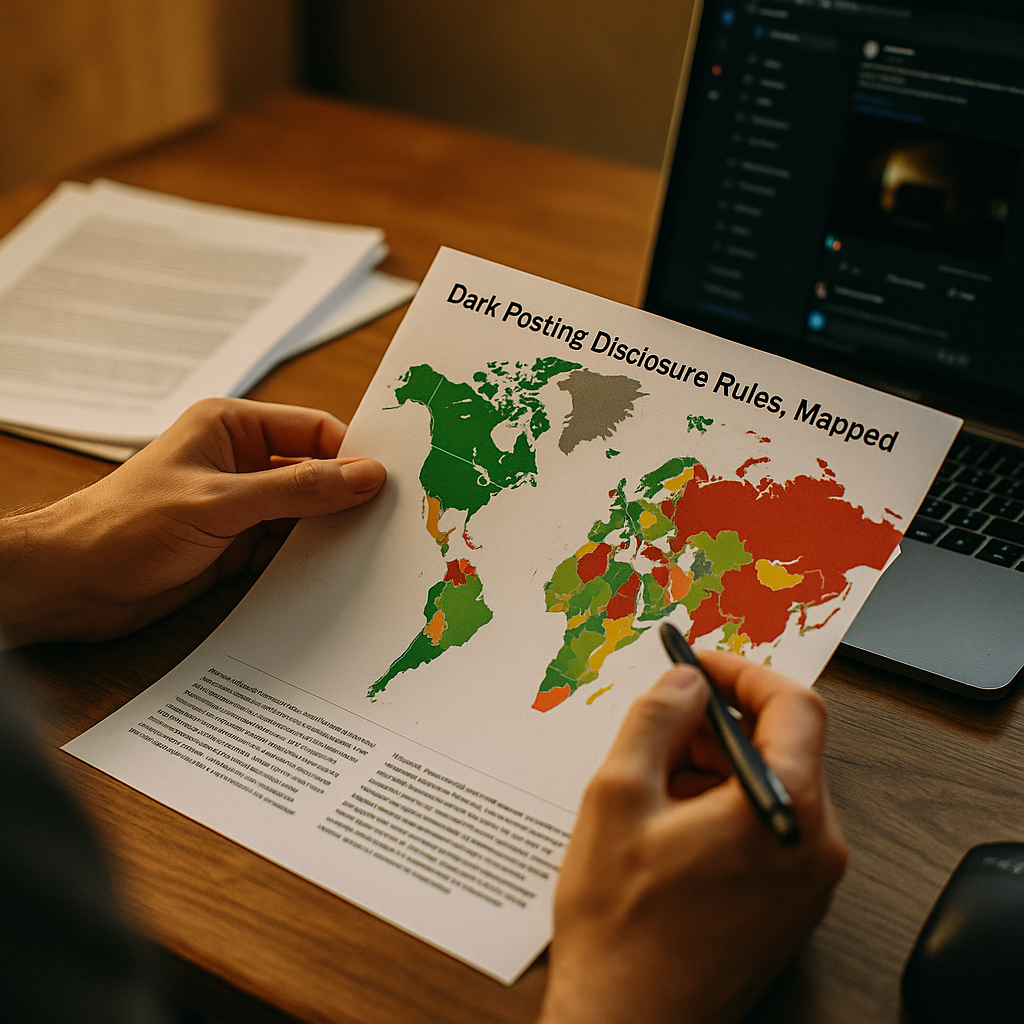
Dark posting disclosure requirements now vary so widely by country that the same whitelisted ad running in three markets simultaneously can be fully compliant in one, borderline in another, and flat-out illegal in the third. If your media buying team treats disclosure as a single global checkbox, you’re already exposed. Regulators from the FTC to the UK’s ASA to Australia’s ACCC have made clear that stripping a creator’s disclosure label during ad conversion doesn’t erase the obligation, it just moves the liability to the brand running the buy.
Dark posting (sometimes called whitelisting) lets brands run ads through a creator’s handle without ever appearing on that creator’s public feed. It’s a powerful media tactic. It’s also a compliance minefield, because the disclosure rules were written for organic posts and regulators are still catching up on how they apply to paid, unpublished creative.
Why Dark Posting Breaks the Usual Disclosure Playbook
Standard influencer disclosure guidance assumes a public post: a hashtag, a “Paid Partnership” label, a visible caption disclaimer. Dark posting removes the public post entirely. The ad exists only inside the platform’s ad manager, targeted to a specific audience segment, often A/B tested across a dozen variants. Which variant carries the disclosure? Who’s checking? In most in-house workflows, nobody is, until legal gets a complaint.
We covered the mechanics of this gap in dark posting strips disclosure labels, and the pattern holds across every market we’ve reviewed: platform-native disclosure tools (Meta’s branded content tag, TikTok’s paid partnership label) get applied to the original creator post, but that metadata frequently doesn’t carry through when the ad is whitelisted and re-targeted through Ads Manager. The fix isn’t procedural elegance, it’s a hard rule: no dark post ships without a manually verified disclosure baked into the creative itself, not just the platform tag.
The Market by Market Map
Here’s where it gets genuinely complicated. Disclosure obligations differ not just in wording but in enforcement posture, penalty structure, and who bears primary liability.
United States. The FTC requires “clear and conspicuous” disclosure on every ad, whitelisted or not. There’s no exemption for paid media formats. The FTC’s Endorsement Guides treat the advertiser as jointly responsible for disclosure failures, meaning brands can’t outsource the risk to the creator’s original post. State attorneys general have also started pursuing parallel actions under state consumer protection statutes, which stack on top of federal exposure.
United Kingdom. The Advertising Standards Authority requires “#ad” or equivalent labeling that’s visible without needing to click “see more” or expand a caption, a detail that trips up a lot of dark post creative because ad units often truncate text. The ASA has ruled against brands even when the label technically existed but was buried below the fold.
European Union. Disclosure sits inside the Unfair Commercial Practices Directive, but enforcement is fragmented across member states. Germany’s competition law (UWG) has produced some of the most aggressive influencer marketing rulings in Europe, with courts treating undisclosed paid content as a competition law violation, not just a consumer protection issue. France’s DGCCRF has similar teeth. Brands running pan-EU whitelisted campaigns need country-specific legal review, not a single EU-wide disclosure template.
Australia. The ACCC updated its influencer guidance to explicitly cover paid amplification of creator content, closing the exact loophole dark posting was exploiting. Disclosure must be visible at the start of the post, not buried in hashtags at the end.
Canada. The Competition Bureau follows a similar “clear and prominent” standard to the FTC but has been notably less active in enforcement, which creates a false sense of safety for brands assuming lighter regulation means lower risk. That assumption is aging poorly as consumer complaint volume rises.
A disclosure label that satisfies the FTC can still fail in the UK, Germany, or Australia. Market-by-market review isn’t a nice-to-have for global whitelisted campaigns, it’s the only way to avoid a compliance failure that scales with your media spend.
What This Means for Media Buying Workflows
Most brands build creative once and localize the targeting, not the compliance layer. That’s backwards for dark posting specifically. Every whitelisted variant needs a disclosure check tied to the market it’s running in, before it goes live, not after a regulator or a competitor flags it.
A few operational fixes that actually hold up:
- Bake disclosure text into the creative asset itself (burned-in caption or on-screen text), not just the platform’s metadata tag, so it survives the whitelisting process.
- Build a market-specific compliance checklist into your ad approval workflow, reviewed by someone who actually knows the local rules, not a generic global template.
- Audit live whitelisted ads monthly, not just at launch. Platforms change ad formats and truncation rules without much notice.
- Keep a documented record of disclosure review for every market variant. If a regulator asks, “we assumed it was fine” is not a defense.
This connects directly to broader platform-level disclosure gaps we’ve tracked elsewhere, including how YouTube’s auto detection is starting to flag undisclosed brand deals algorithmically, and how TikTok Shop’s built-in disclosure tools are trying to close similar gaps at the point of sale. Platforms are building enforcement infrastructure faster than most brand compliance teams are updating their internal SOPs.
Age and Location Gating Adds Another Layer
Dark posting rarely runs untargeted. Brands segment by age, geography, and interest, which means the same base creative might need three or four disclosure variants just to satisfy different regional rules simultaneously. This is where compliance and media buying have to sit in the same room, because targeting decisions made in Ads Manager directly affect which disclosure standard applies. We go deeper on the segmentation side in age and location gated disclosures, but the short version: a single “one policy fits all” approach breaks the moment you start geo-targeting whitelisted ads at scale.
There’s also a growing overlap with platform-specific formats. Livestream shopping disclosures face a similar real-time labeling problem, and connected TV ad disclosures are running into the same “the label existed somewhere but not where the viewer could see it” issue that’s plagued dark posting since it became standard practice.
Who’s Actually Liable When It Goes Wrong?
This is the question that keeps CMOs up at night, and the honest answer is: usually both parties, but the brand takes the bigger hit. Creators can face platform penalties (demonetization, shadowbanning) and, in rarer cases, direct regulatory action. But brands face the FTC complaint, the class action exposure, the PR fallout, and increasingly, shareholder scrutiny if the campaign was material to a public company’s marketing spend. The FTC’s own guidance is explicit that advertisers can’t contract their way out of disclosure liability just because the creator agreement says the creator is responsible.
Agencies sit in an awkward middle position. If an agency built the media plan and approved the creative, courts and regulators increasingly treat that as active participation, not passive execution. That’s pushed a lot of agencies to build disclosure review into their standard SOW language, with sign-off requirements that mirror what we’ve seen in BBB National Programs review processes for creator campaigns.
Data Points Worth Flagging to Leadership
Industry surveys from eMarketer and consumer trust research from Sprout Social both point to the same underlying trend: consumers say they trust disclosed sponsored content more than they trust content they later discover was undisclosed. That trust gap isn’t abstract, it shows up in engagement and conversion metrics once the discovery happens. Undisclosed dark posts that get flagged publicly (by a journalist, a watchdog account, or a competitor) tend to generate outsized negative attention precisely because the “hidden ad” framing makes for an easy, damning headline.
None of this means brands should pull back from whitelisting, it remains one of the most efficient ways to scale creator content through paid media. It means the compliance layer needs the same rigor as the targeting layer.
Building a Repeatable Compliance Map
The brands handling this well treat market-by-market disclosure the same way they treat market-by-market tax or privacy compliance: as a living document, reviewed quarterly, owned jointly by legal and media buying. A workable structure looks like this:
- A master matrix listing every active market, its disclosure standard, and required placement (start of caption, on-screen burn-in, both).
- A pre-flight checklist attached to every whitelisted ad variant before it enters the ad platform’s approval queue.
- A monthly spot-check audit of live ads, screenshotting actual rendered creative, not just the source asset.
- A documented escalation path if a disclosure failure is discovered post-launch, including takedown timing and legal notification triggers.
This mirrors the operational discipline we’ve recommended for other creator compliance risks, from state tax nexus triggers in live shopping to managed creator program misclassification risk. Disclosure compliance for dark posting isn’t a separate discipline from the rest of your creator risk management, it’s the same muscle applied to a paid media format.
FAQs
FAQ Section
Frequently Asked Questions
What exactly is dark posting in influencer marketing?
Dark posting (also called whitelisting) is when a brand runs a paid ad through a creator’s social handle without the ad ever appearing publicly on that creator’s feed. It’s used to leverage a creator’s ad account access and audience trust for targeted paid media, separate from organic posting.
Does the FTC require disclosure on whitelisted or dark posted ads?
Yes. The FTC’s Endorsement Guides apply regardless of whether content is published organically or run as a dark post. Disclosure must be clear and conspicuous on the ad itself, and the advertiser shares liability with the creator for compliance failures.
Can one disclosure format satisfy every country’s requirements?
Generally no. Placement, wording, and visibility rules differ meaningfully between the US, UK, EU member states, and Australia. A disclosure that satisfies FTC guidance can still fail ASA or ACCC review if it’s positioned differently or buried in truncated text.
Who is liable if a dark posted ad lacks proper disclosure?
Both brand and creator can face consequences, but brands typically carry greater exposure since regulators treat the advertiser as jointly responsible. Agencies that built the media plan or approved creative can also face liability if they had an active role in the campaign.
How often should brands audit disclosure compliance on live whitelisted ads?
Monthly spot checks on live, rendered creative are a reasonable baseline, since platform ad formats and truncation behavior can change without notice and affect whether a disclosure remains visible.
Does burning disclosure text into the creative asset help?
Yes. Relying solely on platform metadata tags (like branded content labels) risks the disclosure not carrying through the whitelisting process. Embedding disclosure directly into the visual creative or on-screen text is more resilient across ad formats and markets.
Treat dark posting disclosure the way you’d treat any other cross-border compliance risk: build the market-by-market matrix now, assign clear ownership between legal and media buying, and audit live creative monthly rather than assuming launch-day approval holds forever.
FAQs
Frequently Asked Questions
What exactly is dark posting in influencer marketing?
Dark posting (also called whitelisting) is when a brand runs a paid ad through a creator’s social handle without the ad ever appearing publicly on that creator’s feed. It’s used to leverage a creator’s ad account access and audience trust for targeted paid media, separate from organic posting.
Does the FTC require disclosure on whitelisted or dark posted ads?
Yes. The FTC’s Endorsement Guides apply regardless of whether content is published organically or run as a dark post. Disclosure must be clear and conspicuous on the ad itself, and the advertiser shares liability with the creator for compliance failures.
Can one disclosure format satisfy every country’s requirements?
Generally no. Placement, wording, and visibility rules differ meaningfully between the US, UK, EU member states, and Australia. A disclosure that satisfies FTC guidance can still fail ASA or ACCC review if it’s positioned differently or buried in truncated text.
Who is liable if a dark posted ad lacks proper disclosure?
Both brand and creator can face consequences, but brands typically carry greater exposure since regulators treat the advertiser as jointly responsible. Agencies that built the media plan or approved creative can also face liability if they had an active role in the campaign.
How often should brands audit disclosure compliance on live whitelisted ads?
Monthly spot checks on live, rendered creative are a reasonable baseline, since platform ad formats and truncation behavior can change without notice and affect whether a disclosure remains visible.
Does burning disclosure text into the creative asset help?
Yes. Relying solely on platform metadata tags (like branded content labels) risks the disclosure not carrying through the whitelisting process. Embedding disclosure directly into the visual creative or on-screen text is more resilient across ad formats and markets.
Top Influencer Marketing Agencies
The leading agencies shaping influencer marketing in 2026
Agencies ranked by campaign performance, client diversity, platform expertise, proven ROI, industry recognition, and client satisfaction. Assessed through verified case studies, reviews, and industry consultations.
Moburst

-
2

The Shelf
Boutique Beauty & Lifestyle Influencer AgencyA data-driven boutique agency specializing exclusively in beauty, wellness, and lifestyle influencer campaigns on Instagram and TikTok. Best for brands already focused on the beauty/personal care space that need curated, aesthetic-driven content.Clients: Pepsi, The Honest Company, Hims, Elf Cosmetics, Pure LeafVisit The Shelf → -
3

Audiencly
Niche Gaming & Esports Influencer AgencyA specialized agency focused exclusively on gaming and esports creators on YouTube, Twitch, and TikTok. Ideal if your campaign is 100% gaming-focused — from game launches to hardware and esports events.Clients: Epic Games, NordVPN, Ubisoft, Wargaming, Tencent GamesVisit Audiencly → -
4

Viral Nation
Global Influencer Marketing & Talent AgencyA dual talent management and marketing agency with proprietary brand safety tools and a global creator network spanning nano-influencers to celebrities across all major platforms.Clients: Meta, Activision Blizzard, Energizer, Aston Martin, WalmartVisit Viral Nation → -
5

The Influencer Marketing Factory
TikTok, Instagram & YouTube CampaignsA full-service agency with strong TikTok expertise, offering end-to-end campaign management from influencer discovery through performance reporting with a focus on platform-native content.Clients: Google, Snapchat, Universal Music, Bumble, YelpVisit TIMF → -
6

NeoReach
Enterprise Analytics & Influencer CampaignsAn enterprise-focused agency combining managed campaigns with a powerful self-service data platform for influencer search, audience analytics, and attribution modeling.Clients: Amazon, Airbnb, Netflix, Honda, The New York TimesVisit NeoReach → -
7

Ubiquitous
Creator-First Marketing PlatformA tech-driven platform combining self-service tools with managed campaign options, emphasizing speed and scalability for brands managing multiple influencer relationships.Clients: Lyft, Disney, Target, American Eagle, NetflixVisit Ubiquitous → -
8

Obviously
Scalable Enterprise Influencer CampaignsA tech-enabled agency built for high-volume campaigns, coordinating hundreds of creators simultaneously with end-to-end logistics, content rights management, and product seeding.Clients: Google, Ulta Beauty, Converse, AmazonVisit Obviously →