


Illinois BIPA settlements have topped $2.9 billion in the last five years, and a growing share now trace back to something brands barely think about: AR try-on filters running inside creator content. A data minimization policy for biometric collection isn’t a legal nicety anymore. It’s the difference between a viral campaign and a class action.
Here’s the uncomfortable truth: most brand marketing teams don’t even know their AR try-on tech is collecting biometric data. They think of it as “just a filter.” Regulators disagree, and so do plaintiffs’ attorneys.
Why AR Try-On Features Are a Biometric Liability Hiding in Plain Sight
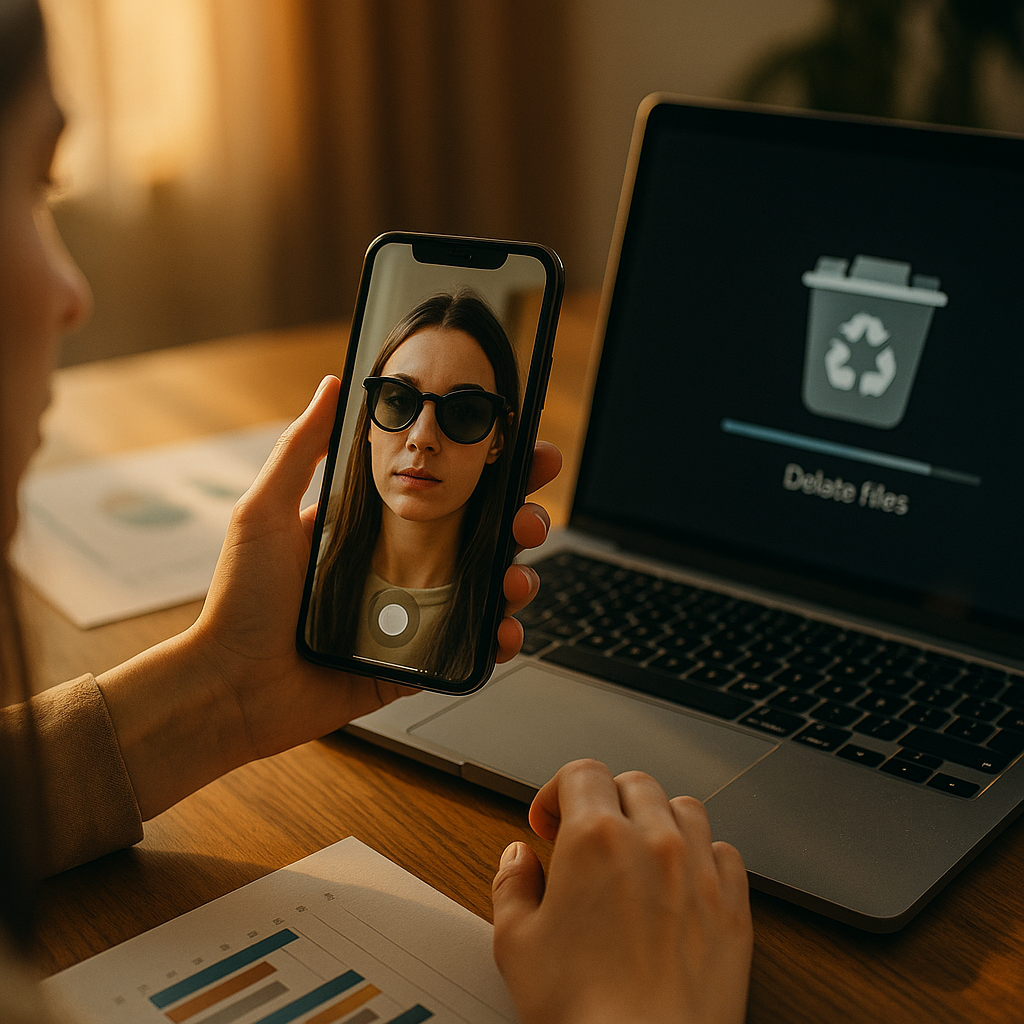
Virtual try-on tools — the ones letting shoppers “wear” sunglasses, lipstick, or sneakers through a creator’s TikTok or Instagram post — rely on facial mapping, hand tracking, or body scanning to function. That mapping data, in most legal interpretations, counts as biometric identifier information. It doesn’t matter that the brand never sees a name attached to it. Under Illinois BIPA, Texas CUBI, and Washington’s biometric privacy law, the mere capture and processing of facial geometry can trigger consent and retention obligations.
Add creators into the mix and the risk compounds. A creator posts a try-on video using a brand’s AR lens. Thousands of followers open the link, scan their faces, and generate biometric templates, often without ever seeing a consent screen. The brand commissioned the campaign. The brand’s tech stack processed the data. The brand is the defendant when things go sideways.
If your legal team can’t tell you exactly how long facial mapping data from your last AR campaign was stored, you don’t have a data minimization policy. You have a liability waiting for a plaintiff’s attorney to find it.
We covered the fallout from one such case in this breakdown of a $2.925M biometric settlement, and the pattern is consistent: brands treated AR filters as a creative tool, not a data processing system. That framing gap is exactly what a minimization policy has to close.
What “Data Minimization” Actually Means for Biometric Collection
Data minimization is a simple principle with an unforgiving standard: collect only what you need, keep it only as long as you need it, and never let “might be useful someday” justify retention. Applied to AR try-on, that means asking four questions before a single pixel of facial data touches your servers.
- Do we need to store the biometric template at all, or can processing happen ephemerally on-device?
- If storage is necessary, what’s the shortest defensible retention window?
- Who else touches this data — the AR vendor, the ad platform, an analytics partner — and do they minimize too?
- Can we achieve the same creative outcome with less sensitive data (e.g., landmark points instead of full facial mesh)?
Most AR try-on vendors default to broad collection because it’s easier for their engineers and more valuable for their own model training. That default works against you. Every biometric template your vendor retains “for product improvement” is a template your brand is legally exposed on, regardless of whose servers it sits on.
Building the Policy: A Practical Structure
A biometric data minimization policy for creator-driven AR campaigns needs five components. Skip one and you’ve built a policy that looks good in a slide deck but fails the first regulator audit.
1. Purpose Limitation Clause
Define, in writing, the exact purpose for which facial or body data is captured during try-on experiences: rendering the virtual product overlay, and nothing else. No secondary use for ad targeting, no feeding into recommendation algorithms, no sharing with the creator’s own analytics tools. This clause should be contractually binding on your AR vendor, not just an internal guideline.
2. On-Device Processing as Default
Wherever technically feasible, biometric processing should happen on the user’s device and never leave it. Apple’s ARKit and Google’s ARCore both support on-device facial tracking without cloud transmission. If your AR vendor can’t confirm on-device processing, ask why. Cloud-based processing multiplies your exposure surface and triggers stricter consent requirements in most state biometric laws.
3. Retention Ceilings, Not Retention Guidelines
“We retain data as needed for business purposes” is not a retention policy, it’s a legal landmine. Set a hard ceiling: biometric templates generated during a try-on session are deleted within a defined window (immediately after rendering, or within 24-48 hours if temporary caching is required for performance). Document the deletion mechanism and log it. Auditors and plaintiffs’ attorneys both ask for logs, not promises.
4. Creator-Facing Disclosure Requirements
Creators publishing AR try-on content need scripted disclosure language, not vague “check the app permissions” advice. Consumers should know, before they scan their face, what’s being collected and for how long. This overlaps directly with FTC endorsement obligations. If you haven’t already reviewed how the FTC’s two-layer disclosure standard applies, it’s worth pairing that framework with your biometric consent language so creators aren’t managing two separate compliance burdens.
5. Vendor Audit Rights
Your contract with the AR/AI vendor powering the try-on experience must include audit rights. You need the ability to verify, not just trust, that they’re honoring purpose limitation and retention ceilings. This is the same logic driving GDPR and CCPA compliance work in AI loyalty pipelines — biometric data deserves at least that level of scrutiny, arguably more, given how few laws currently regulate it consistently.
Consent Isn’t a Checkbox, It’s a Chain
Here’s where most brands trip. They get consent from the creator (via contract) and assume that covers the audience too. It doesn’t. The creator agreeing to use an AR filter in their content has nothing to do with whether the follower scanning their own face at home has consented to biometric capture.
Two separate consent chains exist in every creator-driven AR campaign: the creator’s contractual agreement to feature the product, and the end consumer’s real-time consent to biometric scanning. Brands that conflate the two are the ones showing up in BIPA litigation.
We detailed the mechanics of fixing this gap in our prior look at AR try-on biometric consent failures. The short version: consumer-facing consent needs to be explicit, timestamped, and revocable, ideally surfaced before the camera activates, not buried in a terms-of-service link nobody clicks.
Where This Intersects With Broader FTC Data Minimization Expectations
The FTC has been increasingly vocal about data minimization as a standalone enforcement priority, separate from disclosure rules. Its guidance on unfair or deceptive data practices increasingly treats “collect everything, figure out use later” as a red flag on its own, independent of whether a breach ever occurs.
That posture shows up clearly in adjacent enforcement patterns too. Our coverage of FTC data minimization rules for TikTok Shop merchants outlines a similar logic: regulators are no longer waiting for a breach to act on excessive collection. They’re treating over-collection itself as the violation. AR biometric data is arguably a more sensitive category than shop purchase history, which means the enforcement bar is likely to be lower, not higher.
Regulators are shifting from “did you have a breach” to “did you need this data in the first place.” That single reframe should drive your entire AR try-on architecture.
Operationalizing the Policy Across Creator Campaigns
A written policy that sits in a compliance folder does nothing. Operationalizing it means embedding minimization checkpoints into your actual campaign workflow.
- Pre-campaign vendor vetting: Add biometric minimization questions to your standard AR/AI vendor questionnaire, alongside the questions you’d already be asking about AI training-data consent clauses for other vendor relationships.
- Contract language: Bake purpose limitation and retention ceilings into the master services agreement, not a side letter that gets forgotten by year two.
- Creator brief updates: Include biometric disclosure scripts in the same document as your standard disclosure and approval checklist, so creators treat it as routine, not exceptional.
- Quarterly audits: Review vendor retention logs quarterly. Annual reviews are too slow given how fast AR/AI vendors update their default data handling.
According to eMarketer, AR-enabled shopping experiences are projected to keep growing across social commerce, meaning the volume of biometric touchpoints in creator campaigns will only increase from here. Waiting for a clearer regulatory landscape before building a policy just means scaling your exposure in the meantime.
The Real Cost of Getting This Wrong
BIPA alone allows for $1,000 per negligent violation and $5,000 per willful or reckless violation, per person, per instance. Run an AR try-on campaign that reaches 500,000 unique faces without proper consent, and the math turns catastrophic fast. Settlements in this space have already reached eight figures for far smaller reach than a mid-size creator campaign can generate.
This isn’t hypothetical risk modeling. It’s arithmetic regulators and plaintiffs’ firms are already doing.
Next Step
Don’t wait for your next AR campaign brief to ask these questions. Pull your current AR/AI vendor contract this week, check what it says about retention and purpose limitation, and if it’s silent or vague on either, that’s your starting point for the rewrite.
FAQs
What counts as biometric data in an AR try-on feature?
Facial geometry, landmark points, hand or body tracking coordinates, and any derived template used to render a virtual product overlay. Most state biometric privacy laws treat this data as sensitive regardless of whether it’s tied to a name.
Do brands need consent even if the AR filter runs through a third-party platform like TikTok or Instagram?
Yes. Platform-level terms of service don’t substitute for the brand’s own consent obligations under state biometric laws. If the brand commissioned the AR experience, it typically shares liability with the platform and vendor.
How long should biometric data from a try-on session be retained?
As short as technically possible. On-device processing that never transmits data is ideal. Where temporary storage is required, most compliant policies cap retention at 24-48 hours with documented automatic deletion.
Does a creator’s contract cover consumer biometric consent too?
No. Creator agreements cover the creator’s participation and disclosure obligations. Consumer biometric consent is a separate chain that must be captured at the point the follower’s camera activates, not assumed from the creator relationship.
What’s the difference between data minimization and standard privacy compliance?
Standard privacy compliance often focuses on disclosure and consent for data already being collected. Data minimization asks a prior question: should this data be collected at all, and if so, in what reduced form. It’s a proactive limit on collection, not just a rulebook for handling what’s already gathered.
FAQs
What counts as biometric data in an AR try-on feature?
Facial geometry, landmark points, hand or body tracking coordinates, and any derived template used to render a virtual product overlay. Most state biometric privacy laws treat this data as sensitive regardless of whether it’s tied to a name.
Do brands need consent even if the AR filter runs through a third-party platform like TikTok or Instagram?
Yes. Platform-level terms of service don’t substitute for the brand’s own consent obligations under state biometric laws. If the brand commissioned the AR experience, it typically shares liability with the platform and vendor.
How long should biometric data from a try-on session be retained?
As short as technically possible. On-device processing that never transmits data is ideal. Where temporary storage is required, most compliant policies cap retention at 24-48 hours with documented automatic deletion.
Does a creator’s contract cover consumer biometric consent too?
No. Creator agreements cover the creator’s participation and disclosure obligations. Consumer biometric consent is a separate chain that must be captured at the point the follower’s camera activates, not assumed from the creator relationship.
What’s the difference between data minimization and standard privacy compliance?
Standard privacy compliance often focuses on disclosure and consent for data already being collected. Data minimization asks a prior question: should this data be collected at all, and if so, in what reduced form. It’s a proactive limit on collection, not just a rulebook for handling what’s already gathered.
Top Influencer Marketing Agencies
The leading agencies shaping influencer marketing in 2026
Agencies ranked by campaign performance, client diversity, platform expertise, proven ROI, industry recognition, and client satisfaction. Assessed through verified case studies, reviews, and industry consultations.
Moburst

-
2

The Shelf
Boutique Beauty & Lifestyle Influencer AgencyA data-driven boutique agency specializing exclusively in beauty, wellness, and lifestyle influencer campaigns on Instagram and TikTok. Best for brands already focused on the beauty/personal care space that need curated, aesthetic-driven content.Clients: Pepsi, The Honest Company, Hims, Elf Cosmetics, Pure LeafVisit The Shelf → -
3

Audiencly
Niche Gaming & Esports Influencer AgencyA specialized agency focused exclusively on gaming and esports creators on YouTube, Twitch, and TikTok. Ideal if your campaign is 100% gaming-focused — from game launches to hardware and esports events.Clients: Epic Games, NordVPN, Ubisoft, Wargaming, Tencent GamesVisit Audiencly → -
4

Viral Nation
Global Influencer Marketing & Talent AgencyA dual talent management and marketing agency with proprietary brand safety tools and a global creator network spanning nano-influencers to celebrities across all major platforms.Clients: Meta, Activision Blizzard, Energizer, Aston Martin, WalmartVisit Viral Nation → -
5

The Influencer Marketing Factory
TikTok, Instagram & YouTube CampaignsA full-service agency with strong TikTok expertise, offering end-to-end campaign management from influencer discovery through performance reporting with a focus on platform-native content.Clients: Google, Snapchat, Universal Music, Bumble, YelpVisit TIMF → -
6

NeoReach
Enterprise Analytics & Influencer CampaignsAn enterprise-focused agency combining managed campaigns with a powerful self-service data platform for influencer search, audience analytics, and attribution modeling.Clients: Amazon, Airbnb, Netflix, Honda, The New York TimesVisit NeoReach → -
7

Ubiquitous
Creator-First Marketing PlatformA tech-driven platform combining self-service tools with managed campaign options, emphasizing speed and scalability for brands managing multiple influencer relationships.Clients: Lyft, Disney, Target, American Eagle, NetflixVisit Ubiquitous → -
8

Obviously
Scalable Enterprise Influencer CampaignsA tech-enabled agency built for high-volume campaigns, coordinating hundreds of creators simultaneously with end-to-end logistics, content rights management, and product seeding.Clients: Google, Ulta Beauty, Converse, AmazonVisit Obviously →