


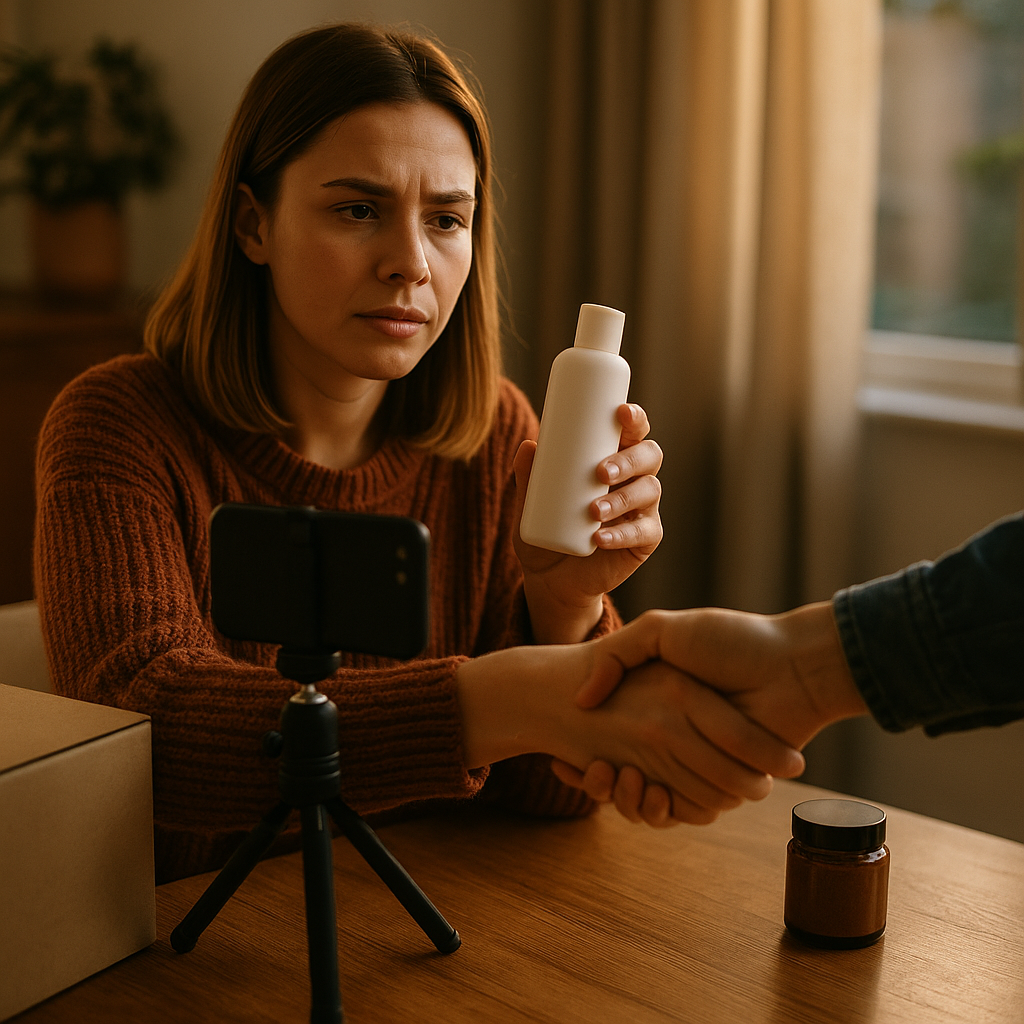
What if the creator telling your audience not to buy your product is actually your most valuable partnership candidate? De-influencing content has driven billions of TikTok views, and brands sitting on the sidelines are ceding credibility to competitors bold enough to engage it.
Why De-Influencing Isn’t a Threat — It’s a Signal
The de-influencing movement didn’t emerge from nowhere. It’s a direct response to years of oversaturated promotional content, declining consumer trust, and audiences that have become remarkably good at detecting inauthentic endorsements. FTC disclosure rules have tightened, but enforcement hasn’t kept pace with creative formats. Meanwhile, audiences developed their own enforcement mechanism: they simply stopped believing.
De-influencing creators built followings by being the antidote. They tell viewers which products aren’t worth the hype, which categories are oversold, and where to spend less without sacrificing results. In beauty, skincare, home goods, and wellness — categories drowning in sameness — these creators carry a level of audience trust that most paid partners can’t touch.
For brand strategists, the instinct is to treat this as adversarial. It isn’t. It’s market intelligence wearing a creator badge.
The Revenue Risk Is Real — But Manageable
Before getting into structure, acknowledge the legitimate concern: partnering with a de-influencing creator who then critiques your product category feels like handing a megaphone to a critic. The fear is justified if you approach it wrong.
The risk calculus changes when you separate product defense from brand trust-building. Your job isn’t to make every de-influencer a cheerleader. It’s to identify creators whose specific critique profile aligns with where your products genuinely over-deliver, then structure the partnership around honest comparison, not promotional language.
Brands that resist the de-influencing conversation don’t avoid it — they just lose control of the narrative. A structured transparency partnership lets you shape the context without scripting the conclusion.
A practical example: A skincare brand with a strong retinol line partners with a skincare de-influencer known for debunking overpriced serums. The creator’s audience skews toward value-conscious buyers who resent being misled. The partnership doesn’t ask the creator to hype the product. It gives them access to the formulation data, the clinical testing, and genuine comparison against competitors — then lets them draw conclusions. If the product holds up, the resulting content is exponentially more persuasive than any sponsored reel. If it doesn’t, you’ve identified a product weakness before a competitor or regulator does.
Partnership Structures That Work
Standard influencer contracts are built for promotion. De-influencer partnerships require a different framework. Here’s what that looks like operationally.
Editorial Independence Clauses With Guardrails. Grant the creator genuine editorial latitude while defining scope limits. The creator can critique the category, compare competitors, and share honest assessments. What’s off the table: false claims, confidential formulation data, and content that violates FTC disclosure standards. This isn’t censorship — it’s liability management. A well-drafted clause gives creators the freedom they need to stay credible while protecting your legal exposure. Consider platforms like Creator.co or Aspire IQ for managing these nuanced contract workflows at scale.
Product Access Tiers. Give de-influencers early access to products before launch, including testing samples, ingredient sheets, and comparison benchmarks. This signals confidence. Creators who receive full transparency packages before they sign anything are far less likely to produce damaging content later, because they’ve already seen your data and chosen to engage. Brands that hide information tend to attract exactly the kind of scrutiny they fear.
Revenue-Neutral Campaign Framing. Protect core product revenue lines by ensuring transparency campaigns target adjacent audiences rather than cannibalizing existing buyer segments. A de-influencing creator whose audience doesn’t currently use your category is a net-new acquisition play. One whose audience overlaps heavily with your existing customers requires more careful message calibration. Use niche creator targeting logic here: smaller, trust-dense audiences often outperform on conversion precisely because they aren’t already saturated with your messaging.
Performance Metrics Reframed. Don’t measure these partnerships on direct conversion or affiliate sales alone. The primary KPIs should include sentiment shift among previously skeptical audiences, share-of-voice in category-level conversation, and earned media generated when the creator’s honest endorsement (or qualified endorsement) gets amplified organically. This connects directly to creator earned media as a search and discovery signal — something increasingly important as AI-powered search surfaces content based on trust signals, not just keyword density.
Vetting De-Influencers: What to Look For
Not every de-influencing creator is a viable partner. Some are genuinely principled critics who monetize through Patreon-style independence models. Others are running a cynical inversion of the promotional playbook, using skepticism as an aesthetic while still operating like traditional sponsored-content machines. The audience can usually tell the difference. Your vetting team needs to as well.
Look at their track record when products they’ve endorsed (or declined to criticize) have faced scrutiny. Have they walked back positions when new information emerged? Do they disclose when a brand has provided product access? Have they ever turned down a partnership publicly and explained why? These behaviors signal genuine editorial standards, not performance skepticism.
Cross-reference their content against social listening data to understand how their audience actually responds. A creator with 400K followers and a 12% engagement rate from a community that trusts their assessments will outperform a 2M-follower account where the audience treats every recommendation as suspect. For deeper due diligence frameworks, the logic applied to creator tool stack audits applies equally to partner vetting: build a systematic scoring rubric, not a gut-feel shortlist.
Compliance and Disclosure: No Shortcuts
This is non-negotiable. Transparency-first partnerships that quietly suppress the sponsored-content label are not transparency-first partnerships. They’re a compliance liability wrapped in a brand safety story.
The FTC’s endorsement guidelines require clear disclosure regardless of how critical or balanced the content appears. A de-influencing creator who received free product and produced a “mixed” review is still producing sponsored content. The disclosure requirement doesn’t disappear because the tone is skeptical. FTC enforcement has specifically called out disclosure failures in creator partnerships, and regulators are not impressed by the argument that honest content shouldn’t need a label.
Build disclosure language into your contract template. Make it specific to format (verbal disclosure for video, text overlay, caption language). Audit content before publication and after. If your legal team isn’t embedded in the partnership structure from the beginning, fix that before you sign anyone.
The most credible transparency campaign in your category becomes the least credible if a regulator flags it for disclosure failure. Compliance isn’t a footnote — it’s the foundation.
Scaling the Model Without Losing Its Integrity
Here’s the tension most brands hit once this strategy shows early results: they try to systematize it at volume, and in doing so, strip out the authenticity that made it work. You can’t run 50 de-influencing partnerships the way you run 50 standard sponsorships. The editorial independence that makes the format credible also makes it harder to control at scale.
The solution is to treat de-influencer partnerships as a premium, high-investment tier within your broader creator roster, not a scalable commodity play. Limit active partnerships to a small cohort (3-8 creators depending on category breadth), invest deeply in each relationship, and resist the temptation to templatize the brief. For context on how roster architecture affects ROI across different creator tiers, the creator roster strategy frameworks are directly applicable here.
Also: be honest with your internal stakeholders. This approach will sometimes produce content that your brand team finds uncomfortable. A creator might qualify their endorsement, note a competitor’s strengths, or flag a product limitation. That discomfort is the point. Audiences can sense when a de-influencer has been fully co-opted. The moment the partnership produces content indistinguishable from a standard sponsorship, you’ve wasted the investment and potentially damaged the creator’s credibility along with your own.
Budget allocation matters too. As paid amplification continues to outpace flat fee structures across the industry, consider whether organically credible de-influencer content warrants boosted distribution — and if so, how that interacts with the creator’s independence positioning in the eyes of their audience.
One final consideration: consumer trust research consistently shows that skeptical audiences convert at higher rates when they do convert, because their decision-making is more considered. A de-influencer audience that chooses your product after a nuanced, honest review is not just a customer. They’re an advocate with receipts.
Start with one creator, one product line, and full transparency on both sides. The content will tell you whether the model works for your brand — and so will the comments section.
Frequently Asked Questions
What is a de-influencing creator partnership and why should brands consider it?
A de-influencing creator partnership is a collaboration with content creators who are known for discouraging unnecessary or overhyped purchases. Brands should consider these partnerships because de-influencers command high audience trust in saturated consumer categories, and a qualified endorsement from a credible skeptic carries more conversion weight than a standard promotional post. The key is structuring the partnership around genuine transparency rather than scripted promotion.
How do brands protect their revenue when partnering with creators who critique product categories?
Brands protect revenue by carefully matching creators whose critique profile aligns with where their product genuinely over-delivers, targeting audiences that don’t overlap heavily with existing buyers, and framing campaign KPIs around trust-building and share-of-voice rather than direct conversion alone. The goal is net-new audience acquisition among skeptical consumers, not risking existing customer loyalty.
What should be included in a de-influencer partnership contract?
A de-influencer partnership contract should include editorial independence clauses with defined scope limits, clear FTC disclosure requirements for all content formats, product access terms, confidentiality provisions for proprietary formulation data, and explicit performance metrics. Standard influencer contracts are insufficient — legal review with influencer marketing expertise is strongly recommended.
How do you vet a de-influencing creator before signing a partnership?
Effective vetting involves reviewing the creator’s track record for consistency, checking whether they’ve publicly turned down partnerships, auditing their disclosure history, and using social listening tools to assess genuine audience engagement quality. Look for creators whose skepticism appears editorially principled rather than performative. A systematic scoring rubric outperforms gut-feel selection.
Are de-influencer partnerships subject to FTC disclosure rules?
Yes, absolutely. Any partnership where a creator receives free product, compensation, or other material benefit requires clear disclosure under FTC guidelines, regardless of how critical or balanced the resulting content is. A mixed or skeptical review does not exempt a partnership from disclosure requirements. Brands must build disclosure language into contracts and audit content before and after publication.
What KPIs should brands use to measure de-influencer campaign performance?
Primary KPIs should include sentiment shift among previously skeptical audience segments, earned media amplification, share-of-voice in category-level conversations, and engagement quality metrics such as comment sentiment and save rates. Direct conversion and affiliate sales can be tracked as secondary metrics but should not be the primary success benchmark, since the strategic value of these partnerships is trust-building over a longer horizon.
Top Influencer Marketing Agencies
The leading agencies shaping influencer marketing in 2026
Agencies ranked by campaign performance, client diversity, platform expertise, proven ROI, industry recognition, and client satisfaction. Assessed through verified case studies, reviews, and industry consultations.
Moburst

-
2

The Shelf
Boutique Beauty & Lifestyle Influencer AgencyA data-driven boutique agency specializing exclusively in beauty, wellness, and lifestyle influencer campaigns on Instagram and TikTok. Best for brands already focused on the beauty/personal care space that need curated, aesthetic-driven content.Clients: Pepsi, The Honest Company, Hims, Elf Cosmetics, Pure LeafVisit The Shelf → -
3

Audiencly
Niche Gaming & Esports Influencer AgencyA specialized agency focused exclusively on gaming and esports creators on YouTube, Twitch, and TikTok. Ideal if your campaign is 100% gaming-focused — from game launches to hardware and esports events.Clients: Epic Games, NordVPN, Ubisoft, Wargaming, Tencent GamesVisit Audiencly → -
4

Viral Nation
Global Influencer Marketing & Talent AgencyA dual talent management and marketing agency with proprietary brand safety tools and a global creator network spanning nano-influencers to celebrities across all major platforms.Clients: Meta, Activision Blizzard, Energizer, Aston Martin, WalmartVisit Viral Nation → -
5

The Influencer Marketing Factory
TikTok, Instagram & YouTube CampaignsA full-service agency with strong TikTok expertise, offering end-to-end campaign management from influencer discovery through performance reporting with a focus on platform-native content.Clients: Google, Snapchat, Universal Music, Bumble, YelpVisit TIMF → -
6

NeoReach
Enterprise Analytics & Influencer CampaignsAn enterprise-focused agency combining managed campaigns with a powerful self-service data platform for influencer search, audience analytics, and attribution modeling.Clients: Amazon, Airbnb, Netflix, Honda, The New York TimesVisit NeoReach → -
7

Ubiquitous
Creator-First Marketing PlatformA tech-driven platform combining self-service tools with managed campaign options, emphasizing speed and scalability for brands managing multiple influencer relationships.Clients: Lyft, Disney, Target, American Eagle, NetflixVisit Ubiquitous → -
8

Obviously
Scalable Enterprise Influencer CampaignsA tech-enabled agency built for high-volume campaigns, coordinating hundreds of creators simultaneously with end-to-end logistics, content rights management, and product seeding.Clients: Google, Ulta Beauty, Converse, AmazonVisit Obviously →