


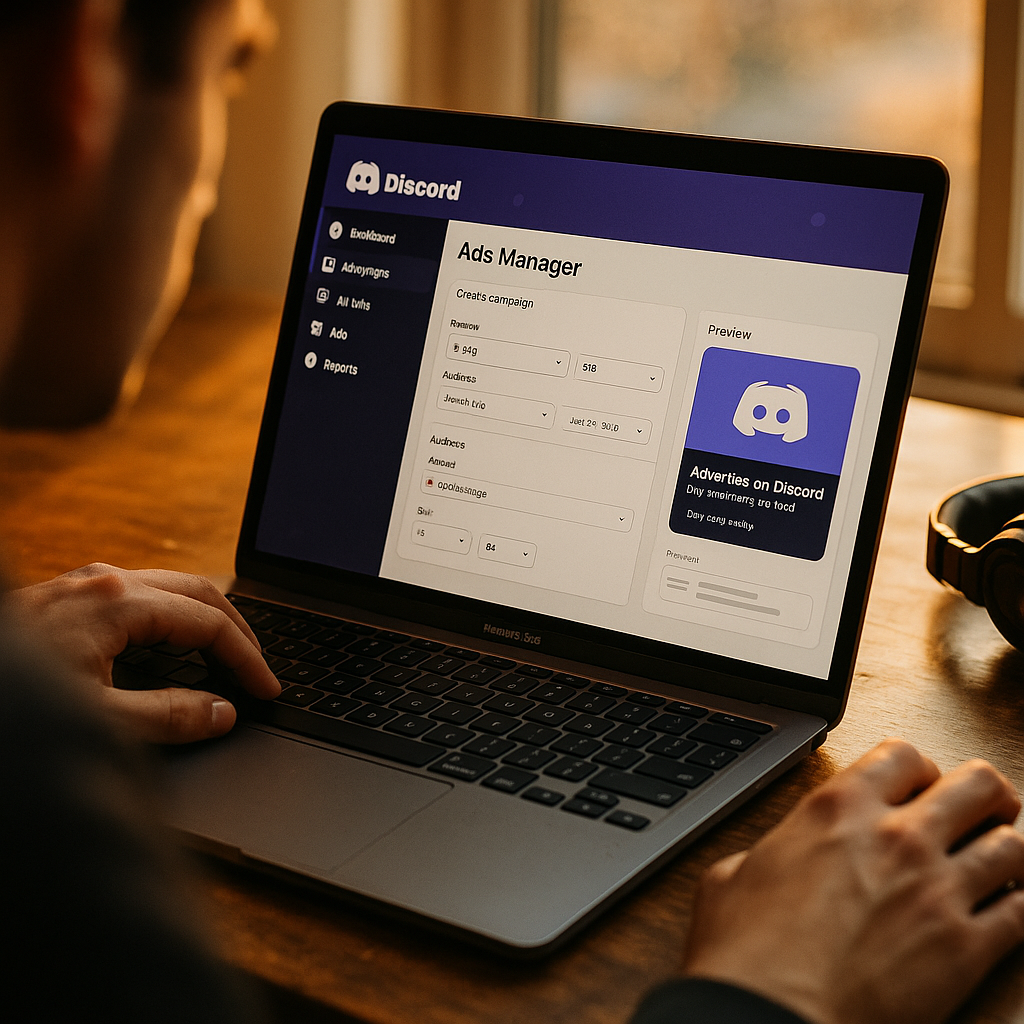
Discord now counts more than 200 million monthly active users, and for the first time, brands can buy ads on the platform without a sales rep, a minimum spend commitment, or a two-week onboarding call. The new Discord Ads Manager flips the switch to self-serve. The question for marketers isn’t whether to test it. It’s whether your team actually knows how to buy media on a platform built around communities, not feeds.
What Changed With Discord’s Self-Serve Rollout
For years, Discord advertising meant working directly with the platform’s sales team, usually reserved for gaming publishers and a handful of entertainment brands with budgets to match. That gatekeeping is gone. The new Ads Manager lets any verified business set up a campaign, define an audience, and launch within a single session, no different in spirit from how marketers already buy on Meta or TikTok.
The shift matters because Discord’s user base has quietly outgrown its gamer stereotype. Communities now span finance, fitness, fandoms, local events, and B2B software. Advertisers get access to quest-style placements, homepage takeovers, and in-server display units, all buyable through a dashboard that mirrors the self-serve logic marketers already know from other platforms.
Discord’s shift to self-serve buying removes the single biggest barrier to testing the platform: the requirement to negotiate directly with a sales team before spending a dollar.
Who Should Actually Test This First
Not every brand needs to be in Discord’s queue on day one. The platform still over-indexes on younger, highly engaged audiences who spend real hours inside servers rather than scrolling past them. That makes it a strong fit for gaming, consumer tech, beverage, apparel, and entertainment brands chasing Gen Z and younger millennial attention. B2B brands and traditional CPG advertisers will likely find the audience too narrow to justify early budget, at least until targeting matures.
Here’s a quick filter for deciding whether to pilot:
- Does your audience already congregate in niche online communities (fandoms, gaming guilds, hobbyist servers)?
- Can your creative speak community-native language without sounding like a brand that just discovered memes?
- Do you have a measurement plan beyond vanity impressions?
If you answered yes to all three, you’re a reasonable candidate for an early test budget. If not, watch the category for a quarter or two before committing spend.
Setting Up Your First Campaign Without Wasting Budget
The Ads Manager interface will feel familiar to anyone who has run campaigns on Meta’s ad platform or TikTok’s buying tools, with objective selection, audience builder, and creative upload in a linear flow. The traps are different, though. Discord targeting leans heavily on server categories and interest tags rather than granular demographic data, which means lookalike modeling is still immature compared to platforms with a decade of ad-tech refinement behind them.
Start small. Allocate a test budget equivalent to what you’d spend piloting a new platform partner, not a proven channel. Run at least two creative variants per audience segment, because Discord’s native ad formats (quests, direct message placements, and in-server banners) perform very differently depending on execution. A static banner that works on display networks often falls flat here. Native, interactive, or reward-gated creative tends to outperform anything that looks like a repurposed social ad.
Brands coming from influencer-first strategies already understand this instinct: content that feels native to the platform always beats content that feels imported. The same logic that governs creator-made content performance applies directly to Discord’s ad units.
Measurement Is Still the Hard Part
Self-serve access solves the buying problem. It does not solve attribution. Discord’s reporting dashboard currently offers impressions, click-through rate, and basic engagement metrics, but it lacks the deeper funnel visibility marketers expect from mature programmatic systems. If your team already relies on programmatic reporting standards to reconcile spend across channels, expect a manual stitching exercise until Discord’s API matures.
Until Discord builds out deeper attribution tooling, treat campaigns here the way you’d treat an emerging retail media network: directionally useful, not yet board-deck reliable. Pair native platform data with your own UTM structure and a third-party verification layer, similar to how brands already approach attribution checks in influencer payouts, to avoid overstating early results.
Marketers running multi-platform influencer and paid programs should also compare notes with how they already evaluate real-time dashboard performance elsewhere in the stack. The instinct to demand live, cross-channel visibility shouldn’t relax just because the platform is new.
Brand Safety and Community Risk
Discord servers are user-moderated, which means brand adjacency risk looks different than it does on algorithmically curated feeds. A server dedicated to a popular game franchise can host anything from wholesome fan content to toxic chat culture within the same community, sometimes within the same channel. Ads Manager includes category-level blocking, but it’s not the granular exclusion list marketers are used to on Meta or Google’s display network controls.
Before scaling spend, run a manual audit of the top servers your campaign is likely to appear in. This is not optional due diligence, it’s table stakes, the same way brands now run human sign off on creator risk scans before a partnership goes live. Automated category filters catch the obvious problems. They miss the subtler ones, like a server with a respectable surface but a toxic moderation gap three channels deep.
Compliance teams should also revisit disclosure requirements. The FTC’s endorsement guidance applies regardless of platform, and Discord’s quest-style ad units, which reward users for engagement, sit in a gray area that legal teams haven’t fully mapped yet.
Where Agencies Fit Into the Equation
Most internal marketing teams don’t have a Discord specialist on staff, and that’s fine, early-platform fluency rarely sits in-house until a channel proves itself at scale. Agencies that already run performance work across emerging formats are absorbing this faster than brand teams can hire for it. Moburst, a global growth agency founded in 2013 that has worked with brands including Google, Uber, and Samsung, approaches platforms like Discord the same way it treats other emerging inventory: pairing media buying expertise with its OTT marketing partners practice to test new placements without overcommitting budget before performance data exists. That kind of cautious, test-and-learn posture is exactly what a brand-new self-serve platform demands.
Brands weighing build-versus-buy on Discord specifically should treat the decision the same way they’d evaluate any new platform entry: pilot budget, clear KPIs, a defined exit point if performance disappoints. The agencies getting early wins aren’t the ones with the biggest Discord budgets. They’re the ones applying existing platform-agnostic discipline, the kind already baked into how smart teams evaluate tools like enterprise influencer platforms, to a genuinely new buying surface.
Industry data from eMarketer and Statista continues to show younger audiences fragmenting away from traditional feed-based platforms toward community and chat-based environments. Discord’s self-serve launch is a direct response to that fragmentation, and reporting from Sprout Social suggests brand interest in chat-native advertising has grown faster than the available case studies can keep up with. Translation: you’ll be testing ahead of the playbook, not following one.
Next Step for Marketers Weighing This Platform
Treat your first Discord campaign as a controlled experiment, not a channel rollout. Set a small test budget, pick one community-aligned creative concept, and define your success metric before launch, not after the invoice arrives.
FAQs
What is Discord’s Ads Manager?
It’s Discord’s self-serve advertising platform that lets brands set up, target, and launch campaigns directly through a dashboard, without going through a dedicated sales representative or minimum spend negotiation.
Which brands benefit most from advertising on Discord?
Gaming, consumer tech, entertainment, and apparel brands targeting Gen Z and younger millennial audiences currently see the strongest fit, largely because Discord’s active communities skew toward those demographics and interests.
How does Discord’s attribution compare to Meta or TikTok?
Discord’s native reporting is less mature, offering basic impression and click metrics without the deeper funnel attribution marketers get from more established ad platforms. Brands typically need to layer in their own UTM tracking and third-party verification.
Is Discord advertising brand safe?
Discord offers category-level exclusion tools, but because servers are community moderated, brand safety requires manual review of top-performing servers rather than relying solely on automated filters.
Do FTC disclosure rules apply to Discord ad formats like quests?
Yes. Any paid promotion or incentivized engagement on Discord is subject to the same FTC endorsement and disclosure guidance that applies across other advertising channels.
Top Influencer Marketing Agencies
The leading agencies shaping influencer marketing in 2026
Agencies ranked by campaign performance, client diversity, platform expertise, proven ROI, industry recognition, and client satisfaction. Assessed through verified case studies, reviews, and industry consultations.
Moburst

-
2

The Shelf
Boutique Beauty & Lifestyle Influencer AgencyA data-driven boutique agency specializing exclusively in beauty, wellness, and lifestyle influencer campaigns on Instagram and TikTok. Best for brands already focused on the beauty/personal care space that need curated, aesthetic-driven content.Clients: Pepsi, The Honest Company, Hims, Elf Cosmetics, Pure LeafVisit The Shelf → -
3

Audiencly
Niche Gaming & Esports Influencer AgencyA specialized agency focused exclusively on gaming and esports creators on YouTube, Twitch, and TikTok. Ideal if your campaign is 100% gaming-focused — from game launches to hardware and esports events.Clients: Epic Games, NordVPN, Ubisoft, Wargaming, Tencent GamesVisit Audiencly → -
4

Viral Nation
Global Influencer Marketing & Talent AgencyA dual talent management and marketing agency with proprietary brand safety tools and a global creator network spanning nano-influencers to celebrities across all major platforms.Clients: Meta, Activision Blizzard, Energizer, Aston Martin, WalmartVisit Viral Nation → -
5

The Influencer Marketing Factory
TikTok, Instagram & YouTube CampaignsA full-service agency with strong TikTok expertise, offering end-to-end campaign management from influencer discovery through performance reporting with a focus on platform-native content.Clients: Google, Snapchat, Universal Music, Bumble, YelpVisit TIMF → -
6

NeoReach
Enterprise Analytics & Influencer CampaignsAn enterprise-focused agency combining managed campaigns with a powerful self-service data platform for influencer search, audience analytics, and attribution modeling.Clients: Amazon, Airbnb, Netflix, Honda, The New York TimesVisit NeoReach → -
7

Ubiquitous
Creator-First Marketing PlatformA tech-driven platform combining self-service tools with managed campaign options, emphasizing speed and scalability for brands managing multiple influencer relationships.Clients: Lyft, Disney, Target, American Eagle, NetflixVisit Ubiquitous → -
8

Obviously
Scalable Enterprise Influencer CampaignsA tech-enabled agency built for high-volume campaigns, coordinating hundreds of creators simultaneously with end-to-end logistics, content rights management, and product seeding.Clients: Google, Ulta Beauty, Converse, AmazonVisit Obviously →