


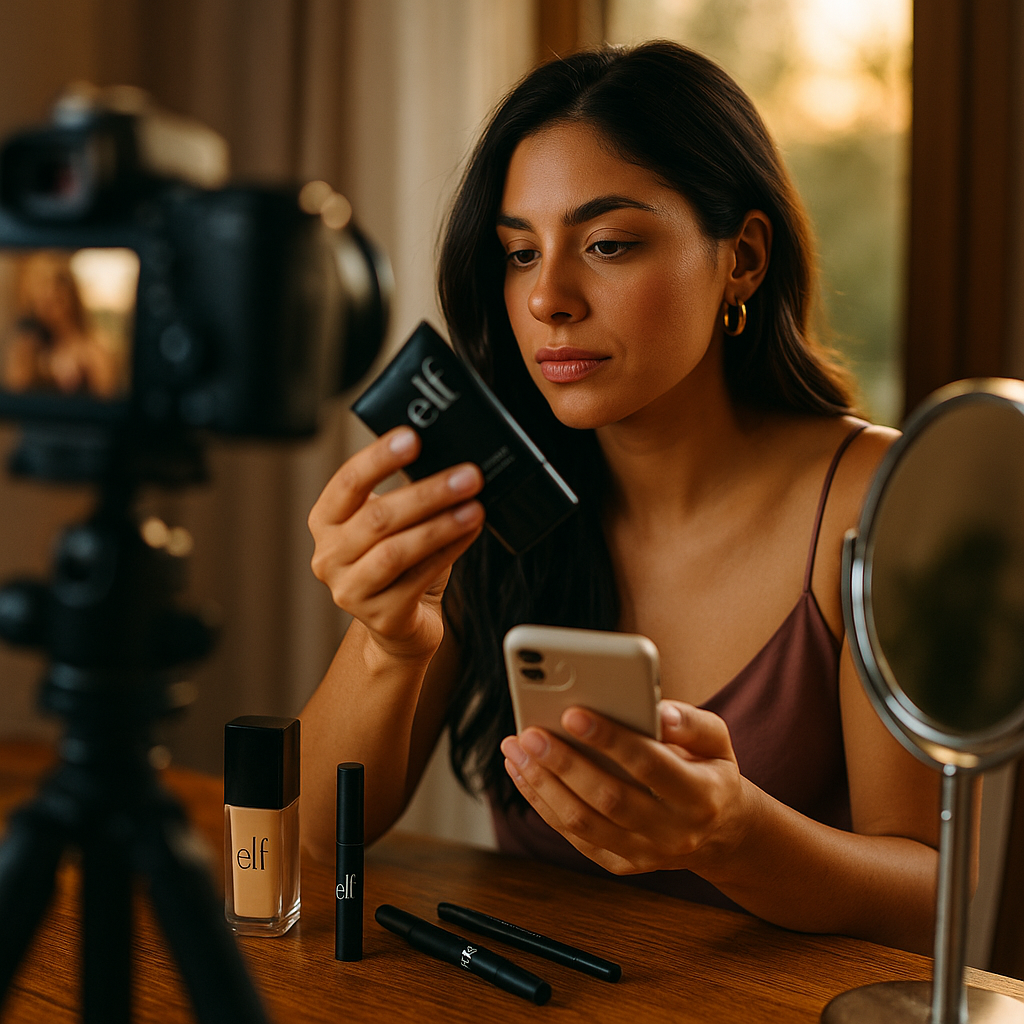
What if your most expensive talent is your worst-performing asset? e.l.f. Beauty’s mid-tier creator program delivers cost-per-sale metrics that routinely undercut celebrity endorsement deals by 60% or more, and the operational model behind it is something every brand strategist should study.
Why e.l.f. Walked Away from the Celebrity Playbook
e.l.f. Beauty didn’t abandon celebrity talent overnight. Like most CPG brands with ambitions in beauty, they ran the traditional playbook: big names, big budgets, big press moments. The problem was that the numbers rarely justified the spend. A single celebrity post might generate massive impressions, but when the attribution team traced those impressions to actual product sales, the cost-per-sale was brutal. You could blow $400K on one sponsored post and move fewer units than a coordinated drop of 40 mid-tier creators at $10K each.
That math is not unique to e.l.f. The shift reflects a broader industry pattern: audiences trust creators who look like them more than they trust aspirational icons. But e.l.f. executed the transition with unusual operational rigor, which is why their program became a benchmark rather than just a footnote.
Defining the Tier That Actually Converts
When e.l.f. talks about “mid-tier creators,” they are not describing anyone with 100K followers. Their roster targets creators in the 150K to 800K follower range on TikTok and Instagram, with specific filters applied around engagement quality, audience demographics, and purchase-intent signals. Follower count is almost a secondary metric at this point. What matters more: Does the creator’s audience skew 18-35 female? Are comments transactional (people asking where to buy) rather than parasocial (people commenting on the creator’s appearance)? Is the creator’s content natively formatted for the platform, rather than repurposed from another channel?
This filtering work happens upstream of any outreach. e.l.f. built proprietary scoring criteria, layered on top of third-party tools like Sprout Social and dedicated influencer analytics platforms, to rank creator candidates before a single dollar is committed. The result is a roster where almost every creator has a documented conversion history, not just reach.
Engagement rate alone is a vanity metric. e.l.f.’s program filters for purchase-intent signals in comment behavior — a qualitative filter that most brand teams still skip entirely.
The Program Architecture: How It Actually Runs
Scalability is the part most brands get wrong. They build a creator program that works at 10 creators and then collapse under the operational weight of running 100. e.l.f. solved this through a tiered management structure that separates discovery, activation, and performance review into distinct workflows.
Discovery layer: A small internal team (three to four people) handles creator identification, vetting, and initial outreach. This team does not manage ongoing relationships. Their sole job is filling the roster pipeline.
Activation layer: Campaign managers handle briefing, content approval, posting coordination, and compliance. Crucially, e.l.f. uses standardized brief templates rather than custom briefs for every creator. This sounds like it would hurt creative quality, but it doesn’t. The brief sets guardrails (claim restrictions, FTC disclosure language, product usage requirements) while leaving the creative execution entirely to the creator. This aligns with what the FTC expects from disclosure-compliant influencer programs and simultaneously protects creative authenticity.
Performance review layer: After each campaign cycle, creators are scored against three KPIs: cost-per-click, cost-per-sale (tracked via unique promo codes and UTM parameters), and content reuse value (can the brand amplify this content as paid social without significant production investment?). Creators who underperform on two consecutive cycles are rotated out. This is not punitive. It’s portfolio management.
For a deeper look at how brief architecture drives creator output, the brief architecture and timing framework covered here is directly applicable to how e.l.f. structures its creative guardrails.
TikTok vs. Instagram: Different Mechanics, Same ROI Logic
e.l.f. doesn’t treat TikTok and Instagram as interchangeable channels. The content formats, posting cadences, and conversion paths are managed separately, even when the same creator posts on both platforms.
On TikTok, e.l.f. leans into TikTok Shop integration. Mid-tier creators link directly to product pages within the video, and the purchase journey is completed without leaving the app. The brand’s cost-per-sale on TikTok Shop-enabled posts runs significantly lower than on traditional link-in-bio Instagram posts, primarily because the friction is removed. The TikTok Shop creator attribution model that Shoezone implemented follows similar logic: when attribution is clean and the purchase path is native, cost-per-sale drops.
On Instagram, e.l.f. prioritizes Reels over static posts, and creator content is frequently licensed for use as paid dark posts through Meta’s Ads Manager. A creator post that organically performs well becomes a paid amplification asset within 48 hours. This dual-use model means the production cost is effectively split between organic and paid budgets, improving the ROI calculation for both. The organic-to-paid amplification strategy here is one of the more underused levers in influencer marketing, and e.l.f. has systematized it.
The Compensation Model That Keeps Creators Engaged
Flat-fee campaigns produce flat-fee effort. e.l.f. structures its mid-tier compensation with a base fee plus a performance bonus tied to trackable sales. Creators who drive above a threshold in attributed revenue during a campaign cycle receive a bonus payment in the following billing period. This creates an incentive structure where creators actively promote the product beyond the minimum contractual post, because the upside is real and achievable at the mid-tier level.
This is not a novel concept. Gymshark’s performance-based tiers operate on similar logic. What e.l.f. added is a rotation mechanism: top performers get first access to new product launches before they hit retail, creating an exclusivity incentive that money alone can’t replicate at this tier. Creators know that staying in e.l.f.’s active roster means early access and ongoing income, not a one-off campaign check.
Attribution That Finance Will Actually Accept
The biggest obstacle to scaling a creator program is often internal, not external. Finance teams need to see cost-per-sale in a format they trust, and creator marketing attribution has historically been messy. e.l.f. built a clean attribution stack: unique discount codes per creator, UTM parameters on all linked content, and TikTok Shop’s native purchase tracking for in-app conversions.
They also run periodic matched-market tests to validate incrementality. This means comparing sales velocity in markets with active creator campaigns against control markets without them. The incrementality data gives the CFO something defensible, which is the real unlock for budget allocation. According to eMarketer, influencer marketing attribution remains a top concern for brand-side marketers, and e.l.f.’s multi-signal approach directly addresses this gap.
Unique promo codes plus UTM tracking plus TikTok Shop native data: e.l.f.’s three-signal attribution stack is what turns a creator program from a brand awareness cost center into a defensible revenue channel.
The broader lesson here connects to how brands like Kimberly-Clark approached platform-native roster ROI: when attribution is built into the program architecture from day one, rather than bolted on afterward, the reporting becomes a competitive advantage rather than a quarterly headache.
What Brands Should Replicate (and What They Should Skip)
Not everything about e.l.f.’s model transfers cleanly to every category. Beauty has a natural advantage: the product is visual, the transformation is demonstrable, and the audience skews toward platforms where creator content thrives. A B2B software brand or a regulated financial product faces different constraints.
What does transfer: the tiered workflow structure, the standardized brief with open creative latitude, the dual-use organic/paid content licensing model, and the performance-bonus compensation design. These are operational frameworks, not category-specific tactics.
What to skip: copying e.l.f.’s exact follower range without doing the audience-fit analysis for your own category. Mid-tier works for e.l.f. because their audience is highly concentrated in a demographic that over-indexes on TikTok and Instagram. Run the audience analysis first. The tier follows the data, not the other way around.
For brands exploring how deeper creator format integration works across different content types, the principles e.l.f. applies to product demo content map directly onto longer-form creator partnership structures.
The real competitive advantage e.l.f. built isn’t a roster or a budget. It’s a repeatable operational system. Build that system, instrument it for attribution your finance team trusts, and the cost-per-sale advantage over celebrity deals becomes self-evident.
FAQ
What is a mid-tier creator in the context of e.l.f. Beauty’s program?
e.l.f. Beauty defines mid-tier creators as those with approximately 150K to 800K followers on TikTok and Instagram. The follower range is a starting filter, but the more important criteria are audience demographics, engagement quality, and purchase-intent signals visible in comment behavior. Creators whose audiences actively ask where to buy products are prioritized over creators with passive, high-volume audiences.
Why does e.l.f.’s creator program outperform celebrity endorsements on cost-per-sale?
Mid-tier creators typically generate higher engagement rates relative to their reach, and their audiences tend to have stronger trust relationships with them than celebrity followers do. This trust translates into higher conversion rates per impression. Combined with lower per-creator fees, the math produces a dramatically lower cost-per-sale compared to a single celebrity deal with similar aggregate reach.
How does e.l.f. attribute sales to individual creators?
e.l.f. uses a three-signal attribution model: unique discount codes assigned to each creator, UTM parameters on all linked content for web traffic tracking, and TikTok Shop’s native purchase tracking for in-app conversions. They supplement this with periodic matched-market incrementality tests to validate that creator campaigns are generating genuine incremental sales rather than capturing demand that would have converted anyway.
Can this creator program model work for brands outside the beauty category?
The operational framework (tiered workflow, standardized briefs with open creative latitude, performance-bonus compensation, dual-use content licensing) transfers across categories. The specific follower tier and platform mix should be recalibrated based on where your target audience is most active and what content formats drive conversion in your category. Beauty has a natural advantage given visual product demonstration, but apparel, food and beverage, wellness, and home goods categories have implemented similar models successfully.
How does e.l.f. keep mid-tier creators engaged over multiple campaign cycles?
e.l.f. uses a base fee plus performance bonus structure, where creators who drive above-threshold attributed sales receive additional payment. High-performing creators also receive early access to new product launches before retail availability, creating an exclusivity incentive that reinforces long-term roster loyalty. This combination of financial upside and product access privilege reduces creator churn and maintains content quality across cycles.
Top Influencer Marketing Agencies
The leading agencies shaping influencer marketing in 2026
Agencies ranked by campaign performance, client diversity, platform expertise, proven ROI, industry recognition, and client satisfaction. Assessed through verified case studies, reviews, and industry consultations.
Moburst

-
2

The Shelf
Boutique Beauty & Lifestyle Influencer AgencyA data-driven boutique agency specializing exclusively in beauty, wellness, and lifestyle influencer campaigns on Instagram and TikTok. Best for brands already focused on the beauty/personal care space that need curated, aesthetic-driven content.Clients: Pepsi, The Honest Company, Hims, Elf Cosmetics, Pure LeafVisit The Shelf → -
3

Audiencly
Niche Gaming & Esports Influencer AgencyA specialized agency focused exclusively on gaming and esports creators on YouTube, Twitch, and TikTok. Ideal if your campaign is 100% gaming-focused — from game launches to hardware and esports events.Clients: Epic Games, NordVPN, Ubisoft, Wargaming, Tencent GamesVisit Audiencly → -
4

Viral Nation
Global Influencer Marketing & Talent AgencyA dual talent management and marketing agency with proprietary brand safety tools and a global creator network spanning nano-influencers to celebrities across all major platforms.Clients: Meta, Activision Blizzard, Energizer, Aston Martin, WalmartVisit Viral Nation → -
5

The Influencer Marketing Factory
TikTok, Instagram & YouTube CampaignsA full-service agency with strong TikTok expertise, offering end-to-end campaign management from influencer discovery through performance reporting with a focus on platform-native content.Clients: Google, Snapchat, Universal Music, Bumble, YelpVisit TIMF → -
6

NeoReach
Enterprise Analytics & Influencer CampaignsAn enterprise-focused agency combining managed campaigns with a powerful self-service data platform for influencer search, audience analytics, and attribution modeling.Clients: Amazon, Airbnb, Netflix, Honda, The New York TimesVisit NeoReach → -
7

Ubiquitous
Creator-First Marketing PlatformA tech-driven platform combining self-service tools with managed campaign options, emphasizing speed and scalability for brands managing multiple influencer relationships.Clients: Lyft, Disney, Target, American Eagle, NetflixVisit Ubiquitous → -
8

Obviously
Scalable Enterprise Influencer CampaignsA tech-enabled agency built for high-volume campaigns, coordinating hundreds of creators simultaneously with end-to-end logistics, content rights management, and product seeding.Clients: Google, Ulta Beauty, Converse, AmazonVisit Obviously →