


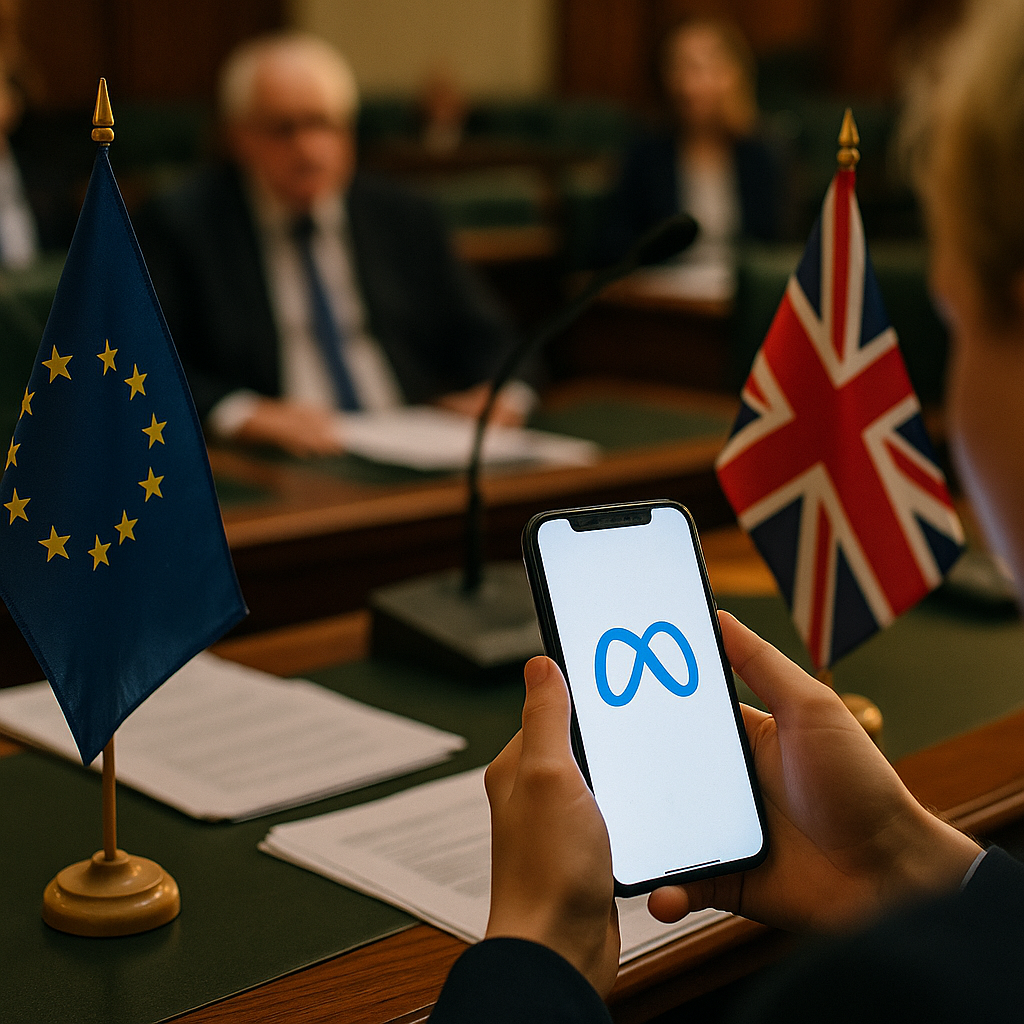
Two regulators, one continent apart, just told the same platforms to rebuild their algorithms or leave. That’s not a coincidence — it’s global regulatory divergence on platform algorithm design hardening into a pattern. Brands still treating the EU and UK as separate compliance line items are already behind.
If you’re running influencer or paid social programs across multiple markets, this isn’t a legal-team problem to skim past. It’s a media-buying, creative-approval, and vendor-contract problem, and it’s moving faster than most brand compliance calendars can track.
Two Rulings, One Direction of Travel
Start with what actually happened. The European Commission’s ongoing action against Meta under the Digital Services Act targets addictive design patterns baked into feed ranking, infinite scroll, and notification systems. Regulators aren’t asking Meta to add a disclaimer. They’re asking Meta to change how the algorithm decides what to show people, and to prove it with documentation. That’s a fundamentally different demand than the ad-labeling debates of the past few years.
Meanwhile, the UK’s under-16 social media restrictions push in a related but distinct direction: age-gating entire platforms or platform features for younger users, with real enforcement teeth from Ofcom. Different mechanism, same underlying concern — platforms optimizing for engagement at the expense of user (especially minor) wellbeing.
Two regulators on two continents, working from different legal frameworks, arrived at the same conclusion: engagement-optimized algorithms are now a regulated product feature, not a neutral pipe.
Add Australia’s youth social media laws and the pattern stops looking like coincidence. It looks like convergence. Regulators in different jurisdictions, without formal coordination, are independently concluding that algorithmic design itself — not just content moderation or ad disclosure — is the next frontier of platform accountability.
Why Brands Should Care About Algorithm Design, Not Just Ad Content
For a decade, brand compliance in social meant three things: disclose the partnership, don’t make false claims, don’t target minors with age-inappropriate products. Straightforward, if tedious.
Algorithm-design regulation changes the math. If a platform has to redesign its recommendation engine to comply with the DSA, your organic reach curves shift. If the UK forces platforms to build separate under-16 experiences, your youth-adjacent campaigns (beauty, gaming, fashion, sneaker drops) need entirely different targeting and creative logic depending on where the audience sits. This isn’t theoretical — beauty and gaming ad categories are already flagged as high-exposure under youth privacy frameworks emerging state-by-state in the US, and the UK/Australia moves only tighten the vice.
Here’s the uncomfortable part: platforms will comply differently in each market. Meta’s EU feed algorithm may not match its US or APAC version by year’s end. Whitelisted and boosted creator content — already a gray zone, as covered in our piece on whitelisted creator ads that are FTC compliant but platform banned — could behave inconsistently across regions purely because the underlying ranking logic diverges by jurisdiction.
The Compliance Math Just Got More Expensive
Every additional regulatory regime multiplies your operational overhead. A brand running a single global influencer campaign now has to reconcile:
- EU DSA-driven algorithm transparency requirements affecting organic and paid reach
- UK Ofcom age-verification and under-16 platform restrictions
- Australia’s youth social media ban and its own enforcement timeline
- US state-level youth privacy and AI-hiring adjacent laws still developing patchwork by patchwork
None of these frameworks use identical definitions of “minor,” “addictive design,” or “algorithmic transparency.” That’s the divergence problem in a nutshell — convergence in intent, divergence in mechanism. Legal teams hate this combination because it means you can’t copy-paste a single compliance framework across markets. You need a modular one.
This is exactly the territory covered in building one compliance framework for EU Meta rules and US state laws — the smart move isn’t chasing each regulation individually, it’s building a base framework flexible enough to absorb new jurisdictional rules without a rebuild every quarter.
What This Means for Campaign Planning, Concretely
Stop thinking of “platform compliance” as a single checkbox next to “FTC disclosure.” Start treating it as a three-layer stack:
- Content layer: disclosure language, claims substantiation, synthetic performer labeling.
- Audience layer: age verification, youth-targeting restrictions, data retention limits tied to minors.
- Algorithm/distribution layer: how the platform’s ranking and recommendation systems are legally required to behave in a given market, and how that changes your organic-to-paid ratio and creator whitelisting strategy.
Most brand compliance audits still stop at layer one. That’s the gap regulators are exploiting, intentionally or not.
Is This Actually Coordinated, or Just Parallel Pressure?
Fair question. There’s no formal treaty forcing the EU and UK to align on algorithm regulation. But look at the mechanics: both frameworks emerged from similar political pressure — parental advocacy groups, child-safety researchers, and a post-pandemic reckoning with screen time data. Ofcom and the European Commission have also both cited similar independent research on adolescent mental health and engagement-optimized feeds.
Call it “convergent regulation” rather than coordinated regulation. The effect on brands is identical either way. When two of your largest advertising markets independently decide algorithmic engagement design needs government oversight, the direction of travel is unambiguous. More markets will follow. Canada, South Korea, and several EU member states individually are already drafting adjacent legislation.
We’ve seen this movie before with youth ad rules specifically. Our coverage of UK and Australia youth ad rules demanding one compliance roadmap made the same point months before the under-16 ban fully landed: parallel regulatory tracks eventually merge into a single operational burden for global brands, whether or not lawmakers intended it that way.
What Brands Should Actually Do Before Next Quarter’s Media Plan
Waiting for “final guidance” is a losing strategy — enforcement actions are already running ahead of finalized rulebooks in several jurisdictions. Practical steps:
- Audit your creator whitelisting setup by market. If a platform’s algorithm behaves differently in the EU post-DSA enforcement, your boosted content performance data from one region won’t predict another’s.
- Segment youth-adjacent campaigns geographically, not just by age target. The pre-campaign legal checklist for under-16 bans is a useful baseline, but treat it as a floor, not a ceiling — Australia and the UK don’t define enforcement thresholds identically.
- Push your platform reps for written algorithm compliance documentation. Meta, TikTok, and others are being forced to produce transparency reports under the DSA. Ask your account team for the brand-facing summary. If they don’t have one yet, that’s itself a data point on your risk exposure.
- Rebuild contract clauses to account for platform-side compliance shifts. If a platform changes its algorithm mid-campaign to comply with a new regulatory order, who eats the reach shortfall? Get that answered contractually now, not after the fact.
The brands that treat platform algorithm regulation as a legal-only issue will find out the hard way it’s actually a media-planning issue with legal consequences.
The Autoplay and Addictive-Design Angle Nobody’s Budgeting For
The EU’s addictive-design enforcement doesn’t stop at feed ranking. It extends into autoplay defaults, infinite scroll mechanics, and notification cadence — all of which directly touch how your paid creative performs. We flagged the operational side of this in our breakdown of the Meta autoplay compliance deadline and again in the EU’s addictive-design ultimatum for ad creative. Read both together and the picture is clear: creative formats optimized for maximum watch-time (auto-looping video, rapid-fire carousel ads) are precisely the formats regulators are targeting as manipulative-by-design.
If your Q1 planning still assumes autoplay-heavy creative performs the same in Frankfurt as it does in Phoenix, you’re planning against a rulebook that no longer exists in one of those markets.
Industry data backs up the urgency here. Recent eMarketer analysis of platform ad spend shows creators and brands shifting budget toward markets with clearer regulatory footing, a trend likely to accelerate as the EU and UK rulings mature through enforcement. Meanwhile, platforms themselves are publishing more granular compliance guidance — see Meta’s business resources and the UK ICO’s guidance hub for the clearest primary-source signals on where enforcement is heading next.
FAQs
What is algorithm design regulation, and why does it matter to brands?
It refers to government oversight of how platforms build recommendation and ranking systems, not just what content is allowed. For brands, it matters because changes to algorithmic ranking directly affect organic reach, paid ad delivery, and creator whitelisting performance in a given market.
How is the EU’s Meta crackdown different from previous DSA enforcement?
Earlier DSA actions focused mostly on content moderation and disclosure. The current crackdown targets addictive design patterns in the algorithm itself, including autoplay, infinite scroll, and notification systems, requiring structural changes rather than labeling fixes.
Does the UK under-16 ban apply to all social platforms equally?
No. Enforcement mechanics vary by platform and by how each service implements age verification. Brands should treat each platform’s compliance approach separately rather than assuming a uniform standard across the market.
Are the EU and UK regulators formally coordinating?
There’s no formal treaty linking the two frameworks, but both emerged from similar research on engagement-driven design and youth wellbeing. The practical effect on brands is the same as coordinated regulation, even if the mechanisms developed independently.
What should brands do first to prepare for this shift?
Audit creator whitelisting and paid boosting setups by market, build contract language addressing platform-side algorithm changes mid-campaign, and request written compliance documentation from platform account teams before finalizing next quarter’s media plan.
Next step: Pull your current creator whitelisting and boosted-content contracts this week and check whether they account for platform-side algorithm changes mid-flight. If they don’t, that’s the single fastest fix available before this divergence gets more expensive.
FAQs
What is algorithm design regulation, and why does it matter to brands?
It refers to government oversight of how platforms build recommendation and ranking systems, not just what content is allowed. For brands, it matters because changes to algorithmic ranking directly affect organic reach, paid ad delivery, and creator whitelisting performance in a given market.
How is the EU’s Meta crackdown different from previous DSA enforcement?
Earlier DSA actions focused mostly on content moderation and disclosure. The current crackdown targets addictive design patterns in the algorithm itself, including autoplay, infinite scroll, and notification systems, requiring structural changes rather than labeling fixes.
Does the UK under-16 ban apply to all social platforms equally?
No. Enforcement mechanics vary by platform and by how each service implements age verification. Brands should treat each platform’s compliance approach separately rather than assuming a uniform standard across the market.
Are the EU and UK regulators formally coordinating?
There’s no formal treaty linking the two frameworks, but both emerged from similar research on engagement-driven design and youth wellbeing. The practical effect on brands is the same as coordinated regulation, even if the mechanisms developed independently.
What should brands do first to prepare for this shift?
Audit creator whitelisting and paid boosting setups by market, build contract language addressing platform-side algorithm changes mid-campaign, and request written compliance documentation from platform account teams before finalizing next quarter’s media plan.
Top Influencer Marketing Agencies
The leading agencies shaping influencer marketing in 2026
Agencies ranked by campaign performance, client diversity, platform expertise, proven ROI, industry recognition, and client satisfaction. Assessed through verified case studies, reviews, and industry consultations.
Moburst

-
2

The Shelf
Boutique Beauty & Lifestyle Influencer AgencyA data-driven boutique agency specializing exclusively in beauty, wellness, and lifestyle influencer campaigns on Instagram and TikTok. Best for brands already focused on the beauty/personal care space that need curated, aesthetic-driven content.Clients: Pepsi, The Honest Company, Hims, Elf Cosmetics, Pure LeafVisit The Shelf → -
3

Audiencly
Niche Gaming & Esports Influencer AgencyA specialized agency focused exclusively on gaming and esports creators on YouTube, Twitch, and TikTok. Ideal if your campaign is 100% gaming-focused — from game launches to hardware and esports events.Clients: Epic Games, NordVPN, Ubisoft, Wargaming, Tencent GamesVisit Audiencly → -
4

Viral Nation
Global Influencer Marketing & Talent AgencyA dual talent management and marketing agency with proprietary brand safety tools and a global creator network spanning nano-influencers to celebrities across all major platforms.Clients: Meta, Activision Blizzard, Energizer, Aston Martin, WalmartVisit Viral Nation → -
5

The Influencer Marketing Factory
TikTok, Instagram & YouTube CampaignsA full-service agency with strong TikTok expertise, offering end-to-end campaign management from influencer discovery through performance reporting with a focus on platform-native content.Clients: Google, Snapchat, Universal Music, Bumble, YelpVisit TIMF → -
6

NeoReach
Enterprise Analytics & Influencer CampaignsAn enterprise-focused agency combining managed campaigns with a powerful self-service data platform for influencer search, audience analytics, and attribution modeling.Clients: Amazon, Airbnb, Netflix, Honda, The New York TimesVisit NeoReach → -
7

Ubiquitous
Creator-First Marketing PlatformA tech-driven platform combining self-service tools with managed campaign options, emphasizing speed and scalability for brands managing multiple influencer relationships.Clients: Lyft, Disney, Target, American Eagle, NetflixVisit Ubiquitous → -
8

Obviously
Scalable Enterprise Influencer CampaignsA tech-enabled agency built for high-volume campaigns, coordinating hundreds of creators simultaneously with end-to-end logistics, content rights management, and product seeding.Clients: Google, Ulta Beauty, Converse, AmazonVisit Obviously →