


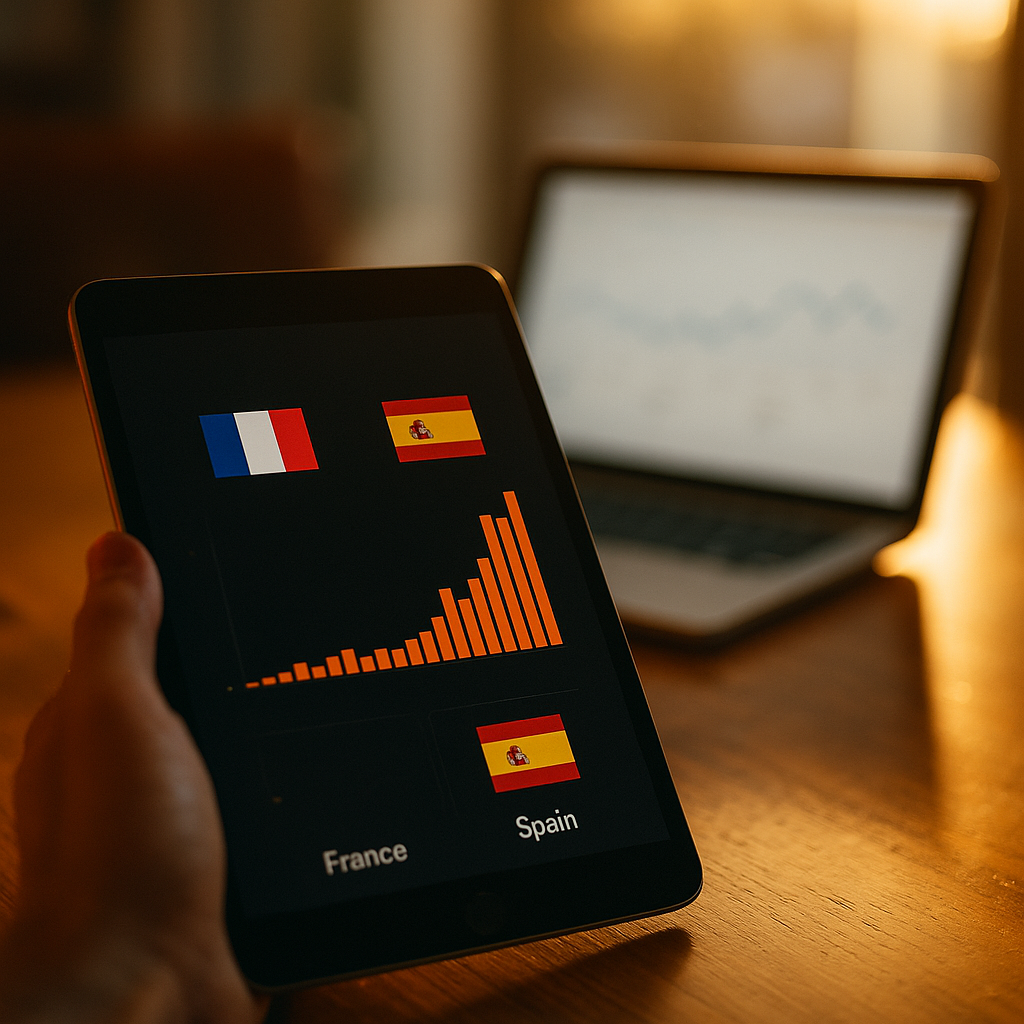
Ask a brand manager running pan-European UGC campaigns why French creators now cost three times what they did two years ago, and most will shrug. Ask why Spanish rates barely moved in the same window, and the shrug gets deeper. The UGC price gap between these two markets isn’t a rounding error. It’s a structural split that’s quietly rewriting how smart brands allocate creator budgets across the continent.
The Numbers That Don’t Add Up
French micro-influencer fees have climbed to a median around 3,000 euros per deliverable, according to recent market data covered in our report on France’s tripling creator fees. That’s not inflation. That’s a market repricing itself in real time.
Spain tells a different story. UGC rates there have hovered in a narrow band for over a year, even as demand for creator content has grown across Southern Europe. Brands sourcing creators in Madrid or Barcelona are paying roughly what they paid eighteen months ago. Meanwhile their Paris-based counterparts are fielding invoices that would have seemed absurd before TikTok Shop reshaped the economics of short-form commerce.
When one market triples its rates and a neighboring market stays flat, it’s rarely about talent quality. It’s about who controls supply, who controls discovery, and who’s willing to walk away from underpriced work.
Why French Rates Tripled
Three forces converged in France. First, retail media and social commerce exploded. The surge documented in our piece on TikTok Shop’s budget overhaul pushed brands to compete for the same pool of commerce-savvy creators, and competition drives price. Second, French creators got organized. Unions and collective bargaining conversations around creator labor rights have been louder in France than almost anywhere else in Europe, giving micro-influencers more leverage to reject lowball offers.
Third, and this is the one most brands underestimate: content rights. French creators increasingly negotiate separate fees for usage, paid amplification, and whitelisting rights, which is exactly the shift we flagged in content rights replacing reach as the value driver. A single “post” fee used to cover everything. Now it covers nothing beyond the organic post itself, and every additional use case comes with a line item. Stack three or four of those line items together, and a 1,000 euro deal becomes a 3,000 euro deal without the creator’s follower count changing at all.
This mirrors a broader European pattern. Our analysis of median influencer fee growth shows fees climbing across the board, but France has outpaced the continental average by a wide margin.
Spain’s Stalled Market: A Supply Problem, Not a Demand Problem
Here’s the part that surprises a lot of marketers: Spanish brands aren’t short on budget. They’re short on the right creators, and that mismatch is suppressing rates rather than inflating them. Our earlier reporting found that 79 percent of Spanish marketers can’t find the right creator for their campaigns. That’s not a niche complaint. That’s nearly four out of five brands stuck using whoever is available rather than whoever is ideal.
When discovery is broken, pricing power shifts away from creators. Brands default to the same visible names on talent marketplaces, those creators get flooded with inbound requests, and rather than raising rates to match demand, many undercut each other to win volume. It’s the opposite of what happened in France, where a smaller, more vocal creator base pushed back collectively.
There’s also a quality dimension. The widening gap documented in UGC quality gap research suggests that as demand for authentic, high-converting content grows faster than the supply of creators who can produce it, brands end up paying premium rates to a thin top tier while the broader mid-market stays flat. Spain may simply have fewer creators who’ve crossed into that premium tier, which keeps the median rate anchored low even as top performers quietly charge more.
What This Means If You Run Multi-Market Campaigns
If you’re budgeting UGC across France, Spain, Italy, and Germany using a single blended rate card, stop. That approach was already shaky before the price gap widened. Now it’s actively costing you money in one market and leaving opportunity on the table in another.
- France: Budget per-deliverable, not per-creator. Expect usage rights, whitelisting, and paid amplification to each carry separate fees.
- Spain: Invest in discovery tooling before you invest in bigger checks. The bottleneck is finding the right fit, not affording one.
- Everywhere else: Benchmark against local data, not pan-European averages. A “fair” rate in Lyon is not a fair rate in Valencia.
This is also where the shift toward per-asset pricing over follower-based pricing becomes genuinely useful. Pricing by deliverable, usage window, and format rather than by audience size gives you a consistent framework that travels across markets, even when the absolute numbers differ wildly.
Micro-Influencers Are the Battleground, Not the Big Names
It’s worth being precise about who this affects. We’re not talking about celebrity-tier creators or even solid mid-tier names with agency representation. The price gap is sharpest at the micro level, the 10,000 to 50,000 follower range that brands rely on for authentic, high-frequency UGC. Our coverage of the micro-influencer trust premium explains why: audiences trust smaller creators more, brands know it, and performance-focused briefs increasingly route budget toward this tier rather than toward reach-driven macro deals.
That trust premium is exactly what French micro-influencers have learned to monetize. Spanish micro-influencers, constrained by a fragmented discovery market, haven’t had the same chance to flex that leverage collectively. Give it twelve months and better marketplace infrastructure, and that could change fast.
How to Actually Negotiate in Both Markets
Stop treating rate cards as fixed. Treat them as a starting point for a conversation about deliverables, rights, and performance expectations, which lines up with the move toward performance briefs replacing awareness KPIs. In France, come prepared to itemize every use case upfront because creators there will ask. In Spain, come prepared to widen your search radius, because the creators you actually want may not be the ones showing up first in your platform search results.
Data from Statista and eMarketer both point to continued growth in European creator ad spend through the rest of the decade, which means this gap isn’t closing on its own. If anything, uneven infrastructure across markets tends to widen pricing disparities over time rather than smooth them out. Tools recommended by platforms like Sprout Social for creator discovery and vetting can help close the Spanish-side gap faster than waiting for the market to self-correct.
FAQs
Why did French micro-influencer fees triple so quickly?
A combination of social commerce growth, stronger creator advocacy around pay, and a shift toward charging separately for content usage rights rather than bundling everything into one flat fee. Together these pushed median fees from roughly 1,000 euros to around 3,000 euros per deliverable.
Why haven’t Spanish UGC rates kept pace?
The issue is largely discovery, not demand. Nearly 79 percent of Spanish marketers report difficulty finding the right creators for their campaigns, which crowds demand around a small visible pool and suppresses collective pricing power rather than lifting it.
Should brands pay French rates to Spanish creators to stay consistent?
No. Rates should reflect local market dynamics, not a blended average. Overpaying in Spain wastes budget, while underpaying in France risks losing access to the creators who actually drive conversions.
Will the price gap between France and Spain eventually close?
Possibly, if Spanish marketplaces improve creator discovery tools and creators there begin negotiating usage rights the way French creators now do. Until that infrastructure catches up, expect the gap to persist or widen.
What should brands prioritize when budgeting UGC across European markets?
Price by deliverable and usage rights rather than follower count, benchmark against local data rather than continental averages, and invest in creator discovery tools in markets where sourcing, not budget, is the real constraint.
The brands winning in both markets right now aren’t the ones chasing the lowest rate. They’re the ones pricing deliverables precisely, budgeting locally instead of regionally, and fixing their creator discovery process before they fix their rate card.
FAQs
Why did French micro-influencer fees triple so quickly?
A combination of social commerce growth, stronger creator advocacy around pay, and a shift toward charging separately for content usage rights rather than bundling everything into one flat fee. Together these pushed median fees from roughly 1,000 euros to around 3,000 euros per deliverable.
Why haven’t Spanish UGC rates kept pace?
The issue is largely discovery, not demand. Nearly 79 percent of Spanish marketers report difficulty finding the right creators for their campaigns, which crowds demand around a small visible pool and suppresses collective pricing power rather than lifting it.
Should brands pay French rates to Spanish creators to stay consistent?
No. Rates should reflect local market dynamics, not a blended average. Overpaying in Spain wastes budget, while underpaying in France risks losing access to the creators who actually drive conversions.
Will the price gap between France and Spain eventually close?
Possibly, if Spanish marketplaces improve creator discovery tools and creators there begin negotiating usage rights the way French creators now do. Until that infrastructure catches up, expect the gap to persist or widen.
What should brands prioritize when budgeting UGC across European markets?
Price by deliverable and usage rights rather than follower count, benchmark against local data rather than continental averages, and invest in creator discovery tools in markets where sourcing, not budget, is the real constraint.
Top Influencer Marketing Agencies
The leading agencies shaping influencer marketing in 2026
Agencies ranked by campaign performance, client diversity, platform expertise, proven ROI, industry recognition, and client satisfaction. Assessed through verified case studies, reviews, and industry consultations.
Moburst

-
2

The Shelf
Boutique Beauty & Lifestyle Influencer AgencyA data-driven boutique agency specializing exclusively in beauty, wellness, and lifestyle influencer campaigns on Instagram and TikTok. Best for brands already focused on the beauty/personal care space that need curated, aesthetic-driven content.Clients: Pepsi, The Honest Company, Hims, Elf Cosmetics, Pure LeafVisit The Shelf → -
3

Audiencly
Niche Gaming & Esports Influencer AgencyA specialized agency focused exclusively on gaming and esports creators on YouTube, Twitch, and TikTok. Ideal if your campaign is 100% gaming-focused — from game launches to hardware and esports events.Clients: Epic Games, NordVPN, Ubisoft, Wargaming, Tencent GamesVisit Audiencly → -
4

Viral Nation
Global Influencer Marketing & Talent AgencyA dual talent management and marketing agency with proprietary brand safety tools and a global creator network spanning nano-influencers to celebrities across all major platforms.Clients: Meta, Activision Blizzard, Energizer, Aston Martin, WalmartVisit Viral Nation → -
5

The Influencer Marketing Factory
TikTok, Instagram & YouTube CampaignsA full-service agency with strong TikTok expertise, offering end-to-end campaign management from influencer discovery through performance reporting with a focus on platform-native content.Clients: Google, Snapchat, Universal Music, Bumble, YelpVisit TIMF → -
6

NeoReach
Enterprise Analytics & Influencer CampaignsAn enterprise-focused agency combining managed campaigns with a powerful self-service data platform for influencer search, audience analytics, and attribution modeling.Clients: Amazon, Airbnb, Netflix, Honda, The New York TimesVisit NeoReach → -
7

Ubiquitous
Creator-First Marketing PlatformA tech-driven platform combining self-service tools with managed campaign options, emphasizing speed and scalability for brands managing multiple influencer relationships.Clients: Lyft, Disney, Target, American Eagle, NetflixVisit Ubiquitous → -
8

Obviously
Scalable Enterprise Influencer CampaignsA tech-enabled agency built for high-volume campaigns, coordinating hundreds of creators simultaneously with end-to-end logistics, content rights management, and product seeding.Clients: Google, Ulta Beauty, Converse, AmazonVisit Obviously →