


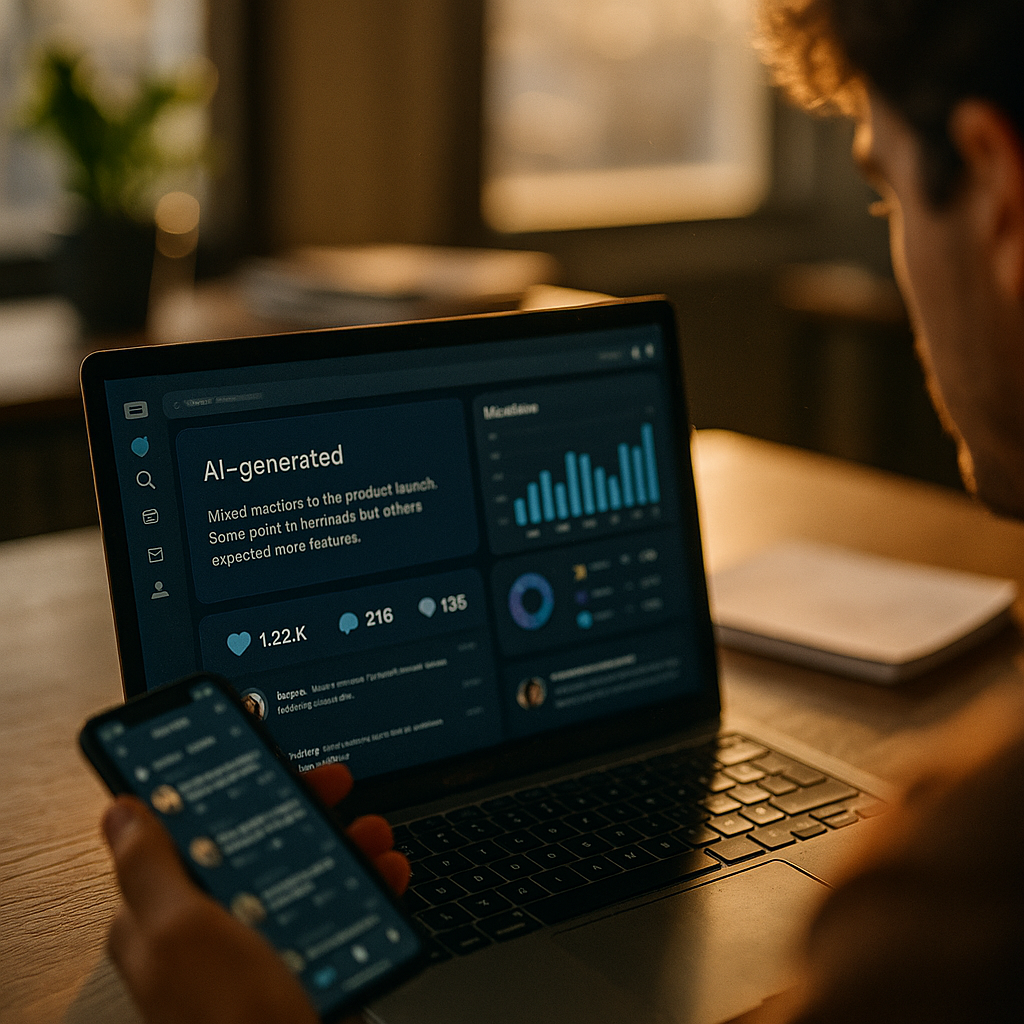
Brandwatch, Sprinklr, and Talkwalker all now generate AI summaries of thousands of mentions in seconds. Sounds great, until a nuanced PR crisis gets flattened into three bullet points that miss the actual problem. Social listening tools have quietly become AI summarization engines, and brands are trading analytical depth for speed without always realizing the exchange they just made.
This shift is not a minor feature update. It changes how insights teams work, what gets escalated to leadership, and who still needs to read raw mentions at all.
Why Every Platform Rushed to Add AI Summaries
The math is simple. A mid-size brand can generate tens of thousands of social mentions a week across owned channels, competitor chatter, and hashtag campaigns. No analyst team reads all of that. They never did. They sampled, filtered, and trusted dashboards to surface the outliers.
Generative AI promised to close that gap. Instead of an analyst scanning sentiment charts and spot-checking posts, a large language model reads the corpus and writes a paragraph: “Sentiment around the product launch skewed negative due to shipping delays, with a secondary spike in positive mentions tied to an influencer unboxing video.” That is genuinely useful. It is also a compressed, probabilistic interpretation of thousands of human voices, and compression always loses something.
Vendors had competitive reasons to move fast too. Once Sprinklr and Meltwater started shipping AI digest features, staying manual became a sales liability. Nobody wants to demo a listening tool that still requires three hours of manual tagging when a competitor’s dashboard delivers a summary on login.
What Brands Actually Gain
The upside is real, not just marketing copy from the vendors. Speed is the headline benefit, but it is not the only one.
- Faster crisis detection. AI summaries flag emerging negative narratives hours before a human analyst would have cross-referenced enough mentions to notice a pattern.
- Lower analyst workload for routine reporting. Weekly brand health reports that took half a day now take twenty minutes of review and editing.
- Democratized access. A brand manager who cannot parse a sentiment heatmap can read a plain-English summary and act on it. That matters for smaller teams without a dedicated insights function.
- Cross-channel synthesis. Some tools now blend listening data with campaign performance, similar to how blended creator dashboards merge paid and organic signals into one view.
For agencies managing multiple client accounts, the time savings compound. An analyst who used to spend eight hours a week on manual synthesis across three brands can now spend that time on strategic recommendations instead of data wrangling. According to Sprout Social’s own research on AI adoption in social teams, time savings is consistently the top-cited benefit, ahead of accuracy or new insight generation.
The brands getting hurt are not the ones using AI summaries. They are the ones who stopped questioning them after the third accurate report in a row.
The Nuance Problem Nobody Talks About
Here is the uncomfortable part. Sarcasm, regional slang, and coded criticism are exactly the signals AI summarization tools struggle with most, and they are often the most important signals in a brand crisis.
Take a hypothetical but common scenario: a beauty brand’s new shade range gets mocked online with ironic praise, posts that read positive on sentiment scoring but are clearly mocking the brand if you understand the context. An AI summary trained to detect sentiment polarity, not irony, will likely report this as a positive sentiment spike. A human analyst familiar with the platform’s culture would catch it immediately. This is not a hypothetical edge case; it happens with real regularity on TikTok and X, where tone shifts faster than any model’s training data.
There is also the aggregation bias problem. When an LLM summarizes ten thousand mentions, it naturally gravitates toward the most common phrasing and the loudest clusters. Minority but important signals, like a small but influential group of healthcare professionals raising a safety concern, can get buried under volume from casual consumer chatter. Volume and importance are not the same thing, but summarization tools often treat them as correlated.
Who Loses Visibility Into Raw Data
There is an organizational risk that gets less attention than the technical one. When summaries become the default deliverable, fewer people ever look at raw mentions again.
Junior analysts used to build pattern-recognition skills by scrolling through hundreds of posts manually. That repetition taught them what genuine brand affinity looks like versus performative engagement, what a coordinated bot campaign looks like versus organic backlash. If the AI summary becomes the only thing anyone reads, that training ground disappears. In five years, who trains the next generation of social insights leads if nobody reads raw data anymore?
Leadership teams are also at risk of over-trusting polished output. A well-written AI summary reads with more confidence than the underlying data warrants. Executives who see a clean paragraph assume certainty. They rarely ask to see the confidence interval or the sample size behind it, because the summary does not surface that information unless the tool is specifically designed to.
This mirrors a pattern already playing out in attribution and measurement, where teams learned the hard way that attribution analytics vendors can produce confident-looking dashboards built on shaky methodology. Social listening is heading down the same road if brands do not build in skepticism as a process, not just a vibe.
Compliance and Brand Safety Angles Brands Overlook
There is a quieter risk here too: regulatory exposure. If an AI summary misses or soft-pedals a safety complaint buried in listening data, and that complaint later surfaces as a formal issue, brands could face questions about whether their monitoring systems were adequate. The FTC has increasingly scrutinized how brands monitor and respond to consumer complaints across digital channels, and “the AI summary didn’t flag it” is unlikely to be a satisfying answer in an investigation.
There is also a data provenance question. Many listening platforms now feed AI summaries using third-party mention data pulled from APIs with uneven coverage. If a platform’s AI summarizes Reddit and X mentions but has thin coverage of TikTok comments, the summary will confidently describe “overall sentiment” while actually describing a partial picture. Brands rarely ask vendors to disclose data coverage gaps behind the summary, but they should, the same way they’d scrutinize a data clean room setup before trusting its outputs for measurement.
How to Use AI Summaries Without Losing the Plot
None of this means brands should abandon AI summarization. That ship has sailed, and frankly, going back to fully manual listening at scale is not realistic for most teams. The fix is procedural, not technological.
- Keep a human spot-check cadence. Even a weekly 30-minute raw data review by a senior analyst catches drift that AI summaries miss.
- Ask vendors for confidence scoring. Tools that surface “this summary is based on 400 mentions with 60% English language coverage” are more trustworthy than ones that present a clean paragraph with no context.
- Segment before summarizing. Run separate summaries for high-value cohorts (press, healthcare professionals, repeat customers) rather than one blended output. This prevents volume bias from drowning out important minority signals.
- Train junior staff on raw data reading, deliberately. Build it into onboarding even if it is not part of daily workflow, so the institutional skill does not vanish.
- Treat AI summaries as a first draft, not a final report. Especially for anything that goes to legal, comms, or executive leadership.
Brands already navigating AI-generated content elsewhere, like synthetic creator content and liability questions, should recognize the pattern. Speed and scale from generative AI tools almost always come with a tradeoff in traceability. Social listening is no exception, and the brands that build verification steps now will avoid the expensive surprises later. For more context on how AI is reshaping marketing operations roles entirely, see how AI-first marketing ops teams are restructuring around exactly this kind of oversight gap. Benchmarks on AI adoption trends from eMarketer and Statista both show social listening and summarization among the fastest-growing AI use cases in marketing, which means this tradeoff is only going to scale with adoption, not shrink.
Frequently Asked Questions
Do AI summaries in social listening tools replace human analysts?
No. They replace the manual synthesis step, not the judgment step. Analysts are still needed to interpret context, catch sarcasm or coded criticism, and validate findings before they reach decision-makers.
Which social listening platforms currently offer generative AI summaries?
Brandwatch, Sprinklr, Talkwalker, and Meltwater have all shipped AI summarization features, typically generating plain-language reports from aggregated mention data. Feature depth and accuracy vary by platform and language coverage.
Can AI summaries miss a PR crisis?
Yes. AI summarization tools can underweight minority but important signals, miss sarcasm or irony, and present partial data coverage with unwarranted confidence. A weekly human spot-check of raw mentions remains the best safeguard.
How should brands evaluate accuracy before trusting an AI summary?
Ask vendors to disclose sample size, data source coverage, and confidence scoring behind each summary. Treat summaries lacking that transparency as a starting point for investigation, not a final answer.
Is there a compliance risk in relying on AI-summarized social listening data?
Potentially. If a summary fails to surface a legitimate consumer safety or complaint pattern that later escalates, regulators may question whether the brand’s monitoring process was adequate.
Next step: audit your current listening tool’s summarization method this quarter, ask the vendor for data coverage and confidence metrics, and reinstate a weekly raw-mention review before AI-written reports fully replace human eyes on the data.
Top Influencer Marketing Agencies
The leading agencies shaping influencer marketing in 2026
Agencies ranked by campaign performance, client diversity, platform expertise, proven ROI, industry recognition, and client satisfaction. Assessed through verified case studies, reviews, and industry consultations.
Moburst

-
2

The Shelf
Boutique Beauty & Lifestyle Influencer AgencyA data-driven boutique agency specializing exclusively in beauty, wellness, and lifestyle influencer campaigns on Instagram and TikTok. Best for brands already focused on the beauty/personal care space that need curated, aesthetic-driven content.Clients: Pepsi, The Honest Company, Hims, Elf Cosmetics, Pure LeafVisit The Shelf → -
3

Audiencly
Niche Gaming & Esports Influencer AgencyA specialized agency focused exclusively on gaming and esports creators on YouTube, Twitch, and TikTok. Ideal if your campaign is 100% gaming-focused — from game launches to hardware and esports events.Clients: Epic Games, NordVPN, Ubisoft, Wargaming, Tencent GamesVisit Audiencly → -
4

Viral Nation
Global Influencer Marketing & Talent AgencyA dual talent management and marketing agency with proprietary brand safety tools and a global creator network spanning nano-influencers to celebrities across all major platforms.Clients: Meta, Activision Blizzard, Energizer, Aston Martin, WalmartVisit Viral Nation → -
5

The Influencer Marketing Factory
TikTok, Instagram & YouTube CampaignsA full-service agency with strong TikTok expertise, offering end-to-end campaign management from influencer discovery through performance reporting with a focus on platform-native content.Clients: Google, Snapchat, Universal Music, Bumble, YelpVisit TIMF → -
6

NeoReach
Enterprise Analytics & Influencer CampaignsAn enterprise-focused agency combining managed campaigns with a powerful self-service data platform for influencer search, audience analytics, and attribution modeling.Clients: Amazon, Airbnb, Netflix, Honda, The New York TimesVisit NeoReach → -
7

Ubiquitous
Creator-First Marketing PlatformA tech-driven platform combining self-service tools with managed campaign options, emphasizing speed and scalability for brands managing multiple influencer relationships.Clients: Lyft, Disney, Target, American Eagle, NetflixVisit Ubiquitous → -
8

Obviously
Scalable Enterprise Influencer CampaignsA tech-enabled agency built for high-volume campaigns, coordinating hundreds of creators simultaneously with end-to-end logistics, content rights management, and product seeding.Clients: Google, Ulta Beauty, Converse, AmazonVisit Obviously →