


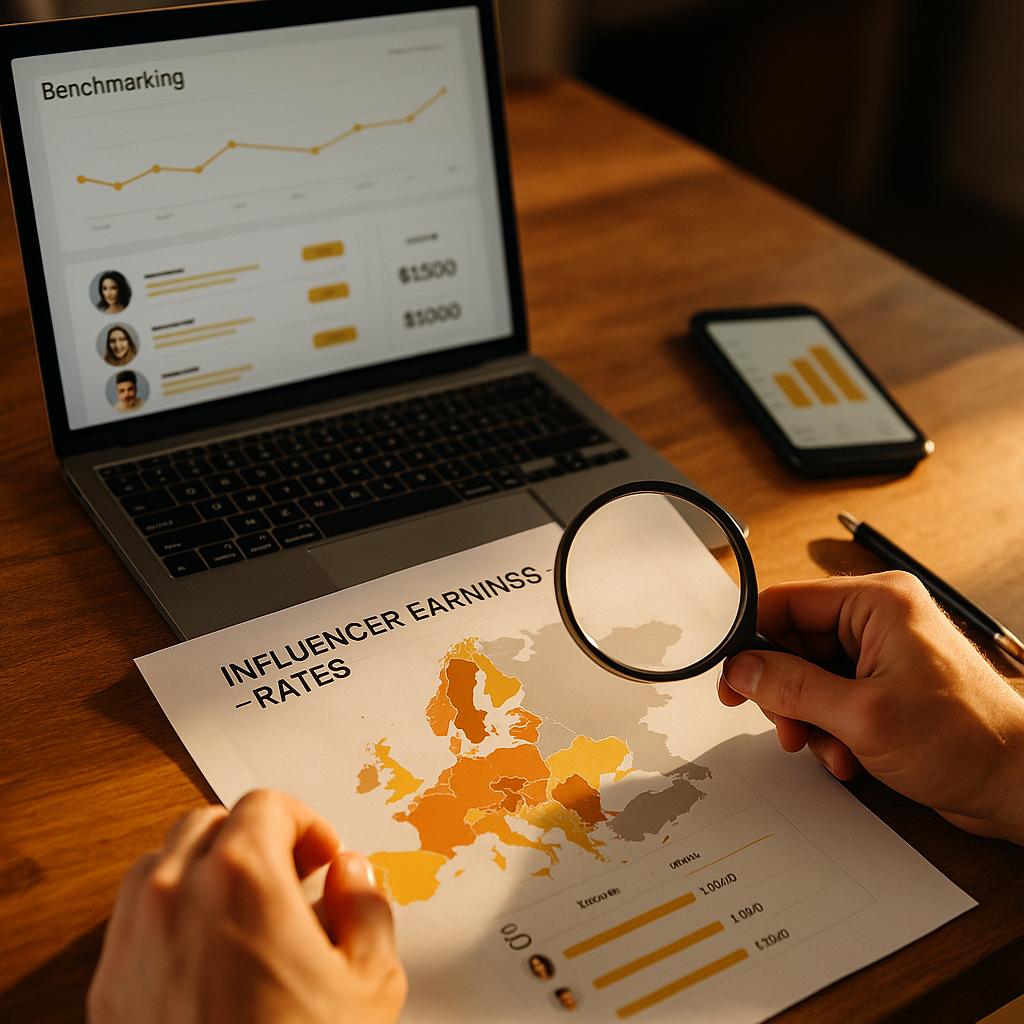
Creator fees in Germany, France, and the UK have climbed as much as 40% year over year on some platforms, according to agency pricing data circulating across European marketing circles. Meanwhile, engagement rates for the same creators have stayed flat or dropped. So why are brands still paying more? The short answer: nobody had reliable pricing data until creator fee benchmarking tools started filling the gap. Now the question isn’t whether to use them, it’s which one actually works.
Why European Creator Rates Are Spiraling
Three things collided at once. Currency volatility made cross-border rate cards unpredictable. A wave of agency consolidation gave a handful of talent managers outsized pricing power in key markets like France and the Netherlands. And brands, flush with reallocated TV budgets, kept bidding against each other without any shared reference point for “fair” pricing.
Add in VAT complexity across EU member states and the patchwork of disclosure rules that vary by country, and you get a market where a mid-tier lifestyle creator in Berlin might quote triple what a comparable creator in Warsaw charges for nearly identical deliverables. There’s no Bloomberg terminal for influencer rates. Until recently, brands were negotiating blind.
Agencies report that unchecked rate inflation in fragmented EU markets can inflate campaign costs by 25% to 40% compared to benchmarked, data-backed negotiations.
What Creator Fee Benchmarking Tools Actually Do
At their core, these platforms aggregate historical deal data, engagement benchmarks, and follower quality scores to generate a “fair market” fee range for a given creator, platform, content format, and region. Think of it as a Zillow Zestimate, but for a sponsored Reel in Lyon versus a YouTube integration in Hamburg.
The better tools pull from three data sources simultaneously:
- First-party deal history submitted by brands and agencies (anonymized and aggregated)
- Platform-reported engagement and audience quality metrics
- Market-level inflation indices tracking category-specific rate movement (beauty, fintech, gaming, etc.)
Without that triangulation, you’re just looking at a creator’s follower count and guessing. And guessing is exactly how brands ended up overpaying in the first place.
The Software Brands Are Actually Buying
A handful of platforms have become the default procurement layer for creator pricing intelligence in Europe. CreatorIQ’s Rate Intelligence module, Captiv8’s benchmarking dashboard, and Aspire’s deal comparison tool all now offer region-specific filtering for EU and UK markets, a feature that didn’t exist widely two years ago.
These sit alongside discovery platforms doing double duty as pricing references. Tools covered in our breakdown of discovery platforms for vetting speed increasingly bundle fee benchmarking directly into creator profiles, so brand teams see projected cost alongside audience quality in a single view. That consolidation matters because it removes a step in the workflow where pricing errors used to creep in.
It’s also worth watching how AI-driven discovery engines handle refresh rates, because stale pricing data is almost as dangerous as no data. A benchmark built on deals from eighteen months ago won’t reflect a market that moved 30% since then.
Does Benchmarking Data Actually Lower Your Costs?
Mostly, yes, but not automatically. The tool doesn’t negotiate for you. What it does is arm your team with a defensible counteroffer. Brand managers who walk into negotiations citing “the market rate for a creator at this tier, in this category, in this region is X” close deals faster and at lower prices than those relying on gut instinct or the creator’s own quoted rate card.
One European beauty brand we spoke with (speaking on background due to vendor agreements) reported a 22% reduction in average cost-per-creator after six months of benchmarking-informed negotiations. That’s not a universal outcome, but it’s consistent with what procurement teams see in other categories once pricing transparency enters the conversation.
There’s a second-order benefit too. Benchmarking data feeds directly into broader ROI modeling. If you’re already running marketing mix modeling to validate influencer budget allocation, having accurate per-creator cost baselines makes the whole model more honest. Garbage cost inputs produce garbage ROI outputs, no matter how sophisticated the modeling layer is.
Where the Data Still Falls Short
Benchmarking tools struggle with niche categories and emerging markets where deal volume is thin. A finance creator in Lisbon doing fifteen deals a year doesn’t generate enough data points for a confident benchmark. In those cases, tools tend to extrapolate from adjacent categories or similar-sized markets, which introduces error. Treat benchmarks in thin-data categories as a starting point, not gospel.
There’s also a disclosure wrinkle. Rate benchmarking only works if underlying deal data reflects actual, compliant sponsorships. Regulators across Europe, including the UK’s Information Commissioner’s Office, have tightened expectations around how sponsored content gets labeled, and undisclosed deals don’t make it into clean benchmark datasets. That means the data pool is inherently biased toward brands and creators already playing by the rules, which is arguably fine, since those are the deals you want to benchmark against anyway.
Benchmarking Without Context Is Just Noise
Here’s the trap a lot of brand teams fall into: they treat the benchmark number as a hard ceiling rather than a negotiating anchor. A creator with unusually strong conversion history, verified through proper attribution analytics tied to proof over vanity metrics, might legitimately command above-benchmark pricing. Benchmarking tools price the market average. They don’t price performance outliers, and that distinction gets lost when procurement teams start treating software output as the final word.
The smartest operators use benchmarking as one input among several: historical performance data, category fit, exclusivity terms, and usage rights all still require human judgment. Software tells you what the market typically pays. It doesn’t tell you what a specific creator is worth to your specific campaign.
Benchmarking software sets the floor and ceiling of a fair negotiation. It doesn’t replace the judgment required to know where a specific creator belongs on that curve.
Operational Efficiency: The Overlooked ROI Driver
Beyond raw cost savings, benchmarking tools cut negotiation cycle time dramatically. Procurement teams that previously spent days going back and forth on rate cards now resolve pricing in a single conversation because both sides can reference the same third-party data point. That’s not a minor efficiency gain when you’re running campaigns with forty or fifty creators simultaneously across multiple EU markets.
Faster negotiation also means faster payout cycles downstream. Brands pairing benchmarking data with payout automation that compresses creator payment timelines are seeing the full pipeline, from quote to contract to payment, shrink from weeks to days. That matters for creator relationships too. Nobody wants to work with a brand that haggles for three weeks and then pays net 90.
Industry benchmarking data from sources like eMarketer and Statista continues to show influencer marketing spend climbing across European markets even as brands report tighter overall budgets, which only increases the pressure to get fee negotiation right the first time.
Choosing the Right Tool for Your Market
Not every benchmarking platform covers every European market equally well. German and UK data tends to be the deepest, simply because deal volume is higher and agency reporting is more standardized. Southern and Eastern European coverage is thinner across most vendors. Before committing budget to a platform, ask for a sample benchmark report in your specific target markets. If the vendor can’t produce granular, region-specific data for where you’re actually spending, the tool isn’t ready for your use case yet.
Resources like Sprout Social and HubSpot also publish periodic creator economy pricing surveys worth cross-referencing against vendor claims, especially for categories where vendor data might be thin.
FAQs
Frequently Asked Questions
What are creator fee benchmarking tools?
Creator fee benchmarking tools are software platforms that aggregate historical deal data, engagement metrics, and market pricing trends to estimate a fair rate range for a creator based on region, platform, content format, and category.
Why are European creator rates inflating faster than other regions?
Agency consolidation in key markets, currency volatility, fragmented VAT and disclosure rules across EU member states, and increased brand demand have combined to push creator fees up without a corresponding increase in performance, creating a pricing gap that benchmarking tools are designed to close.
Do benchmarking tools guarantee lower creator costs?
No. They provide data to support negotiation but don’t negotiate on your behalf. Brands that use benchmark data as a reference point in conversations typically see meaningful cost reductions, but outcomes depend on execution, not just access to the tool.
How accurate is benchmarking data for niche or small markets?
Accuracy drops in thin-data categories and smaller markets where deal volume is low. In those cases, tools often extrapolate from adjacent categories, which introduces more error. Treat benchmarks in low-volume markets as directional rather than definitive.
Can benchmarking software replace human judgment in creator negotiations?
No. Benchmarking tools price the market average, but they can’t account for a specific creator’s proven conversion history, exclusivity terms, or usage rights, all of which still require experienced human evaluation.
If you’re negotiating European creator deals without a benchmarking tool in your stack, you’re paying a premium for information asymmetry that’s no longer necessary. Start with one target market, pull a sample report, and compare it against your last three signed deals before you scale the approach company-wide.
Top Influencer Marketing Agencies
The leading agencies shaping influencer marketing in 2026
Agencies ranked by campaign performance, client diversity, platform expertise, proven ROI, industry recognition, and client satisfaction. Assessed through verified case studies, reviews, and industry consultations.
Moburst

-
2

The Shelf
Boutique Beauty & Lifestyle Influencer AgencyA data-driven boutique agency specializing exclusively in beauty, wellness, and lifestyle influencer campaigns on Instagram and TikTok. Best for brands already focused on the beauty/personal care space that need curated, aesthetic-driven content.Clients: Pepsi, The Honest Company, Hims, Elf Cosmetics, Pure LeafVisit The Shelf → -
3

Audiencly
Niche Gaming & Esports Influencer AgencyA specialized agency focused exclusively on gaming and esports creators on YouTube, Twitch, and TikTok. Ideal if your campaign is 100% gaming-focused — from game launches to hardware and esports events.Clients: Epic Games, NordVPN, Ubisoft, Wargaming, Tencent GamesVisit Audiencly → -
4

Viral Nation
Global Influencer Marketing & Talent AgencyA dual talent management and marketing agency with proprietary brand safety tools and a global creator network spanning nano-influencers to celebrities across all major platforms.Clients: Meta, Activision Blizzard, Energizer, Aston Martin, WalmartVisit Viral Nation → -
5

The Influencer Marketing Factory
TikTok, Instagram & YouTube CampaignsA full-service agency with strong TikTok expertise, offering end-to-end campaign management from influencer discovery through performance reporting with a focus on platform-native content.Clients: Google, Snapchat, Universal Music, Bumble, YelpVisit TIMF → -
6

NeoReach
Enterprise Analytics & Influencer CampaignsAn enterprise-focused agency combining managed campaigns with a powerful self-service data platform for influencer search, audience analytics, and attribution modeling.Clients: Amazon, Airbnb, Netflix, Honda, The New York TimesVisit NeoReach → -
7

Ubiquitous
Creator-First Marketing PlatformA tech-driven platform combining self-service tools with managed campaign options, emphasizing speed and scalability for brands managing multiple influencer relationships.Clients: Lyft, Disney, Target, American Eagle, NetflixVisit Ubiquitous → -
8

Obviously
Scalable Enterprise Influencer CampaignsA tech-enabled agency built for high-volume campaigns, coordinating hundreds of creators simultaneously with end-to-end logistics, content rights management, and product seeding.Clients: Google, Ulta Beauty, Converse, AmazonVisit Obviously →