


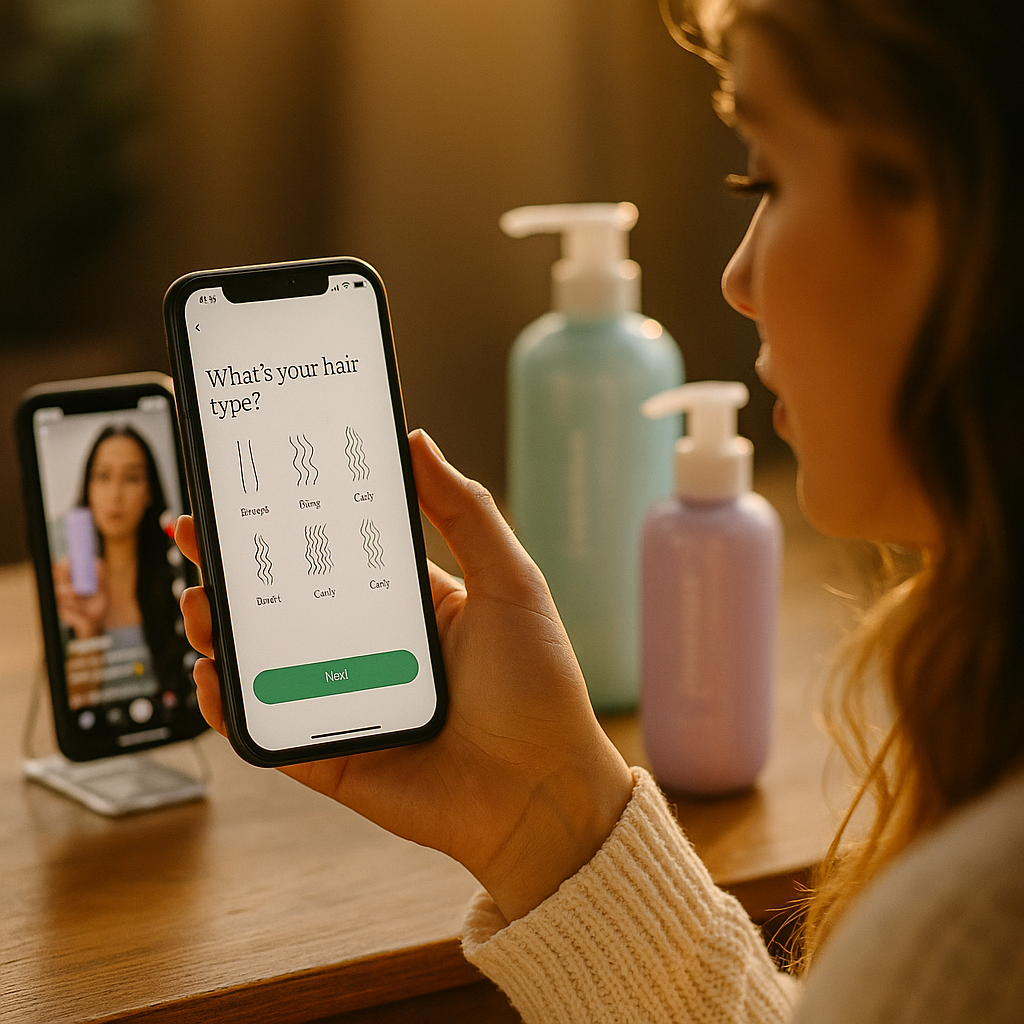
Function of Beauty sells shampoo that doesn’t exist until a customer answers 25 quiz questions. That’s a hard product to demo on TikTok in nine seconds. So the brand did something smarter: it turned the quiz itself into the content engine, feeding creator briefs directly from customer data. The result is a personalized quiz-to-creator handoff model that other DTC brands are now studying line by line.
The Problem With Selling a Product That Doesn’t Exist Yet
Custom haircare has a trust gap built into the business model. You can’t hold up a bottle and say “this works” because the bottle is different for every customer. Function of Beauty’s entire value proposition — hair type, goals, and fragrance mapped to a formula mixed on demand — is invisible until someone actually takes the quiz.
Traditional influencer marketing struggles here. A single creator review shows one formula, one hair type, one outcome. Scroll through comments on any generic haircare video and you’ll see the same objection repeated: “But will it work for MY hair?” That question kills conversion faster than any pricing objection.
Function of Beauty’s answer was to stop treating the quiz as a pre-purchase step and start treating it as the actual content brief.
How the Quiz-to-Creator Handoff Actually Works
The mechanic is simpler than it sounds, which is probably why it scales so well. Creators take the real customer quiz on camera, unscripted reactions included, and the brand’s backend generates their specific formula recommendation in real time. That output becomes the video’s second act: unboxing a product that was built from their own answers, not a generic sample sent by a PR team.
- Creator films the quiz-taking moment, including hesitation, jokes about hair damage confessions, and genuine curiosity about the result
- The formula reveal happens on-screen, tying quiz inputs directly to visible outputs (color, ingredients, fragrance name)
- A second video captures the unboxing and first wash, closing the loop between “quiz answer” and “real product”
- Captions and on-screen text reference specific quiz questions, which doubles as organic keyword coverage for search-driven TikTok discovery
This isn’t a script handed to a creator with brand talking points bolted on. The quiz generates the content structure automatically. Every creator gets a different formula, different result, different narrative — but the format stays consistent enough to build pattern recognition across a feed.
When the product personalization engine and the content brief are the same system, you don’t need fifty different creative concepts. You need one mechanic and a hundred different people running through it.
Why This Beats the Standard Unboxing Format
Most beauty brands hand creators a finished product and ask for a review. Function of Beauty hands creators an open question and lets the algorithm answer it on camera. That distinction matters more than it looks.
Viewers aren’t watching a review anymore. They’re watching a diagnostic process resolve in real time, which taps into the same curiosity loop that makes personality quizzes and horoscope content perform well on TikTok in the first place. The audience isn’t just evaluating the product. They’re mentally answering the quiz alongside the creator, which is a far stickier form of engagement than passive product viewing.
It also solves the “will it work for me” objection before anyone types it in the comments. Different creators with different hair textures get visibly different formulas. Curly hair gets one blend, fine straight hair gets another, color-treated hair gets a third. The proof isn’t a claim. It’s a side-by-side data set spread across dozens of creator accounts.
This mirrors a pattern seen across performance-driven creator programs: when the format itself demonstrates product-market fit, you spend less on convincing and more on distribution. Brands like Ridge Wallet built entire growth arcs on demo-first content instead of discounts, and Function of Beauty is applying the same logic to a far more complex, personalized product.
The Creator Tier Strategy: Nano and Micro Do the Heavy Lifting
Function of Beauty didn’t build this program around celebrity haircare influencers with agents and usage-rights riders. The bulk of the content comes from nano and micro creators with hair types and life circumstances that mirror the actual buyer base — postpartum hair loss, gray coverage, curl pattern changes after chemical treatments, teenage acne-related scalp issues.
Why nano and micro over big names? Three reasons brands keep landing on the same answer:
- Believability scales down, not up. A creator with 8,000 followers taking a real quiz reads as authentic. A celebrity doing the same thing reads as an ad, no matter how it’s shot.
- Volume beats reach for this format. The quiz-to-creator loop needs dozens of variations to prove the personalization claim. That’s a volume game, and nano/micro rates make volume affordable.
- Niche hair concerns need niche voices. A creator known for documenting their transition to natural hair carries more credibility on that specific topic than a general beauty influencer ever could.
This tracks with what’s worked for other brands leaning into smaller creators for credibility over reach — Grubhub’s shift away from celebrity talent and Chewy’s nano-creator subscription engine both point to the same underlying math: smaller creators convert better on trust-dependent categories, and haircare personalization is about as trust-dependent as it gets.
Operational Lessons for Brands Watching This Play Out
Copying the quiz-to-creator format takes more than a Typeform and a TikTok media budget. There’s real operational work behind it.
Data infrastructure has to move faster than content production. If the quiz result takes days to generate a real formula, the content moment dies. Function of Beauty’s backend has to output a personalized recommendation instantly, on camera, without a lag that breaks the narrative. Brands attempting this without real-time personalization tech will end up faking it, and audiences notice fake immediately.
Creator briefs need structure without scripts. The brief tells creators what moment to capture (quiz start, formula reveal, first wash) but doesn’t dictate what they say. This is the same lesson Chubbies has repeated across its absurdist creator brief system: structure the format, not the language.
Disclosure compliance can’t be an afterthought. Every gifted or paid quiz-to-creator video needs clear, upfront disclosure under FTC guidelines, especially since the format is built around what looks like an organic, unscripted moment. Brands that skip this step are one complaint away from a compliance review. The playbook Ollie used for credentialed nano-creator disclosure is a useful reference point for any brand running quiz or diagnostic content at scale.
Search intent matters as much as watch time. Quiz-based captions naturally include long-tail search phrases: “best shampoo for postpartum hair loss,” “curly hair quiz results,” “gray hair custom formula.” TikTok’s search function increasingly rewards this kind of natural keyword density, and Function of Beauty’s format generates it without trying.
What the Data Suggests About Personalization at Scale
Personalization has been a marketing buzzword for a decade, but most brands still execute it as a segmented email flow, not a content strategy. Function of Beauty’s approach treats personalization as the creative concept itself, not a targeting layer applied after the fact.
eMarketer has repeatedly flagged personalization and creator-led product discovery as the two fastest-growing influences on beauty purchase decisions, and this format sits directly at that intersection. It’s not influencer marketing bolted onto a personalization engine. It’s the personalization engine, filmed.
There’s a broader lesson here for any brand with a configurator, quiz, or diagnostic tool sitting underused on its website. That tool is a content brief waiting to happen. The mistake most brands make is treating the quiz as a conversion funnel step and the creator program as a separate awareness channel. Function of Beauty collapsed the two into one system, and the content got both more scalable and more believable as a result.
For teams evaluating whether their own product fits this model, the test is simple: does your product have a visible, personalized output that changes per customer? If yes, you likely have a content mechanic sitting inside your existing tech stack. If no, this format won’t translate, and forcing it will just produce another generic unboxing video with extra steps.
Next Step for Brands Considering This Model
Audit whatever quiz, configurator, or diagnostic tool already lives on your site, then brief three nano creators to film the exact same quiz-to-reveal arc before investing in a full production system. If the format proves out at that small scale, the infrastructure investment to run it at volume becomes an easy call.
FAQs
What is quiz-to-creator handoff content?
It’s a content format where a brand’s customer-facing quiz or diagnostic tool becomes the actual creative brief for influencer content, with creators filming their real quiz results and personalized product reveal instead of following a scripted review.
Why did Function of Beauty use nano and micro creators instead of larger influencers?
Nano and micro creators produce more believable, unscripted-feeling content, and their lower rates make it affordable to produce the volume of videos needed to prove a personalization claim across different hair types and concerns.
Does this format require special technology?
Yes. The brand needs a backend capable of generating a real, personalized product recommendation instantly and on camera. Any noticeable delay between quiz completion and formula reveal undermines the authenticity the format depends on.
How does this approach handle FTC disclosure requirements?
Gifted or paid creator content must include clear, upfront disclosure regardless of how organic the quiz moment appears on camera. Brands should build disclosure language into the creator brief itself rather than leaving it to individual creator discretion.
Can other product categories use a quiz-to-creator model?
Any brand with a configurator, quiz, or diagnostic tool that produces a visibly personalized output per customer can adapt this model, including supplements, skincare, pet food, and fitness programs.
Top Influencer Marketing Agencies
The leading agencies shaping influencer marketing in 2026
Agencies ranked by campaign performance, client diversity, platform expertise, proven ROI, industry recognition, and client satisfaction. Assessed through verified case studies, reviews, and industry consultations.
Moburst

-
2

The Shelf
Boutique Beauty & Lifestyle Influencer AgencyA data-driven boutique agency specializing exclusively in beauty, wellness, and lifestyle influencer campaigns on Instagram and TikTok. Best for brands already focused on the beauty/personal care space that need curated, aesthetic-driven content.Clients: Pepsi, The Honest Company, Hims, Elf Cosmetics, Pure LeafVisit The Shelf → -
3

Audiencly
Niche Gaming & Esports Influencer AgencyA specialized agency focused exclusively on gaming and esports creators on YouTube, Twitch, and TikTok. Ideal if your campaign is 100% gaming-focused — from game launches to hardware and esports events.Clients: Epic Games, NordVPN, Ubisoft, Wargaming, Tencent GamesVisit Audiencly → -
4

Viral Nation
Global Influencer Marketing & Talent AgencyA dual talent management and marketing agency with proprietary brand safety tools and a global creator network spanning nano-influencers to celebrities across all major platforms.Clients: Meta, Activision Blizzard, Energizer, Aston Martin, WalmartVisit Viral Nation → -
5

The Influencer Marketing Factory
TikTok, Instagram & YouTube CampaignsA full-service agency with strong TikTok expertise, offering end-to-end campaign management from influencer discovery through performance reporting with a focus on platform-native content.Clients: Google, Snapchat, Universal Music, Bumble, YelpVisit TIMF → -
6

NeoReach
Enterprise Analytics & Influencer CampaignsAn enterprise-focused agency combining managed campaigns with a powerful self-service data platform for influencer search, audience analytics, and attribution modeling.Clients: Amazon, Airbnb, Netflix, Honda, The New York TimesVisit NeoReach → -
7

Ubiquitous
Creator-First Marketing PlatformA tech-driven platform combining self-service tools with managed campaign options, emphasizing speed and scalability for brands managing multiple influencer relationships.Clients: Lyft, Disney, Target, American Eagle, NetflixVisit Ubiquitous → -
8

Obviously
Scalable Enterprise Influencer CampaignsA tech-enabled agency built for high-volume campaigns, coordinating hundreds of creators simultaneously with end-to-end logistics, content rights management, and product seeding.Clients: Google, Ulta Beauty, Converse, AmazonVisit Obviously →