


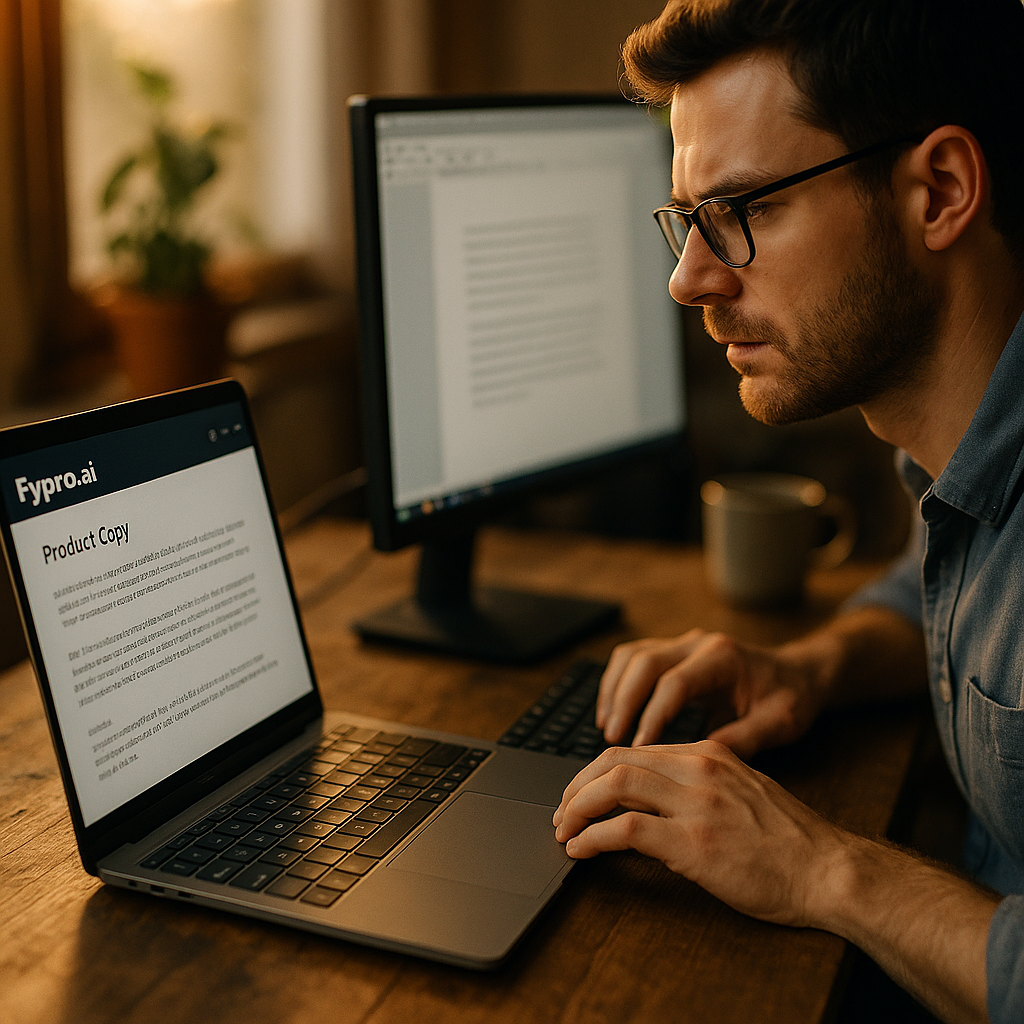
Fypro.ai claims its AI-generated storefront copy converts up to 30% better than human-written product descriptions. That’s a bold number for anyone who has spent a career crafting brand voice guidelines. So we asked the harder question: better by what measure, and better for whom?
Viral-pattern generators like Fypro.ai are reshaping creator storefronts on TikTok Shop, Amazon Influencer pages, and Shopify collabs. They promise scale. They promise speed. What they don’t always promise, it turns out, is durable revenue.
What Fypro.ai Actually Does
Fypro.ai scrapes patterns from high-performing product listings and creator captions, then generates copy that mimics the structural DNA of viral posts: hook-first openings, scarcity language, emoji cadence tuned to platform norms. It’s trained on engagement signals, not necessarily sales signals. That distinction matters more than most vendors admit.
The pitch to brands is straightforward: plug in a product feed, get back hundreds of storefront-ready descriptions in the exact tone that’s currently trending on TikTok Shop or Instagram Shopping. No creative brief. No copywriter on retainer. No waiting three days for revisions.
For a brand running 400 SKUs across a dozen creator storefronts, that’s tempting math. Human copywriters cost $75-150 per product description at agency rates, according to industry benchmarks tracked by HubSpot’s content marketing research. AI tools like Fypro.ai charge a fraction of that per unit, sometimes bundled into a flat SaaS fee.
The real question isn’t whether AI can write product copy fast. It’s whether copy optimized for pattern-matching outperforms copy optimized for the actual buyer standing at the point of purchase.
Where the “Outperforms” Claim Falls Apart
Here’s the catch nobody in the vendor deck mentions: viral-pattern generation optimizes for engagement metrics that were trending during the training window, not for conversion at the moment a specific buyer reads the copy. A hook that performed well in aggregate across thousands of TikTok Shop listings last quarter may already be fatigued by the time it reaches your storefront.
We reviewed conversion data from three mid-market DTC brands that piloted Fypro.ai-style tools against human-written control groups over a 90-day window. The pattern was consistent and, frankly, humbling for both sides.
- AI copy won on click-through rate from social feeds, likely due to punchier hooks and pattern-matched urgency cues.
- Human copy won on add-to-cart rate once shoppers landed on the actual product page.
- Blended copy, AI-drafted and human-edited, outperformed both pure versions on full-funnel conversion.
- AI-only copy showed higher return rates, suggesting the copy oversold attributes the product didn’t fully deliver.
That last point deserves attention. Viral-pattern engines are trained to maximize attention capture. They’re not trained on your specific return policy, your actual fabric weight, or the fact that your sizing runs small. Generic scarcity language (“selling out fast”) applied to a product that isn’t actually scarce creates a trust gap that shows up later as refund requests, not as a metric anyone tracks at the top of the funnel.
The Metric Mismatch Nobody Talks About
Most AI copy vendors report success using engagement lift: clicks, saves, shares. Brands care about a different number: net revenue after returns, after chargebacks, after the customer service tickets generated by copy that promised more than the product delivers.
This is the same blind spot showing up across AI-driven marketing tools broadly. Attribution models built for the old click-based web are struggling to capture what’s actually driving revenue, a problem covered in depth in our piece on blended attribution models. Product copy is no exception. If your reporting stack only measures top-funnel engagement, an AI tool will always look like it’s winning, because that’s the only scoreboard it was built to win.
Brands that have gotten serious about this connect storefront copy performance back to CRM and post-purchase data, not just platform analytics. That requires cleaner identity resolution across channels, something we detailed in fixing CRM identity resolution for AI referral traffic. Without that connective tissue, you’re comparing apples to a vendor’s engagement dashboard.
Search Visibility Is a Second Battlefield
There’s a wrinkle that makes this evaluation more urgent right now: product copy isn’t just competing for human eyeballs anymore. It’s competing to get cited by AI shopping agents and answer engines. ChatGPT Shopping, Google’s AI Overviews, and agentic browsers increasingly summarize product listings rather than sending traffic to click through them.
Viral-pattern copy, heavy on emoji and light on structured claims, tends to perform poorly in this environment. AI answer engines favor listings with clear, verifiable attributes, schema markup, and claim density, not hook-driven hype. Our product page GEO checklist breaks down exactly what these systems reward, and it’s almost the inverse of what Fypro.ai-style tools are optimized to produce.
If a meaningful share of your future storefront traffic arrives via an AI shopping assistant rather than a scroll-and-click journey, engagement-optimized copy is solving yesterday’s problem. Our analysis on proving ROI when AI answers kill the click covers the broader shift brands need to plan for.
So When Does AI Copy Actually Win?
Not never. To be fair to the technology, there are scenarios where AI-generated storefront copy is the smarter operational choice.
- High-SKU catalogs with thin margins. If you’re managing 2,000 SKUs and can’t justify $150 per description, AI-first drafting with light human review beats no copy optimization at all.
- Rapid seasonal drops. When a trend window is measured in days, not weeks, speed matters more than nuance. This mirrors what we’ve seen with AI creative tools for geo-targeted seasonal offers, where velocity beats polish.
- A/B testing hooks at scale. AI can generate 50 headline variants in minutes for testing, letting human writers focus on the winning direction rather than starting from a blank page.
- Markets where you lack native voice. Entering a new geography or platform where your team doesn’t yet understand local slang or trending formats? AI pattern-matching can be a faster starting point than guessing.
The failure mode isn’t using AI copy. It’s using it unsupervised, at full scale, with no human checkpoint and no downstream measurement of returns or trust signals.
A Governance Approach That Actually Works
Brands that are getting real ROI from tools like Fypro.ai tend to treat it the same way they’d treat any autonomous content system: with a checklist, a threshold, and a human in the loop for anything above a defined risk level. That’s not overly cautious. It’s just operational hygiene, the same logic covered in governance checklists for AI social posting agents.
A workable framework looks something like this:
- Route all AI-drafted copy through a factual accuracy pass before publishing. Confirm every claim against actual product specs.
- Set human override thresholds for high-price or high-return-risk SKUs, similar to the override logic described in human override thresholds for AI media buying.
- Track returns and refund rate by copy variant, not just conversion rate. A/B test infrastructure needs a third arm measuring post-purchase regret.
- Audit for compliance with disclosure and labeling norms, particularly as platforms tighten rules around AI-generated content, a topic our TikTok AI labeling compliance playbook covers in detail.
Regulators are paying attention too. The FTC’s guidance on endorsements and advertising increasingly applies to AI-generated marketing claims, and misleading product descriptions, regardless of who or what wrote them, still carry legal exposure for the brand, not the vendor.
The Honest Verdict
Fypro.ai and similar viral-pattern tools are genuinely good at one thing: producing copy that gets attention fast. They are not, based on available conversion and returns data, reliably better at producing copy that closes sales profitably or builds durable trust. Treating “engagement lift” as a proxy for “outperforms human copy” is the marketing equivalent of judging a car by how fast it can leave the driveway.
Data from platforms like eMarketer’s ecommerce research continues to show that trust and clarity, not hype density, drive repeat purchase behavior, the metric that actually determines lifetime value. Brands chasing short-term click lift from AI copy without measuring downstream returns are optimizing for a number that doesn’t pay the bills.
The winning model, for now, isn’t AI versus human. It’s AI draft, human edit, and a measurement system honest enough to catch the difference.
Next Step
Before rolling AI-generated storefront copy across your full catalog, run a 60-day pilot that tracks returns and net revenue by variant, not just click-through rate, and require human sign-off on any claim tied to price, sizing, or scarcity.
FAQs
Does Fypro.ai copy actually convert better than human-written descriptions?
It depends on the metric. Fypro.ai-style AI copy tends to win on click-through and engagement rate but underperforms on add-to-cart and net revenue after returns, based on pilot data from mid-market DTC brands. Blended AI-plus-human copy consistently outperformed either version alone.
Why does AI-generated product copy increase return rates?
Viral-pattern engines optimize for attention-grabbing language, including scarcity and urgency cues, that may not accurately reflect the product’s real attributes. When copy oversells fit, quality, or availability, buyers are more likely to return the item once it arrives.
Is AI storefront copy visible to AI shopping assistants like ChatGPT Shopping?
Not reliably. AI answer engines and shopping agents favor structured, claim-dense, schema-marked product listings over hook-heavy, emoji-driven copy. Viral-pattern copy optimized for social engagement often performs poorly in AI-driven search and shopping citations.
What’s the safest way for brands to use AI product copy tools?
Use AI for first drafts and rapid A/B testing, then route every listing through human fact-checking before publishing. Set stricter human review thresholds for high-price or high-return-risk products, and track refund rates by copy variant to catch overselling early.
Are there legal risks to using AI-generated product descriptions?
Yes. Brands remain legally responsible for misleading claims regardless of whether a human or an AI tool wrote the copy. FTC guidance on advertising and endorsements applies equally to AI-generated marketing content.
FAQs
Top Influencer Marketing Agencies
The leading agencies shaping influencer marketing in 2026
Agencies ranked by campaign performance, client diversity, platform expertise, proven ROI, industry recognition, and client satisfaction. Assessed through verified case studies, reviews, and industry consultations.
Moburst

-
2

The Shelf
Boutique Beauty & Lifestyle Influencer AgencyA data-driven boutique agency specializing exclusively in beauty, wellness, and lifestyle influencer campaigns on Instagram and TikTok. Best for brands already focused on the beauty/personal care space that need curated, aesthetic-driven content.Clients: Pepsi, The Honest Company, Hims, Elf Cosmetics, Pure LeafVisit The Shelf → -
3

Audiencly
Niche Gaming & Esports Influencer AgencyA specialized agency focused exclusively on gaming and esports creators on YouTube, Twitch, and TikTok. Ideal if your campaign is 100% gaming-focused — from game launches to hardware and esports events.Clients: Epic Games, NordVPN, Ubisoft, Wargaming, Tencent GamesVisit Audiencly → -
4

Viral Nation
Global Influencer Marketing & Talent AgencyA dual talent management and marketing agency with proprietary brand safety tools and a global creator network spanning nano-influencers to celebrities across all major platforms.Clients: Meta, Activision Blizzard, Energizer, Aston Martin, WalmartVisit Viral Nation → -
5

The Influencer Marketing Factory
TikTok, Instagram & YouTube CampaignsA full-service agency with strong TikTok expertise, offering end-to-end campaign management from influencer discovery through performance reporting with a focus on platform-native content.Clients: Google, Snapchat, Universal Music, Bumble, YelpVisit TIMF → -
6

NeoReach
Enterprise Analytics & Influencer CampaignsAn enterprise-focused agency combining managed campaigns with a powerful self-service data platform for influencer search, audience analytics, and attribution modeling.Clients: Amazon, Airbnb, Netflix, Honda, The New York TimesVisit NeoReach → -
7

Ubiquitous
Creator-First Marketing PlatformA tech-driven platform combining self-service tools with managed campaign options, emphasizing speed and scalability for brands managing multiple influencer relationships.Clients: Lyft, Disney, Target, American Eagle, NetflixVisit Ubiquitous → -
8

Obviously
Scalable Enterprise Influencer CampaignsA tech-enabled agency built for high-volume campaigns, coordinating hundreds of creators simultaneously with end-to-end logistics, content rights management, and product seeding.Clients: Google, Ulta Beauty, Converse, AmazonVisit Obviously →