


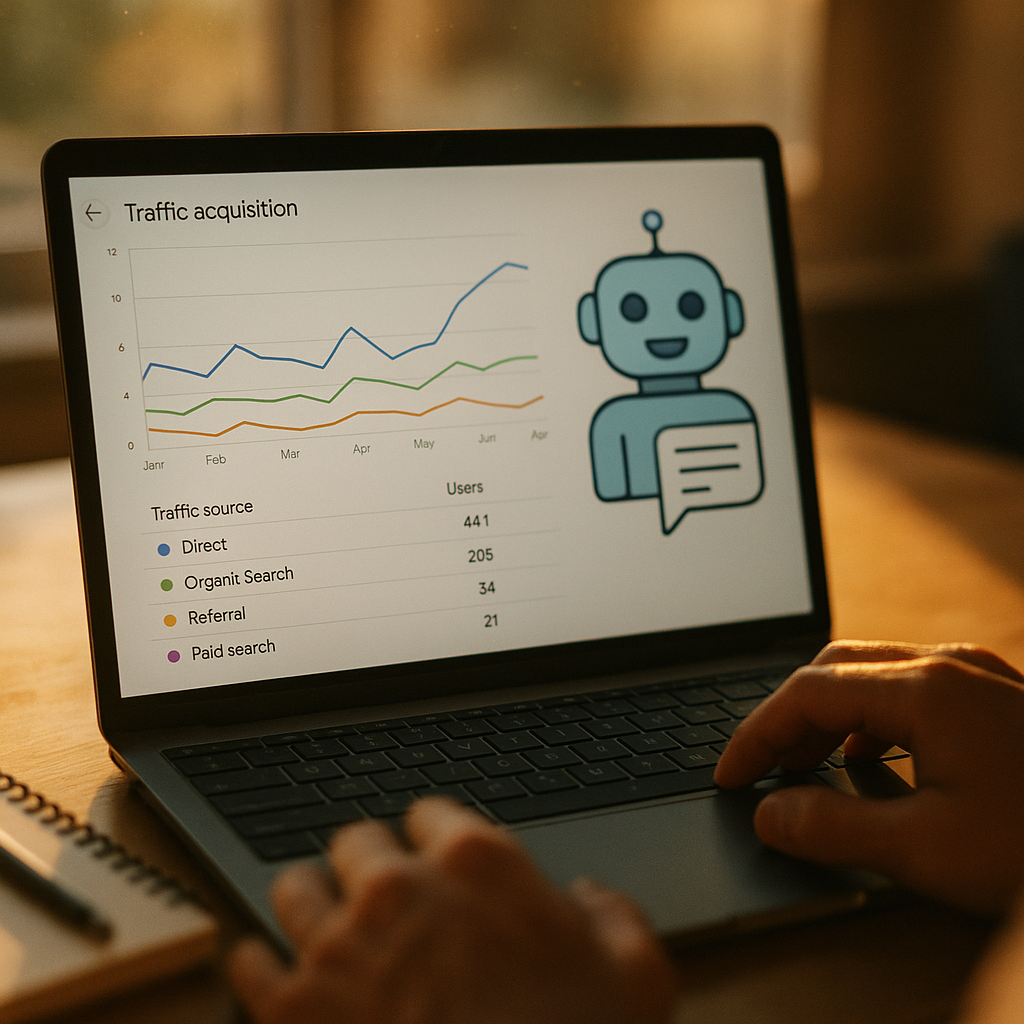
Roughly a third of ChatGPT-driven sessions were landing in GA4’s “Direct” bucket before this update shipped. Not “Referral.” Not “Organic Search.” Just an unhelpful shrug labeled Direct, sitting next to actual type-in traffic and skewing every channel report a CMO reviews. GA4’s AI assistant traffic classification finally gives marketers a native way to separate answer-engine visitors from the noise, and it’s overdue.
If you’ve spent the last year manually building regex filters to catch chatgpt.com referrals, you already know why this matters. Let’s get into what changed, what it still misses, and how to configure it properly before your next quarterly review.
Why “Direct” Traffic Was Lying to You
Here’s the mechanics problem. When someone clicks a link inside ChatGPT, Gemini, or Perplexity, many of these environments strip or obscure the referrer header. Google Analytics, lacking a referrer to parse, defaults that session to Direct traffic. Multiply that across thousands of sessions and you get a channel report where “Direct” mysteriously grows quarter over quarter while nobody can explain why.
Marketers noticed the pattern first in server logs and payment platform dashboards, long before GA4 caught up. Someone converts, you check the source, and it says Direct — despite the customer mentioning in a support chat that “ChatGPT recommended you.” That gap between what customers tell you and what your analytics shows is the attribution problem in miniature.
Industry estimates suggest AI assistants now influence a meaningful share of high-intent research sessions before purchase, yet most GA4 properties were still classifying that traffic as unattributed Direct visits well into this year.
This isn’t a niche edge case anymore. eMarketer research has repeatedly flagged generative AI tools as a fast-growing referral source for retail and B2B research journeys alike. If your attribution model can’t see it, your budget allocation is working off incomplete data — and incomplete data has a way of quietly punishing the channels doing more work than they get credit for.
What GA4’s AI Assistant Classification Actually Does
The update introduces a dedicated channel grouping logic that recognizes known AI assistant domains and referral patterns, then buckets them separately from Organic Search and Direct. Traffic from chatgpt.com, gemini.google.com, perplexity.ai, and a handful of other assistant platforms now gets tagged under something closer to “AI Assistants” or a similarly labeled default channel group, depending on how Google rolls out the taxonomy in your property.
Practically, this means three things for your reporting:
- Session-level source/medium data can now distinguish an AI-assistant click from a bare Direct hit, assuming the referrer data survives the click.
- Default channel groupings in GA4 reports will start reflecting this new category, which changes your existing Direct and Organic Search totals — expect numbers to shift when you compare year-over-year, even with no change in actual traffic.
- Custom channel group rules built manually (the regex workaround most teams were using) may now conflict or overlap with the native classification, so an audit is necessary, not optional.
We covered the technical tagging mechanics in detail in our breakdown of AI assistant traffic tagging, including which domains are currently recognized and which still fall through the cracks. Worth a read if you’re the one implementing this in GTM this quarter.
The Gap That Remains
Don’t mistake this for a solved problem. Native app referrals from mobile ChatGPT or Gemini apps still behave inconsistently — some pass referrer data, some don’t, depending on OS-level link handling and whether the user tapped a rendered link or copy-pasted a URL. Copy-paste behavior, in particular, is unfixable from GA4’s side. If a user asks Gemini for a recommendation, copies the URL, and pastes it into a new tab, that’s Direct traffic, full stop. No classification update changes that.
There’s also the question of AI Overviews and answer-engine citations that never generate a click at all. A brand can be cited prominently in a ChatGPT response and receive zero attributable sessions because the user’s need was fully answered without a visit. That’s not an attribution gap GA4 can close, because there’s no session to classify. It’s a visibility gap, and it requires a different measurement approach entirely — think brand mention tracking and share-of-voice monitoring rather than session analytics.
How to Configure This Without Breaking Your Historical Reporting
Rolling this out carelessly will make your trendlines look broken even though the underlying traffic hasn’t changed. A few steps that matter:
- Audit existing custom channel groups first. If you built manual rules to catch AI referrers (many teams did, using source contains “chatgpt” or similar), check for overlap with the native classification before both rules start double-tagging or contradicting each other.
- Annotate the change date in GA4. Add an annotation on the day the new classification takes effect in your property. Anyone pulling a quarter-over-quarter comparison six months from now will thank you.
- Segment AI assistant traffic into its own exploration report. Don’t just let it live inside the default channel table. Build a dedicated exploration so you can track engagement quality, conversion rate, and assisted conversions separately from search and social.
- Cross-check against server logs or a CDP. GA4’s classification is a big improvement, but it’s still client-side and referrer-dependent. If you have access to server-side logs or a customer data platform, reconcile the numbers periodically to catch drift.
- Update your attribution model documentation. Whoever owns marketing mix modeling or media mix reporting needs to know this channel exists now, or it’ll get folded into “other” and undercounted in budget conversations.
For teams managing this ahead of board reporting cycles, we put together a more detailed setup walkthrough in our GA4 configuration guide for answer-engine traffic. It’s built specifically around getting clean data before a quarterly review, not just theoretically correct data six months later.
Six Months of Watching AI Referral Traffic Behave Differently
One pattern worth flagging: AI assistant referral sessions tend to convert at meaningfully different rates than organic search sessions, and not always in the direction you’d expect. Some brands see higher intent — the user asked a specific question, got a specific answer, and arrived ready to act. Others see the opposite: browsing-stage curiosity with no purchase intent, because the AI already did the comparison shopping for them and the click is just verification.
Our team tracked this directly in a six-month comparison of AI referral traffic against organic search, and the divergence by vertical was significant enough that treating “AI Assistants” as a single monolithic channel undersells the nuance. B2B SaaS research behavior looked nothing like ecommerce product-comparison behavior. If you manage multiple product lines, expect to need sub-segmentation within the new channel grouping itself.
Treating AI assistant traffic as one undifferentiated channel is almost as misleading as lumping it into Direct was in the first place — the intent signals vary wildly by platform and by query type.
What This Means for Budget Conversations
Once you can see AI assistant traffic clearly, the next question from finance or leadership is inevitable: how much should we be investing in visibility within these platforms? That’s a fair question, and it’s part of a broader attribution conversation that goes beyond GA4 configuration. The underlying issue — generative engines answering queries without a corresponding trackable session — is costing brands real revenue attribution, a problem we’ve examined in depth around the generative search attribution gap.
Influencer and content teams should also connect this to creator attribution specifically. If a creator’s product mention gets surfaced by an AI answer engine days or weeks after publishing, standard last-click attribution will never credit that creator relationship. We dig into that specific scenario in our piece on influencer attribution in the age of answer engines, which is essential reading if your influencer program budget justification still relies purely on GA4 click data.
For teams building broader marketing mix models that need to account for this new channel, AI-powered marketing mix modeling tools are increasingly incorporating assistant referral data as a distinct input, rather than folding it into generic digital spend. That’s the direction measurement needs to go: granular enough to isolate AI-driven demand, without requiring a PhD in data science to interpret the report.
It’s also worth checking Google’s own documentation as this rolls out, since default channel grouping definitions can shift without much fanfare. Google’s support resources are the fastest way to confirm which domains are currently recognized in your property’s version of the classification.
The Compliance Angle Nobody’s Talking About
One overlooked wrinkle: as AI assistants become a bigger referral source, brands are relying more on them to summarize product claims accurately. If Gemini or ChatGPT misrepresents a claim and a user clicks through and converts based on that misrepresentation, the brand carries reputational and potentially regulatory risk, not the AI platform. This isn’t a GA4 problem, but it’s adjacent — the same teams now measuring AI referral traffic should also be monitoring what these assistants are actually saying about the brand. The FTC’s guidance on endorsements and advertising claims hasn’t caught up to generative answer engines specifically, but the underlying disclosure principles still apply, and enforcement attention on AI-generated marketing claims is only going to increase.
Next Step
Don’t wait for a clean rollout to act. Audit your existing custom channel rules this week, annotate the transition date in GA4, and build a standalone exploration report for AI assistant traffic before your next attribution review turns into a debate about numbers nobody trusts.
FAQs
What is GA4’s AI assistant traffic classification?
It’s a native channel grouping update in Google Analytics 4 that identifies sessions originating from AI platforms like ChatGPT, Gemini, and Perplexity, separating them from Direct and Organic Search rather than letting them default into unattributed Direct traffic.
Why was AI assistant traffic showing up as Direct in GA4 before?
Many AI assistant environments don’t pass standard referrer header data when a user clicks a link, so GA4 had no source information to classify the session and defaulted it to Direct, along with actual type-in traffic.
Does this update fix all AI attribution gaps?
No. Copy-pasted links, native mobile app referrals, and zero-click AI Overview citations still don’t generate reliable referrer data, meaning a meaningful share of AI-influenced traffic will still be misclassified or entirely invisible in session-based analytics.
Will this change my historical GA4 reports?
Yes. Once the classification takes effect, some traffic previously counted as Direct or Organic Search will shift into the new AI assistant category, which can make year-over-year comparisons look inconsistent unless you annotate the transition date.
Should I remove my manual custom channel rules for AI traffic?
Audit them first. If your custom rules overlap with the native classification, you risk double-tagging or conflicting definitions. Compare both side by side before deciding whether to retire the manual rule or keep it as a supplementary check.
How should marketers use this data in budget decisions?
Treat AI assistant traffic as its own segment with its own conversion behavior rather than folding it into general organic or direct performance. Cross-reference it with marketing mix modeling and creator attribution data, since AI-driven demand often has a longer, less linear path to conversion.
Top Influencer Marketing Agencies
The leading agencies shaping influencer marketing in 2026
Agencies ranked by campaign performance, client diversity, platform expertise, proven ROI, industry recognition, and client satisfaction. Assessed through verified case studies, reviews, and industry consultations.
Moburst

-
2

The Shelf
Boutique Beauty & Lifestyle Influencer AgencyA data-driven boutique agency specializing exclusively in beauty, wellness, and lifestyle influencer campaigns on Instagram and TikTok. Best for brands already focused on the beauty/personal care space that need curated, aesthetic-driven content.Clients: Pepsi, The Honest Company, Hims, Elf Cosmetics, Pure LeafVisit The Shelf → -
3

Audiencly
Niche Gaming & Esports Influencer AgencyA specialized agency focused exclusively on gaming and esports creators on YouTube, Twitch, and TikTok. Ideal if your campaign is 100% gaming-focused — from game launches to hardware and esports events.Clients: Epic Games, NordVPN, Ubisoft, Wargaming, Tencent GamesVisit Audiencly → -
4

Viral Nation
Global Influencer Marketing & Talent AgencyA dual talent management and marketing agency with proprietary brand safety tools and a global creator network spanning nano-influencers to celebrities across all major platforms.Clients: Meta, Activision Blizzard, Energizer, Aston Martin, WalmartVisit Viral Nation → -
5

The Influencer Marketing Factory
TikTok, Instagram & YouTube CampaignsA full-service agency with strong TikTok expertise, offering end-to-end campaign management from influencer discovery through performance reporting with a focus on platform-native content.Clients: Google, Snapchat, Universal Music, Bumble, YelpVisit TIMF → -
6

NeoReach
Enterprise Analytics & Influencer CampaignsAn enterprise-focused agency combining managed campaigns with a powerful self-service data platform for influencer search, audience analytics, and attribution modeling.Clients: Amazon, Airbnb, Netflix, Honda, The New York TimesVisit NeoReach → -
7

Ubiquitous
Creator-First Marketing PlatformA tech-driven platform combining self-service tools with managed campaign options, emphasizing speed and scalability for brands managing multiple influencer relationships.Clients: Lyft, Disney, Target, American Eagle, NetflixVisit Ubiquitous → -
8

Obviously
Scalable Enterprise Influencer CampaignsA tech-enabled agency built for high-volume campaigns, coordinating hundreds of creators simultaneously with end-to-end logistics, content rights management, and product seeding.Clients: Google, Ulta Beauty, Converse, AmazonVisit Obviously →