


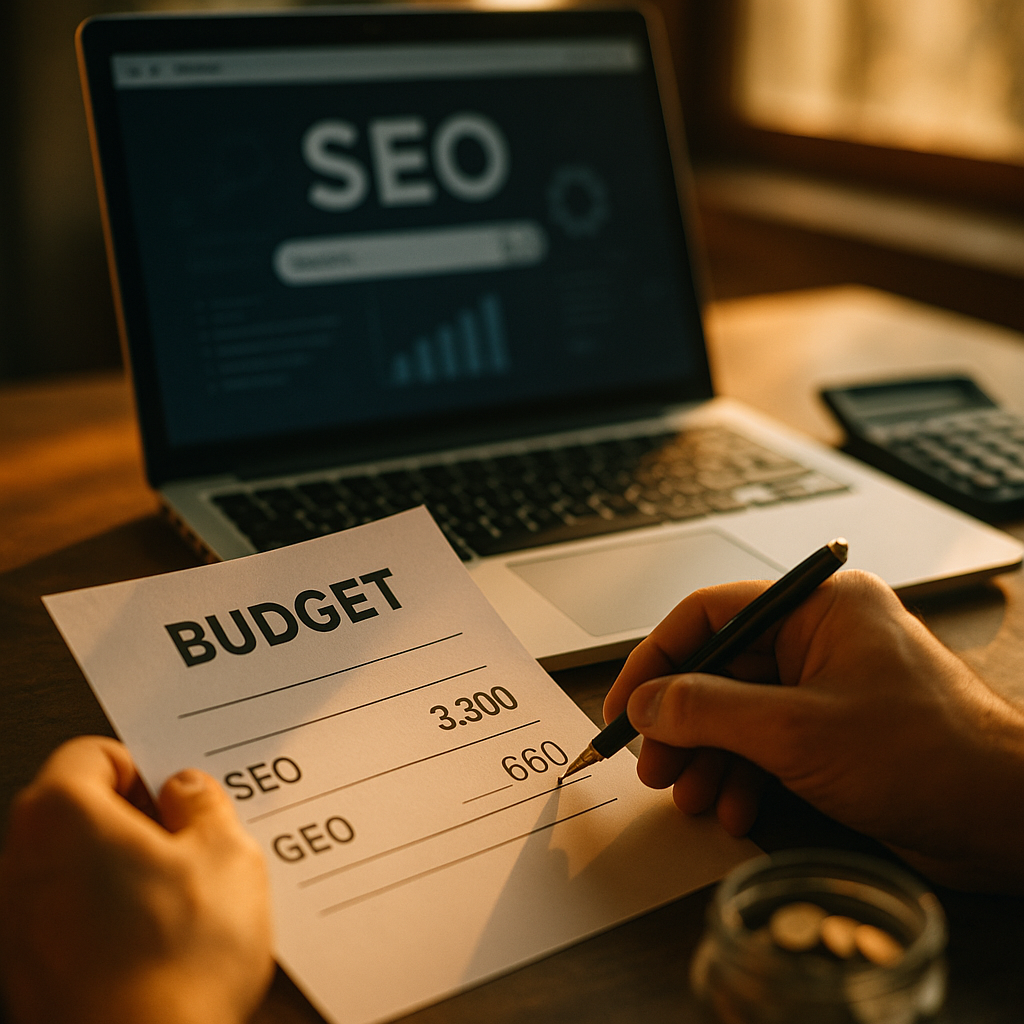
Nearly 60% of Google searches now end without a click, according to industry analyses of search behavior. If your marketing budget still treats zero-click search as an SEO line item, you’re funding a strategy built for a search engine that no longer exists.
Search hasn’t declined. It’s mutated. Answers now arrive inside AI Overviews, ChatGPT responses, and Perplexity summaries before a user ever sees a blue link. That shift has a name — Generative Engine Optimization, or GEO — and it’s exposing a budgeting problem most CMOs haven’t confronted yet.
The Traffic Is Gone, but the Demand Isn’t
Here’s the uncomfortable part: brands aren’t losing interest, they’re losing attribution. A user asks Google’s AI Overview “best skincare for rosacea” and gets a synthesized answer citing three brands. No click happens. No session shows up in GA4. But a decision just got made, and your brand was either in that answer or it wasn’t.
This is the core distinction separating GEO from SEO. SEO optimizes for ranking and click-through. GEO optimizes for citation inside a generated answer where there’s no click to measure at all. We covered this shift in depth in how zero-click search is redefining discovery, and the pattern has only accelerated since.
When nearly six in ten searches end without a click, “we’ll fold it into the SEO budget” stops being a cost-saving decision and starts being a visibility risk.
Marketers who still report success in organic sessions are measuring the wrong funnel. The new funnel starts with a prompt, not a query, and it ends with a citation, not a landing page visit.
Why GEO and SEO Aren’t the Same Discipline
SEO teams optimize titles, meta descriptions, backlinks, and Core Web Vitals. Good GEO practice cares about none of that directly. What matters instead:
- Structured, extractable content that LLMs can parse and quote cleanly
- Being cited as a source in training data or retrieval-augmented generation (RAG) pipelines
- Third-party validation — Reddit threads, review sites, and forums that AI models weight heavily
- Entity clarity: does the model understand who you are and what you’re an authority on?
These require different tooling, different KPIs, and frankly, different skill sets. A technical SEO who’s spent a decade chasing PageRank signals isn’t necessarily equipped to reverse-engineer why ChatGPT cites Healthline over your brand for a supplement query. That’s a research and content-authority problem, not a crawl-budget problem.
We’ve argued before that brands need to win citations, not clicks — and that requires reallocating effort, not just relabeling existing SEO tasks.
The Budget Conflation Problem
Most marketing orgs still run GEO experiments out of the existing SEO budget, treating it as a sub-line under “organic search.” That’s understandable — nobody wants to ask finance for a new category when the ROI story is still fuzzy. But it creates three specific problems.
First, resourcing gets deprioritized the moment SEO KPIs (rankings, sessions, backlinks) come under pressure, because GEO work doesn’t move those metrics and looks like a distraction. Second, GEO initiatives get evaluated with SEO-era tools — rank trackers, not citation trackers — so leadership can’t actually see whether the work is paying off. Third, and most damaging, agencies and internal teams end up doing GEO badly as an afterthought, tacking “AI-friendly formatting” onto existing content instead of building content architecture designed for retrieval from the ground up.
This mirrors a pattern we’ve seen elsewhere in the industry: budgets calcify around the last channel’s logic. It happened when influencer spend hit 25% of media mix and brands kept measuring it with TV-era metrics. It’s happening again with GEO trapped inside SEO reporting frameworks that weren’t built to see it.
What a Separate GEO Line Actually Buys You
Splitting the budget isn’t a bureaucratic exercise. It changes what gets measured, who gets hired, and what gets prioritized in planning meetings.
A dedicated GEO budget typically funds: citation-tracking tools (Profound, Athena, and similar platforms that monitor brand mentions across AI Overviews, ChatGPT, and Perplexity), structured data and schema investment beyond what SEO teams typically prioritize, content specifically engineered for extraction — FAQ blocks, comparison tables, definitional clarity — and outreach to third-party sites and communities that LLMs weight as trust signals.
None of that competes for the same dollars as link-building campaigns or technical SEO audits. It’s adjacent work, not redundant work. Keeping them in one bucket means one always cannibalizes the other when budgets tighten, and GEO — being newer and harder to prove — usually loses.
Treat GEO as a rounding error in the SEO budget, and it will behave like one: underfunded, unmeasured, and the first thing cut in a Q3 reforecast.
How Much Should Actually Move?
There’s no industry-standard split yet — this is genuinely new territory, and most reporting bodies including eMarketer are still building frameworks to quantify it. But directionally, brands running early pilots are testing 10-20% of the combined SEO/GEO budget on generative-engine-specific work, scaling based on category exposure.
Categories where zero-click behavior is most advanced — health, finance, software, travel — should skew higher. If your customers are asking ChatGPT “what’s the best project management tool for a 10-person team” instead of Googling it, and you’re not in that answer, you’re not losing a click. You’re losing the sale before the funnel even starts. This connects directly to the broader trend we’ve tracked in AI-mediated product discovery reshaping brand strategy, where the entire consideration phase now happens inside a chat interface.
Where the Overlap Still Matters
None of this means SEO and GEO should be run in silos with no communication. Technical foundations — site speed, crawlability, structured data — still matter for both. A page that Googlebot can’t parse won’t get cited by an LLM either, since many models still lean on search index data for retrieval.
The smart structure most brands are landing on: shared technical infrastructure, separate content and measurement budgets. One team keeps the lights on technically. Two distinct workstreams — one optimizing for ranked results, one optimizing for generative citation — report against different KPIs to different stakeholders, even if they sit in the same department.
This is similar to how brands eventually had to separate budget allocation by funnel stage across platforms rather than treating “social” as one undifferentiated bucket. The channels look adjacent. The mechanics are different enough to demand separate accounting.
The Measurement Gap Nobody’s Solved
Let’s be honest about the limitation here: GEO attribution is still messy. There’s no equivalent of Google Search Console for “how often did ChatGPT cite us.” Vendors are racing to fill that gap, but most brands are still cobbling together proxy signals: manual prompt testing, brand mention monitoring, and directional share-of-voice studies inside AI answers.
That measurement immaturity is exactly why a lot of finance teams resist a separate line item — how do you justify spend against a KPI you can’t cleanly report? The answer isn’t to wait for perfect measurement. It’s to start tracking directional signals now (citation frequency, sentiment in AI-generated answers, referral traffic from AI platforms where trackable) and refine as tooling matures. Brands that wait for a perfect dashboard will be several content cycles behind competitors who started testing now.
This mirrors the broader talent and measurement gap we’ve flagged in marketing analytics struggling to keep pace with AI — the tools and skills are lagging the shift in consumer behavior, and brands that invest early in building that muscle will have a real advantage once measurement standardizes.
Next Step
Stop asking your SEO team to “also handle AI search” as a favor. Carve out a specific GEO budget — even a modest pilot of 10% of organic spend — assign owned KPIs around citation frequency and AI-referral traffic, and revisit the split quarterly as measurement tools catch up to the behavior shift that’s already happened.
Frequently Asked Questions
What is GEO in marketing, and how is it different from SEO?
GEO (Generative Engine Optimization) is the practice of optimizing content to be cited or summarized inside AI-generated answers, such as Google AI Overviews, ChatGPT, or Perplexity. SEO optimizes for ranking in traditional search results and earning clicks; GEO optimizes for being quoted or referenced in a synthesized answer where no click may occur at all.
Why can’t GEO just be part of the existing SEO budget?
Because GEO competes with SEO for resources and gets deprioritized when SEO KPIs like rankings or sessions come under pressure. GEO also requires different tools (citation trackers instead of rank trackers), different content formats, and different success metrics, making it hard to manage well as an unfunded subtask.
How do you measure GEO performance if there’s no click to track?
Most brands currently rely on proxy signals: manual prompt testing to see if and how a brand is cited, brand-mention monitoring across AI platforms, sentiment analysis within generated answers, and referral traffic from AI tools where trackable. Dedicated citation-tracking platforms are emerging but the space lacks a mature, standardized measurement tool.
What percentage of budget should brands allocate to GEO?
There’s no fixed industry benchmark yet. Early adopters are testing roughly 10-20% of combined SEO/GEO budget on generative-engine-specific work, with higher allocations for categories like health, finance, and software where zero-click AI research behavior is most advanced.
Does technical SEO still matter if AI search is taking over?
Yes. Many AI models still rely on search engine indexes for retrieval, so site speed, crawlability, and structured data remain foundational. The split should happen at the content and measurement layer, not necessarily the technical infrastructure layer.
FAQs
Top Influencer Marketing Agencies
The leading agencies shaping influencer marketing in 2026
Agencies ranked by campaign performance, client diversity, platform expertise, proven ROI, industry recognition, and client satisfaction. Assessed through verified case studies, reviews, and industry consultations.
Moburst

-
2

The Shelf
Boutique Beauty & Lifestyle Influencer AgencyA data-driven boutique agency specializing exclusively in beauty, wellness, and lifestyle influencer campaigns on Instagram and TikTok. Best for brands already focused on the beauty/personal care space that need curated, aesthetic-driven content.Clients: Pepsi, The Honest Company, Hims, Elf Cosmetics, Pure LeafVisit The Shelf → -
3

Audiencly
Niche Gaming & Esports Influencer AgencyA specialized agency focused exclusively on gaming and esports creators on YouTube, Twitch, and TikTok. Ideal if your campaign is 100% gaming-focused — from game launches to hardware and esports events.Clients: Epic Games, NordVPN, Ubisoft, Wargaming, Tencent GamesVisit Audiencly → -
4

Viral Nation
Global Influencer Marketing & Talent AgencyA dual talent management and marketing agency with proprietary brand safety tools and a global creator network spanning nano-influencers to celebrities across all major platforms.Clients: Meta, Activision Blizzard, Energizer, Aston Martin, WalmartVisit Viral Nation → -
5

The Influencer Marketing Factory
TikTok, Instagram & YouTube CampaignsA full-service agency with strong TikTok expertise, offering end-to-end campaign management from influencer discovery through performance reporting with a focus on platform-native content.Clients: Google, Snapchat, Universal Music, Bumble, YelpVisit TIMF → -
6

NeoReach
Enterprise Analytics & Influencer CampaignsAn enterprise-focused agency combining managed campaigns with a powerful self-service data platform for influencer search, audience analytics, and attribution modeling.Clients: Amazon, Airbnb, Netflix, Honda, The New York TimesVisit NeoReach → -
7

Ubiquitous
Creator-First Marketing PlatformA tech-driven platform combining self-service tools with managed campaign options, emphasizing speed and scalability for brands managing multiple influencer relationships.Clients: Lyft, Disney, Target, American Eagle, NetflixVisit Ubiquitous → -
8

Obviously
Scalable Enterprise Influencer CampaignsA tech-enabled agency built for high-volume campaigns, coordinating hundreds of creators simultaneously with end-to-end logistics, content rights management, and product seeding.Clients: Google, Ulta Beauty, Converse, AmazonVisit Obviously →