


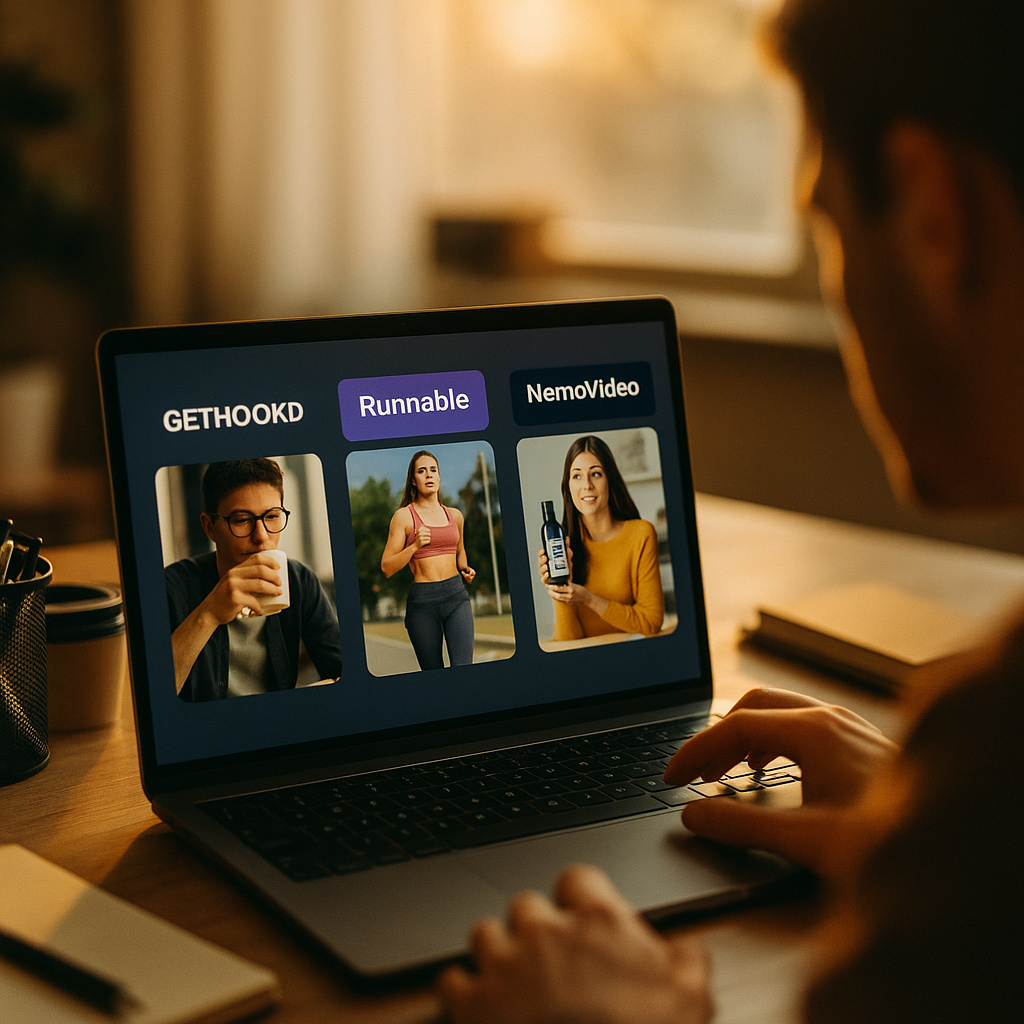
Small-business marketing teams now spend an average of 15-20% of their production budget testing AI ad tools that never make it past the trial phase. That’s the real cost of choosing wrong. If you’re evaluating an AI ad generator for the first time, the GetHookd vs Runable vs NemoVideo decision isn’t just about features — it’s about which tool actually fits how your team ships creative.
This guide breaks down all three platforms for marketers who don’t have an in-house production team, a six-figure ad budget, or patience for another failed pilot.
Why This Comparison Matters Now
AI-generated video ads stopped being a novelty around the time TikTok and Meta both rolled out native generative tools into their ad managers. Small businesses got squeezed. Agencies with custom AI stacks pulled ahead on speed, while everyone else kept paying freelancers $800 per video and waiting a week for revisions.
GetHookd, Runable, and NemoVideo emerged to close that gap. Each promises the same core outcome — turn a product image or a script into a scroll-stopping ad in minutes. But “minutes” means different things depending on the tool, and the output quality varies enough to matter for your conversion rates.
The real differentiator isn’t generation speed anymore — every tool in this category claims sub-five-minute output. The differentiator is how much manual cleanup your team does before an ad is publish-ready.
GetHookd: Built for Speed, Not Nuance
GetHookd positions itself as the fastest path from product photo to finished ad. It leans heavily on templated hooks — the first three seconds are algorithmically optimized based on a library of high-performing patterns pulled from TikTok and Reels data.
For small ecommerce brands running high volume, low-complexity campaigns, this works well. Feed it a product shot, pick a hook style, and you get a usable ad in under three minutes. We’ve covered how GetHookd’s copywriting compares to human copywriters in a separate test, and the short version: it’s competitive on direct-response copy but weaker on brand voice consistency across a campaign set.
The tradeoff? Customization is shallow. If your brand has a distinct tone or you’re running anything beyond straightforward DTC product ads, you’ll find yourself fighting the templates rather than using them.
- Best for: DTC brands running high-volume paid social with fast creative refresh cycles
- Weak spot: Limited brand voice controls, thin analytics on ad performance feedback loops
- Pricing model: Credit-based, scales with output volume rather than seats
Where GetHookd Falls Short for Service Businesses
If you sell a service — consulting, SaaS, local trades — GetHookd’s product-first design shows its seams. The tool assumes a physical product with a clean background shot. Service businesses end up forcing stock footage into templates built for sneakers and skincare. It’s not impossible, just clunky.
Runable: The Workflow-First Option
Runable takes a different approach entirely. Instead of optimizing for single-ad speed, it’s built around campaign workflows — brief in, multiple ad variants out, with built-in approval chains for teams that need sign-off before anything goes live.
This matters more than it sounds. Small marketing teams often operate without a dedicated creative director, which means ads go out without a second set of eyes. Runable’s approval layer forces a review step, which reduces the risk of a tone-deaf or non-compliant ad slipping through. Given how the FTC continues to tighten disclosure and claims enforcement, that extra checkpoint is worth more than it seems on a feature list.
Runable also integrates with common project management tools, which shortens the handoff between marketing and whoever owns the ad account. That’s a meaningful efficiency gain if you’re a team of two or three wearing multiple hats.
Teams without a dedicated creative reviewer are the ones most likely to publish a legally risky or off-brand ad. A workflow tool with built-in approval steps isn’t a nice-to-have — it’s a guardrail.
The downside: Runable is slower per-asset than GetHookd. You’re trading raw speed for process. For a solo marketer just trying to get one good ad out the door today, that overhead can feel unnecessary.
Runable’s Pricing Reality
Runable charges per seat plus a usage tier, which makes it cost-effective for small teams (3-8 people) but expensive if you’re a solo operator generating a handful of ads per month. Compare that against your current cost-per-ad from freelancers before committing — for very low volume, freelance still might win on cost, even if it loses on speed.
NemoVideo: The Editing-Heavy Middle Ground
NemoVideo splits the difference between the two above. It generates a strong first draft, similar to GetHookd, but gives you a fuller editing suite — timeline controls, layered text, voiceover swaps — so you can push a generated ad closer to a polished, on-brand asset without starting from scratch.
This makes NemoVideo the pick for marketers who want AI to handle the heavy lifting but still expect to put a real editing pass on every ad before it ships. It’s also the strongest of the three for repurposing long-form content into short-form ad cuts, which matters if your brand already has a library of webinars, demos, or customer testimonials sitting unused.
NemoVideo’s UI has a steeper learning curve than GetHookd’s, and it’s noticeably slower to render finished exports at scale. If you’re running dozens of ad variants a week for split testing, that render time adds up.
- Best for: Teams repurposing existing video assets, brands with strict visual identity guidelines
- Weak spot: Render speed at scale, higher learning curve for non-editors
- Pricing model: Tiered subscription based on export resolution and volume
How to Actually Choose Between Them
Stop asking “which tool is best.” Ask which tool matches your bottleneck. Every small business marketing team has one constraint that’s actually limiting output — speed, brand consistency, or approval risk. Pick the tool that solves your specific constraint.
Run a two-week pilot before committing to an annual plan. Generate the same brief across all three tools, run the resulting ads through a small test budget on TikTok Ads Manager or Meta Business Suite, and compare cost-per-result rather than trusting the demo. Vendor demos are optimized to impress, not to reflect your actual product category or audience.
It’s also worth checking how each tool’s output performs against organic-style formats. Data compiled by eMarketer continues to show that ads mimicking native, unpolished creator content outperform overtly produced ads on conversion — a trend our own reporting confirms in how tutorial-style videos beat static product pages and in how discovery-first demo formats drive conversion. If a tool’s output looks too polished, it might actually underperform scrappier alternatives.
A Quick Scoring Framework
Score each tool 1-5 on these four criteria based on your pilot results:
- Time-to-publish: How long from brief to a ready-to-run ad?
- Brand fidelity: Does it need heavy editing to sound like you?
- Compliance risk: Does the workflow include a review step before publishing?
- Cost per usable ad: Total spend divided by ads you actually shipped, not ads generated.
Add the scores. The highest total wins your budget, not the tool with the flashiest demo reel. This same evaluation logic applies broadly to AI marketing tools — our scoring framework for AI campaign agents covers a version of this that’s worth cross-referencing if you’re evaluating more than just ad generators this quarter.
One more thing nobody tells you upfront: none of these tools eliminate the need for human review. Treat all three as draft generators, not final-mile producers. Marketers who skip the human check tend to be the ones dealing with brand safety issues six months later, long after the AI vendor’s demo has been forgotten.
What This Means for Your Budget Next Quarter
If you’re a lean team prioritizing volume, start with GetHookd and layer in a manual QA step. If your bottleneck is process and risk — multiple stakeholders, brand guidelines, legal review — Runable’s workflow structure earns its higher cost. And if you’ve got a backlog of existing video content sitting idle, NemoVideo will get more mileage out of assets you’ve already paid for.
Run the two-week pilot, score it against real ad spend data, and commit only after you’ve seen cost-per-result — not cost-per-generation.
FAQs
Which AI ad generator is cheapest for a small business just starting out?
GetHookd’s credit-based pricing tends to be the lowest entry cost for teams generating a small number of ads per month, since you’re not paying for seats or workflow features you won’t use yet.
Can these tools replace a freelance video editor entirely?
Not reliably. All three are strongest as draft generators. Most small business marketers still run a light human edit pass before publishing, especially for brand voice and compliance checks.
Do AI-generated ads perform as well as human-made ads on conversion?
Performance depends more on format than production method. Ads that mimic native, unpolished content tend to outperform highly produced ones regardless of whether AI or a human made them.
How long should a pilot test run before committing to a subscription?
Two weeks is typically enough to generate a meaningful sample of ads, run a small test budget, and compare cost-per-result across tools before locking into an annual contract.
Is there compliance risk in using AI ad generators?
Yes. Without a human review step, AI-generated ads can slip past disclosure or claims requirements. Tools with built-in approval workflows, like Runable, reduce that risk but don’t eliminate the need for legal review on regulated categories.
FAQs
Top Influencer Marketing Agencies
The leading agencies shaping influencer marketing in 2026
Agencies ranked by campaign performance, client diversity, platform expertise, proven ROI, industry recognition, and client satisfaction. Assessed through verified case studies, reviews, and industry consultations.
Moburst

-
2

The Shelf
Boutique Beauty & Lifestyle Influencer AgencyA data-driven boutique agency specializing exclusively in beauty, wellness, and lifestyle influencer campaigns on Instagram and TikTok. Best for brands already focused on the beauty/personal care space that need curated, aesthetic-driven content.Clients: Pepsi, The Honest Company, Hims, Elf Cosmetics, Pure LeafVisit The Shelf → -
3

Audiencly
Niche Gaming & Esports Influencer AgencyA specialized agency focused exclusively on gaming and esports creators on YouTube, Twitch, and TikTok. Ideal if your campaign is 100% gaming-focused — from game launches to hardware and esports events.Clients: Epic Games, NordVPN, Ubisoft, Wargaming, Tencent GamesVisit Audiencly → -
4

Viral Nation
Global Influencer Marketing & Talent AgencyA dual talent management and marketing agency with proprietary brand safety tools and a global creator network spanning nano-influencers to celebrities across all major platforms.Clients: Meta, Activision Blizzard, Energizer, Aston Martin, WalmartVisit Viral Nation → -
5

The Influencer Marketing Factory
TikTok, Instagram & YouTube CampaignsA full-service agency with strong TikTok expertise, offering end-to-end campaign management from influencer discovery through performance reporting with a focus on platform-native content.Clients: Google, Snapchat, Universal Music, Bumble, YelpVisit TIMF → -
6

NeoReach
Enterprise Analytics & Influencer CampaignsAn enterprise-focused agency combining managed campaigns with a powerful self-service data platform for influencer search, audience analytics, and attribution modeling.Clients: Amazon, Airbnb, Netflix, Honda, The New York TimesVisit NeoReach → -
7

Ubiquitous
Creator-First Marketing PlatformA tech-driven platform combining self-service tools with managed campaign options, emphasizing speed and scalability for brands managing multiple influencer relationships.Clients: Lyft, Disney, Target, American Eagle, NetflixVisit Ubiquitous → -
8

Obviously
Scalable Enterprise Influencer CampaignsA tech-enabled agency built for high-volume campaigns, coordinating hundreds of creators simultaneously with end-to-end logistics, content rights management, and product seeding.Clients: Google, Ulta Beauty, Converse, AmazonVisit Obviously →