


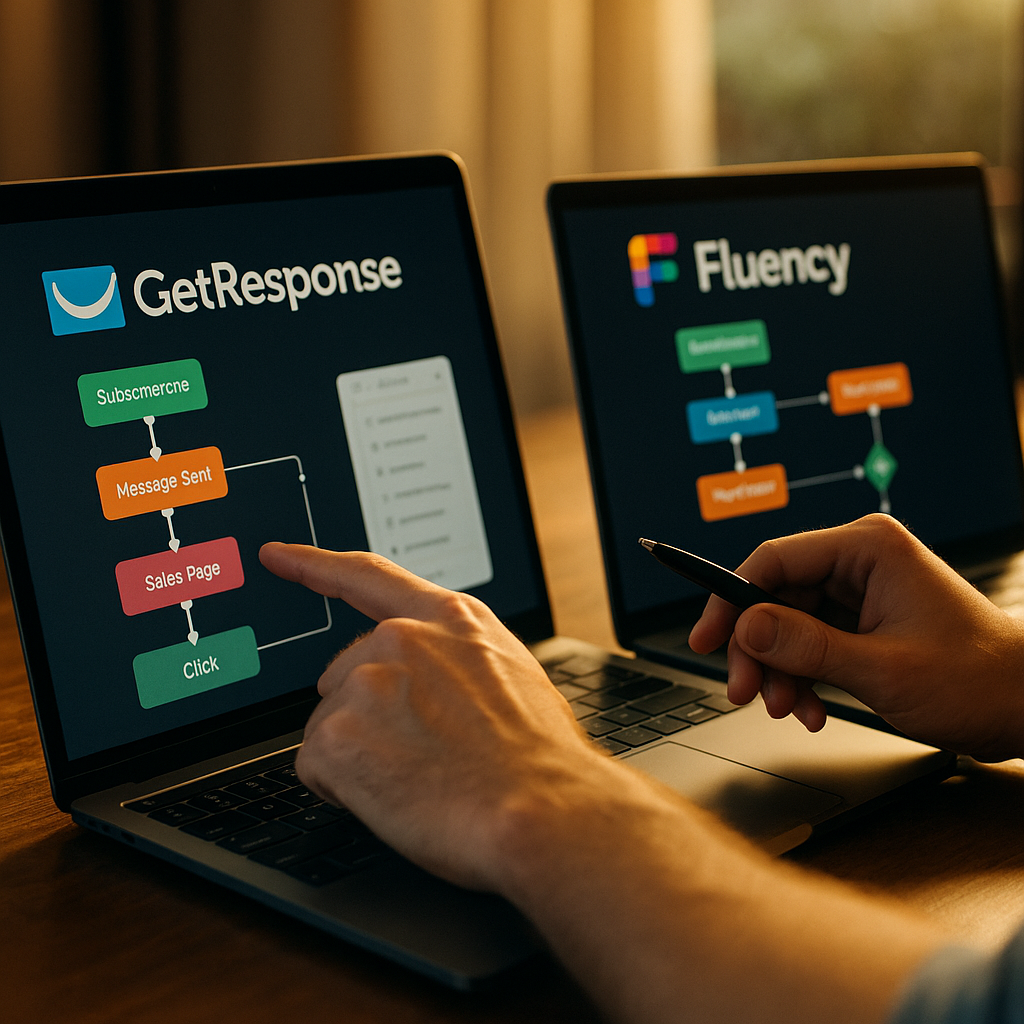
Gartner predicts that by the end of the year, most net-new marketing automation deployments will include some form of agentic decisioning. Yet a huge share of brand teams still can’t articulate what “agentic” actually means for their workflows. If you’re weighing GetResponse vs Fluency as your first step into autonomous campaign management, you’re not choosing a feature set. You’re choosing an operating philosophy.
This comparison isn’t about which tool has more buttons. It’s about which one matches how your team actually works, and where the guardrails sit when an AI agent starts making live budget or send decisions on its own.
Why “Agentic” Is the Wrong First Question
Every vendor now slaps “agentic” on their pitch deck. Before comparing GetResponse and Fluency feature-by-feature, ask a sharper question: how much decision-making authority are you comfortable handing to software, and at what dollar threshold?
GetResponse started life as an email and marketing automation platform for SMBs and mid-market e-commerce brands. Its agentic layer, rolled out as an AI-assisted campaign builder, sits on top of a mature marketing suite: email, landing pages, webinars, basic CRM. Fluency, by contrast, was built agent-first. It’s designed around autonomous multi-channel execution, meaning the AI doesn’t just suggest a subject line, it can plan, launch, and adjust campaigns across paid and owned channels with minimal human sign-off.
That distinction matters more than any pricing tier. One platform bolted agentic capability onto existing infrastructure. The other built infrastructure around the agent. Neither approach is wrong, but they produce very different day-to-day realities for your team.
The real decision isn’t “which platform is smarter.” It’s “how much autonomy does my compliance and brand-risk tolerance actually allow?”
What Each Platform Actually Automates
GetResponse’s agentic features focus narrowly: subject line generation, send-time optimization, basic audience segmentation, and increasingly, autonomous A/B test resolution where the system picks a winner without waiting for a human to eyeball results. It’s useful, but it’s task automation with AI polish, not true multi-step planning.
Fluency operates differently. Its agents can take a campaign brief, generate creative variants, allocate budget across channels, and rebalance spend in near real time based on performance signals. Think of it less like a marketing assistant and more like a junior media buyer who never sleeps and never asks for a raise. That’s powerful. It’s also the part that keeps compliance and finance teams up at night, because the agent is making spend decisions, not just content decisions.
- GetResponse: AI-assisted content and send optimization inside a traditional automation workflow builder.
- Fluency: Autonomous campaign orchestration across paid social, search, and owned channels, with human-in-the-loop checkpoints you configure yourself.
If your primary use case is nurturing an email list and running the occasional webinar funnel, GetResponse’s lighter-touch automation is probably sufficient. If you’re managing paid media budgets across five platforms and drowning in manual reallocation work, Fluency’s model starts to look like the only sane option.
Setup Time and the Hidden Onboarding Tax
Nobody talks enough about onboarding friction when evaluating agentic tools, and it’s often where projected ROI quietly evaporates.
GetResponse is fast to stand up. Most teams are sending campaigns within a day, because the underlying UX hasn’t changed much from its pre-AI days. The agentic features layer in gradually as you use the platform, so there’s no steep learning curve, just incremental capability unlocks.
Fluency’s onboarding is heavier. You’re not just configuring email templates, you’re defining decision boundaries: budget caps, channel permissions, escalation triggers, brand voice constraints. Expect two to four weeks of setup for a mid-market team, longer if legal wants to review every autonomous-action pathway (they should). This mirrors what we’ve seen across the broader shift toward testing agentic AI claims before you buy — vendors oversell the “plug and play” narrative, and the real work happens in defining guardrails, not flipping a switch.
That upfront investment isn’t wasted, though. Teams that skip it tend to regret it the first time an agent overspends on a campaign at 2 a.m. because nobody set a daily cap.
Pricing Reality: What You’re Actually Paying For
GetResponse’s pricing is transparent and tiered by contact volume, starting affordably for small lists and scaling predictably. There’s no separate “agentic module” fee, the AI features come bundled into mid and upper tiers. For budget-conscious teams, this predictability is a real advantage.
Fluency prices more like an enterprise media platform: often a base platform fee plus a percentage tied to managed ad spend or a seat-based enterprise contract. That model aligns incentive with outcome in theory, but it also means costs scale with your ambition, not just your headcount. Budget for a quarterly review of whether the automation is actually reducing your media-buying labor costs enough to justify the fee.
Here’s the uncomfortable truth: a lot of brands buy the flashier agentic platform, then use ten percent of its autonomous capability because nobody trusts it enough to let it run unsupervised. If that’s going to be you, you’re paying enterprise prices for glorified scheduling.
Risk, Governance, and Who Gets Blamed When the Agent Is Wrong
This is the section brand and legal teams should read twice.
Autonomous agents that adjust ad spend or send communications without a human checkpoint introduce a new category of operational risk. Regulators are paying attention. The FTC has signaled increased scrutiny of automated decision-making that affects consumers, and in the UK, the ICO has published guidance specifically on accountability for AI-driven marketing decisions. If your agent sends a discriminatory offer variant or blows through a compliance boundary, “the AI did it” is not a defense that holds up.
GetResponse’s more limited scope of autonomy is, frankly, lower-risk by design. It’s not making high-stakes spend decisions, so the blast radius of an error is smaller: a poorly optimized subject line, not a six-figure ad overspend.
Fluency’s greater power demands proportionally greater governance discipline. You need documented escalation rules, budget ceilings, and regular audits of agent decisions. This is the same governance conversation playing out across generative CMS platforms, where award-winning automation has exposed real governance gaps. Autonomy without oversight isn’t innovation, it’s exposure dressed up as efficiency.
If you can’t explain, in one sentence, who is accountable when the agent makes a bad call, you’re not ready to give it that authority.
Which Teams Fit Which Platform
Let’s get concrete, because abstract comparisons don’t help anyone sign a contract.
Choose GetResponse if: you’re primarily email and content-marketing led, you have a lean team without a dedicated media-buying function, and you want AI assistance that speeds up execution without handing over strategic control. E-commerce brands running lifecycle email and the occasional promo campaign fit this profile well.
Choose Fluency if: you’re managing significant paid media spend across multiple channels, you have (or are building) the governance infrastructure to supervise autonomous decisions, and your team’s bottleneck is genuinely execution speed, not strategic clarity. Agencies managing multiple client accounts often see the strongest ROI here, since the labor savings compound across accounts.
There’s also a hybrid path worth considering: many brands run GetResponse for owned-channel nurture while piloting Fluency on a single paid channel with a hard budget cap, essentially A/B testing autonomy itself before going all-in. That staged approach echoes the broader lesson from how interoperability standards are reshaping vendor selection — nobody should bet the whole stack on one agent’s judgment in year one.
What the Data Says About Adoption Speed
According to eMarketer, marketers cite trust and explainability, not cost, as the top barrier to expanding AI autonomy in campaign management. That tracks with what we’re hearing from brand-side sources: the technology is ready before the organization is. HubSpot’s own research on AI adoption in marketing teams shows a similar pattern, usage of AI suggestions is high, but delegation of full decision authority lags well behind.
Translate that into your GetResponse vs Fluency decision: if your organization hasn’t built trust in AI outputs yet, jumping straight to a highly autonomous platform like Fluency risks a stalled rollout where nobody actually lets the agent run. Sometimes the more conservative tool is the more strategic first move, precisely because it builds internal confidence before you scale autonomy.
The Practical Next Step
Run a 30-day pilot on one campaign type with each platform’s AI features fully enabled, then compare not just performance lift but how much manual override your team needed. The platform requiring the least babysitting to hit its promised outcomes is your real answer, regardless of which logo looks better on the vendor slide.
FAQs
Is GetResponse a true agentic marketing platform?
GetResponse offers AI-assisted automation, like send-time optimization and content generation, but its autonomy is narrower than platforms built agent-first. It’s better described as AI-augmented rather than fully agentic.
What makes Fluency different from traditional marketing automation tools?
Fluency’s agents can plan and execute multi-step campaigns across channels, including budget reallocation, with minimal human intervention. Traditional tools like GetResponse typically require a human to approve or trigger each major action.
Which platform is better for a brand’s first agentic tool?
It depends on your risk tolerance and use case. GetResponse suits teams starting with lower-stakes automation like email; Fluency suits teams ready to hand over paid media execution with proper governance in place.
Do agentic marketing platforms create compliance risk?
Yes. Autonomous decision-making in advertising and communications can trigger regulatory scrutiny around consumer protection and discrimination. Brands should establish documented escalation rules and audit trails before granting full autonomy.
How much does Fluency typically cost compared to GetResponse?
GetResponse uses transparent, contact-based tiered pricing suitable for smaller budgets. Fluency generally follows an enterprise model with fees tied to managed spend or seats, making it more expensive but potentially justified for teams managing large paid media budgets.
FAQs
Is GetResponse a true agentic marketing platform?
GetResponse offers AI-assisted automation, like send-time optimization and content generation, but its autonomy is narrower than platforms built agent-first. It’s better described as AI-augmented rather than fully agentic.
What makes Fluency different from traditional marketing automation tools?
Fluency’s agents can plan and execute multi-step campaigns across channels, including budget reallocation, with minimal human intervention. Traditional tools like GetResponse typically require a human to approve or trigger each major action.
Which platform is better for a brand’s first agentic tool?
It depends on your risk tolerance and use case. GetResponse suits teams starting with lower-stakes automation like email; Fluency suits teams ready to hand over paid media execution with proper governance in place.
Do agentic marketing platforms create compliance risk?
Yes. Autonomous decision-making in advertising and communications can trigger regulatory scrutiny around consumer protection and discrimination. Brands should establish documented escalation rules and audit trails before granting full autonomy.
How much does Fluency typically cost compared to GetResponse?
GetResponse uses transparent, contact-based tiered pricing suitable for smaller budgets. Fluency generally follows an enterprise model with fees tied to managed spend or seats, making it more expensive but potentially justified for teams managing large paid media budgets.
Top Influencer Marketing Agencies
The leading agencies shaping influencer marketing in 2026
Agencies ranked by campaign performance, client diversity, platform expertise, proven ROI, industry recognition, and client satisfaction. Assessed through verified case studies, reviews, and industry consultations.
Moburst

-
2

The Shelf
Boutique Beauty & Lifestyle Influencer AgencyA data-driven boutique agency specializing exclusively in beauty, wellness, and lifestyle influencer campaigns on Instagram and TikTok. Best for brands already focused on the beauty/personal care space that need curated, aesthetic-driven content.Clients: Pepsi, The Honest Company, Hims, Elf Cosmetics, Pure LeafVisit The Shelf → -
3

Audiencly
Niche Gaming & Esports Influencer AgencyA specialized agency focused exclusively on gaming and esports creators on YouTube, Twitch, and TikTok. Ideal if your campaign is 100% gaming-focused — from game launches to hardware and esports events.Clients: Epic Games, NordVPN, Ubisoft, Wargaming, Tencent GamesVisit Audiencly → -
4

Viral Nation
Global Influencer Marketing & Talent AgencyA dual talent management and marketing agency with proprietary brand safety tools and a global creator network spanning nano-influencers to celebrities across all major platforms.Clients: Meta, Activision Blizzard, Energizer, Aston Martin, WalmartVisit Viral Nation → -
5

The Influencer Marketing Factory
TikTok, Instagram & YouTube CampaignsA full-service agency with strong TikTok expertise, offering end-to-end campaign management from influencer discovery through performance reporting with a focus on platform-native content.Clients: Google, Snapchat, Universal Music, Bumble, YelpVisit TIMF → -
6

NeoReach
Enterprise Analytics & Influencer CampaignsAn enterprise-focused agency combining managed campaigns with a powerful self-service data platform for influencer search, audience analytics, and attribution modeling.Clients: Amazon, Airbnb, Netflix, Honda, The New York TimesVisit NeoReach → -
7

Ubiquitous
Creator-First Marketing PlatformA tech-driven platform combining self-service tools with managed campaign options, emphasizing speed and scalability for brands managing multiple influencer relationships.Clients: Lyft, Disney, Target, American Eagle, NetflixVisit Ubiquitous → -
8

Obviously
Scalable Enterprise Influencer CampaignsA tech-enabled agency built for high-volume campaigns, coordinating hundreds of creators simultaneously with end-to-end logistics, content rights management, and product seeding.Clients: Google, Ulta Beauty, Converse, AmazonVisit Obviously →