


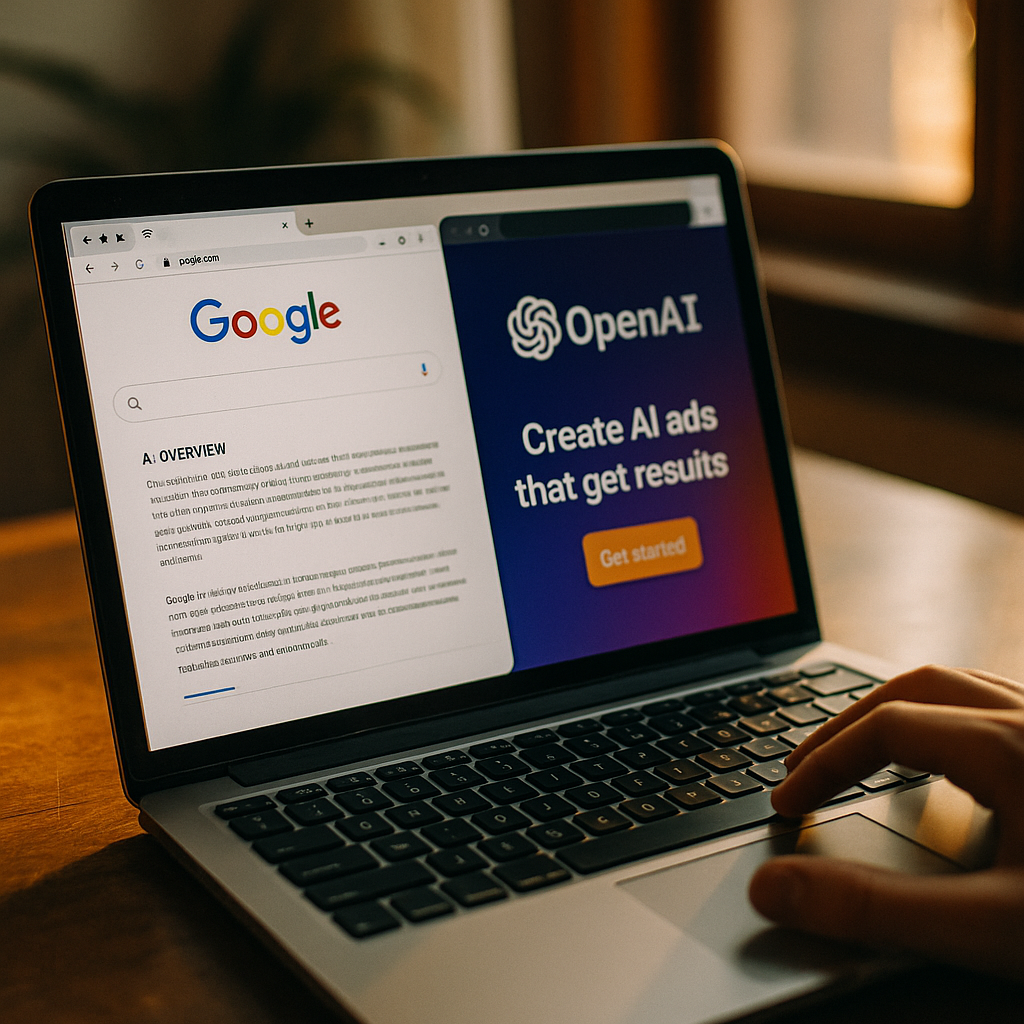
Google’s AI Overviews now appear in roughly one in five searches, and OpenAI just started testing ads inside ChatGPT answers. Two systems, two citation logics, one content budget. If your team is still optimizing for a single “AI search” playbook, you’re leaving visibility on the table in whichever system you didn’t build for.
That’s the uncomfortable truth facing brand strategists right now. AI Overviews pulls from Google’s index and leans hard on established E-E-A-T signals, structured data, and page-level authority. OpenAI’s ad answers, by contrast, are shaping up to reward something closer to conversational relevance and real-time commercial intent. Treating them as interchangeable is how brands end up cited in one and invisible in the other.
Two Systems, Two Sets of Rules
Start with what’s actually different. AI Overviews is fundamentally a search-index product. Google crawls, ranks, and then summarizes, pulling citations from pages that already rank reasonably well organically. A 2024 Google statement confirmed AI Overviews draws from the same web index that powers traditional search, which means your existing SEO equity still matters. 97% of supplement sites are already showing up in AI Overviews, largely because that category has spent a decade building topical authority and schema-rich product pages.
OpenAI’s ad answers work differently. They’re not summarizing an index in the traditional sense — they’re generating a response and then slotting in commercial content based on relevance signals that look more like intent-matching than backlink authority. Early tests suggest OpenAI is weighing recency, direct answer clarity, and structured product data (think schema markup and merchant feeds) over the kind of domain authority Google has trained marketers to chase for twenty years.
A page that ranks on page one of Google organic search has no guaranteed advantage inside OpenAI’s ad-supported answers — the citation logic simply isn’t the same game.
Why This Matters for Budget Allocation
Marketers love a single dashboard. One CMS, one SEO strategy, one AI visibility score. But if AI Overviews and OpenAI’s system pull from different signal sets, a single-strategy approach guarantees you’re underperforming in at least one channel.
Consider the split most teams are already wrestling with in how they divide AI search budget between generative engine optimization and answer engine optimization. That framework applies here too, but with a sharper edge: Google’s system rewards depth and accumulated trust signals, while OpenAI’s ad answers seem to reward structured clarity and fresh, well-tagged commercial data. Spend your entire content budget shoring up domain authority, and you might win Google’s citation game while OpenAI’s ad answers route around you entirely because your product data isn’t structured for machine parsing.
This isn’t hypothetical. Brands running paid search alongside organic content teams are already reporting citation mismatches — showing up prominently in AI Overviews for a query, then discovering ChatGPT’s answer cites a competitor with a fraction of the domain authority but far cleaner structured data. eMarketer’s research on AI-driven search behavior suggests this fragmentation is accelerating as more platforms introduce their own answer layers.
What Actually Drives Citations in Each System
Let’s get specific, because vague advice about “quality content” helps nobody making a Q3 budget decision.
For AI Overviews, the signals that correlate with citation inclusion look familiar: original data or research, clear author bylines with demonstrated expertise, schema markup (FAQPage, HowTo, Product), and pages that already rank in the top ten organically. Google’s own Search documentation continues to emphasize helpful, people-first content as the baseline requirement — AI Overviews doesn’t override that, it amplifies it.
For OpenAI’s ad-supported answers, the emerging pattern is different. Early advertiser feedback points to:
- Structured product feeds (similar to what powers Google Shopping) that OpenAI can parse without ambiguity
- Direct, unambiguous answers to specific questions rather than long-form exploratory content
- Recency signals — content updated within the last few months seems to outperform older, more authoritative pages
- Clear commercial intent matching, where the page’s stated purpose aligns tightly with the query’s likely intent
The overlap exists, but it’s thinner than most teams assume. Both systems reward clarity and structured data. Neither rewards keyword stuffing or thin content built purely for crawlers. But the weighting is different enough that a page optimized purely for one will underperform in the other.
Building the Dual-System Content Framework
So what does a content strategy that actually wins in both look like? Not two separate content teams, mercifully. It’s more about layering signals into the same content so both systems can extract what they need.
Start with the foundation every AI system respects: genuine expertise and clear sourcing. This is the E-E-A-T backbone Google has pushed for years, and it hasn’t gotten less important just because OpenAI entered the picture. Author credentials, original research, and transparent methodology still matter — arguably more, since both systems are trying to filter out synthetic, low-trust content at scale.
Then layer in structure specifically for machine parsing. This means:
- FAQ schema on any page answering common questions, since both AI Overviews and OpenAI-style answer engines lean on Q&A formatting for extraction
- Product and offer schema kept current, especially pricing, availability, and specs, since OpenAI’s ad answers appear to weight freshness heavily
- Clear, extractable answer sentences near the top of sections — the “answer first, elaborate after” structure that both systems seem to favor when pulling citation snippets
- Author bios with verifiable credentials, linked to LinkedIn or bylines elsewhere, reinforcing the expertise signal both platforms are trying to validate
This is the same discipline covered in fixing citation gaps between Google and ChatGPT, but the OpenAI ad layer adds a new wrinkle: you’re no longer just optimizing for organic citation, you’re optimizing for inclusion in a paid, commercially-weighted answer surface. That’s a different incentive structure, and it changes how you prioritize product data hygiene.
The Compliance Angle Nobody’s Talking About
Here’s where it gets interesting for brand and legal teams. OpenAI introducing ads inside answers raises the same disclosure questions that have dogged influencer marketing for years. If a brand’s product gets cited inside an AI-generated answer that’s technically ad-supported, does that require disclosure under FTC guidelines? The lines are still being drawn, but brands should assume regulatory scrutiny on AI-answer advertising will tighten, not loosen, especially as the ICO and other regulators globally start scrutinizing algorithmic ad placement more broadly.
This is also where grounding and citation accuracy start to matter for legal risk, not just visibility. If your brand’s claims get pulled into an AI Overview or an OpenAI answer with outdated pricing or an unverified claim, you own that exposure even though you didn’t write the summary. Teams already comparing grounding behavior across AI models for creator brief compliance are finding the same discipline applies to owned content: keep source pages accurate and current, because AI systems will surface stale claims just as readily as accurate ones.
If your product page hasn’t been updated in six months, assume any AI system citing it is surfacing outdated pricing, availability, or claims — and you’re liable for that gap, not the platform.
Measurement: The Part Everyone Skips
Most brands can tell you their organic rankings. Far fewer can tell you their AI Overview citation rate, and almost none are tracking OpenAI answer inclusion separately. That’s a gap worth closing before Q3 budget conversations, not after.
Practical steps: run branded and category queries manually across both systems weekly, log which pages get cited and which get skipped, and cross-reference against your schema and update cadence. Tools are emerging to automate this, but manual tracking still beats no tracking. Pair this with the kind of probabilistic attribution models tracking AI search purchases that are starting to connect AI citation to actual conversion, because citation without downstream traffic or sales is a vanity metric.
One more thing worth flagging: don’t assume more citations automatically means more value. A citation in an OpenAI ad answer that drives a click is worth more than five AI Overview mentions that never generate a session. Track click-through and downstream conversion by source system, not just raw citation counts.
What This Means for Team Structure
The practical implication is that content, SEO, and paid media teams need to talk to each other more than they currently do. Historically these were separate lanes: organic content optimized for search, paid media bought placements, and never the two shall meet. OpenAI’s ad-answer model collapses that separation. A page’s organic content quality now directly influences whether it gets pulled into a paid AI answer surface — that’s a fundamentally new dynamic that most org charts haven’t caught up to.
Brands that win here will be the ones that assign explicit ownership: someone accountable for AI Overview citation health, someone accountable for structured data feeding OpenAI’s commercial layer, and a shared measurement framework so neither team is optimizing against the other’s metrics. It’s not glamorous work. But it’s the operational discipline that separates brands showing up consistently across both systems from the ones wondering why their competitor keeps getting cited instead.
Next step: audit your top twenty commercial pages this month. Check schema completeness, update recency, and answer-clarity structure against both AI Overviews and OpenAI’s answer format — then fix the gaps before your competitors do.
FAQs
Do AI Overviews and OpenAI’s ad answers pull from the same sources?
Not exactly. AI Overviews draws from Google’s existing search index, so pages that already rank organically have an advantage. OpenAI’s ad answers appear to weight structured product data, recency, and direct answer clarity more heavily, independent of traditional domain authority.
Should we build separate content for each AI system?
No — build one strong content foundation with layered technical signals. Strong E-E-A-T fundamentals (expertise, original data, clear sourcing) benefit both systems, while schema markup, freshness, and answer-first formatting help each platform extract and cite the content correctly.
How often should product pages be updated to stay eligible for citation?
Aim for at least quarterly updates on pricing, availability, and specs, since OpenAI’s system appears to favor recency. Pages older than six to twelve months with no updates risk being skipped or, worse, cited with outdated information that creates compliance exposure.
Does getting cited in an AI answer guarantee traffic or sales?
No. Citation volume is a vanity metric unless paired with click-through and conversion tracking. Some AI Overview mentions generate minimal traffic, while a single OpenAI ad-answer citation with strong intent match can drive meaningful conversions.
Who should own AI citation strategy internally?
It works best as a shared responsibility across SEO, content, and paid media teams, with one person accountable for schema and citation health tracking across both AI Overviews and OpenAI’s answer surfaces. Siloed ownership is the most common reason brands underperform in one system while winning in the other.
Top Influencer Marketing Agencies
The leading agencies shaping influencer marketing in 2026
Agencies ranked by campaign performance, client diversity, platform expertise, proven ROI, industry recognition, and client satisfaction. Assessed through verified case studies, reviews, and industry consultations.
Moburst

-
2

The Shelf
Boutique Beauty & Lifestyle Influencer AgencyA data-driven boutique agency specializing exclusively in beauty, wellness, and lifestyle influencer campaigns on Instagram and TikTok. Best for brands already focused on the beauty/personal care space that need curated, aesthetic-driven content.Clients: Pepsi, The Honest Company, Hims, Elf Cosmetics, Pure LeafVisit The Shelf → -
3

Audiencly
Niche Gaming & Esports Influencer AgencyA specialized agency focused exclusively on gaming and esports creators on YouTube, Twitch, and TikTok. Ideal if your campaign is 100% gaming-focused — from game launches to hardware and esports events.Clients: Epic Games, NordVPN, Ubisoft, Wargaming, Tencent GamesVisit Audiencly → -
4

Viral Nation
Global Influencer Marketing & Talent AgencyA dual talent management and marketing agency with proprietary brand safety tools and a global creator network spanning nano-influencers to celebrities across all major platforms.Clients: Meta, Activision Blizzard, Energizer, Aston Martin, WalmartVisit Viral Nation → -
5

The Influencer Marketing Factory
TikTok, Instagram & YouTube CampaignsA full-service agency with strong TikTok expertise, offering end-to-end campaign management from influencer discovery through performance reporting with a focus on platform-native content.Clients: Google, Snapchat, Universal Music, Bumble, YelpVisit TIMF → -
6

NeoReach
Enterprise Analytics & Influencer CampaignsAn enterprise-focused agency combining managed campaigns with a powerful self-service data platform for influencer search, audience analytics, and attribution modeling.Clients: Amazon, Airbnb, Netflix, Honda, The New York TimesVisit NeoReach → -
7

Ubiquitous
Creator-First Marketing PlatformA tech-driven platform combining self-service tools with managed campaign options, emphasizing speed and scalability for brands managing multiple influencer relationships.Clients: Lyft, Disney, Target, American Eagle, NetflixVisit Ubiquitous → -
8

Obviously
Scalable Enterprise Influencer CampaignsA tech-enabled agency built for high-volume campaigns, coordinating hundreds of creators simultaneously with end-to-end logistics, content rights management, and product seeding.Clients: Google, Ulta Beauty, Converse, AmazonVisit Obviously →