


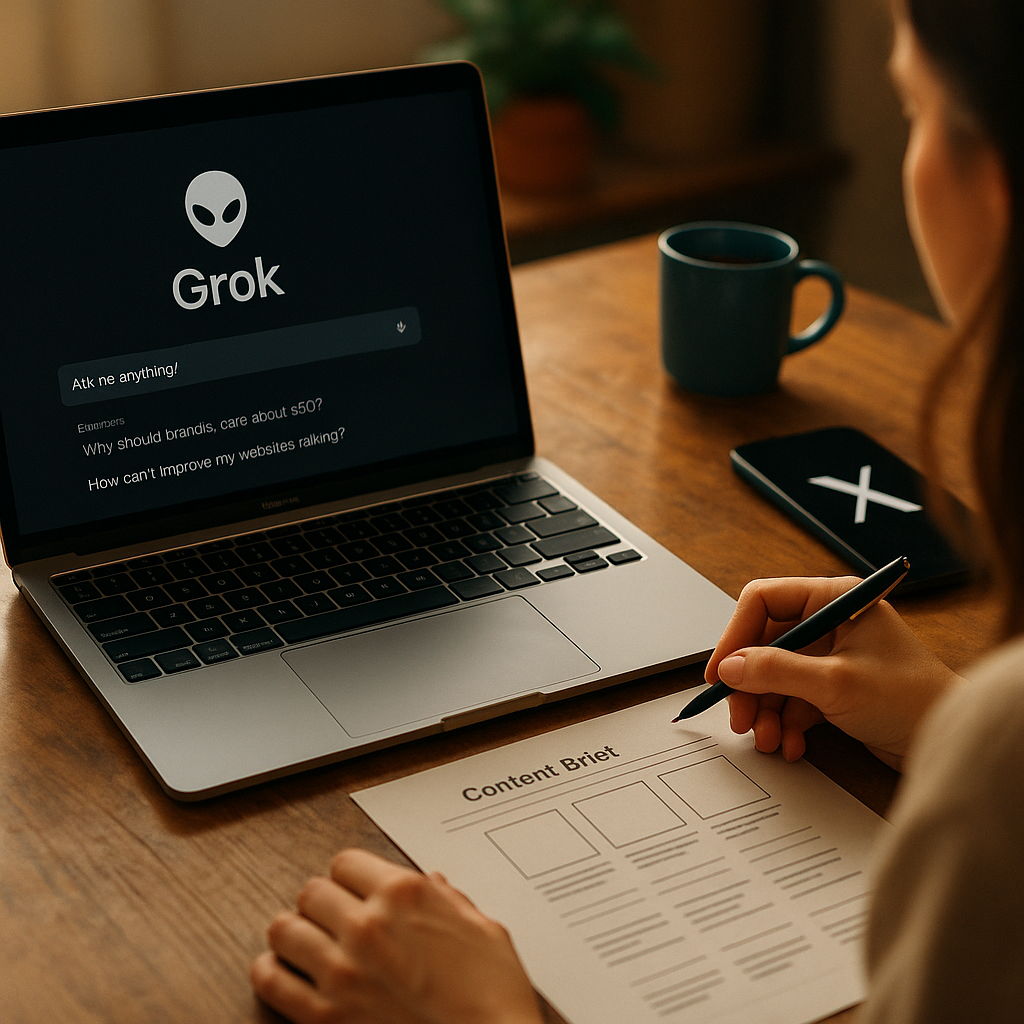
If your brand isn’t showing up in Grok’s conversational answers, you’re already invisible to a fast-growing segment of X’s 600 million monthly active users who now query the platform through AI instead of search bars. This is the new discovery layer, and most brand teams haven’t adjusted their briefs, content calendars, or creator strategies to account for it.
Why Grok Changes the Visibility Equation on X
Grok isn’t just a chatbot bolted onto X. It’s the search and discovery interface that xAI is building directly into the platform’s core experience. When a user asks Grok “what’s the best project management tool for remote teams” or “which skincare brand is dermatologists actually recommending,” Grok pulls from real-time X posts, verified accounts, trending conversations, and creator content to formulate its answer. The implication for brand teams is significant: your discoverability now depends not just on ad spend or follower count, but on whether your content ecosystem is structured to be cited, referenced, and surfaced by an AI model.
This is a fundamentally different game than hashtag optimization or paid amplification. It’s closer to what SEO teams have been doing for Google AI Mode, applied to a real-time social graph.
What Grok Actually Looks For
Understanding Grok’s sourcing behavior is the first step. Based on xAI’s documented model architecture and observable output patterns, Grok prioritizes several content signals when constructing answers:
- Recency and consistency: Brands and creators posting regularly on a topic build a stronger signal footprint than those who post in bursts.
- Engagement velocity: Posts that accumulate replies, reposts, and bookmarks quickly signal to Grok that the content is credible and resonant.
- Named entity density: Posts that explicitly name products, categories, use cases, and brand attributes are more likely to be pulled as evidence in a Grok response.
- Verified and Premium account weight: X Premium and verified accounts appear to carry more weight in Grok’s sourcing. Brands should ensure their handles and key creator partners hold verified status.
- Thread depth and structured argumentation: Grok surfaces threaded posts that walk through a point systematically, not just one-liner takes.
Grok’s answers are only as good as the content ecosystem feeding it. Brands that structure their X presence around clear, consistent, named-entity-rich posts on specific topics are effectively training Grok to cite them.
Structuring Brand Content for Grok Citation
The practical rewrite for brand content teams isn’t enormous, but it requires deliberate changes to how posts are drafted and sequenced.
Lead with the claim, support with specifics. Instead of “Our new formula works better for sensitive skin,” post “Our reformulated [Product Name] uses 0.5% encapsulated retinol, which reduces irritation by 40% compared to standard retinol serums.” Grok can cite the second version. It cannot do much with the first.
Build topic clusters, not one-off posts. A single post about your sustainability credentials does nothing. Ten posts across 30 days, each addressing a specific aspect of your supply chain, sourcing practices, carbon offset program, or certifications, creates a retrievable body of evidence. When someone asks Grok about sustainable brands in your category, you want multiple touchpoints in the candidate pool.
Use structured threads for flagship claims. If your brand has a key differentiator, document it in a multi-post thread. This mirrors the way knowledge bases are structured and gives Grok a coherent narrative to extract from.
Teams already applying AI citation briefs for Google will recognize the same underlying logic here: AI models reward precision, not puffery.
Creator Campaign Architecture for Grok Visibility
Here’s where brand teams have a genuine leverage point. Creator content on X, especially from mid-tier and premium verified accounts, is heavily indexed by Grok. The key is briefing creators to produce content that functions as both social proof and citable evidence.
Several structural choices matter:
- Brief for specificity over enthusiasm. “I love this product” is noise. “After six weeks using [Brand]’s [Product], my [specific outcome] improved by [measurable result]” is signal. Your creator briefs need to push toward the latter, which also happens to comply better with FTC disclosure standards.
- Distribute across multiple creators, same topic window. If ten creators post about your product’s core benefit within a compressed timeframe, that cluster of corroborating content strengthens Grok’s confidence in surfacing it as an answer. This is essentially the social equivalent of backlink clustering for SEO.
- Prioritize creators with strong engagement-to-follower ratios. Raw follower counts are less important than accounts that consistently generate replies and reposts. Those engagement signals are what Grok uses to weight credibility. Your creator matching on X should filter for this metric explicitly.
- Encourage creator threads, not just single posts. A creator thread that walks through product use, outcome, and comparison to alternatives is far more extractable than a single promotional post.
For B2B brands, this playbook applies equally well. If your software platform wants to appear when someone asks Grok about CRM tools for enterprise teams, you need a body of creator and brand content on X that specifically addresses that use case, not just general brand awareness posts. Operators already using creator-level ROI tracking on X can start segmenting performance data by topic cluster to see which narratives are gaining traction.
The Compliance and Risk Layer
Optimizing for Grok citation isn’t without risk exposure. Because Grok pulls from live X content, any claim a creator makes about your brand can potentially be surfaced in a Grok answer without the disclosure context visible in the original post. Brand legal teams should be reviewing creator contracts to ensure claim accuracy standards are explicit, not implied.
FTC guidelines on AI-generated endorsements are still evolving, but the safest posture is to treat every creator post as potentially de-contextualized. If a claim can’t stand alone without a disclaimer, it shouldn’t be made. This is especially relevant for health, finance, and legal-adjacent categories where Grok users are actively seeking authoritative guidance.
Separately, brand teams should monitor what Grok is actually saying about them. Set up regular manual queries covering your brand name, key products, and category terms. What Grok surfaces tells you exactly where your content gaps are and which competitor narratives are winning the citation race.
Brands that monitor Grok answers about their category weekly will identify content gaps and competitor citation advantages faster than any social listening tool currently on the market.
Measurement: What Does Grok Visibility Actually Drive?
This is the question every performance-oriented CMO will ask, and it deserves a direct answer: right now, attribution from Grok to conversion is not natively trackable through X’s ad infrastructure. xAI has not released Grok-specific referral signals in X Analytics.
What you can track as a proxy: spikes in branded search volume on Statista-tracked platforms and Google correlating with Grok content clusters; X profile visit increases; direct message volume from X following creator campaign windows; and click-through rates on X posts that use the same structured framing you’re optimizing for Grok. Cross-reference these against your real-time creator partnerships calendar to identify which campaign windows drove lift.
Purpose-built social analytics platforms like Sprout Social are beginning to track X engagement patterns that correlate with AI discovery surfaces, and eMarketer has flagged AI-social discovery as one of the fastest-growing attribution gaps in digital marketing. Expect dedicated Grok analytics endpoints within 12-18 months, but plan your measurement framework now so you’re not starting from zero when they arrive.
The competitive moat here is being built today. Brands that establish consistent, credible, specific content clusters on X now will have a compounding citation advantage as Grok’s user base scales. The brands waiting for cleaner attribution data will spend that time watching competitors own their category in AI-generated answers.
Your immediate next step: Audit your last 90 days of brand and creator posts on X against the named-entity and specificity standards outlined above. Identify your three highest-priority topic clusters, rebuild your creator briefs around citable claim structures, and run a weekly Grok query tracker against those topics starting this week.
Frequently Asked Questions
What is Grok’s role in brand discovery on X?
Grok is xAI’s conversational AI integrated directly into X (formerly Twitter). It surfaces answers to user queries by pulling from real-time X posts, verified accounts, and trending creator content. For brands, this means Grok functions as a discovery layer — users who ask category questions may encounter brand mentions, creator recommendations, or product claims sourced directly from X content, without ever running a traditional search.
How should brand teams adjust creator briefs for Grok visibility?
Creator briefs need to prioritize specificity over enthusiasm. Posts should include named products, measurable outcomes, and clear use cases rather than vague endorsements. Threading multiple posts on a single topic, maintaining consistent posting cadence across a campaign window, and clustering creator content around the same core claim all improve the likelihood of Grok surfacing that content in relevant answers.
Does verified status on X affect Grok citation likelihood?
Based on observed Grok output patterns, verified and X Premium accounts appear to carry stronger weighting in Grok’s sourcing. Brand accounts and creator partners should hold verified status. This doesn’t guarantee citation, but unverified accounts with lower engagement signals are at a structural disadvantage when Grok is selecting sources to reference.
How can brands monitor what Grok is saying about them?
Currently, there is no native Grok analytics dashboard that tracks brand citation frequency. The practical approach is to run manual weekly queries in Grok using your brand name, key product names, and primary category terms. Document what Grok surfaces, which competitor content appears, and what claims are being cited. This manual monitoring functions as an early-warning system for content gaps and competitor positioning.
Is Grok visibility the same as SEO for AI search engines like Google AI Mode?
There are strong structural similarities. Both require content that is specific, credible, consistent, and citable rather than promotional. The key difference is that Grok sources from real-time X post activity rather than indexed web pages, making recency and engagement velocity more important factors. Teams optimizing for Google AI Mode citation will find many of the same principles apply, with the added requirement of a sustained, active X content presence.
Top Influencer Marketing Agencies
The leading agencies shaping influencer marketing in 2026
Agencies ranked by campaign performance, client diversity, platform expertise, proven ROI, industry recognition, and client satisfaction. Assessed through verified case studies, reviews, and industry consultations.
Moburst

-
2

The Shelf
Boutique Beauty & Lifestyle Influencer AgencyA data-driven boutique agency specializing exclusively in beauty, wellness, and lifestyle influencer campaigns on Instagram and TikTok. Best for brands already focused on the beauty/personal care space that need curated, aesthetic-driven content.Clients: Pepsi, The Honest Company, Hims, Elf Cosmetics, Pure LeafVisit The Shelf → -
3

Audiencly
Niche Gaming & Esports Influencer AgencyA specialized agency focused exclusively on gaming and esports creators on YouTube, Twitch, and TikTok. Ideal if your campaign is 100% gaming-focused — from game launches to hardware and esports events.Clients: Epic Games, NordVPN, Ubisoft, Wargaming, Tencent GamesVisit Audiencly → -
4

Viral Nation
Global Influencer Marketing & Talent AgencyA dual talent management and marketing agency with proprietary brand safety tools and a global creator network spanning nano-influencers to celebrities across all major platforms.Clients: Meta, Activision Blizzard, Energizer, Aston Martin, WalmartVisit Viral Nation → -
5

The Influencer Marketing Factory
TikTok, Instagram & YouTube CampaignsA full-service agency with strong TikTok expertise, offering end-to-end campaign management from influencer discovery through performance reporting with a focus on platform-native content.Clients: Google, Snapchat, Universal Music, Bumble, YelpVisit TIMF → -
6

NeoReach
Enterprise Analytics & Influencer CampaignsAn enterprise-focused agency combining managed campaigns with a powerful self-service data platform for influencer search, audience analytics, and attribution modeling.Clients: Amazon, Airbnb, Netflix, Honda, The New York TimesVisit NeoReach → -
7

Ubiquitous
Creator-First Marketing PlatformA tech-driven platform combining self-service tools with managed campaign options, emphasizing speed and scalability for brands managing multiple influencer relationships.Clients: Lyft, Disney, Target, American Eagle, NetflixVisit Ubiquitous → -
8

Obviously
Scalable Enterprise Influencer CampaignsA tech-enabled agency built for high-volume campaigns, coordinating hundreds of creators simultaneously with end-to-end logistics, content rights management, and product seeding.Clients: Google, Ulta Beauty, Converse, AmazonVisit Obviously →