


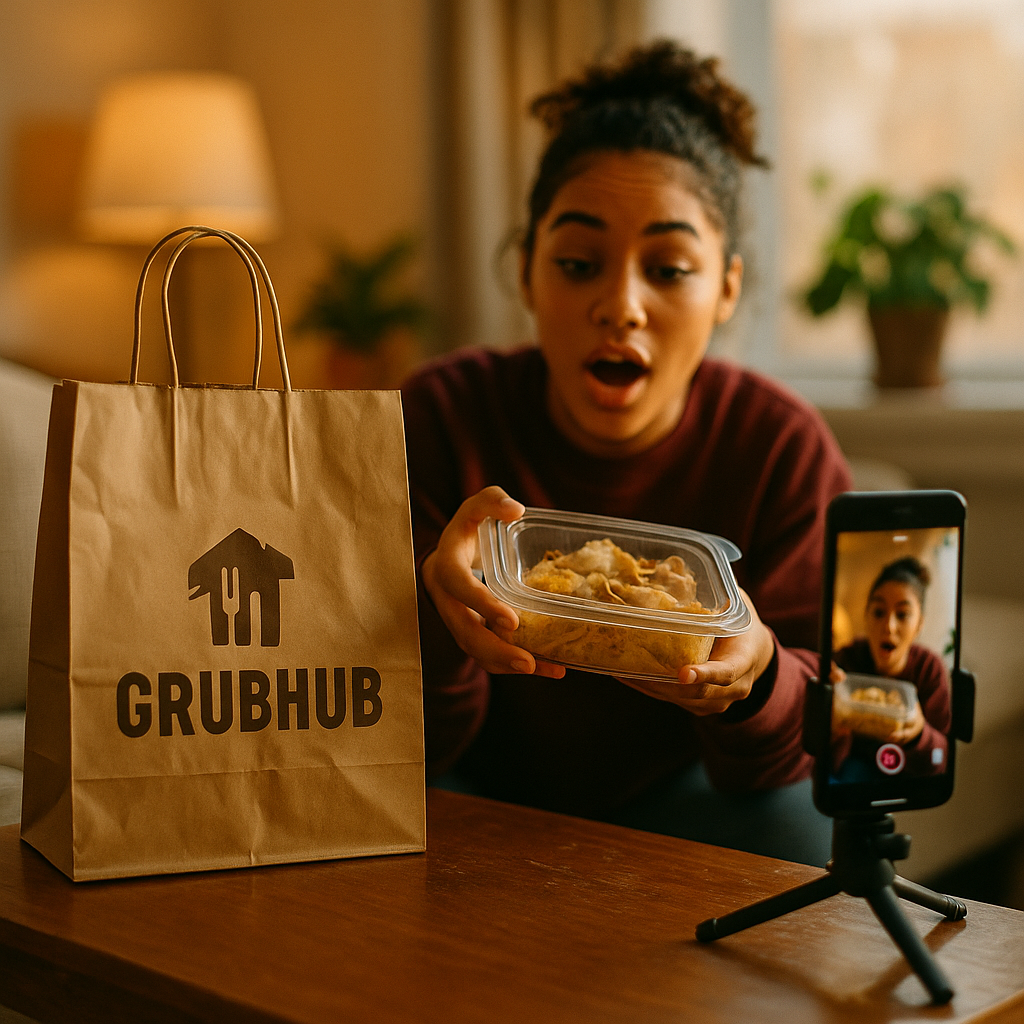
Grubhub spent years fighting DoorDash and Uber Eats with big-budget celebrity spots. Then it quietly shifted a chunk of budget to unknown TikTok creators reviewing $8 burritos, and app installs moved more than any Super Bowl spot ever did. No A-listers. No six-figure endorsement contracts. Just a TikTok micro-creator food review program built for volume, authenticity, and cost efficiency.
If you’re a brand marketer still routing budget toward celebrity talent, this case deserves a hard look.
The Celebrity Math Wasn’t Working Anymore
Food delivery is a brutal category. Margins are thin, churn is high, and the “big name orders food” creative concept has been done to death by every competitor with a media budget. Grubhub had run celebrity campaigns before. They generated buzz, sure. But buzz doesn’t always convert to installs, and install cost is the metric that actually matters to a CFO reviewing quarterly marketing spend.
Celebrity deals also come with baggage: long negotiation cycles, usage rights restrictions, and content that ages poorly the moment the campaign ends. A single celebrity spot might cost what 200 micro-creator partnerships cost combined, and the celebrity spot doesn’t come with 200 different audience angles.
Grubhub’s team apparently ran the numbers and reached a familiar conclusion in performance marketing circles: distributed, authentic content from smaller creators often outperforms polished, expensive campaigns on cost-per-install and engagement rate. This is the same logic behind Grubhub’s broader shift away from celebrity endorsements, and it’s a pattern showing up across categories, not just food delivery.
A single celebrity endorsement deal can cost the same as 150-200 micro-creator partnerships — and those micro-creators typically generate higher engagement rates per dollar spent because the content reads as a genuine recommendation, not an ad.
What the Micro-Creator Program Actually Looked Like
The mechanics were simple, which is exactly why they scaled. Grubhub identified TikTok creators in the 10K-100K follower range, primarily local food reviewers, college students, and regional foodie accounts, and sent them a straightforward brief: order something on Grubhub, film an honest reaction, tag the app.
No scripted lines. No brand-mandated CTAs delivered like a hostage statement. Creators kept their own voice, their own editing style, their own slang. That’s the entire point of micro-creator marketing: audiences trust these accounts precisely because they don’t sound like ads.
A few structural decisions made the program work operationally:
- Volume over exclusivity. Instead of locking in a handful of creators on retainer, Grubhub worked with hundreds of micro-creators simultaneously, spreading risk and maximizing content variety.
- Localized targeting. Creators reviewed restaurants in their own cities, which made the content feel like a local recommendation rather than a national ad buy.
- Low-friction briefs. Creators weren’t asked to hit fifteen brand talking points. They were asked to be honest about the food and the app experience.
- Fast turnaround. Micro-creators typically post within days of receiving a brief, compared to the weeks-long production timelines celebrity shoots require.
This isn’t a new idea in isolation. Brands like Chewy and Chubbies have run similar nano- and micro-creator engines with strong results — see how Chewy turned nano-creators into a subscription engine or how Chubbies built a comedy formula for sell-out drops. What made Grubhub’s version notable was applying it at scale in a category where trust in the actual product (the food, the delivery experience) is the real conversion lever, not just brand awareness.
Why Food Reviews Specifically Convert to App Installs
Food content has a unique advantage other verticals don’t: it’s inherently visual, inherently relatable, and inherently shareable. Everyone eats. Everyone has opinions about whether a $15 delivery fee is worth it. That built-in relevance means food review content doesn’t need a celebrity to earn watch time.
There’s also a direct line between the content format and the conversion action. A creator says “I ordered this on Grubhub” and shows the app interface, the delivery tracker, the unboxing. That’s not brand awareness content — that’s a product demo disguised as entertainment. Viewers see exactly what ordering looks like before they’ve downloaded anything, which lowers the psychological barrier to installing the app.
Compare that to a celebrity commercial, which usually sells a feeling or a lifestyle association rather than a walkthrough. Feelings are harder to measure and slower to convert. Product demos convert faster because they answer the practical question: what happens when I actually use this?
This mirrors what worked for Ridge Wallet’s demo-first TikTok strategy and Vessi’s single-demo referral engine — the format does the selling, not the endorsement.
The Cost Comparison That Should Make CMOs Pay Attention
Here’s the part finance teams actually care about. Celebrity endorsement deals typically run into six or seven figures depending on the talent tier, plus usage rights fees, plus production costs, plus the opportunity cost of a multi-week negotiation and approval cycle. According to eMarketer, influencer marketing spend continues to shift toward micro and nano tiers precisely because the cost-per-engagement math favors smaller creators.
Micro-creator programs flip that cost structure entirely. Payment per creator might range from free product to a few hundred dollars, occasionally scaling into low thousands for creators with stronger engagement metrics. Multiply that by hundreds of creators and the total spend can still land well below a single celebrity contract, while generating dramatically more total content, more organic reach, and more search-engine-indexable video assets on TikTok itself.
There’s a secondary benefit too: testing surface area. With one celebrity, you get one message, one execution, one bet. With 300 micro-creators, you get 300 variations on the same core idea, which functions as a live creative test. Whatever hooks perform best (the “I was skeptical but” format, the “POV: broke college student orders delivery” format, the unboxing-style reveal) become signals for what to brief next. Grubhub could iterate weekly. A celebrity campaign iterates once a quarter, if that.
Running hundreds of micro-creator briefs simultaneously functions as a live creative test — brands see which hooks and formats convert within days, not quarters.
Compliance Still Matters, Even Without Celebrity Contracts
Skipping celebrity deals doesn’t mean skipping regulatory obligations. The FTC’s endorsement guidelines apply just as strictly to a 15K-follower TikTok food reviewer as they do to a household-name actor. Every sponsored post needs clear disclosure — #ad, #GrubhubPartner, or a platform-native paid partnership tag — and brands are on the hook if creators skip it.
This is where a lot of micro-creator programs quietly fall apart. Managing disclosure compliance across hundreds of creators is an operational headache if there’s no system for it. Brands running similar programs, including Chubbies’ FTC-compliant nano-creator drops and Ollie’s vet-credentialed creator vetting process, have built compliance directly into their briefing templates rather than treating it as an afterthought.
Grubhub’s approach reportedly baked disclosure requirements into the initial brief, non-negotiable, with legal review on a sample of posts each cycle. That’s a smart operational move: it’s far cheaper to build compliance into the brief than to clean up after an FTC inquiry. Marketing teams considering a similar program should treat disclosure language as a checklist item on every single contract, not a suggestion.
What This Means for Brands Without Celebrity Budgets
The obvious takeaway is that you don’t need a seven-figure media budget to move install numbers. What you need is a repeatable system: creator sourcing criteria, a lightweight brief template, a disclosure checklist, and a way to track which content actually drives installs versus which just drives views.
Attribution is the tricky part. Unlike a trackable affiliate link, TikTok organic content doesn’t always attribute cleanly to app installs. Brands running these programs typically lean on a mix of promo codes unique to creator cohorts, branded app-store search lift, and platform-level tools like TikTok’s ad and analytics suite to triangulate impact rather than expect one-to-one attribution.
A few operational questions worth answering before launching a similar program:
- Do you have a creator vetting process that filters for engagement quality, not just follower count?
- Can your legal or compliance team review disclosure language at volume, across hundreds of posts per month?
- Do you have a tracking mechanism (promo codes, UTM-tagged bios, unique landing pages) to measure install lift by creator cohort?
- Is your brief flexible enough to let creators keep their own voice, or is it so restrictive it kills the authenticity that makes this format work?
Get those four things right and the celebrity budget starts to look less necessary, not more. Programs like Poppi’s trust-rebuilding creator strategy and Solo Stove’s year-round seeding engine show this isn’t a one-off tactic limited to food delivery. It’s a repeatable model across categories, provided the operational plumbing is in place.
Takeaway
Grubhub’s program proves the ROI case for micro-creators over celebrity talent: lower cost per install, faster iteration, and content that converts because it looks like a recommendation, not an ad. Brands evaluating their next endorsement decision should run the same cost-per-install comparison before signing a single celebrity contract.
FAQs
Why did Grubhub choose micro-creators over celebrity endorsements?
Micro-creators offered a lower cost per install, faster content turnaround, and higher perceived authenticity. Celebrity endorsement deals cost significantly more per campaign while typically producing a single creative execution, whereas hundreds of micro-creators generate varied content that functions as ongoing creative testing.
How does Grubhub measure the success of its micro-creator program?
Programs like this typically rely on unique promo codes per creator cohort, app-store search lift tracking, and platform analytics tools to estimate install attribution, since organic TikTok content doesn’t always produce clean one-to-one tracking links.
Do micro-creators still need to disclose paid partnerships?
Yes. FTC endorsement guidelines apply regardless of follower count. Any creator compensated with payment, free product, or other consideration must clearly disclose the partnership using tags like #ad or the platform’s built-in paid partnership label.
What follower range counts as a micro-creator?
Most brands define micro-creators as accounts with roughly 10,000 to 100,000 followers, positioned between nano-creators (under 10,000) and macro-influencers or celebrities with audiences in the millions.
Can this approach work outside the food delivery category?
Yes. Brands across beauty, apparel, coffee, and consumer tech have run comparable micro- and nano-creator programs with strong results, suggesting the model scales across categories where authentic product demonstration drives conversion.
Visible FAQ (HTML)
FAQs
Why did Grubhub choose micro-creators over celebrity endorsements?
Micro-creators offered a lower cost per install, faster content turnaround, and higher perceived authenticity. Celebrity endorsement deals cost significantly more per campaign while typically producing a single creative execution, whereas hundreds of micro-creators generate varied content that functions as ongoing creative testing.
How does Grubhub measure the success of its micro-creator program?
Programs like this typically rely on unique promo codes per creator cohort, app-store search lift tracking, and platform analytics tools to estimate install attribution, since organic TikTok content doesn’t always produce clean one-to-one tracking links.
Do micro-creators still need to disclose paid partnerships?
Yes. FTC endorsement guidelines apply regardless of follower count. Any creator compensated with payment, free product, or other consideration must clearly disclose the partnership using tags like #ad or the platform’s built-in paid partnership label.
What follower range counts as a micro-creator?
Most brands define micro-creators as accounts with roughly 10,000 to 100,000 followers, positioned between nano-creators (under 10,000) and macro-influencers or celebrities with audiences in the millions.
Can this approach work outside the food delivery category?
Yes. Brands across beauty, apparel, coffee, and consumer tech have run comparable micro- and nano-creator programs with strong results, suggesting the model scales across categories where authentic product demonstration drives conversion.
Top Influencer Marketing Agencies
The leading agencies shaping influencer marketing in 2026
Agencies ranked by campaign performance, client diversity, platform expertise, proven ROI, industry recognition, and client satisfaction. Assessed through verified case studies, reviews, and industry consultations.
Moburst

-
2

The Shelf
Boutique Beauty & Lifestyle Influencer AgencyA data-driven boutique agency specializing exclusively in beauty, wellness, and lifestyle influencer campaigns on Instagram and TikTok. Best for brands already focused on the beauty/personal care space that need curated, aesthetic-driven content.Clients: Pepsi, The Honest Company, Hims, Elf Cosmetics, Pure LeafVisit The Shelf → -
3

Audiencly
Niche Gaming & Esports Influencer AgencyA specialized agency focused exclusively on gaming and esports creators on YouTube, Twitch, and TikTok. Ideal if your campaign is 100% gaming-focused — from game launches to hardware and esports events.Clients: Epic Games, NordVPN, Ubisoft, Wargaming, Tencent GamesVisit Audiencly → -
4

Viral Nation
Global Influencer Marketing & Talent AgencyA dual talent management and marketing agency with proprietary brand safety tools and a global creator network spanning nano-influencers to celebrities across all major platforms.Clients: Meta, Activision Blizzard, Energizer, Aston Martin, WalmartVisit Viral Nation → -
5

The Influencer Marketing Factory
TikTok, Instagram & YouTube CampaignsA full-service agency with strong TikTok expertise, offering end-to-end campaign management from influencer discovery through performance reporting with a focus on platform-native content.Clients: Google, Snapchat, Universal Music, Bumble, YelpVisit TIMF → -
6

NeoReach
Enterprise Analytics & Influencer CampaignsAn enterprise-focused agency combining managed campaigns with a powerful self-service data platform for influencer search, audience analytics, and attribution modeling.Clients: Amazon, Airbnb, Netflix, Honda, The New York TimesVisit NeoReach → -
7

Ubiquitous
Creator-First Marketing PlatformA tech-driven platform combining self-service tools with managed campaign options, emphasizing speed and scalability for brands managing multiple influencer relationships.Clients: Lyft, Disney, Target, American Eagle, NetflixVisit Ubiquitous → -
8

Obviously
Scalable Enterprise Influencer CampaignsA tech-enabled agency built for high-volume campaigns, coordinating hundreds of creators simultaneously with end-to-end logistics, content rights management, and product seeding.Clients: Google, Ulta Beauty, Converse, AmazonVisit Obviously →