


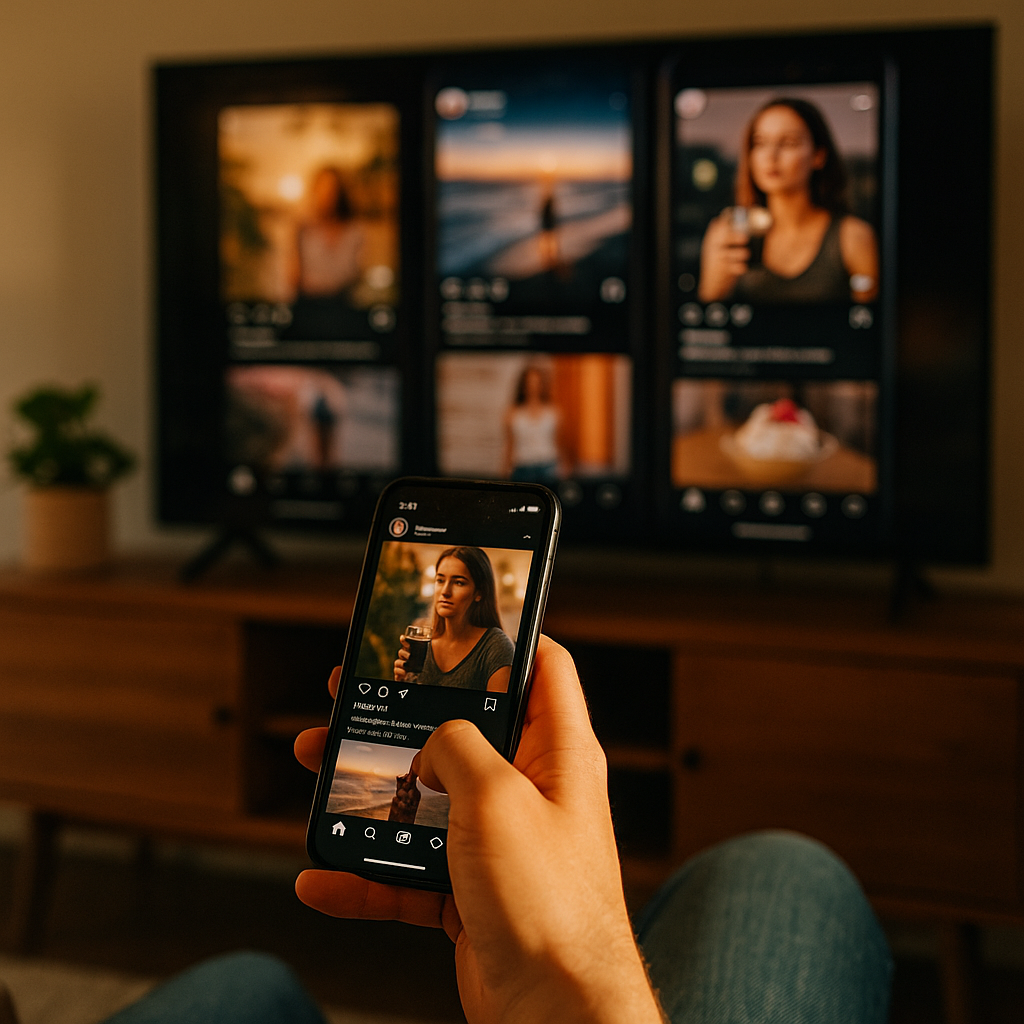
Sixty-eight percent of connected TV owners now say they scroll a second screen while watching, according to eMarketer viewership data. Meta just built a format around that habit instead of fighting it. Call it the Instagram-for-TV shared-scrolling format, and it’s forcing brands to rewrite their 2026 platform playbooks in real time.
This isn’t a gimmick. It’s a structural bet that the living room and the phone are merging into one shared surface, and whoever wins creator attention there wins the next wave of influencer budgets.
What Is the Shared-Scrolling Format, Exactly?
Picture Instagram Reels, but rendered on your television, synced to a companion phone feed that lets viewers react, tap product tags, or jump into a creator’s grid without leaving the couch. Meta’s pilot pairs a TV app experience with a mobile “remote control” layer, so the person holding the phone drives the scroll while everyone in the room watches the feed on the big screen.
It’s part streaming app, part social feed, part shared remote. Early access is rolling out through smart TV partnerships, and the initial creator cohort skews heavily toward lifestyle, comedy sketches, and product-review formats, content that already performs in vertical video but benefits from a bigger canvas.
The shared-scrolling format doesn’t just change where content is watched. It changes who is watching together, and that changes what “engagement” even means for a brand’s media plan.
Why Brands Should Care Right Now
Because attention measurement just got messier, and messier means opportunity for the brands that adapt first. A single household viewing session might now represent three, four, even five individual viewers, none of whom are logged in separately. That breaks a lot of assumptions baked into influencer reporting dashboards built for single-user mobile scrolling.
Consider what this means for reach math. A creator’s Reel that used to count one view per phone now might register as one “session” representing an entire household. Brands running performance-based influencer deals need to ask their agencies and platforms hard questions about how shared-scrolling sessions get attributed. If your contracts still price on raw view count, you’re already exposed. Publications covering the shift toward view-count transparency in creator reporting have flagged this exact problem for over a year, and it’s about to get worse before platforms standardize.
There’s also a real opportunity buried in the risk. Shared viewing sessions historically drive higher purchase intent than solo scrolling, per longstanding research from Nielsen and others on co-viewing behavior. If Instagram’s TV format captures family or group watch parties, brands get a shot at influencing multiple household decision-makers in a single ad exposure. That’s a rare thing in fragmented, single-user mobile advertising.
The Creator Economics Are Different Here
Creators optimizing for shared-scrolling need a different production mindset than pure mobile-first creators. Vertical video shot for a five-inch screen doesn’t always hold up on a 65-inch television. Text overlays that read fine on a phone can look sloppy or illegible from a couch ten feet away. Pacing matters more too: TV-native audiences tolerate slower builds than TikTok scrollers who bail in the first two seconds.
This is exactly the kind of production challenge brands have already wrestled with in adjacent formats. The same logic that applies to vertical microdrama series production applies here: shoot with the biggest possible destination screen in mind, then downsize creative for smaller formats, not the other way around.
Smart agencies are already updating creator briefs to require dual-resolution thinking, one cut optimized for mobile feed scroll, one cut optimized for TV-scale legibility. That’s not a huge lift if you’re already building usage-rights-ready video briefs that anticipate reuse across surfaces. It’s a bigger lift if your creator contracts still assume single-platform delivery with no cross-format flexibility built in.
What This Means for Budget Allocation
Media planners love clean channel buckets: social budget here, streaming budget there, influencer budget somewhere adjacent to both. The shared-scrolling format collapses that separation, and budget owners who cling to old category lines will misallocate spend.
Here’s the practical question worth raising in your next planning cycle: does a creator partnership that runs on Instagram-for-TV belong in your social budget, your CTV budget, or a new hybrid line item? There’s no universally correct answer yet, but the brands moving fastest are creating blended test budgets specifically for hybrid formats, treating them as a distinct experimental category rather than forcing them into legacy reporting structures.
This mirrors what’s already happening with cross-platform amplification strategy more broadly. The logic behind shoot-once, post-everywhere briefs was built for exactly this kind of platform fragmentation. Shared-scrolling is just the newest surface demanding that same operational discipline.
Measurement Is the Real Battleground
Ask any brand marketer what keeps them up at night about hybrid formats, and measurement comes up before creative quality almost every time. Attribution models built for one-viewer, one-device environments simply don’t map cleanly onto shared household viewing.
Meta hasn’t published granular measurement standards for the format yet, and that ambiguity is a genuine risk for brands running paid amplification against creator content in this space. Meta’s business platform documentation covers standard Reels and in-stream metrics, but shared-scrolling attribution is still evolving, and brands should treat early performance claims from any vendor with appropriate skepticism until third-party verification catches up.
This is the same transparency fight playing out across the industry right now. Coverage of YouTube’s revised view-count methodology showed how quickly “a view” can shift definitions when platforms change measurement logic mid-stream. Expect Meta to face similar pressure to clarify what counts as engagement in a shared-scrolling session, especially once regulators and industry bodies start asking questions about disclosure accuracy in paid placements.
If your influencer reporting can’t tell you whether a “view” was one person or a living room of five, your ROI math is a guess dressed up as a metric.
Compliance teams should also be thinking ahead here. Shared-scrolling sessions complicate disclosure requirements too. If a sponsored post displays on a shared household screen, does existing disclosure language remain sufficiently visible and legible at TV scale? The FTC’s endorsement guidance doesn’t yet address multi-viewer TV-social hybrids specifically, but the underlying principle, clear and conspicuous disclosure, still applies regardless of screen size. Brands running influencer content through this format should treat disclosure legibility on a ten-foot screen as a genuine creative requirement, not an afterthought.
How Platform Strategy Shifts Going Forward
Here’s the uncomfortable truth for platform-specific specialists: the category lines that used to define influencer strategy are dissolving. “TikTok strategy” and “YouTube strategy” and “streaming strategy” are converging into something closer to “attention surface strategy,” where the question isn’t which app you’re on but which screen, and how many people are watching it together.
That’s a genuine mindset shift for teams still organized around platform-specific pods. It might mean restructuring creator relationship management around content types and audience behaviors rather than app names.
Brands already comfortable repurposing a single shoot across multiple destinations have a real head start here. The operational muscle built for cross-format asset briefs spanning YouTube and TikTok translates directly to hybrid social-streaming formats. The core skill, briefing creators to produce flexible, resolution-agnostic content upfront, is the same regardless of which new surface Meta or Google rolls out next quarter.
Worth noting too: this isn’t happening in isolation. Sprout Social’s ongoing research on social media trends has repeatedly flagged convergence between streaming and social as a top strategic concern for brand marketers, and HubSpot’s marketing benchmarks show growing budget movement toward blended video formats over the past several reporting cycles. The shared-scrolling format is a specific, visible expression of a trend that’s been building for a while.
What to Actually Do This Quarter
Don’t overhaul your entire influencer program around a beta format. Do run small, deliberate tests. A few concrete moves worth considering:
- Ask your agency or platform rep directly how shared-scrolling sessions get counted in reporting, and get it in writing before committing real budget.
- Brief a small cohort of creators to produce one TV-scale cut and one mobile-scale cut from the same shoot, testing legibility and pacing differences firsthand.
- Review disclosure language in any hybrid-format creative for readability at TV scale, not just mobile scale.
- Set up a blended test budget line so hybrid formats don’t get starved by rigid channel-specific allocation rules.
- Revisit creator contracts to ensure usage rights explicitly cover TV-social hybrid distribution, not just the platform where content was originally shot.
Treat this like any other emerging surface: test with discipline, measure skeptically, scale only what proves out.
Next step: Pick one existing creator partnership already generating strong mobile engagement and greenlight a small hybrid-format test this quarter, then compare cost-per-engagement against your standard Reels benchmark before committing further budget.
FAQs
What is the Instagram-for-TV shared-scrolling format?
It’s a hybrid viewing experience that puts an Instagram-style scrollable feed on a television screen, controlled by a companion phone app, allowing multiple household viewers to watch and interact with the same content simultaneously.
How does shared-scrolling change influencer campaign measurement?
Because a single viewing session can represent multiple household members watching together, traditional per-user view counts and engagement metrics don’t map cleanly onto the format, requiring brands to negotiate clearer attribution definitions before committing spend.
Should brands shift budget from social to CTV for this format?
Not necessarily. Most brands testing the format are creating a separate blended budget line specifically for hybrid social-streaming tests rather than pulling funds from existing social or CTV allocations.
Does existing FTC disclosure guidance cover TV-scale sponsored content?
The FTC’s core clear-and-conspicuous disclosure standard still applies regardless of screen size, but brands should specifically test disclosure legibility on larger screens since text sized for mobile feeds may not read clearly from typical television viewing distances.
What production changes does shared-scrolling require from creators?
Creators need to account for larger-screen legibility, slower pacing suited to shared viewing, and text overlays readable from a distance, ideally producing a TV-optimized cut alongside their standard mobile-first version.
FAQs
What is the Instagram-for-TV shared-scrolling format?
It’s a hybrid viewing experience that puts an Instagram-style scrollable feed on a television screen, controlled by a companion phone app, allowing multiple household viewers to watch and interact with the same content simultaneously.
How does shared-scrolling change influencer campaign measurement?
Because a single viewing session can represent multiple household members watching together, traditional per-user view counts and engagement metrics don’t map cleanly onto the format, requiring brands to negotiate clearer attribution definitions before committing spend.
Should brands shift budget from social to CTV for this format?
Not necessarily. Most brands testing the format are creating a separate blended budget line specifically for hybrid social-streaming tests rather than pulling funds from existing social or CTV allocations.
Does existing FTC disclosure guidance cover TV-scale sponsored content?
The FTC’s core clear-and-conspicuous disclosure standard still applies regardless of screen size, but brands should specifically test disclosure legibility on larger screens since text sized for mobile feeds may not read clearly from typical television viewing distances.
What production changes does shared-scrolling require from creators?
Creators need to account for larger-screen legibility, slower pacing suited to shared viewing, and text overlays readable from a distance, ideally producing a TV-optimized cut alongside their standard mobile-first version.
Top Influencer Marketing Agencies
The leading agencies shaping influencer marketing in 2026
Agencies ranked by campaign performance, client diversity, platform expertise, proven ROI, industry recognition, and client satisfaction. Assessed through verified case studies, reviews, and industry consultations.
Moburst

-
2

The Shelf
Boutique Beauty & Lifestyle Influencer AgencyA data-driven boutique agency specializing exclusively in beauty, wellness, and lifestyle influencer campaigns on Instagram and TikTok. Best for brands already focused on the beauty/personal care space that need curated, aesthetic-driven content.Clients: Pepsi, The Honest Company, Hims, Elf Cosmetics, Pure LeafVisit The Shelf → -
3

Audiencly
Niche Gaming & Esports Influencer AgencyA specialized agency focused exclusively on gaming and esports creators on YouTube, Twitch, and TikTok. Ideal if your campaign is 100% gaming-focused — from game launches to hardware and esports events.Clients: Epic Games, NordVPN, Ubisoft, Wargaming, Tencent GamesVisit Audiencly → -
4

Viral Nation
Global Influencer Marketing & Talent AgencyA dual talent management and marketing agency with proprietary brand safety tools and a global creator network spanning nano-influencers to celebrities across all major platforms.Clients: Meta, Activision Blizzard, Energizer, Aston Martin, WalmartVisit Viral Nation → -
5

The Influencer Marketing Factory
TikTok, Instagram & YouTube CampaignsA full-service agency with strong TikTok expertise, offering end-to-end campaign management from influencer discovery through performance reporting with a focus on platform-native content.Clients: Google, Snapchat, Universal Music, Bumble, YelpVisit TIMF → -
6

NeoReach
Enterprise Analytics & Influencer CampaignsAn enterprise-focused agency combining managed campaigns with a powerful self-service data platform for influencer search, audience analytics, and attribution modeling.Clients: Amazon, Airbnb, Netflix, Honda, The New York TimesVisit NeoReach → -
7

Ubiquitous
Creator-First Marketing PlatformA tech-driven platform combining self-service tools with managed campaign options, emphasizing speed and scalability for brands managing multiple influencer relationships.Clients: Lyft, Disney, Target, American Eagle, NetflixVisit Ubiquitous → -
8

Obviously
Scalable Enterprise Influencer CampaignsA tech-enabled agency built for high-volume campaigns, coordinating hundreds of creators simultaneously with end-to-end logistics, content rights management, and product seeding.Clients: Google, Ulta Beauty, Converse, AmazonVisit Obviously →