


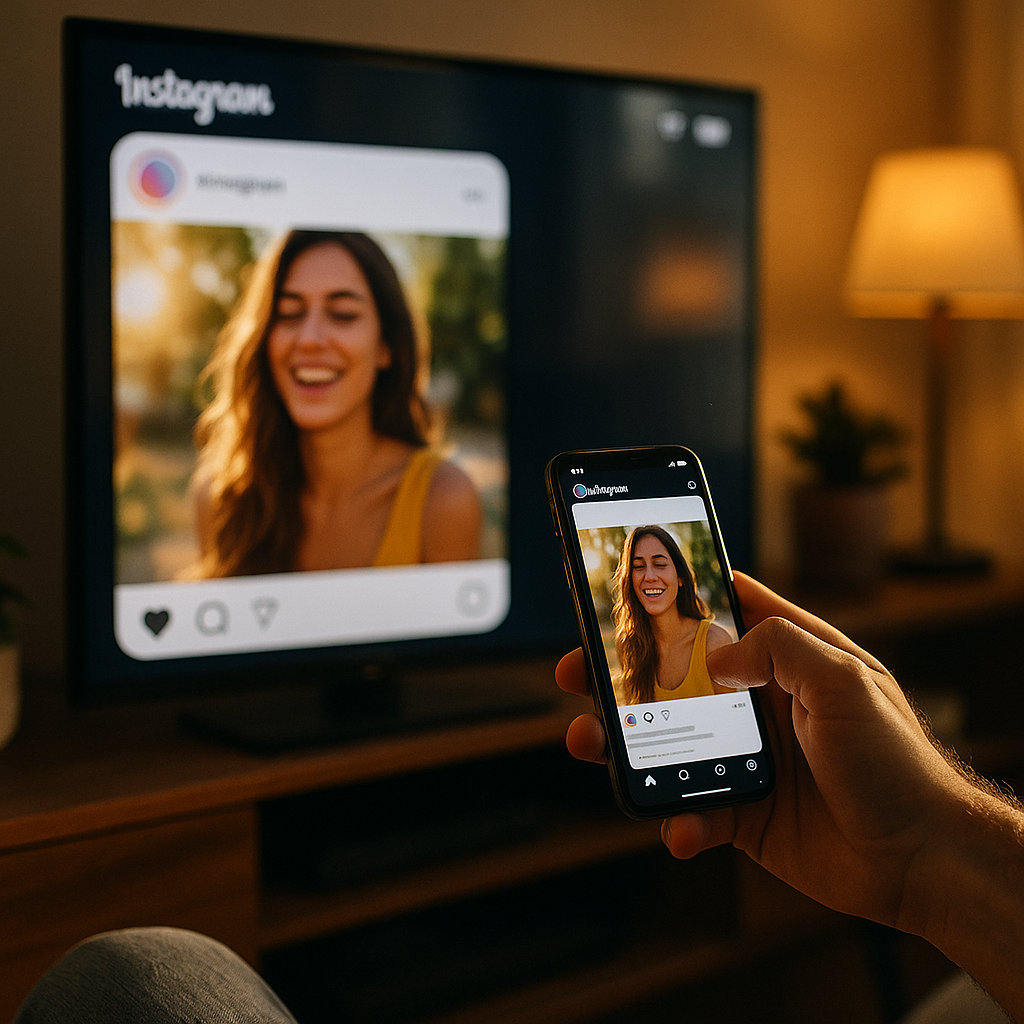
Meta just put a couch in your feed. Instagram for TV‘s new shared-scrolling format lets two people watch and react to the same video queue in real time, from separate rooms, separate cities, even separate time zones. Is this a gimmick, or the first real sign that social and streaming are merging into one buying decision? For brands still splitting budgets between “social content” and “streaming media,” the answer matters more than the feature itself.
What Shared-Scrolling Actually Is
Strip away the marketing language and shared-scrolling is a synchronized viewing session. Two users open Instagram, land on a shared queue of Reels or long-form video, and scroll together — same content, same order, same timing, with reactions and comments visible to both in a side chat. It’s built for the big screen first: Instagram for TV pushes this toward smart TVs and connected devices, not just phones propped on a nightstand.
That’s the part strategists should sit with. Meta isn’t just adding a feature to Instagram. It’s positioning Instagram as a lean-back, living-room experience that competes directly with FAST channels, YouTube TV, and even Netflix’s ad tier. We covered the early mechanics of this rollout in how brands should test, measure, and budget for the format, and the shared-scrolling layer adds a social dimension that changes the calculus again.
Why This Is a Platform Strategy Signal, Not a Feature Update
Features come and go. Platforms rarely build shared, synchronous viewing unless they’re chasing a specific behavioral shift. Meta has watched co-viewing dominate Discord watch parties, Twitch’s shared streams, and even TikTok’s “watch together” tests. The message is clear: passive, solo scrolling has a ceiling, and engagement time on TV screens is the next battleground.
When a social platform starts optimizing for shared, TV-sized attention instead of solo phone attention, it’s not tweaking UX — it’s competing for a completely different ad budget line.
That budget line has historically belonged to linear TV, connected TV (CTV), and FAST channels. If Instagram for TV pulls even a sliver of that spend, brands need to know where influencer content fits in a living-room context versus a scroll context. It’s not the same creative job. A hook that stops a thumb in three seconds doesn’t necessarily hold two people’s attention on a 55-inch screen for ninety.
The Co-Viewing Data Point Nobody’s Talking About Enough
Social viewing behavior already skews toward group consumption more than platforms admit. eMarketer has tracked rising CTV ad spend for several consecutive years, and eMarketer’s research consistently shows advertisers chasing screens where attention is shared, not solitary — because shared attention tends to correlate with longer dwell time and higher recall. Meta’s shared-scrolling bet is a direct attempt to capture that same effect inside its own ecosystem, using creator content as the fuel instead of licensed TV shows.
For brand strategists, that’s the real opportunity: creator-led content formatted for group viewing, sponsored inside a queue two people are watching together. Nobody has built a mature ad product for that yet. Early movers get to write the playbook.
What This Means for Creator Briefs and Content Formatting
Vertical, hook-heavy Reels were built for solo scrolling on a 6-inch screen. Shared-scrolling on a TV changes the physics of attention entirely. A few practical shifts brands should be testing now:
- Longer arcs, slower pacing. Group viewers don’t need a pattern-interrupt every two seconds. Content with a narrative thread — tutorials, reactions, unboxings with commentary — holds up better in a co-viewing context.
- Conversation triggers baked into the content. If two people are watching together with a live chat, creators who prompt discussion (“wait, pause here”) outperform creators optimized purely for solo completion rate.
- TV-safe visual design. Text overlays sized for phones often become unreadable or awkward on a 55-inch screen. Creative teams need TV-format exports, not just vertical crops.
- Brand mentions placed for shared moments. A product callout that lands during a “wait, what is that” moment performs differently in a shared session than a scroll-past ad unit.
This isn’t a wholesale rewrite of creator briefs. It’s an added layer. Our team broke down the tactical testing approach in what brands should test now, and the short version is: treat this as a distinct placement, not a repurposed Reel.
Budget Allocation: Where Does This Money Come From?
This is the question every CMO’s going to ask before greenlighting a test budget. Does shared-scrolling spend come from the social budget, the streaming/CTV budget, or a new hybrid line item? There’s no universal answer yet, but a few principles help:
- Start small and treat it as R&D. Pull from existing Instagram creator budgets first. This is a placement test, not a new channel launch.
- Track co-viewing metrics separately. Session length, chat activity, and shared-queue completion rate are new KPIs. Don’t force them into existing Reels reporting templates.
- Reassess after one full quarter. Meta’s ad tooling for this format is early. Expect measurement gaps similar to what sponsors dealt with during YouTube’s view count reporting changes — new formats often outpace measurement infrastructure.
We’ve laid out a more detailed budgeting framework in how brands should test and budget for this rollout, including suggested test-to-scale ratios for mid-size influencer programs.
The Compliance Angle Brands Can’t Skip
Shared, synchronous viewing with live chat introduces a wrinkle for disclosure compliance. If a creator’s sponsored content plays inside a shared queue, does the disclosure need to appear at the start of each viewer’s session, or just once per queue? The FTC’s endorsement guidelines already require clear and conspicuous disclosure regardless of format, and FTC guidance on endorsements hasn’t been updated specifically for co-viewing yet — which means brands are on the hook for interpreting existing rules conservatively.
Practical guidance: disclose at the top of each individual video in the queue, not just the session start. Assume every viewer could be joining mid-queue. This mirrors the caution we recommended around TikTok Shop’s restock alert compliance — when a platform introduces a new consumption pattern, disclosure needs to follow the viewer’s actual experience, not the platform’s technical structure.
How This Fits the Bigger FAST and CTV Convergence Story
Instagram for TV doesn’t exist in a vacuum. Roku, Tubi, and other FAST channels have spent the past two years building sponsorship inventory that looks increasingly like influencer marketing with a TV wrapper — a trend we detailed in structuring FAST channel sponsorship deals. Twitch has gone the other direction, pulling its creator-driven sponsorship model into more traditional upfront-style pitches, as covered in our piece on PlayFronts convergence.
The pattern across all three: platforms are collapsing the line between “social content” and “TV content” because advertisers have started asking why they should have to choose. Instagram’s shared-scrolling format is Meta’s answer. It’s saying, you don’t need a separate CTV strategy — just extend the Instagram budget you already have.
Whether that pitch survives contact with actual measurement standards is the open question. Sprout Social’s ongoing research on Sprout Social’s platform benchmarking data shows measurement fragmentation is already a top complaint among social marketers juggling five-plus platforms. Adding a TV-hybrid format without unified reporting risks making that fragmentation worse, not better.
A Reality Check on Timing
Early access to new ad formats always comes with a novelty premium and a measurement discount. Brands rushing into shared-scrolling sponsorships now should expect Meta’s business tools to lag behind the consumer feature by two to three quarters, based on how similar rollouts (Reels ads, Threads ads) played out. Patience isn’t optional here. It’s structural.
Next step: Run a single shared-scrolling test with one existing creator partner this quarter, cap spend at what you’d normally allocate to a Reels experiment, and measure co-viewing session length as your primary new KPI before committing further budget.
Frequently Asked Questions
What is Instagram for TV’s shared-scrolling format?
It’s a synchronized viewing feature that lets two users watch the same queue of Instagram video content together in real time, with a shared chat, optimized for smart TVs and connected devices rather than solo phone scrolling.
Should brands treat this as a social budget or a streaming/CTV budget?
Most brands should treat early tests as an extension of existing Instagram creator budgets rather than pulling from CTV line items, since the ad tooling and measurement are still tied to Meta’s social infrastructure.
Does shared-scrolling require different creator content than standard Reels?
Yes. Content built for solo phone scrolling often doesn’t translate well to a shared, TV-sized viewing session. Slower pacing, conversation triggers, and TV-safe text sizing tend to perform better in co-viewing contexts.
What are the compliance risks with shared-scrolling sponsorships?
Disclosure needs to appear at the start of each sponsored video in a shared queue, not just once per session, since viewers may join a queue mid-stream. FTC endorsement guidelines still apply regardless of the new format.
How soon should brands expect mature measurement tools for this format?
Based on prior Meta ad format rollouts, expect a lag of roughly two to three quarters between consumer feature launch and full-featured business measurement tools.
Top Influencer Marketing Agencies
The leading agencies shaping influencer marketing in 2026
Agencies ranked by campaign performance, client diversity, platform expertise, proven ROI, industry recognition, and client satisfaction. Assessed through verified case studies, reviews, and industry consultations.
Moburst

-
2

The Shelf
Boutique Beauty & Lifestyle Influencer AgencyA data-driven boutique agency specializing exclusively in beauty, wellness, and lifestyle influencer campaigns on Instagram and TikTok. Best for brands already focused on the beauty/personal care space that need curated, aesthetic-driven content.Clients: Pepsi, The Honest Company, Hims, Elf Cosmetics, Pure LeafVisit The Shelf → -
3

Audiencly
Niche Gaming & Esports Influencer AgencyA specialized agency focused exclusively on gaming and esports creators on YouTube, Twitch, and TikTok. Ideal if your campaign is 100% gaming-focused — from game launches to hardware and esports events.Clients: Epic Games, NordVPN, Ubisoft, Wargaming, Tencent GamesVisit Audiencly → -
4

Viral Nation
Global Influencer Marketing & Talent AgencyA dual talent management and marketing agency with proprietary brand safety tools and a global creator network spanning nano-influencers to celebrities across all major platforms.Clients: Meta, Activision Blizzard, Energizer, Aston Martin, WalmartVisit Viral Nation → -
5

The Influencer Marketing Factory
TikTok, Instagram & YouTube CampaignsA full-service agency with strong TikTok expertise, offering end-to-end campaign management from influencer discovery through performance reporting with a focus on platform-native content.Clients: Google, Snapchat, Universal Music, Bumble, YelpVisit TIMF → -
6

NeoReach
Enterprise Analytics & Influencer CampaignsAn enterprise-focused agency combining managed campaigns with a powerful self-service data platform for influencer search, audience analytics, and attribution modeling.Clients: Amazon, Airbnb, Netflix, Honda, The New York TimesVisit NeoReach → -
7

Ubiquitous
Creator-First Marketing PlatformA tech-driven platform combining self-service tools with managed campaign options, emphasizing speed and scalability for brands managing multiple influencer relationships.Clients: Lyft, Disney, Target, American Eagle, NetflixVisit Ubiquitous → -
8

Obviously
Scalable Enterprise Influencer CampaignsA tech-enabled agency built for high-volume campaigns, coordinating hundreds of creators simultaneously with end-to-end logistics, content rights management, and product seeding.Clients: Google, Ulta Beauty, Converse, AmazonVisit Obviously →