


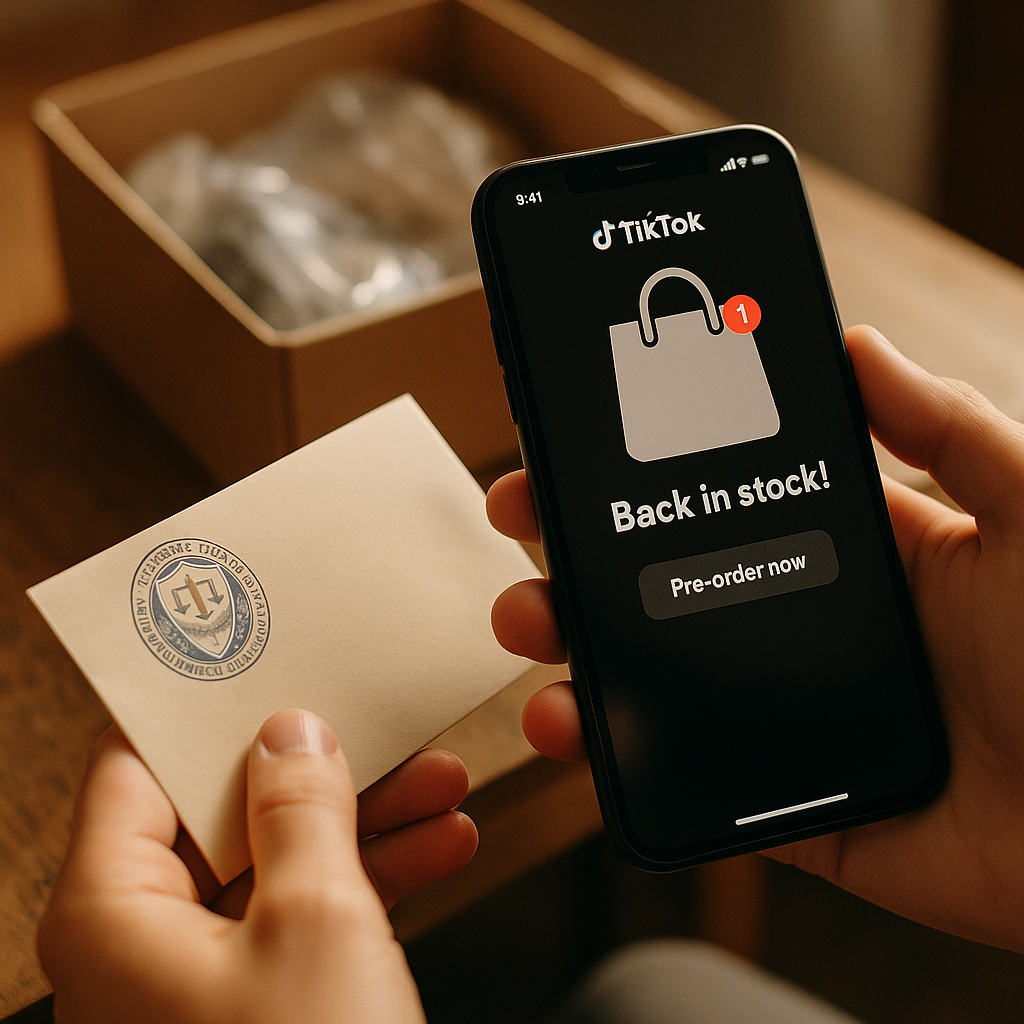
The FTC issued more than $20 million in scarcity-marketing penalties last year, and TikTok Shop’s restock alert feature sits squarely in the crosshairs. TikTok Shop restock alerts feel like free urgency marketing — until legal pulls you into a room and asks who approved the “only 3 left” banner on a product that’s been in stock all week.
Brands love restock alerts because they convert. Compliance teams are wary of them for the same reason. The gap between those two positions is where smart operators are now building their playbooks.
Why Restock Alerts Became the New Countdown Timer
Countdown timers got flagged years ago. Dark-pattern researchers picked them apart, regulators took notice, and platforms quietly started limiting fake urgency widgets. Restock alerts emerged as the tidier alternative — they’re native to TikTok Shop, they feel organic, and they tap into something countdown clocks never could: social proof through actual inventory movement.
When a shopper gets a push notification saying an item they favorited just came back in stock, that’s not manufactured pressure. That’s a real event. The problem is what brands do with that real event once they start dressing it up.
Sellers now stagger inventory drops deliberately, release small batches to trigger alert cascades, or list “limited restock” language even when a full pallet sits in the warehouse. That’s where restock alerts stop being a notification feature and start becoming a liability.
The FTC doesn’t care whether your scarcity claim came from a countdown timer or a restock push notification — the standard is the same: if the claim isn’t materially true, it’s actionable.
What the FTC Actually Regulates Here
There’s no FTC rule that says “restock alerts are illegal.” That’s not how this works. What exists is a broader framework under Section 5 of the FTC Act prohibiting unfair or deceptive practices, plus specific guidance the agency has issued on dark patterns and manufactured scarcity claims. Restock alerts fall under that umbrella when the underlying claim is false.
The test is simple, even if the enforcement is messy: is the scarcity real? If a brand says “back in stock, limited quantity” and there genuinely is a limited quantity tied to a supply constraint, that’s a factual statement. If a brand artificially throttles listing quantity to manufacture a “low stock” badge while a full inventory sits unlisted, that’s a misrepresentation of material fact — the exact thing Section 5 exists to catch.
Check the FTC’s guidance on deceptive practices directly if your legal team hasn’t reviewed it against your current TikTok Shop setup. Most haven’t. That’s not a knock — it’s a genuinely new intersection of platform mechanics and decades-old consumer protection law, and guidance hasn’t fully caught up to live commerce yet.
Low-Stock Badges Are the Riskier Cousin
Restock alerts tell shoppers something came back. Low-stock badges tell shoppers something is about to disappear. The second claim is harder to substantiate and easier to fabricate, which is exactly why it draws more scrutiny.
Brands running TikTok Shop at scale should treat these as two separate compliance questions, not one. A restock alert references a past event (inventory arrived). A low-stock badge asserts a future state (inventory will run out). Regulators evaluate future-state claims more skeptically because they’re inherently harder to verify and easier to game.
How Brands Are Building Real Urgency Instead
The brands getting this right aren’t avoiding urgency. They’re anchoring it to operational reality instead of marketing theater.
Here’s what that looks like in practice:
- Tie alerts to actual batch sizes. If a supplier ships 500 units per restock cycle, say so, or at minimum let the “limited restock” claim reflect that real ceiling rather than an arbitrary one.
- Timestamp inventory data internally. Keep a system-of-record log showing what stock levels were at the moment an alert or badge fired. If the FTC or a plaintiff’s attorney ever asks, you want a timestamped answer, not a shrug.
- Avoid staggered release patterns designed purely to trigger notifications. If your ops team is deliberately listing small batches solely to generate “restocked” pings, that’s the pattern most likely to read as manufactured scarcity in a legal review.
- Separate seasonal scarcity from evergreen SKUs. A limited holiday drop genuinely selling out is different from a core SKU brands falsely frame as scarce every single week.
This is the same discipline that’s reshaping other TikTok Shop mechanics right now. The platform’s algorithm rewards structure over raw follower count, which means brands who build honest, repeatable inventory cadences tend to outperform those chasing one-off viral spikes anyway. Urgency built on real supply constraints just happens to align with what the algorithm already favors.
The Livestream Complication
Live selling makes this messier. A host saying “we’ve only got 40 units left, going fast” in real time is a different risk profile than a static badge on a product page, because it’s harder to fact-check in the moment and harder for compliance to review before it airs.
TikTok’s own livestream compliance rules around returns and shipping already show the platform is tightening operational standards for live commerce. Scarcity claims made on-camera should get the same pre-approved script treatment brands already apply to shipping and return statements. If your host can’t verify the number they’re saying, they shouldn’t be saying a number at all — “selling quickly” is defensible; “only 12 left” when nobody checked the dashboard is not.
A scripted, verifiable urgency claim converts nearly as well as an exaggerated one — and it doesn’t carry six-figure legal exposure.
Building the Internal Guardrails
Most of the brands running clean restock alert programs have done one specific thing: they’ve made inventory data and marketing claims talk to each other automatically, instead of relying on a marketer’s judgment call.
Practically, that means:
- Pulling live inventory counts directly into the claim (via TikTok Shop’s own inventory sync, not a manually updated spreadsheet).
- Setting a floor threshold below which “limited stock” language is allowed to trigger, and above which it’s automatically suppressed.
- Auditing creator scripts and product descriptions quarterly against actual sell-through data.
- Training affiliate creators — who often write their own urgency copy — on what claims are and aren’t substantiated, since brands can be held responsible for creator statements made on their behalf.
This last point trips up more brands than anything else. A brand can have a spotless internal compliance policy and still get burned because an affiliate creator improvised “selling out fast!” on a livestream with zero inventory data to back it up. The restock alerts without countdown pressure approach that’s gaining traction treats creator scripting as part of the compliance perimeter, not outside it.
Brands managing subsidy-driven catalogs face a related wrinkle. If you’re running tiered subsidy structures by funnel stage, restock timing and subsidized pricing windows can look suspiciously coordinated to an outside observer, even when they aren’t. Document the separation between “this SKU is subsidized this week” and “this SKU is scarce this week.” Conflating the two in a single push notification is asking for scrutiny.
What Good Documentation Actually Looks Like
Legal and compliance teams don’t need brands to stop using urgency. They need a paper trail proving the urgency was real when the claim went live. That’s a much lower bar than “never mention low stock,” and it’s achievable without gutting conversion performance.
A defensible restock alert program keeps:
- Inventory snapshots at the time each alert fired
- Version history of product page copy referencing stock levels
- Creator brief language explicitly restricting unverified scarcity claims
- A designated internal owner (not “marketing generally”) responsible for sign-off on urgency-based copy
None of this is exotic. It’s the same operational rigor brands already apply to shipping claims and return policies under TikTok’s livestream compliance standards. Treat scarcity claims with the same seriousness, and most of the FTC exposure disappears on its own.
Marketing teams sometimes push back that this documentation slows down campaign velocity. It doesn’t, really — once the inventory sync and threshold rules are built once, the system runs itself. The upfront lift is a week of engineering and legal alignment, not an ongoing tax on every campaign.
The ROI Case for Doing This Right
Skeptical marketers will ask: does compliant urgency even convert as well as the aggressive version? Early data from brands running verified-inventory alert systems suggests yes, close enough that the risk-adjusted return clearly favors the honest approach. eMarketer’s research on social commerce consistently shows that trust signals — verified reviews, transparent shipping timelines, accurate stock claims — correlate with repeat purchase rates more strongly than one-time urgency spikes. A shopper who gets burned by a fake “low stock” claim doesn’t just distrust that SKU. They distrust the storefront, and often the brand, for months.
There’s also a quieter operational benefit. Brands syncing real inventory data to their marketing claims catch stockout and overstock problems faster, because the same system that powers the customer-facing alert is now a live signal for supply chain teams too. Compliance discipline, in this case, doubles as an inventory management upgrade.
The bigger picture: TikTok Shop’s commerce infrastructure keeps maturing, and enforcement around TikTok’s own seller policies and FTC scrutiny are converging faster than most brand playbooks are updating. Get the documentation right now, while the enforcement wave is still building, rather than after the first cease-and-desist letter arrives.
Next step: audit your last 90 days of restock alerts and low-stock badges against actual inventory logs. If you can’t produce a timestamped record proving each claim was true when it fired, fix that system before your next campaign, not after a complaint does it for you.
FAQs
Are TikTok Shop restock alerts illegal under FTC rules?
No, restock alerts themselves aren’t illegal. The FTC’s concern is deceptive scarcity claims, meaning alerts or badges that misrepresent actual inventory levels. A truthful restock notification tied to real stock movement is generally fine.
What’s the difference between a restock alert and a low-stock badge for compliance purposes?
A restock alert reports a past, verifiable event: inventory arrived. A low-stock badge makes a forward-looking claim about limited remaining quantity, which is harder to substantiate and draws more regulatory scrutiny when it can’t be backed by real-time data.
Can brands be held liable for creator-generated urgency claims?
Yes. If a creator makes unverified scarcity statements while promoting a brand’s product, the brand can share liability, especially in an affiliate or livestream context. Scripting guidance and pre-approved claim language reduce this exposure.
How should brands document inventory claims to stay compliant?
Keep timestamped inventory snapshots at the moment any urgency-based claim goes live, version-control product page copy referencing stock levels, and assign a single internal owner responsible for approving scarcity language.
Does compliant urgency marketing hurt conversion rates?
Not meaningfully. Verified, threshold-based urgency claims tend to perform close to exaggerated ones, while carrying far less legal risk and building more durable customer trust over time.
Top Influencer Marketing Agencies
The leading agencies shaping influencer marketing in 2026
Agencies ranked by campaign performance, client diversity, platform expertise, proven ROI, industry recognition, and client satisfaction. Assessed through verified case studies, reviews, and industry consultations.
Moburst

-
2

The Shelf
Boutique Beauty & Lifestyle Influencer AgencyA data-driven boutique agency specializing exclusively in beauty, wellness, and lifestyle influencer campaigns on Instagram and TikTok. Best for brands already focused on the beauty/personal care space that need curated, aesthetic-driven content.Clients: Pepsi, The Honest Company, Hims, Elf Cosmetics, Pure LeafVisit The Shelf → -
3

Audiencly
Niche Gaming & Esports Influencer AgencyA specialized agency focused exclusively on gaming and esports creators on YouTube, Twitch, and TikTok. Ideal if your campaign is 100% gaming-focused — from game launches to hardware and esports events.Clients: Epic Games, NordVPN, Ubisoft, Wargaming, Tencent GamesVisit Audiencly → -
4

Viral Nation
Global Influencer Marketing & Talent AgencyA dual talent management and marketing agency with proprietary brand safety tools and a global creator network spanning nano-influencers to celebrities across all major platforms.Clients: Meta, Activision Blizzard, Energizer, Aston Martin, WalmartVisit Viral Nation → -
5

The Influencer Marketing Factory
TikTok, Instagram & YouTube CampaignsA full-service agency with strong TikTok expertise, offering end-to-end campaign management from influencer discovery through performance reporting with a focus on platform-native content.Clients: Google, Snapchat, Universal Music, Bumble, YelpVisit TIMF → -
6

NeoReach
Enterprise Analytics & Influencer CampaignsAn enterprise-focused agency combining managed campaigns with a powerful self-service data platform for influencer search, audience analytics, and attribution modeling.Clients: Amazon, Airbnb, Netflix, Honda, The New York TimesVisit NeoReach → -
7

Ubiquitous
Creator-First Marketing PlatformA tech-driven platform combining self-service tools with managed campaign options, emphasizing speed and scalability for brands managing multiple influencer relationships.Clients: Lyft, Disney, Target, American Eagle, NetflixVisit Ubiquitous → -
8

Obviously
Scalable Enterprise Influencer CampaignsA tech-enabled agency built for high-volume campaigns, coordinating hundreds of creators simultaneously with end-to-end logistics, content rights management, and product seeding.Clients: Google, Ulta Beauty, Converse, AmazonVisit Obviously →