


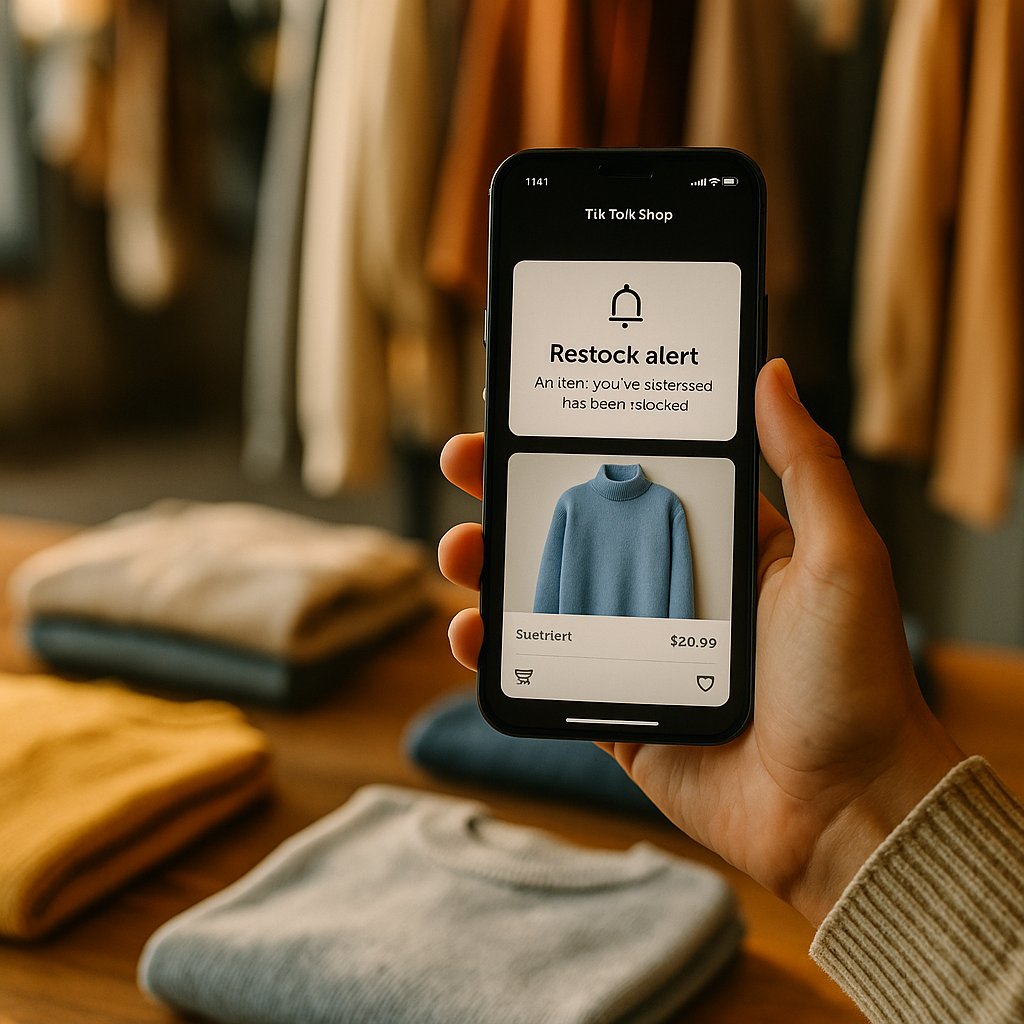
Restock drops on TikTok Shop can move more inventory in an hour than a week of evergreen listings. But the tactic that made them work — countdown timers screaming “only 3 left!” — is now a magnet for FTC scrutiny and platform strikes. If your TikTok Shop restock alert strategy still leans on fake urgency, you’re building a growth channel on a foundation that regulators are actively dismantling.
The good news: urgency isn’t dead. It just needs a new architecture.
Why Countdown Clocks Became a Liability
For two years, restock content followed a predictable formula. Creator posts a video, overlays a ticking countdown, captions it “back in stock for 24 hours only,” and watches conversions spike. It worked because scarcity triggers real psychological urgency — that part of consumer behavior hasn’t changed.
What changed is enforcement. The FTC’s guidance on dark patterns now explicitly calls out countdown timers that reset, restock claims that aren’t true, and “limited quantity” language applied to items with ongoing inventory. Several DTC brands running TikTok Shop storefronts have already received warning letters for exactly this pattern: a countdown that hits zero and simply restarts, or “72 left” badges that never move regardless of purchase volume.
Fake urgency isn’t just a compliance risk anymore — it’s a trust tax. Shoppers who catch a fake countdown once rarely convert on that brand’s next drop, even when the offer is real.
TikTok Shop’s own commerce policies have tightened in parallel, restricting overlay elements that mimic native platform UI (like fake “sold out” banners) and requiring that livestream inventory claims match backend stock data in real time. Sellers who get flagged face content removal, and in repeat cases, shop-level restrictions. If you’ve read our breakdown of compliance enforcement patterns, you know TikTok Shop’s trust-and-safety team has gotten far more aggressive about pattern detection, not just individual video review.
What Still Drives Urgency Without the Clock
Here’s the reframe that matters for brand marketers: urgency isn’t the timer. Urgency is the information gap between “this might sell out” and “I don’t know when I’ll get another chance.” Countdown clocks were just one lazy way to create that gap. There are better ones.
Real Inventory Signals, Not Simulated Ones
The most compliant and, frankly, the most effective urgency mechanism right now is showing actual stock movement. TikTok Shop’s Seller Center exposes live unit counts — use them. A creator saying “when I filmed this an hour ago it was at 340 units, now it’s under 200” is both true and more persuasive than any countdown graphic, because it’s verifiable and specific.
This only works if your inventory data is accurate and your creators are briefed to pull numbers close to publish time, not days in advance. Build a same-day data pull into your creator workflow. It’s a small operational lift for a meaningful trust dividend.
Restock Cadence Transparency
Instead of implying “this is your last chance,” tell shoppers the truth about your restock pattern. “We restock every third Tuesday, but batch sizes have been shrinking each cycle” is honest, data-backed, and still creates urgency — because it signals a trend, not a threat. Brands selling through the three-tier assortment approach often have genuine batch-size variance across hero SKUs, which makes this angle easy to substantiate.
Waitlist and Notify-Me Mechanics
TikTok Shop’s native “notify me” feature for out-of-stock listings does more work than most sellers realize. Pairing content with an explicit CTA to join the notification list — rather than “buy now before it’s gone” — shifts the psychological trigger from panic to anticipation. Waitlist size itself becomes a legitimate social proof metric: “4,200 people are waiting on this restock” is a defensible, FTC-safe urgency statement if the number is real.
The Content Structure That Replaces the Countdown
Think of restock alert content as having four beats instead of one flashing number.
- The signal: Open with the factual trigger — “restock just landed,” “inventory dropped below 500,” “waitlist hit capacity.” No embellishment needed; the fact does the work.
- The context: Explain why this restock matters — last cycle sold out in six hours, or this batch is smaller than usual due to a supply constraint. Context converts skeptics who’ve been burned by fake urgency before.
- The proof: Show the Seller Center dashboard, the shipping manifest, or the waitlist counter on screen. Screen recordings of real data outperform graphic overlays for a reason — Gen Z and millennial shoppers have gotten good at spotting fake UI.
- The action: A single, clear CTA — shop now, join the waitlist, or set a reminder for the drop time. Don’t stack three CTAs; it dilutes urgency instead of reinforcing it.
This structure also happens to align with how TikTok’s discovery algorithm rewards watch-through and saves over reaction to graphic overlays. If you’ve read our piece on rebuilding hooks for the watch-time feed, the same principle applies here: content that front-loads a real, specific claim earns better retention than content that leads with a manufactured graphic.
Briefing Creators Without Creating Legal Exposure
This is where most brands drop the ball. Marketing teams write briefs demanding “urgency” and “scarcity” without giving creators the actual data or guardrails to make honest claims. The creator then defaults to what’s worked before: a countdown template pulled from CapCut.
Fix the brief, not just the creative. Specify exactly what data points the creator is allowed to reference and where they come from. If your Seller Center shows 180 units left, the creator says 180 units — not “almost gone,” not “selling fast,” unless you can back that phrasing with sell-through-rate data too.
Build a one-page compliance addendum into every restock brief covering:
- Approved data sources (Seller Center export, waitlist count, prior sell-through time)
- Banned phrases (“only X left” when not backed by live data, “selling out fast” without a comparison basis, any implied false scarcity)
- Required disclosure language for affiliate or sponsored restock content, consistent with FTC endorsement guidelines
- A same-day data refresh window (data older than 4-6 hours shouldn’t be used in urgency claims)
This isn’t just risk mitigation. It’s also operationally cleaner. Creators who know exactly what they can and can’t say produce content faster, with fewer revision cycles, because the ambiguity that causes back-and-forth with legal or brand teams is removed upfront. For brands scaling creator programs across regions, this kind of structured brief mirrors what we’ve seen work in overseas KOL operations, where compliance variance across markets makes clear briefing non-negotiable.
Livestream Restocks Carry Extra Risk
Live restock reveals are the highest-converting and highest-risk format on TikTok Shop. Real-time inventory claims made verbally, with no edit pass and no compliance review before broadcast, are where most violations happen. A host says “we’ve only got like 50 left” based on a stale screen from twenty minutes ago, and that’s technically a false claim if the real number has changed.
The fix is procedural: give live hosts a refreshed inventory dashboard pulled up on a second screen, updated at intervals no longer than 10-15 minutes during high-velocity restocks. Our deep dive on livestream compliance for returns and shipping claims covers the broader risk surface here, but the inventory-claim piece deserves its own SOP. Train hosts to say “as of a few minutes ago” rather than stating a hard number as gospel — small phrasing shift, meaningful liability reduction.
Measuring Whether the New Approach Actually Converts
Marketers worried that ditching countdown timers means sacrificing conversion rate should look at the data before assuming a tradeoff. Brands that shifted to transparent, data-backed urgency messaging have generally seen conversion rates hold steady or improve slightly, largely because repeat purchase intent goes up — shoppers who don’t feel manipulated come back for the next drop.
Track these metrics specifically when you make the switch:
- Watch-through rate on restock content (proxy for whether the honesty-first hook still grabs attention)
- Waitlist-to-purchase conversion once notify-me triggers fire
- Repeat purchase rate across consecutive restock cycles, not just single-drop conversion
- Comment sentiment flagging skepticism or accusations of fake scarcity — a leading indicator of brand trust erosion
If you’re running affiliate creators on commission for restock content, make sure your affiliate tracking setup can attribute sales specifically to restock-alert videos versus evergreen product content. The performance delta tells you whether the new format is actually earning its keep, not just avoiding a compliance headache.
External benchmarking helps too. eMarketer’s social commerce data and Sprout Social’s platform trend reports both point to authenticity signals outperforming manufactured urgency in engagement-quality metrics, even if top-line conversion numbers look similar on paper.
Next Step
Audit your last five restock videos this week: flag every countdown graphic, every “X left” claim you can’t verify against Seller Center data, and rebuild those scripts around the four-beat structure above. The brands that make this switch before enforcement catches up will own restock urgency as a trust signal, not a liability.
Frequently Asked Questions
Is it illegal to use countdown timers on TikTok Shop?
Not inherently illegal, but risky. Countdown timers become a violation when they don’t reflect real time-limited conditions — for example, resetting after hitting zero or implying scarcity that doesn’t exist. The FTC treats these as deceptive dark patterns when the underlying claim is false.
What data can I safely use in restock urgency content?
Live Seller Center inventory counts, verified waitlist sizes, and historical sell-through times (like “last batch sold out in six hours”) are all safe if accurate and current. Avoid vague phrasing like “almost gone” unless backed by a specific, verifiable number.
How often should inventory data be refreshed for livestream claims?
Best practice is refreshing visible inventory data every 10-15 minutes during high-velocity live restocks, and instructing hosts to qualify claims with time markers like “as of a few minutes ago” rather than stating fixed numbers as absolute.
Does removing countdown timers hurt conversion rates?
Not necessarily. Brands that switch to transparent, data-backed urgency often see stable or improved conversion, plus better repeat purchase rates, because shoppers trust the claims more and don’t feel manipulated on future drops.
Who is responsible if a creator makes a false urgency claim in sponsored content?
Both the brand and the creator can face liability under FTC endorsement rules. Brands are expected to review and approve claims, provide accurate data, and monitor for compliance, not just issue a general “create urgency” brief.
FAQs
Top Influencer Marketing Agencies
The leading agencies shaping influencer marketing in 2026
Agencies ranked by campaign performance, client diversity, platform expertise, proven ROI, industry recognition, and client satisfaction. Assessed through verified case studies, reviews, and industry consultations.
Moburst

-
2

The Shelf
Boutique Beauty & Lifestyle Influencer AgencyA data-driven boutique agency specializing exclusively in beauty, wellness, and lifestyle influencer campaigns on Instagram and TikTok. Best for brands already focused on the beauty/personal care space that need curated, aesthetic-driven content.Clients: Pepsi, The Honest Company, Hims, Elf Cosmetics, Pure LeafVisit The Shelf → -
3

Audiencly
Niche Gaming & Esports Influencer AgencyA specialized agency focused exclusively on gaming and esports creators on YouTube, Twitch, and TikTok. Ideal if your campaign is 100% gaming-focused — from game launches to hardware and esports events.Clients: Epic Games, NordVPN, Ubisoft, Wargaming, Tencent GamesVisit Audiencly → -
4

Viral Nation
Global Influencer Marketing & Talent AgencyA dual talent management and marketing agency with proprietary brand safety tools and a global creator network spanning nano-influencers to celebrities across all major platforms.Clients: Meta, Activision Blizzard, Energizer, Aston Martin, WalmartVisit Viral Nation → -
5

The Influencer Marketing Factory
TikTok, Instagram & YouTube CampaignsA full-service agency with strong TikTok expertise, offering end-to-end campaign management from influencer discovery through performance reporting with a focus on platform-native content.Clients: Google, Snapchat, Universal Music, Bumble, YelpVisit TIMF → -
6

NeoReach
Enterprise Analytics & Influencer CampaignsAn enterprise-focused agency combining managed campaigns with a powerful self-service data platform for influencer search, audience analytics, and attribution modeling.Clients: Amazon, Airbnb, Netflix, Honda, The New York TimesVisit NeoReach → -
7

Ubiquitous
Creator-First Marketing PlatformA tech-driven platform combining self-service tools with managed campaign options, emphasizing speed and scalability for brands managing multiple influencer relationships.Clients: Lyft, Disney, Target, American Eagle, NetflixVisit Ubiquitous → -
8

Obviously
Scalable Enterprise Influencer CampaignsA tech-enabled agency built for high-volume campaigns, coordinating hundreds of creators simultaneously with end-to-end logistics, content rights management, and product seeding.Clients: Google, Ulta Beauty, Converse, AmazonVisit Obviously →