


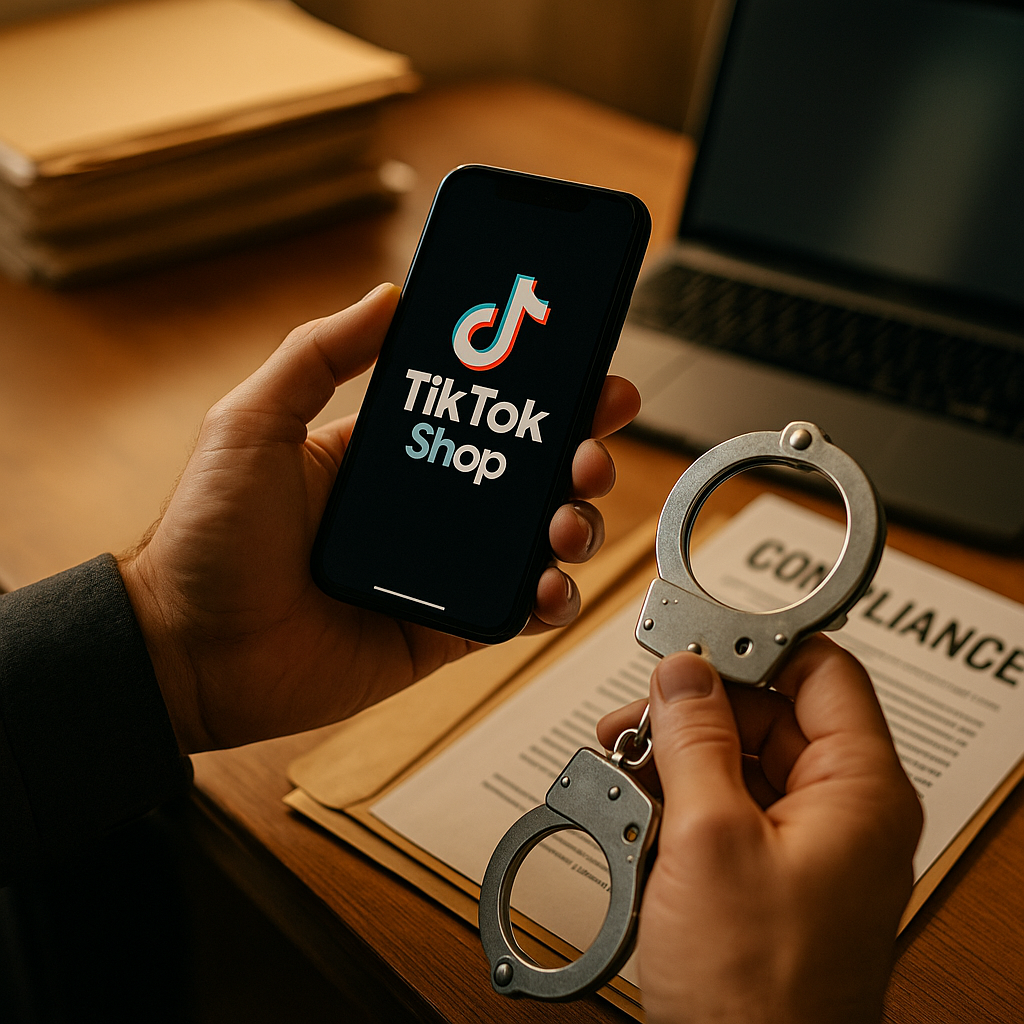
Roughly a third of TikTok Shop’s active sellers still haven’t completed Real IP merchant verification, according to seller-forum chatter and agency audits circulating this quarter. If that number holds, TikTok Shop’s real IP merchant verification freeze could wipe out listings for thousands of brands before Q1 2027 even gets started. Not hypothetical. Not distant. This is a compliance deadline with teeth.
What the Freeze Actually Does
TikTok Shop’s Real IP Merchant Program isn’t new. It launched to crack down on shell sellers, IP-infringing resellers, and dropshippers hiding behind fake business credentials. We covered the early rollout data in our piece on the Real IP merchant program’s first six months, and the pattern was clear even then: verification wasn’t optional, it was a slow-motion gate closing on unverified accounts.
What changes now is enforcement velocity. Instead of flagging non-compliant merchants for manual review, TikTok Shop is moving toward automatic listing suspension for any seller who hasn’t submitted verified business registration, trademark ownership documents, or authorized distributor agreements by the Q1 2027 cutoff. No warning grace period. No soft rollout. Your catalog goes dark, and your affiliate links break overnight.
Brands treating Real IP verification as “eventually” paperwork are the ones most likely to wake up to a suspended storefront in Q1. Verification lag is now a revenue risk, not an admin task.
Why This Matters More Than Past Policy Shifts
TikTok Shop has rolled out plenty of policy changes. Most brands shrugged them off because enforcement was inconsistent. This one is different for three reasons.
- It’s tied to legal liability, not just platform preference. TikTok is responding to counterfeit and trademark complaints, some of which touch FTC-adjacent territory. That means the platform has external pressure to actually enforce this, not just announce it.
- It’s automated. Manual review queues are slow and forgiving. Automated suspension triggers are not. If your documentation doesn’t match TikTok’s verification schema exactly, you’re flagged.
- It affects affiliate and livestream revenue simultaneously. A suspended listing doesn’t just disappear from search, it also breaks every creator affiliate link pointing to that product, killing commission payouts mid-campaign.
If you’ve built livestream shopping segments around specific SKUs, per our breakdown in livestream segments that capture impulse buys, a suspended product mid-stream is a worst-case scenario. Hosts can’t sell what doesn’t exist in the catalog anymore.
Who’s Actually at Risk
Not every merchant is exposed equally. Three categories carry the highest risk profile heading into Q1:
- White-label and private-label sellers who haven’t updated trademark registration since launch. If your brand name isn’t formally trademarked in the market you’re selling into, you’re vulnerable regardless of how long you’ve operated.
- Multi-brand agencies managing shops on behalf of clients. Verification is tied to the legal entity operating the store, not the agency running it. If client paperwork is outdated or mismatched, the agency inherits the suspension risk.
- Cross-border sellers using regional fulfillment partners without matching business registration in the destination market. TikTok’s verification schema increasingly checks for jurisdictional consistency, not just document existence.
Domestic, single-brand sellers with existing trademark registration are lowest risk, but “lowest risk” still means “verify anyway.” TikTok’s system doesn’t grade on a curve.
The Verification Checklist, Realistically
Here’s what actually needs to be current in your TikTok Seller Center before the freeze hits:
- Business registration documents matching the legal entity name on your Shop account, not a DBA or old parent company name.
- Trademark certificates for any branded product line, especially private label. Pending applications may not satisfy the requirement, registered marks are safer.
- Authorized reseller or distributor agreements if you’re selling a third-party brand, not manufacturing it yourself.
- Matching business address across your Shop profile, tax documentation, and shipping/fulfillment records. Mismatches are a common automated flag.
- Updated banking and payout information tied to the verified entity, since TikTok cross-references financial and legal identity data.
-
2

The Shelf
Boutique Beauty & Lifestyle Influencer AgencyA data-driven boutique agency specializing exclusively in beauty, wellness, and lifestyle influencer campaigns on Instagram and TikTok. Best for brands already focused on the beauty/personal care space that need curated, aesthetic-driven content.Clients: Pepsi, The Honest Company, Hims, Elf Cosmetics, Pure LeafVisit The Shelf → -
3

Audiencly
Niche Gaming & Esports Influencer AgencyA specialized agency focused exclusively on gaming and esports creators on YouTube, Twitch, and TikTok. Ideal if your campaign is 100% gaming-focused — from game launches to hardware and esports events.Clients: Epic Games, NordVPN, Ubisoft, Wargaming, Tencent GamesVisit Audiencly → -
4

Viral Nation
Global Influencer Marketing & Talent AgencyA dual talent management and marketing agency with proprietary brand safety tools and a global creator network spanning nano-influencers to celebrities across all major platforms.Clients: Meta, Activision Blizzard, Energizer, Aston Martin, WalmartVisit Viral Nation → -
5

The Influencer Marketing Factory
TikTok, Instagram & YouTube CampaignsA full-service agency with strong TikTok expertise, offering end-to-end campaign management from influencer discovery through performance reporting with a focus on platform-native content.Clients: Google, Snapchat, Universal Music, Bumble, YelpVisit TIMF → -
6

NeoReach
Enterprise Analytics & Influencer CampaignsAn enterprise-focused agency combining managed campaigns with a powerful self-service data platform for influencer search, audience analytics, and attribution modeling.Clients: Amazon, Airbnb, Netflix, Honda, The New York TimesVisit NeoReach → -
7

Ubiquitous
Creator-First Marketing PlatformA tech-driven platform combining self-service tools with managed campaign options, emphasizing speed and scalability for brands managing multiple influencer relationships.Clients: Lyft, Disney, Target, American Eagle, NetflixVisit Ubiquitous → -
8

Obviously
Scalable Enterprise Influencer CampaignsA tech-enabled agency built for high-volume campaigns, coordinating hundreds of creators simultaneously with end-to-end logistics, content rights management, and product seeding.Clients: Google, Ulta Beauty, Converse, AmazonVisit Obviously →
Run this as an actual audit, not a checklist you eyeball once. Pull every document, compare it line by line against what’s on file in Seller Center. Discrepancies as small as a mismatched suite number have triggered flags in past enforcement waves, according to seller reports on TikTok’s own TikTok for Business platform.
Operational Fallout: What Happens to Your Creator Program
Suspension doesn’t just hurt your storefront. It cascades into every creator relationship built on top of it.
Affiliate commissions stop tracking the moment a product is delisted, even retroactively in some cases. If you’ve built out a robust affiliate structure using the guidance in real-time commission tracking, a frozen listing breaks that entire pipeline. Creators who were mid-campaign lose earned commissions, and trust erodes fast. Influencer relationships are built on reliable payouts. Nothing burns goodwill faster than a broken commission chain that isn’t the creator’s fault.
There’s also the discovery-and-reach angle. TikTok’s algorithm rewards consistency and product tag activity, something we detailed in how product tags boost organic reach. A suspended SKU doesn’t just vanish, it resets whatever algorithmic momentum you built. Re-verification and re-listing means starting the discovery curve over, not picking up where you left off.
A single suspended SKU can undo months of algorithmic momentum built through consistent tagging and creator activity. Recovery isn’t instant, it’s a cold restart.
Building a Freeze-Proof Operating Rhythm
Treat verification like you’d treat any compliance deadline with revenue consequences, meaning it needs an owner, a timeline, and a backup plan.
Assign ownership now. Someone on your team, or your agency of record, needs explicit responsibility for TikTok Shop compliance status. Not “marketing handles it generally.” A named person checking Seller Center verification status weekly through Q1.
Audit before TikTok audits you. Pull your current verification status today. Don’t wait for a notification email, TikTok’s communication on enforcement timing has historically been inconsistent across regions and seller tiers.
Diversify platform dependency. This freeze is a reminder that single-platform commerce concentration is a structural risk, not just a TikTok-specific one. Brands leaning entirely on TikTok Shop should be running comparative analysis against other checkout paths, something we explored in Instagram checkout versus TikTok and YouTube. Redundancy isn’t paranoia, it’s operational insurance.
Communicate proactively with affiliate creators. If there’s any chance a SKU could be affected, tell your creator roster now. Silence during a suspension event damages relationships far more than an early heads-up ever could.
Industry data from eMarketer continues to show social commerce as one of the fastest-growing retail channels, which is exactly why platforms like TikTok are tightening compliance infrastructure. Growth invites scrutiny. Scrutiny invites regulation. Brands that treat verification as a growth-stage tax, rather than busywork, will be the ones still selling in Q1.
The Bigger Pattern Behind the Policy
This freeze fits a broader trend across social platforms tightening operational guardrails, not loosening them. We’ve tracked similar shifts with countdown timer restrictions tied to FTC scarcity risk and livestream script structures designed to avoid regulatory exposure. TikTok Shop is maturing into a regulated commerce channel, not a loosely governed content feed with a checkout button bolted on.
That maturity is good for brands playing by the rules. It’s existential for brands that aren’t.
Consult the FTC’s guidance on endorsements and commerce disclosures alongside your TikTok verification audit. Overlapping compliance requirements are becoming the norm, not the exception, across social commerce.
Frequently Asked Questions
FAQs
What is TikTok Shop’s Real IP merchant verification freeze?
It’s an enforcement escalation where TikTok Shop moves from manual compliance review to automatic listing suspension for merchants who haven’t completed Real IP verification, including business registration and trademark documentation, ahead of the Q1 2027 deadline.
Who is most at risk of listing suspension?
White-label sellers without registered trademarks, agencies managing shops with outdated client paperwork, and cross-border sellers with mismatched jurisdictional business records face the highest exposure.
What happens to affiliate commissions if a listing is suspended?
Commission tracking stops the moment a product is delisted, and in some cases payouts are affected retroactively. Creators mid-campaign can lose earned commissions through no fault of their own.
How can brands check their verification status before the freeze?
Log into TikTok Seller Center and review the Real IP verification section directly rather than waiting for a platform notification, since enforcement communication has been inconsistent across regions.
Does this affect creators directly, or only merchants?
Verification obligations sit with the merchant, but creators feel the impact through broken affiliate links, paused livestream product tags, and interrupted commission payouts.
Should brands reduce reliance on TikTok Shop because of this policy?
Not necessarily abandon it, but diversifying checkout and social commerce channels reduces the operational risk of depending on a single platform’s compliance timeline.
Next step: Pull your TikTok Seller Center verification status this week, not next quarter, and assign one accountable owner to track it through Q1. The brands still selling after the freeze will be the ones who treated this as a deadline, not a suggestion.
Top Influencer Marketing Agencies
The leading agencies shaping influencer marketing in 2026
Agencies ranked by campaign performance, client diversity, platform expertise, proven ROI, industry recognition, and client satisfaction. Assessed through verified case studies, reviews, and industry consultations.
Moburst
