


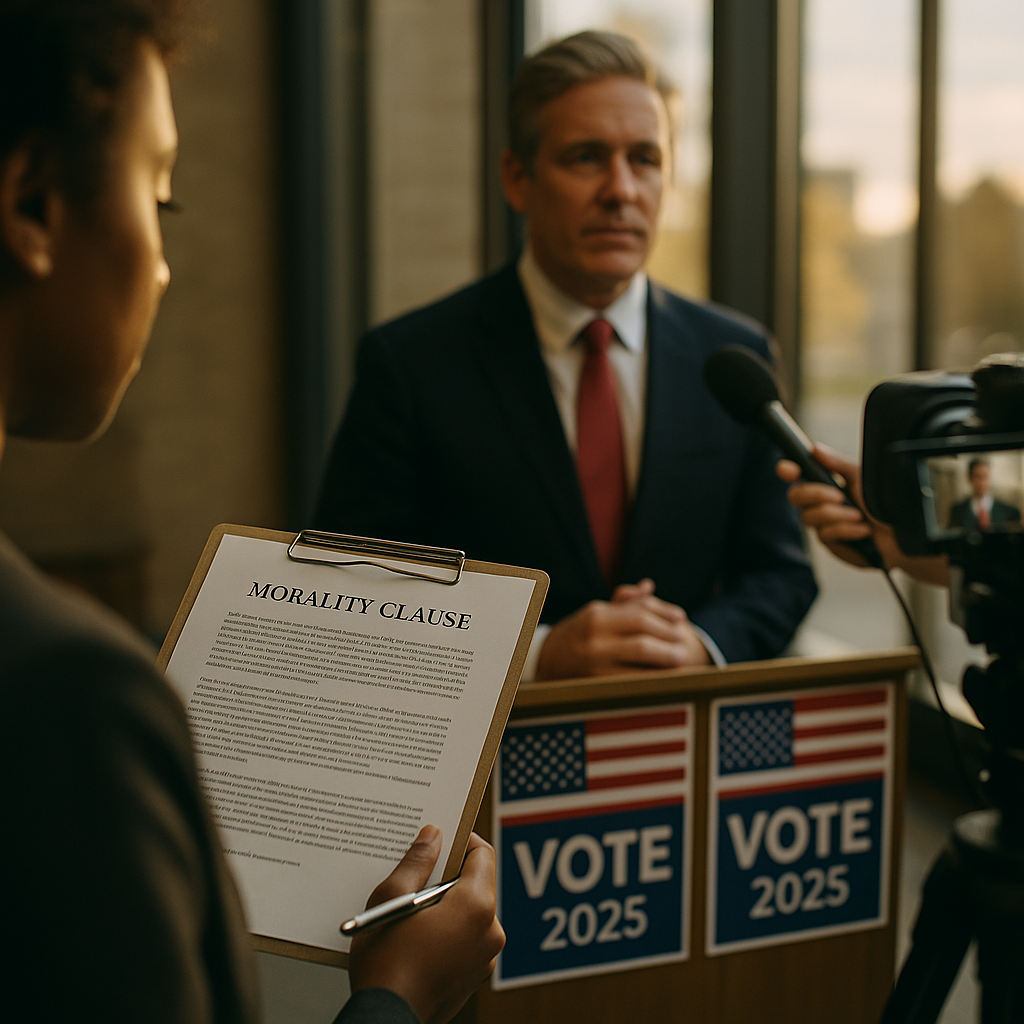
Handling morality clauses in political election cycles has become increasingly complex, with heightened scrutiny of candidates’ personal and professional conduct. Political campaigns, compliance teams, and candidates themselves must navigate these stipulations expertly. Understanding how to approach morality clauses ensures both legal compliance and public trust—so what strategies work best as the stakes rise in 2025?
Understanding Morality Clauses in Campaign Agreements
Morality clauses are contractual provisions outlining acceptable (and unacceptable) behavior by political candidates and campaign staff. In an election cycle, these clauses often cover areas like fraud, criminal behavior, discrimination, and behavior that could damage a party’s or sponsor’s reputation. The rise of digital media and instant news means content—no matter how far in the past—can resurface, making morality clause enforcement more critical than ever.
Political parties and campaign committees rely on morality clauses to protect their reputations and maintain voter trust. In 2025, many campaigns include these stipulations not just in candidate contracts, but also for senior advisors and affiliated spokespersons. The clauses serve both as deterrents and as legal backstops should damaging behavior be exposed.
Understanding the breadth and intent of these clauses is essential before signing any campaign agreement. A recent survey by the Campaign Legal Center indicates that over 72% of state-level parties have now adopted some form of morality clause, reflecting growing concern over reputational risk management in politics.
Key Legal Considerations and Risks of Morality Clauses
Morality clauses intersect with legal standards around contracts, employment law, and even constitutional rights. For candidates and their teams, the main risks include vague language, uneven enforcement, and potential legal disputes. In 2025, legal experts recommend clear, precise drafting to minimize ambiguity and ensure enforceability.
- Vagueness: Unclear terms like “immoral behavior” or “public scandal” leave interpretation open, exposing candidates to arbitrary or politically motivated enforcement.
- Due process: It’s vital that clauses outline how violations are investigated, who decides, and whether there is an appeals process.
- First Amendment concerns: Especially in the US, overly broad morality clauses may raise free speech issues if they attempt to police constitutionally-protected expression.
Consulting with an experienced attorney is essential before agreeing to any morality clause. Legal counsel can help review drafts, ensure terms are fair and defensible, and identify negotiating leverage for the candidate.
Strategic Approaches for Candidates and Campaigns
The strategic approach to handling morality clauses begins well before signing any documents—through self-assessment, transparency, and proactive communications. In an era where opposition research teams and journalists can unearth decades-old posts or incidents, advance preparation is critical to minimizing risk.
- Self-audit: Candidates should conduct thorough background checks on themselves and key staff, assessing any actions or history that could be interpreted as violation of a morality clause.
- Disclose early: When possible, disclose past incidents that might come to light, establishing honesty and allowing for narrative control rather than reaction.
- Negotiate terms: Where possible, seek to limit the scope of morality clauses—clarifying what constitutes a violation and narrowing the time frame to recent, relevant behavior.
- Establish internal protocols: Campaigns should have clear processes for responding to alleged breaches, including media strategies and internal investigations before public statements.
In 2025, digital records from social media, past employment, and public commentary form a significant part of the due diligence process. Many campaigns now retain professional risk mitigation consultants to advise on best practices around candidate vetting and ongoing reputation management.
Impact of Morality Clauses on Political Messaging
Morality clauses can directly affect a campaign’s messaging and public image. When candidates or staff are affected by these clauses—whether through controversy or legal dispute—it can shift the narrative away from policy and priorities to personal conduct. Media outlets cover these incidents intensely, often dominating headlines and social media.
In 2025, the public increasingly values authenticity and accountability. Campaigns that handle morality clause breaches with transparency and decisive action can sometimes mitigate reputational damage. For example, parties that proactively address breaches, communicate clear next steps, and set ethical benchmarks are more likely to regain public trust than those who hesitate or obfuscate.
The integration of ethics into campaign narratives is more than defensive—it shapes the brand of the candidate. Voters are primed to scrutinize both adherence to and breaches of morality clauses, and how teams handle such issues signals leadership and integrity.
Best Practices for Ethical Compliance Throughout the Election Cycle
Staying proactive on morale and ethics is non-negotiable in modern elections. Instead of viewing morality clauses as hurdles, campaigns should see them as frameworks for sustained integrity. Implementing best practices reduces risk and positions the campaign as forward-thinking and responsible.
- Regular training: Conduct ethics and compliance training for all staff, emphasizing relevant behaviors and expectations.
- Clear reporting channels: Encourage staff to raise concerns early via anonymous reporting mechanisms, without fear of reprisal.
- Continuous monitoring: Use digital tools to monitor media mentions and social media for emerging risks related to conduct or public perception.
- Independent review: Engage neutral ethics advisors to periodically assess campaign practices against leading standards.
- Transparent consequences: Communicate clearly, internally and externally, about actions taken following breaches of morality clauses.
Having these systems visible to the public helps boost voter confidence. In 2025, voters want assurance that parties not only talk about ethics but back up words with sustained, verifiable action.
Morality Clauses and Future Election Trends
The prominence of morality clauses is only expected to grow beyond 2025, alongside increased scrutiny from regulators and the voting public. New areas of concern—such as AI-generated content, deepfakes, and digital privacy breaches—will likely be addressed in future iterations of morality clauses and compliance policies.
Parties and campaigns able to adapt quickly to this evolving landscape will be best positioned for success. By viewing morality clauses as tools for positive change, rather than last-minute hurdles, campaigns can foster cultures of ethical leadership that resonate with modern voters.
Ultimately, the ability to handle these clauses effectively will remain a key differentiator in high-stakes political environments.
FAQs: Morality Clauses in Political Election Cycles
-
What is a morality clause in a political campaign?
A morality clause is a contract provision requiring candidates or staff to uphold certain standards of conduct. Violations, such as public scandal or illegal behavior, can trigger penalties or removal from the campaign.
-
How can candidates protect themselves from unfair morality clauses?
Work with a qualified attorney to ensure clear, fair terms. Negotiate definitions, ensure due process provisions, and clarify what constitutes a breach to forgo ambiguous or overly broad clauses.
-
Do morality clauses infringe on free speech?
If drafted too broadly, morality clauses may raise free speech concerns. However, carefully worded clauses that focus on specific, unlawful, or widely condemned conduct typically stand up to legal scrutiny.
-
What happens if someone violates a morality clause during an election?
The consequences depend on the contract but can include removal from the campaign, termination of agreements, or public censure. Transparent procedures and communication can help manage fallout.
-
Will morality clauses become stricter in future election cycles?
Given current trends like digital transparency and public demand for accountability, it’s likely morality clauses will become both more precise and more prominent in future campaign documentation.
In summary, handling morality clauses in political election cycles requires careful legal review, ethical proactivity, and transparent communication. By addressing these contractual obligations with clarity and foresight, campaigns can protect their reputation, win voter trust, and navigate the high-stakes world of modern elections with integrity in 2025 and beyond.
Top Influencer Marketing Agencies
The leading agencies shaping influencer marketing in 2026
Agencies ranked by campaign performance, client diversity, platform expertise, proven ROI, industry recognition, and client satisfaction. Assessed through verified case studies, reviews, and industry consultations.
Moburst

-
2

The Shelf
Boutique Beauty & Lifestyle Influencer AgencyA data-driven boutique agency specializing exclusively in beauty, wellness, and lifestyle influencer campaigns on Instagram and TikTok. Best for brands already focused on the beauty/personal care space that need curated, aesthetic-driven content.Clients: Pepsi, The Honest Company, Hims, Elf Cosmetics, Pure LeafVisit The Shelf → -
3

Audiencly
Niche Gaming & Esports Influencer AgencyA specialized agency focused exclusively on gaming and esports creators on YouTube, Twitch, and TikTok. Ideal if your campaign is 100% gaming-focused — from game launches to hardware and esports events.Clients: Epic Games, NordVPN, Ubisoft, Wargaming, Tencent GamesVisit Audiencly → -
4

Viral Nation
Global Influencer Marketing & Talent AgencyA dual talent management and marketing agency with proprietary brand safety tools and a global creator network spanning nano-influencers to celebrities across all major platforms.Clients: Meta, Activision Blizzard, Energizer, Aston Martin, WalmartVisit Viral Nation → -
5

The Influencer Marketing Factory
TikTok, Instagram & YouTube CampaignsA full-service agency with strong TikTok expertise, offering end-to-end campaign management from influencer discovery through performance reporting with a focus on platform-native content.Clients: Google, Snapchat, Universal Music, Bumble, YelpVisit TIMF → -
6

NeoReach
Enterprise Analytics & Influencer CampaignsAn enterprise-focused agency combining managed campaigns with a powerful self-service data platform for influencer search, audience analytics, and attribution modeling.Clients: Amazon, Airbnb, Netflix, Honda, The New York TimesVisit NeoReach → -
7

Ubiquitous
Creator-First Marketing PlatformA tech-driven platform combining self-service tools with managed campaign options, emphasizing speed and scalability for brands managing multiple influencer relationships.Clients: Lyft, Disney, Target, American Eagle, NetflixVisit Ubiquitous → -
8

Obviously
Scalable Enterprise Influencer CampaignsA tech-enabled agency built for high-volume campaigns, coordinating hundreds of creators simultaneously with end-to-end logistics, content rights management, and product seeding.Clients: Google, Ulta Beauty, Converse, AmazonVisit Obviously →