


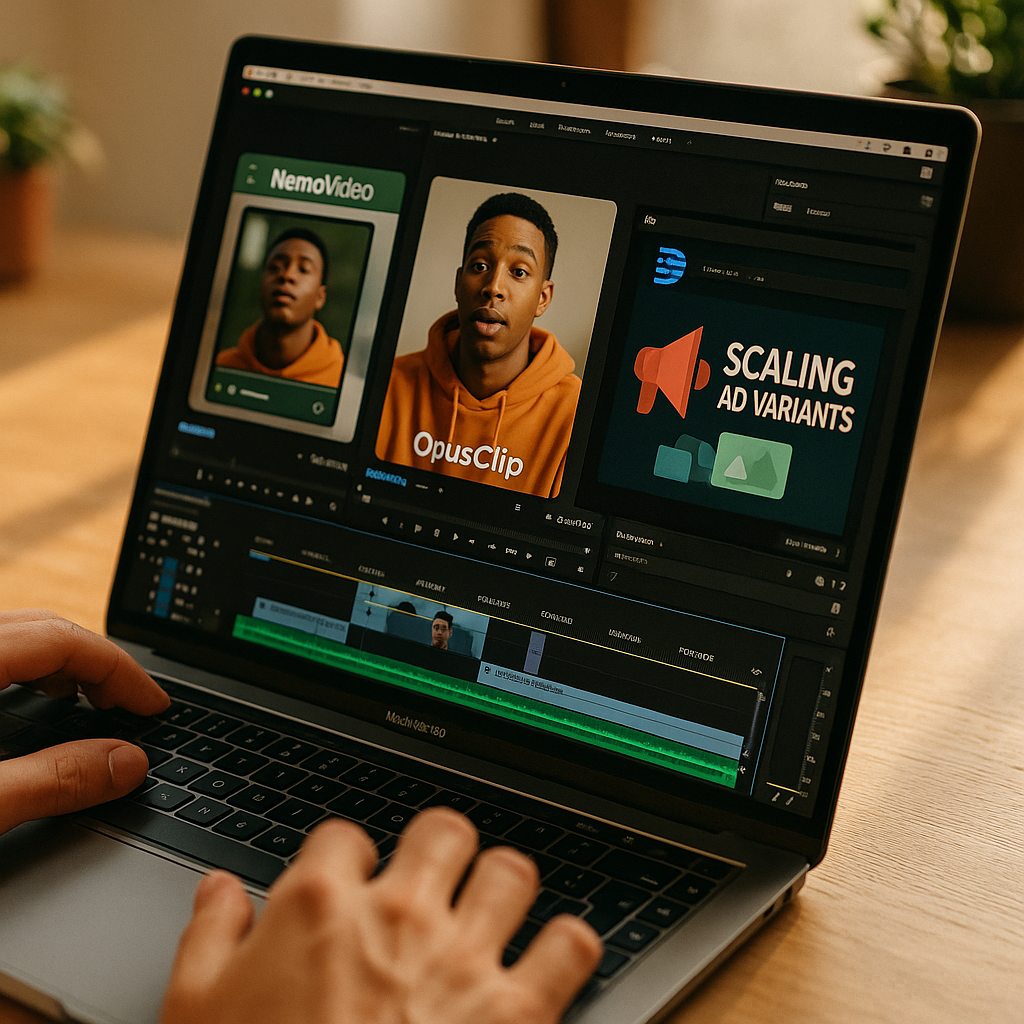
One product shoot. Eleven markets. Two hundred and forty ad variants due by Friday. If that sentence gives you a headache, you’re not alone — and it’s exactly why NemoVideo vs Opus Clip vs Descript has become one of the most searched comparisons among performance marketers this quarter. Brands are done paying for reshoots. They want one asset, infinite permutations.
The promise is seductive: shoot once, localize everywhere, cut production spend by 70% or more. But the three tools people lump together for this job actually solve different problems. Confuse them and you’ll either overpay for capability you don’t need, or underbuy and blow a launch deadline.
Why “one shoot, hundreds of variants” is suddenly the brief
Performance teams got squeezed from two directions. Ad fatigue is faster than ever — eMarketer has repeatedly flagged declining creative shelf life on paid social, with some verticals seeing performance drop-off inside two weeks. At the same time, platforms reward variant volume. Meta’s Advantage+ and TikTok’s Smart Performance campaigns both perform better with more creative inputs to test against, according to guidance from Meta Business and TikTok for Business.
Add localization requirements — different languages, different cultural cues, different compliance rules by region — and the math stops working with a traditional shoot-per-market model. A single global campaign that once required a dozen shoots now gets attempted with one hero asset and a stack of AI tools stitching, dubbing, and reformatting it into local variants.
The real cost of manual video localization isn’t the editing time — it’s the opportunity cost of shipping fewer test variants than your ad platform’s algorithm needs to optimize efficiently.
What each tool actually does (they’re not interchangeable)
This is where most comparison articles get lazy and treat these three as competitors in the same lane. They’re not. Here’s the honest breakdown.
NemoVideo is built specifically for ad variant generation from a source asset — think product shots or short video, spun into dozens of aspect ratios, hooks, captions, and localized voiceovers aimed at paid social formats. It leans heavily on templated ad structures rather than long-form editing, which makes it fast but occasionally formulaic if you don’t feed it varied creative direction.
Opus Clip was built for a different job entirely: turning long-form video (podcasts, webinars, live streams) into short clips for organic and influencer distribution. Its core strength is identifying the “viral moment” inside a long recording using engagement-prediction scoring. Using it to localize a product shoot into paid ad variants is possible, but it’s working against the tool’s original design intent.
Descript is a full editing environment with AI features layered in — text-based video editing, AI voice cloning (“Overdub”), and translation/dubbing via its Underlord feature set. It’s the most flexible of the three, but flexibility means more manual assembly. Descript won’t auto-generate 200 ad variants for you; it gives you the toolkit to build them faster than in Premiere or After Effects.
If your brief is genuinely “one shoot, hundreds of localized paid ad variants,” NemoVideo is closest to purpose-built for that outcome. Opus Clip and Descript are better thought of as adjacent tools that can be forced into the job with more manual orchestration.
Localization is the part everyone underestimates
Translation is the easy 20%. The hard 80% is cultural adaptation: color psychology, gesture norms, local regulatory disclosures, currency and pricing formats, even which product benefit to lead with in different markets. None of these three tools solve that problem fully on their own.
NemoVideo’s localization features handle voiceover translation and on-screen text swaps reasonably well for major languages, but nuance in idiomatic markets (Brazilian Portuguese vs. European Portuguese, for instance) still needs human review. Descript’s dubbing, powered by third-party translation APIs under the hood, has similar limitations — it’s fast, not infallible.
Opus Clip doesn’t really position itself as a localization tool at all; if you’re using it for multi-market ad variants, you’re layering translation work on top of it manually.
This matters for compliance too. The FTC and the ICO both have jurisdiction-specific disclosure requirements for advertising, and AI-translated ad copy has a track record of missing required disclaimers when brands assume “translated” means “compliant.” Build a human legal review step into your workflow regardless of which tool generates the draft variants. For more on how approval workflows need to evolve around AI-generated creative, see this breakdown of content credential requirements.
The cost-per-variant math brands actually care about
Here’s the question every CMO asks in the vendor call: what does this actually cost per usable variant, not per subscription seat?
Rough benchmarks from teams running this workflow at scale:
- Traditional agency reshoot per market: $3,000–$15,000 depending on production complexity, plus 2-4 week turnaround.
- NemoVideo-style AI variant generation: Often falls into a credits-or-subscription model where marginal cost per variant drops sharply after the first dozen, sometimes under $10 per finished variant once you’re past setup.
- Descript-based manual localization: Lower software cost, but higher labor cost — an editor still assembles each variant, so cost-per-variant scales with headcount hours, not just software fees.
- Opus Clip repurposed for ads: Cheapest per-clip if you’re already using it for organic content, but quality control overhead is higher since it wasn’t built for compliance-sensitive paid placements.
The trap is comparing subscription price tags instead of fully-loaded cost per finished, compliant, on-brand variant. A cheaper tool that needs three rounds of manual fixes per output isn’t actually cheaper. This is the same evaluation error we flagged in our look at AI ad-copy generators and true cost-per-variant — the sticker price rarely tells the real story.
If your team is still counting cost-per-seat instead of cost-per-approved-variant, you’re measuring the wrong thing entirely.
Where each tool breaks down at scale
Nothing scales cleanly to “hundreds of variants” without hitting friction. Know the failure modes before you commit budget.
NemoVideo’s templated approach can produce creative sameness across variants if you don’t rotate hooks and visual treatments deliberately — the algorithm rewards novelty, and a wall of near-identical ads trained on the same template will plateau fast.
Descript’s manual assembly model means “hundreds of variants” really means hundreds of editor-hours unless you build reusable project templates and delegate heavily. It’s a fantastic tool for a lean team producing dozens of high-quality variants; it’s a bottleneck if you’re trying to brute-force volume.
Opus Clip’s engagement-prediction scoring is tuned for organic virality signals, not paid conversion signals. A clip Opus Clip ranks highly for shareability might underperform on cost-per-acquisition because it’s optimizing for a different outcome than your media buyer needs.
None of this means these tools are bad. It means the “single shoot to hundreds of ads” pitch works best when the tool’s core design matches your actual distribution channel and KPI.
A practical evaluation framework before you sign anything
Run any candidate tool — these three or others — through the same five questions we’d apply to any AI ad variant platform:
- What’s the actual output format range? Vertical, square, horizontal, plus platform-native specs for Meta, TikTok, YouTube Shorts, and connected TV if relevant.
- How does localization actually work under the hood? Ask which translation/dubbing engine powers it, and get a sample in a non-English market before buying.
- What’s the human-in-the-loop requirement per variant? Zero-touch sounds great in a demo; find out what breaks that promise in production.
- Does it integrate with your DAM and approval workflow? A tool that generates 200 variants but dumps them into a folder with no version control creates a new bottleneck downstream.
- What does compliance review actually catch? Ask for a documented case where the tool’s output required legal correction, and how that was flagged.
We go deeper on this scoring approach in our full guide to evaluating AI ad variant platforms before you scale, and if you’re specifically choosing between newer entrants in this category, the head-to-head on GetHookd, Runable and NemoVideo is worth reading alongside this one.
So which one should you actually pick?
If your brief is genuinely “hundreds of localized paid ad variants from one shoot,” start with NemoVideo and treat Descript as your finishing tool for the handful of hero variants that need frame-perfect polish. Use Opus Clip separately for what it’s actually good at: mining long-form content (founder interviews, behind-the-scenes shoot footage, UGC testimonials) for organic and influencer-adjacent clips that support the paid push rather than replace it.
Running all three in a coordinated pipeline — NemoVideo for volume, Descript for polish, Opus Clip for organic support — is increasingly common among teams that have the operational maturity to manage multiple tools. Teams without that maturity should pick one primary tool and accept its constraints rather than stitching together a fragile multi-tool workflow that nobody fully owns.
Product demo and shoot-derived creative has its own evaluation quirks worth understanding before you lock in a vendor; our framework for AI product demo video tools covers several of the same red flags that apply here.
FAQs
Frequently Asked Questions
Can NemoVideo, Opus Clip, and Descript replace a localization agency entirely?
Not entirely. They dramatically reduce the volume of manual translation and editing work, but cultural adaptation, legal disclosure review, and idiomatic accuracy still benefit from human localization expertise, especially in regulated categories like finance, health, or alcohol.
Which tool is cheapest for producing hundreds of ad variants?
Cost per subscription seat isn’t the right metric. Compare cost-per-approved-variant instead: NemoVideo’s credit-based model tends to scale more predictably for high-volume output, while Descript’s lower software cost can be offset by higher labor hours for manual assembly.
Does Opus Clip work for paid social ads, or just organic content?
Opus Clip was designed for repurposing long-form content into short organic clips using virality-prediction scoring. It can be adapted for paid ads, but its scoring model optimizes for shareability rather than conversion, so results for direct-response campaigns are less reliable than purpose-built ad variant tools.
How accurate is AI dubbing and translation in these tools for non-English markets?
Accuracy is generally strong for major languages (Spanish, French, German, Portuguese) but drops for idiomatic or regional dialects. Brands running multi-market campaigns should budget for a human review pass rather than trusting fully automated translation output for launch-ready assets.
What compliance risks come with AI-generated localized ad variants?
The main risks are missing region-specific disclosure requirements, mistranslated claims that create regulatory exposure, and inconsistent brand messaging across markets. Regulators like the FTC and ICO hold advertisers responsible for compliance regardless of whether copy was AI-generated.
How many ad variants should a brand realistically test per product launch?
There’s no universal number, but most performance teams running Advantage+ or TikTok Smart Performance campaigns see better optimization with at least 10-20 distinct variants per ad set, scaling higher for multi-market launches where each locale needs its own creative set.
Pick the tool that matches your actual bottleneck, not the flashiest demo. If localization compliance is your real risk, build the human review step in before you scale volume, not after the first legal complaint.
Top Influencer Marketing Agencies
The leading agencies shaping influencer marketing in 2026
Agencies ranked by campaign performance, client diversity, platform expertise, proven ROI, industry recognition, and client satisfaction. Assessed through verified case studies, reviews, and industry consultations.
Moburst

-
2

The Shelf
Boutique Beauty & Lifestyle Influencer AgencyA data-driven boutique agency specializing exclusively in beauty, wellness, and lifestyle influencer campaigns on Instagram and TikTok. Best for brands already focused on the beauty/personal care space that need curated, aesthetic-driven content.Clients: Pepsi, The Honest Company, Hims, Elf Cosmetics, Pure LeafVisit The Shelf → -
3

Audiencly
Niche Gaming & Esports Influencer AgencyA specialized agency focused exclusively on gaming and esports creators on YouTube, Twitch, and TikTok. Ideal if your campaign is 100% gaming-focused — from game launches to hardware and esports events.Clients: Epic Games, NordVPN, Ubisoft, Wargaming, Tencent GamesVisit Audiencly → -
4

Viral Nation
Global Influencer Marketing & Talent AgencyA dual talent management and marketing agency with proprietary brand safety tools and a global creator network spanning nano-influencers to celebrities across all major platforms.Clients: Meta, Activision Blizzard, Energizer, Aston Martin, WalmartVisit Viral Nation → -
5

The Influencer Marketing Factory
TikTok, Instagram & YouTube CampaignsA full-service agency with strong TikTok expertise, offering end-to-end campaign management from influencer discovery through performance reporting with a focus on platform-native content.Clients: Google, Snapchat, Universal Music, Bumble, YelpVisit TIMF → -
6

NeoReach
Enterprise Analytics & Influencer CampaignsAn enterprise-focused agency combining managed campaigns with a powerful self-service data platform for influencer search, audience analytics, and attribution modeling.Clients: Amazon, Airbnb, Netflix, Honda, The New York TimesVisit NeoReach → -
7

Ubiquitous
Creator-First Marketing PlatformA tech-driven platform combining self-service tools with managed campaign options, emphasizing speed and scalability for brands managing multiple influencer relationships.Clients: Lyft, Disney, Target, American Eagle, NetflixVisit Ubiquitous → -
8

Obviously
Scalable Enterprise Influencer CampaignsA tech-enabled agency built for high-volume campaigns, coordinating hundreds of creators simultaneously with end-to-end logistics, content rights management, and product seeding.Clients: Google, Ulta Beauty, Converse, AmazonVisit Obviously →