


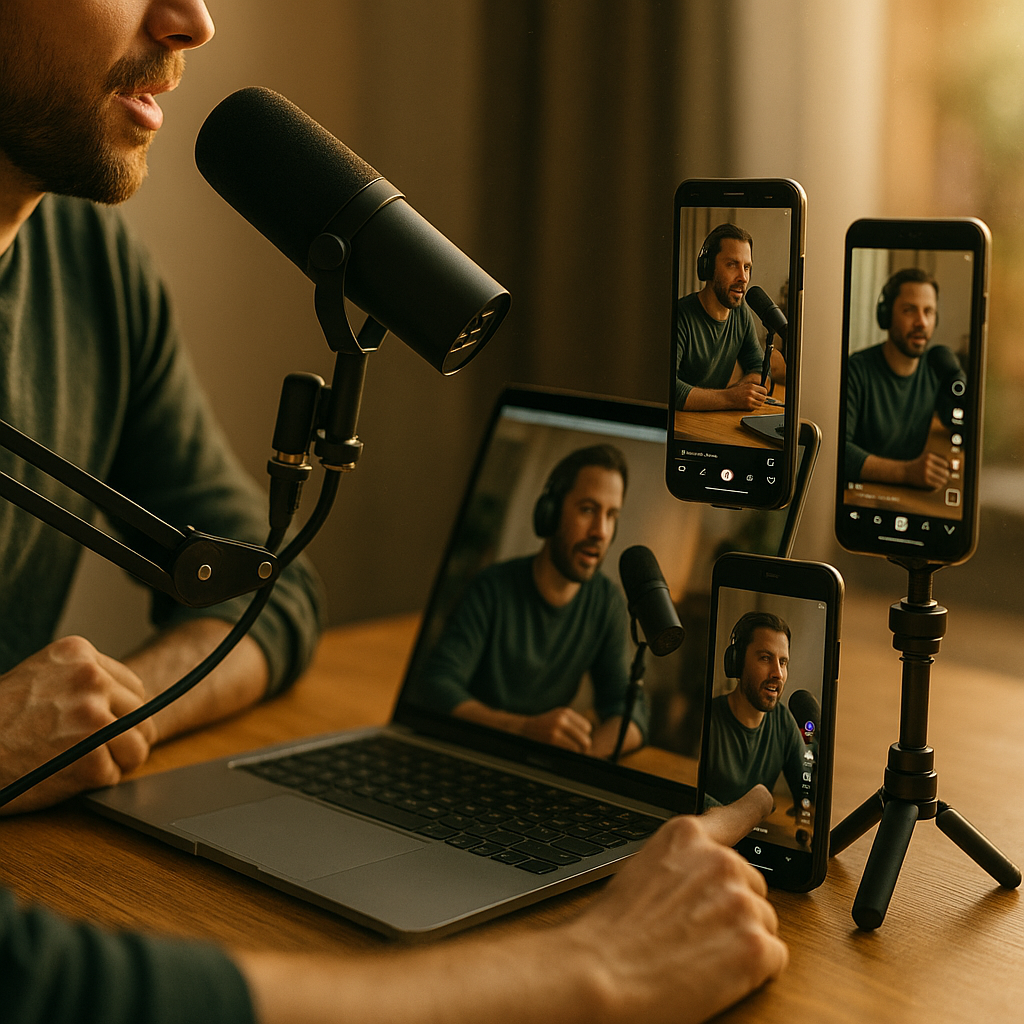
Seventy-eight percent of marketers say short-form video delivers the highest ROI of any content format, according to HubSpot research. Yet most brands still buy podcast sponsorships and shorts campaigns as separate line items. The podcast-to-shorts repurposing format fixes that waste by turning one long-form interview into a single upfront deal spanning YouTube, TikTok, Instagram, and LinkedIn.
If your media plan still treats audio and vertical video as different budgets, you’re paying twice for the same conversation.
Why Brands Are Consolidating Podcast and Shorts Buys
Podcast advertising has matured past the “read this ad copy” era. Brands now want the halo of long-form credibility — a 45-minute conversation where a founder or creator genuinely engages with a topic — plus the reach mechanics of short-form. The problem is that these used to require separate contracts, separate creators, and separate approval chains.
Smart buyers have started collapsing that into one deal structure. A single podcast episode becomes the source material for six to twelve vertical clips, each edited and captioned for a specific platform’s native behavior. The brand gets one integration fee covering the full output, and the creator gets guaranteed distribution across formats instead of a one-off mention that disappears after a week.
This isn’t just efficient. It’s how upfront negotiations are shifting in general — buyers want committed volume across formats before the quarter starts, not format-by-format spot buys. Our earlier piece on cross-format upfront assets covers the broader trend; podcast-to-shorts is simply the audio-first version of it.
Treating a podcast episode as raw footage rather than a finished product is the single biggest mindset shift brands need to make in this format.
What the Brief Actually Needs to Say
Directing a creator to “cut some clips” from a podcast is how you end up with six nearly identical 60-second talking-head videos that all underperform. The brief has to specify platform intent, not just clip count.
- Hook timestamps: Ask the creator or editor to flag three to five moments in the raw recording where the guest says something quotable, contradicts a common assumption, or drops a number. These become the cold-open for each cut.
- Platform-specific pacing: A YouTube Short can breathe a little longer than a TikTok cut. Instagram Reels performs better with on-screen captions burned in from frame one. LinkedIn video needs a professional framing device — a title card or lower-third with the guest’s credentials — because that audience scrolls with sound off and judges credibility fast.
- Brand mention placement: Specify whether the sponsor read needs to survive the cut, get replaced with a graphic overlay, or move to a pinned comment. This is where most legal reviews get held up, so decide it before editing starts, not after.
- Aspect ratio and safe zones: Vertical 9:16 with UI-safe margins for captions and platform buttons. Sounds obvious. Still gets missed constantly by editors used to horizontal video.
This level of specificity is the same discipline we outlined in cross-format storytelling briefs — one source asset, multiple deliverable specs, all defined upfront so nobody’s guessing mid-edit.
Who Owns the Edit: Creator, Agency, or In-House Team?
This is the operational question that trips up most first-time buyers. Three models exist, and each has a different cost and control profile.
Creator-led editing works when the talent already runs a shorts channel and understands their own audience’s pattern-interrupt needs. You pay a premium for this, but you get clips that actually match platform-native behavior rather than a chopped-up interview. Agency or third-party editing is more scalable across a slate of podcast integrations, and it standardizes quality, but it can flatten the creator’s voice into something generic. In-house brand editing gives you the most control over messaging and compliance, but it’s slow, and most brand marketing teams don’t have bandwidth to turn around ten clips per episode on a weekly cadence.
Most upfront deals we’re seeing now use a hybrid: the creator or their producer does a rough cut identifying key moments, and a specialized repurposing vendor (think Opus Clip, Descript, or Riverside’s clip tools) handles the technical edit, captioning, and format variants. The brand retains final approval before anything publishes.
The Upfront Deal Structure That Makes This Work
Traditional podcast sponsorship is priced per episode or per download (CPM against downloads, typically). Shorts campaigns are priced per creator, per post, or per view guarantee. Merging these into one upfront requires a pricing model that accounts for both.
The structures gaining traction in the market right now:
- Episode-plus-package pricing: One fee for the long-form integration, plus a fixed number of guaranteed vertical cuts distributed across named platforms. Typically 6-10 clips per 45-60 minute episode.
- Volume-tiered quarterly deals: Brand commits to sponsoring X episodes over a quarter; creator commits to a total clip output and platform mix, with rates improving as volume increases. This mirrors traditional upfront TV buying logic, just applied to creator inventory.
- Performance kicker on shorts: Base rate for the podcast placement, with a bonus tied to aggregate view thresholds across the vertical cuts. This shifts some risk to the brand but rewards creators whose clips actually travel.
Whichever structure you choose, define what counts as a “view” contractually. YouTube’s updated view-count methodology already complicates cross-platform comparisons, and Shorts, TikTok, and Reels each calculate views differently. Baking a shared measurement standard into the contract avoids the reporting disputes that show up at renewal time.
A Quick Word on Rights and Usage
Podcast recordings often involve two parties: the host (your paid creator) and the guest (who may or may not be under contract with you). Before you greenlight a shorts campaign built from an interview, confirm the guest has signed off on derivative usage across paid and organic distribution. This gets messy fast when the guest is a competitor’s spokesperson, a journalist, or an executive whose employer has its own social media policy. Get it in writing before the episode records, not after it’s a viral clip.
Compliance Doesn’t Disappear Just Because It’s a Clip
A 90-second cutdown carries the same disclosure obligations as the full episode. If the original podcast included a sponsored segment or product mention, every derivative clip pulled from that segment needs the disclosure to travel with it — not buried in the original show notes, but visible in the clip itself or its caption.
The FTC’s endorsement guidelines apply per-post, not per-campaign. That means a brand can’t rely on one disclosure in the long-form episode to cover eight downstream shorts. Each vertical cut needs its own clear and conspicuous disclosure, whether that’s a spoken mention, an on-screen tag, or a platform-native paid partnership label.
A disclosure that lives only in the original 45-minute episode does not carry legal weight for a 60-second clip pulled from minute 22.
This is also where brand safety reviews get complicated. A guest might say something in an off-the-cuff moment during the full interview that reads fine in context but becomes a liability when isolated into a punchy 20-second hook. Build a review step into the workflow where legal or brand safety teams watch the cut clips, not just the source recording. Our guide on avoiding backlash in adjacent brand briefs is a useful reference for how isolated soundbites can shift tone once removed from their original context.
Platform-by-Platform Notes Worth Building Into the Brief
YouTube Shorts rewards clips that function as a standalone story with a beginning, middle, and payoff — not just a highlight. The algorithm favors completion rate, so a 45-second clip that finishes strong outperforms a 90-second clip that trails off. TikTok wants the hook in the first two seconds, ideally text-based, since a huge share of the audience is scrolling without sound initially. Instagram Reels benefits from carousel-style sequencing if you’re running a five-part series pulled from one episode — think of it as a mini “episode arc” similar to the structure covered in our cliffhanger series breakdown. LinkedIn is the outlier: professional framing, longer runtime tolerance (up to 3 minutes performs fine), and a caption that reads like a mini case study rather than a hook.
Don’t assume one clip fits all four. According to Sprout Social, platform-native formatting is now one of the top-ranked factors audiences cite for why they engage with branded short video. Recycling an identical export across platforms is the fastest way to underperform your upfront guarantee.
Measuring Success Across a Fragmented Format
Because the podcast-to-shorts model spans platforms with different measurement standards, brands need a unified scorecard rather than four separate platform reports. At minimum, track: aggregate views across all cuts, completion rate by platform, click-through to any linked landing page or promo code, and cost-per-thousand blended across the full asset package (long-form plus shorts) rather than isolated per platform. This blended CPM is usually where the ROI case gets made to finance teams who otherwise see podcast sponsorship as a soft-metrics buy.
Reporting transparency matters more here than in a single-platform campaign, given how easy it is for view counts to get inflated or double-counted across reposts. If you’re negotiating renewal terms, insist on platform-native analytics exports rather than creator-supplied screenshots — a lesson that applies just as directly here as it does in the broader push for view-count transparency across creator reporting.
Next step: before your next podcast sponsorship renewal, ask the creator for a shorts-repurposing add-on quote and compare the blended CPM against buying a standalone shorts campaign — the math usually favors the bundle, but only if the brief specifies platform-native cuts, not generic clips.
FAQs
What is the podcast-to-shorts repurposing format?
It’s a content and deal structure where a single long-form podcast interview is edited into multiple vertical video clips, each tailored to a specific platform (YouTube Shorts, TikTok, Instagram Reels, LinkedIn), and sold to brands as one bundled sponsorship instead of separate long-form and short-form buys.
How many shorts should come from one podcast episode?
Most upfront deals guarantee six to ten vertical cuts from a 45-60 minute episode, though this varies based on how many distinct quotable or newsworthy moments the conversation contains.
Does each short need its own FTC disclosure?
Yes. FTC endorsement guidelines apply per post. A disclosure in the original long-form episode does not automatically cover derivative shorts; each clip needs a clear and conspicuous disclosure of its own.
Who should edit the clips — the creator or an agency?
It depends on scale and control needs. Creator-led editing preserves platform-native voice but costs more. Agency or vendor editing scales better across multiple episodes but can flatten tone. Many brands now use a hybrid: creator identifies key moments, a repurposing vendor handles the technical cut, and the brand approves final output.
How should brands price a bundled podcast-and-shorts deal?
Common models include episode-plus-package pricing (one fee covering the long-form spot and a fixed number of clips), volume-tiered quarterly commitments, or a base rate plus a performance kicker tied to aggregate shorts views.
What’s the biggest mistake brands make with this format?
Treating all platforms identically. A clip optimized for TikTok’s sound-off, fast-hook behavior rarely performs the same way on LinkedIn or YouTube Shorts without re-editing for pacing, captions, and framing.
FAQs
What is the podcast-to-shorts repurposing format?
It’s a content and deal structure where a single long-form podcast interview is edited into multiple vertical video clips, each tailored to a specific platform (YouTube Shorts, TikTok, Instagram Reels, LinkedIn), and sold to brands as one bundled sponsorship instead of separate long-form and short-form buys.
How many shorts should come from one podcast episode?
Most upfront deals guarantee six to ten vertical cuts from a 45-60 minute episode, though this varies based on how many distinct quotable or newsworthy moments the conversation contains.
Does each short need its own FTC disclosure?
Yes. FTC endorsement guidelines apply per post. A disclosure in the original long-form episode does not automatically cover derivative shorts; each clip needs a clear and conspicuous disclosure of its own.
Who should edit the clips — the creator or an agency?
It depends on scale and control needs. Creator-led editing preserves platform-native voice but costs more. Agency or vendor editing scales better across multiple episodes but can flatten tone. Many brands now use a hybrid: creator identifies key moments, a repurposing vendor handles the technical cut, and the brand approves final output.
How should brands price a bundled podcast-and-shorts deal?
Common models include episode-plus-package pricing (one fee covering the long-form spot and a fixed number of clips), volume-tiered quarterly commitments, or a base rate plus a performance kicker tied to aggregate shorts views.
What’s the biggest mistake brands make with this format?
Treating all platforms identically. A clip optimized for TikTok’s sound-off, fast-hook behavior rarely performs the same way on LinkedIn or YouTube Shorts without re-editing for pacing, captions, and framing.
Top Influencer Marketing Agencies
The leading agencies shaping influencer marketing in 2026
Agencies ranked by campaign performance, client diversity, platform expertise, proven ROI, industry recognition, and client satisfaction. Assessed through verified case studies, reviews, and industry consultations.
Moburst

-
2

The Shelf
Boutique Beauty & Lifestyle Influencer AgencyA data-driven boutique agency specializing exclusively in beauty, wellness, and lifestyle influencer campaigns on Instagram and TikTok. Best for brands already focused on the beauty/personal care space that need curated, aesthetic-driven content.Clients: Pepsi, The Honest Company, Hims, Elf Cosmetics, Pure LeafVisit The Shelf → -
3

Audiencly
Niche Gaming & Esports Influencer AgencyA specialized agency focused exclusively on gaming and esports creators on YouTube, Twitch, and TikTok. Ideal if your campaign is 100% gaming-focused — from game launches to hardware and esports events.Clients: Epic Games, NordVPN, Ubisoft, Wargaming, Tencent GamesVisit Audiencly → -
4

Viral Nation
Global Influencer Marketing & Talent AgencyA dual talent management and marketing agency with proprietary brand safety tools and a global creator network spanning nano-influencers to celebrities across all major platforms.Clients: Meta, Activision Blizzard, Energizer, Aston Martin, WalmartVisit Viral Nation → -
5

The Influencer Marketing Factory
TikTok, Instagram & YouTube CampaignsA full-service agency with strong TikTok expertise, offering end-to-end campaign management from influencer discovery through performance reporting with a focus on platform-native content.Clients: Google, Snapchat, Universal Music, Bumble, YelpVisit TIMF → -
6

NeoReach
Enterprise Analytics & Influencer CampaignsAn enterprise-focused agency combining managed campaigns with a powerful self-service data platform for influencer search, audience analytics, and attribution modeling.Clients: Amazon, Airbnb, Netflix, Honda, The New York TimesVisit NeoReach → -
7

Ubiquitous
Creator-First Marketing PlatformA tech-driven platform combining self-service tools with managed campaign options, emphasizing speed and scalability for brands managing multiple influencer relationships.Clients: Lyft, Disney, Target, American Eagle, NetflixVisit Ubiquitous → -
8

Obviously
Scalable Enterprise Influencer CampaignsA tech-enabled agency built for high-volume campaigns, coordinating hundreds of creators simultaneously with end-to-end logistics, content rights management, and product seeding.Clients: Google, Ulta Beauty, Converse, AmazonVisit Obviously →