


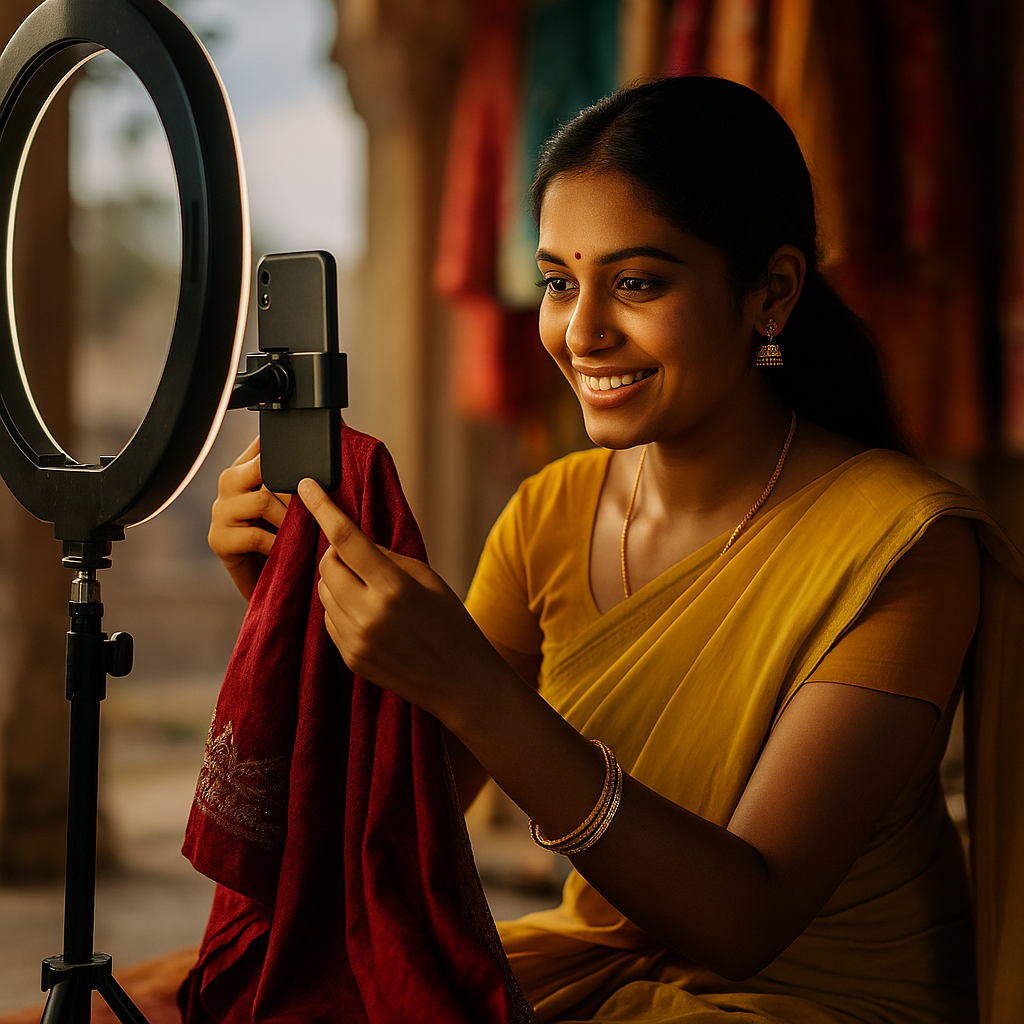
Sixty seconds. That’s roughly how long you have before an Indian shopper on Myntra, Flipkart Live, or Instagram decides whether your shoppable livestream script is worth staying for. Miss that window and your CAC math falls apart, regardless of how good the product or the host is.
Most brands treat livestream openings as throat-clearing: a “hi guys, welcome” followed by a slow walk to the product table. That’s the fastest way to lose 40% of your peak viewers before you’ve said a single selling proposition. This piece breaks down a tested opening structure built specifically for India’s social commerce context, where language switching, trust signals, and payment friction behave differently than in US or Southeast Asian markets.
Why the First Minute Is the Whole Game
Livestream platforms report viewer counts spiking at broadcast start and cratering within the first two minutes if there’s no hook. Data from live commerce operators in India suggests drop-off curves are steeper here than in China or the US, largely because discovery traffic (from app home feeds, notification pushes, or short-video redirects) is colder. Viewers land mid-scroll, not mid-intent. They haven’t chosen to watch you the way a TikTok Shop viewer in the US might have.
That means your opening can’t assume interest. It has to manufacture it, fast.
If your host is still explaining who the brand is at the 45-second mark, you’ve already lost the viewers who mattered most: the ones who arrived with zero context and needed a reason to stay in under ten seconds.
The 60-Second Script Skeleton
Break the first minute into four micro-segments. Each has a job. None of them is “welcome to our channel.”
- 0–10 seconds: The visual jolt. Show the product in use, mid-action, before any dialogue. A blender running, a saree draping, a gadget lighting up. Silence or ambient sound only.
- 10–25 seconds: The stakes statement. One sentence that tells viewers what’s in it for them today specifically, not generally. “Only 200 units at this price, live for the next 40 minutes” beats “welcome to our Diwali sale.”
- 25–40 seconds: The proof flash. A quick credibility marker: order count, a review overlay, a recognizable face, or a certification badge. This is where Indian shoppers, who are famously price- and trust-sensitive, decide if the deal is real.
- 40–60 seconds: The action prompt. Tell viewers exactly what to do: tap the pinned product, comment a keyword, or set a reminder. Repeat it visually on screen, not just verbally.
This isn’t a rigid template you paste and forget. It’s scaffolding. Swap in category-specific hooks, but keep the sequence: visual, stakes, proof, action. That order matters more than the specific words you use.
Why Language Sequencing Changes the Math
In India, code-switching between Hindi, English, and regional languages happens within a single sentence, let alone a single broadcast. A common mistake: hosts open in polished English to sound “premium,” then switch to Hindi once they relax into the pitch. That mismatch confuses viewers who chose the stream expecting a specific language experience based on the thumbnail or category page.
Decide your primary language before scripting, and open in it immediately. If you’re running parallel streams in Tamil, Bengali, or Marathi, don’t just translate the English script; localize the stakes statement too, since urgency language (“last stock,” “sirf aaj,” “ONLY today”) lands differently across regions. This is the same principle behind regional-language product demos, where one script structure gets adapted per dialect rather than blindly translated.
The Proof Flash Is Where Most Brands Get Lazy
Here’s an uncomfortable truth: Indian shoppers have been burned by fake urgency before. “Only 3 left” banners that reset every hour, review counts that don’t match delivered orders, discount timers that restart on refresh. Trust has eroded, and viewers now scan for tells within seconds.
Your proof flash needs to be specific and slightly imperfect, because too-polished claims trigger skepticism. “1,240 units sold this week across Delhi, Bengaluru and Pune” reads as real. “India’s No. 1 bestseller” reads as marketing filler.
If you’re running countdown mechanics later in the stream, the same honesty principle applies there. We’ve covered this in detail in FTC-safe urgency tactics, and the compliance logic holds even outside the US: India’s Consumer Protection (E-Commerce) Rules increasingly scrutinize dark-pattern urgency claims, so build proof you can actually substantiate.
Casting the Right Host for a 60-Second Sprint
Not every creator who’s great at 10-minute unboxings is good at an opening sprint. The skill set is different: rapid pacing, comfort with silence during the visual jolt, and the ability to deliver a stakes statement without sounding like a scripted ad read. When briefing talent, be explicit that the first minute is choreographed, not improvised. Give them the beat structure, not just talking points.
This is also where a written livestream scripting brief earns its keep: it aligns host, production, and brand marketing on exactly what happens second by second, so nobody freelances the opening on broadcast day.
A practical tip from agencies running high-frequency livestream slates: rehearse the first 60 seconds as a standalone clip, separate from the rest of the broadcast rundown. Time it with a stopwatch. If it runs 75 seconds, cut, don’t stretch the rest of the show to compensate.
Platform Quirks Worth Building Into the Script
Flipkart Live, Myntra Live, and Instagram Live each surface viewer counts and comment feeds differently, which affects how your host should react in real time. On Instagram, comments scroll fast and disappear; your host needs to call out usernames quickly to make new arrivals feel seen. On Flipkart and Myntra’s native live formats, the shopping cart integration is more prominent, so the action prompt in seconds 40–60 can be more direct: “tap the yellow button,” since viewers are already primed for an in-app purchase flow.
Meta’s own guidance on live shopping features emphasizes early product tagging, which reinforces the same point: don’t wait until minute five to surface the buy button.
What the Data Says About Retention Windows
Industry estimates from eMarketer peg India’s live commerce market as one of the fastest-growing globally, but growth in market size hasn’t solved the retention problem at the individual broadcast level. Anecdotal data from creator agencies running multiple weekly streams shows completion rates for the first 60 seconds directly correlating with total watch time and, more importantly, conversion rate. Viewers who make it past minute one convert at multiples of those who bounce early.
That’s the entire argument for treating the opening as its own discipline, worth scripting, rehearsing, and testing independently from the rest of the show.
Treat your opening 60 seconds as a standalone creative asset, not a preamble. Test it, cut it, A/B it across streams, the same way you’d test a paid ad’s first three seconds.
That comparison isn’t accidental. The same urgency logic that governs app install ad hooks applies to livestream openings: attention is won or lost before the pitch even starts. If your paid social team already thinks this way about static and video ads, get your livestream producers thinking the same way about broadcast openings.
Building This Into Your Standard Operating Process
One-off good openings don’t scale. What scales is a repeatable checklist your production team runs before every broadcast:
- Confirm primary language and any regional variants before scripting begins.
- Lock the visual jolt shot in a pre-broadcast run-through, don’t leave it to chance on air.
- Write the stakes statement with a specific number, not a vague superlative.
- Source one honest, checkable proof point for the proof flash.
- Rehearse the action prompt as an on-screen graphic plus verbal cue, not verbal alone.
This kind of structured, testable approach mirrors what we’ve recommended for live-reaction unboxing formats: consistency in structure, flexibility in creative execution. Livestream commerce in India is maturing fast, and brands still winging their openings will keep losing viewers to competitors who’ve bothered to script the first minute like it matters. It does.
Next step: pull your last three livestream recordings, clip just the first 60 seconds of each, and watch them back-to-back. If you can’t identify a clear visual jolt, stakes statement, proof flash, and action prompt in that order, your script needs the rebuild outlined above before your next broadcast airs.
FAQs
How long should the opening hook be in an India-focused shoppable livestream?
Aim for 60 seconds total, broken into four roughly 10-20 second segments: a visual jolt, a stakes statement, a proof flash, and an action prompt. Going longer risks losing cold-traffic viewers who arrived without prior brand context.
Which language should I open a shoppable livestream in for Indian audiences?
Choose your primary language before scripting and commit to it from second one. Mixing English and Hindi mid-opening, or opening in a language that doesn’t match viewer expectations set by the thumbnail or category page, increases early drop-off.
What counts as a good proof point in the first minute?
Specific, checkable numbers work better than superlatives. “1,240 units sold this week” builds more trust than “India’s No. 1 bestseller,” especially given how skeptical Indian shoppers have become of inflated urgency and review claims.
Should the buy button or product tag appear before or after the pitch?
Surface it early, ideally by the 40-second mark, alongside a direct action prompt. Waiting until deeper into the broadcast to reveal the purchase path costs you viewers who were ready to act immediately.
How do I test whether my livestream opening is actually working?
Clip the first 60 seconds of past broadcasts and compare viewer retention curves against total watch time and conversion rate. Treat the opening as a standalone creative asset you A/B test, similar to how you’d test the first seconds of a paid video ad.
FAQs
How long should the opening hook be in an India-focused shoppable livestream?
Aim for 60 seconds total, broken into four roughly 10-20 second segments: a visual jolt, a stakes statement, a proof flash, and an action prompt. Going longer risks losing cold-traffic viewers who arrived without prior brand context.
Which language should I open a shoppable livestream in for Indian audiences?
Choose your primary language before scripting and commit to it from second one. Mixing English and Hindi mid-opening, or opening in a language that doesn’t match viewer expectations set by the thumbnail or category page, increases early drop-off.
What counts as a good proof point in the first minute?
Specific, checkable numbers work better than superlatives. “1,240 units sold this week” builds more trust than “India’s No. 1 bestseller,” especially given how skeptical Indian shoppers have become of inflated urgency and review claims.
Should the buy button or product tag appear before or after the pitch?
Surface it early, ideally by the 40-second mark, alongside a direct action prompt. Waiting until deeper into the broadcast to reveal the purchase path costs you viewers who were ready to act immediately.
How do I test whether my livestream opening is actually working?
Clip the first 60 seconds of past broadcasts and compare viewer retention curves against total watch time and conversion rate. Treat the opening as a standalone creative asset you A/B test, similar to how you’d test the first seconds of a paid video ad.
Top Influencer Marketing Agencies
The leading agencies shaping influencer marketing in 2026
Agencies ranked by campaign performance, client diversity, platform expertise, proven ROI, industry recognition, and client satisfaction. Assessed through verified case studies, reviews, and industry consultations.
Moburst

-
2

The Shelf
Boutique Beauty & Lifestyle Influencer AgencyA data-driven boutique agency specializing exclusively in beauty, wellness, and lifestyle influencer campaigns on Instagram and TikTok. Best for brands already focused on the beauty/personal care space that need curated, aesthetic-driven content.Clients: Pepsi, The Honest Company, Hims, Elf Cosmetics, Pure LeafVisit The Shelf → -
3

Audiencly
Niche Gaming & Esports Influencer AgencyA specialized agency focused exclusively on gaming and esports creators on YouTube, Twitch, and TikTok. Ideal if your campaign is 100% gaming-focused — from game launches to hardware and esports events.Clients: Epic Games, NordVPN, Ubisoft, Wargaming, Tencent GamesVisit Audiencly → -
4

Viral Nation
Global Influencer Marketing & Talent AgencyA dual talent management and marketing agency with proprietary brand safety tools and a global creator network spanning nano-influencers to celebrities across all major platforms.Clients: Meta, Activision Blizzard, Energizer, Aston Martin, WalmartVisit Viral Nation → -
5

The Influencer Marketing Factory
TikTok, Instagram & YouTube CampaignsA full-service agency with strong TikTok expertise, offering end-to-end campaign management from influencer discovery through performance reporting with a focus on platform-native content.Clients: Google, Snapchat, Universal Music, Bumble, YelpVisit TIMF → -
6

NeoReach
Enterprise Analytics & Influencer CampaignsAn enterprise-focused agency combining managed campaigns with a powerful self-service data platform for influencer search, audience analytics, and attribution modeling.Clients: Amazon, Airbnb, Netflix, Honda, The New York TimesVisit NeoReach → -
7

Ubiquitous
Creator-First Marketing PlatformA tech-driven platform combining self-service tools with managed campaign options, emphasizing speed and scalability for brands managing multiple influencer relationships.Clients: Lyft, Disney, Target, American Eagle, NetflixVisit Ubiquitous → -
8

Obviously
Scalable Enterprise Influencer CampaignsA tech-enabled agency built for high-volume campaigns, coordinating hundreds of creators simultaneously with end-to-end logistics, content rights management, and product seeding.Clients: Google, Ulta Beauty, Converse, AmazonVisit Obviously →