


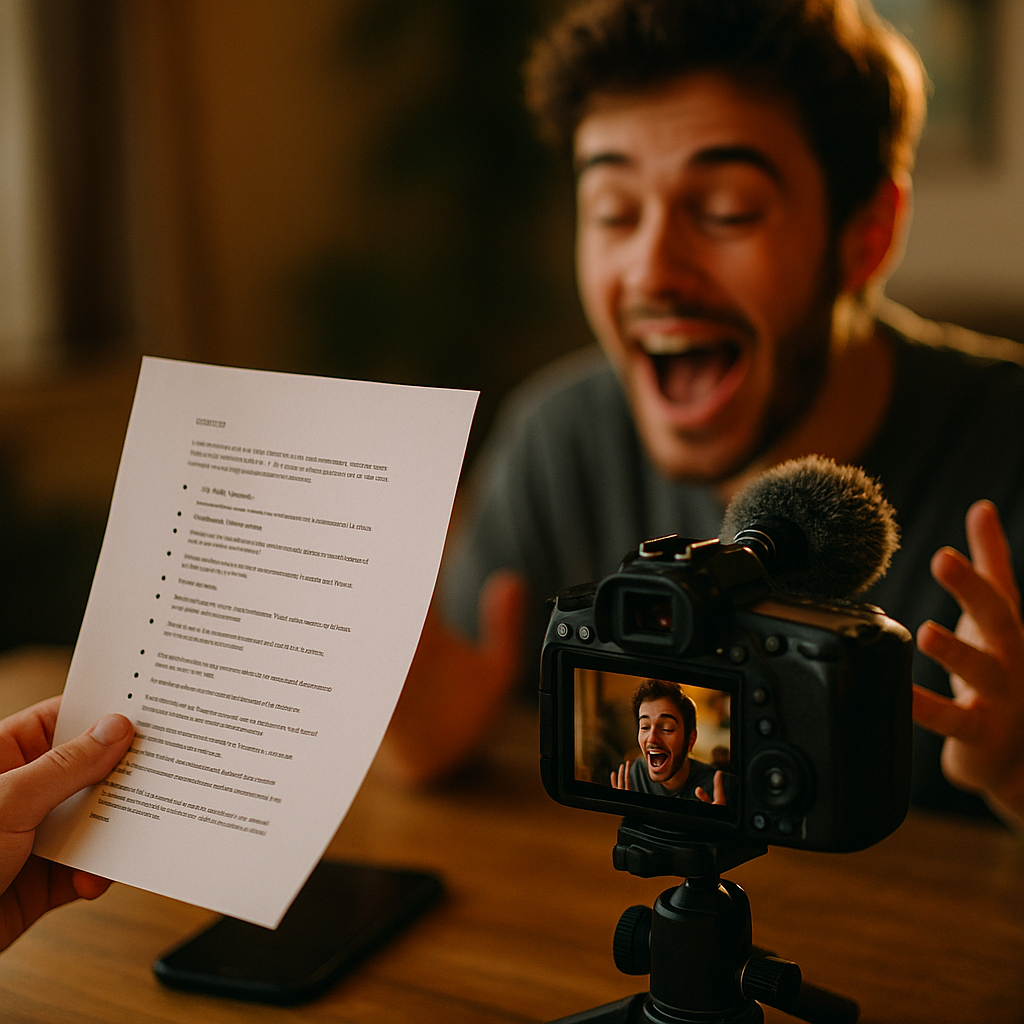
Seventy three percent of brand safety incidents involving influencer content happen during unscripted commentary, not product demos. The reaction video format sits right at the center of that risk because the entire genre is built on a creator watching something, reacting in real time, and saying whatever comes to mind. That spontaneity is exactly why audiences trust it, and exactly why legal and compliance teams lose sleep over it.
If your brand is leaning into reaction content for its authenticity premium, you need a script framework that preserves the live feel while closing the gaps that lead to takedowns, FTC inquiries, or a creator saying something you can never unsee.
Why Reaction Content Is Brand Safety’s Soft Underbelly
Reaction videos work because viewers believe they’re watching an honest, unfiltered response. Retention data from platforms like TikTok and YouTube consistently shows reaction and commentary formats outperforming polished brand content on watch time. But that same unscripted quality means a creator can drift into territory nobody cleared: competitor trash talk, unverified health claims, political commentary, or copyrighted footage used without a license.
Marketing teams often treat reaction content like a lower-risk cousin of UGC because the creator “isn’t really advertising anything.” That’s a mistake. A reaction video is still sponsored content once a brand pays for it, places product in it, or directs the topic. The FTC doesn’t care that the creator was reacting to a movie trailer instead of reading ad copy. If there’s material connection, disclosure rules apply the same way they do for a straight product review.
A reaction video is paid media the moment a brand’s fingerprints are on it, whether that’s a brief, a product placement, or a topic assignment. Treat it like sponsored content from day one, not after something goes wrong.
The Three Failure Points Brands Actually Hit
After reviewing how reaction campaigns typically break down, three recurring failure points show up again and again.
- Source material clearance. Creators reacting to news clips, competitor ads, or copyrighted video often lack rights to that footage. If your brand’s logo or name appears adjacent to unlicensed content, you inherit that exposure.
- Undisclosed sponsorship. Reaction content feels so casual that creators forget to disclose, or they bury #ad in a description nobody reads. The FTC’s endorsement guidance requires disclosure to be clear and conspicuous, not hidden.
- Unscripted commentary drift. This is the big one. A creator reacting live can say something defamatory, make a false comparative claim, or veer into a controversial opinion that gets the brand pulled into a conversation it never agreed to join.
None of these require a fully scripted performance to fix. They require a structural script, which is a different thing entirely.
Structural Scripts vs Word for Word Scripts
The mistake brands make when they hear “script” is assuming it means handing a creator dialogue to read. That kills the format. Audiences can smell a scripted reaction from a mile away, and engagement tanks when they do.
What actually works is a structural script: a document that defines the boundaries, beats, and disclosure requirements, while leaving the actual reaction, the words, the facial expressions, the tangents, entirely to the creator. Think of it as guardrails on a highway, not a route printed turn by turn. The creator still drives.
A solid structural brief for reaction content should include:
- The source material approved for reaction (with licensing confirmed before filming)
- A disclosure line placed at the start of the video, not just in the caption
- A list of topics or claims that are off limits (competitor names, health claims, pricing promises)
- A required product mention or placement window, stated as a beat, not a script line
- An approval checkpoint for raw footage before publishing, especially for first time creator partners
This approach mirrors what we’ve recommended for other loosely structured formats. The logic in our confessional booth testimonial guide applies here too: give creators a framework, not a script, and the content stays credible while staying compliant.
Building the Brand Safety Script: A Practical Template
Here’s a template structure that balances authenticity with risk control. It’s built around five sections a brand brief should always cover for reaction content specifically.
1. Source and context lock. Specify exactly what the creator is reacting to. If it’s a competitor product, a news clip, or third party video, confirm usage rights before the camera rolls. This single step prevents the majority of takedown requests.
2. Disclosure placement, not disclosure wording. Don’t script the exact disclosure phrase, that often reads as stiff and inauthentic. Instead, mandate where and when disclosure happens: verbally in the first fifteen seconds, and on screen text for the duration of any sponsored segment. The FTC’s own guidance on endorsement disclosures emphasizes clarity over exact phrasing, so give creators room to say it in their own voice.
3. Red line topics. List subjects the creator must avoid entirely: direct competitor comparisons, unverified claims, political or religious commentary, and anything touching ongoing litigation or controversy involving the brand. This isn’t censorship, it’s risk scoping. Creators generally appreciate clarity here because it protects them too.
4. Reaction beats, not reaction lines. Define the emotional or narrative beats you need (surprise at a feature reveal, comparison to expectation, a close on genuine opinion) without writing the words. This is the same beat based approach used in UGC style video ad scripting, adapted for a live reaction format.
5. Raw footage review window. Build in a 24 to 48 hour review period before publishing, particularly for new creator relationships. This isn’t about approving every word, it’s a safety net to catch anything that crossed a red line before it goes live.
Brands that skip the raw footage review step report nearly double the rate of post publication content disputes compared to those who build in even a light touch 24 hour check.
What About Disclosure When AI Enters the Reaction?
Reaction content is increasingly mixing in AI generated elements: synthetic voiceovers, AI summarized clips, or avatar reactions standing in for a live creator. That adds a disclosure layer most brand safety scripts haven’t caught up to yet. If any part of the reaction is AI generated or AI assisted, that needs its own disclosure, separate from the sponsorship disclosure. Our guide on AI generated asset disclosure covers the specific language platforms are starting to require, and it’s worth building into any reaction brief where AI tools touch the production pipeline.
This matters more than brands think. Platforms including TikTok and YouTube have begun rolling out mandatory AI content labels, and getting caught without one isn’t just a policy violation, it undermines the authenticity that made the format valuable in the first place.
Measuring Whether the Guardrails Are Working
A brand safety script is only useful if you can tell whether it’s actually reducing risk, not just adding friction. Track these signals across your reaction campaigns:
- Takedown and dispute rate per campaign, compared against your UGC and traditional sponsored content baselines
- Disclosure compliance rate, checked via spot audits rather than assuming every creator follows the brief
- Red line violations caught during the raw footage review window versus those that slipped through to publication
- Engagement delta between structurally scripted reactions and fully scripted ones, to confirm you’re not sacrificing performance for safety
Tools like Sprout Social and native platform analytics can help track engagement deltas, while legal or compliance teams should own the disclosure audit piece manually, at least until your creator roster is large enough to justify dedicated tooling.
If you’re running reaction content at scale across multiple creators, it’s worth benchmarking against broader influencer marketing spend data from eMarketer to understand whether your risk mitigation investment is proportional to the media spend flowing through the format.
Where This Fits Alongside Other Commentary Formats
Reaction videos don’t exist in isolation. They often sit in the same content calendar as myth busting segments, founder commentary, or POV style breakdowns. If your team is building a broader library of commentary driven formats, it’s worth reviewing how disclosure and claim verification work across adjacent formats like myth busting scripts, since the same red line and claims verification logic applies whether the creator is debunking a rumor or reacting to a product unboxing.
The common thread across all of these formats is the same lesson: structure protects authenticity, it doesn’t replace it. A creator who understands the boundaries can still deliver a reaction that feels completely unscripted, because it is, within the lines you’ve drawn.
Next Step
Build a one page structural brief for your next reaction campaign using the five sections above, source clearance, disclosure placement, red line topics, reaction beats, and a footage review window, and test it against a single creator before rolling it out across your full roster.
Frequently Asked Questions
Does a reaction video need an FTC disclosure if the creator isn’t directly promoting the product?
Yes. If the brand paid for the video, provided the product, or directed the topic, disclosure is required regardless of whether the product is the main subject or just present in the background.
Can brands pre approve reaction videos without scripting them word for word?
Yes, and this is the recommended approach. A structural brief defining topics, disclosure placement, and red lines lets creators react naturally while giving brands a clear basis for pre publication review.
What happens if a creator reacts to copyrighted footage without clearing rights?
The brand can face takedown requests or claims of contributory infringement if its sponsorship is visible in the video. Source material clearance should happen before filming, not after a complaint arrives.
How long should the raw footage review window be for reaction content?
A 24 to 48 hour window is typically enough to catch red line violations without delaying the content so long that it loses topical relevance, especially for reactions tied to trending events.
Do AI generated reactions need separate disclosure from sponsorship disclosure?
Yes. AI generated or AI assisted content increasingly requires its own disclosure label, separate from standard sponsorship disclosure, as platforms roll out stricter synthetic media policies.
FAQPage Schema
Top Influencer Marketing Agencies
The leading agencies shaping influencer marketing in 2026
Agencies ranked by campaign performance, client diversity, platform expertise, proven ROI, industry recognition, and client satisfaction. Assessed through verified case studies, reviews, and industry consultations.
Moburst

-
2

The Shelf
Boutique Beauty & Lifestyle Influencer AgencyA data-driven boutique agency specializing exclusively in beauty, wellness, and lifestyle influencer campaigns on Instagram and TikTok. Best for brands already focused on the beauty/personal care space that need curated, aesthetic-driven content.Clients: Pepsi, The Honest Company, Hims, Elf Cosmetics, Pure LeafVisit The Shelf → -
3

Audiencly
Niche Gaming & Esports Influencer AgencyA specialized agency focused exclusively on gaming and esports creators on YouTube, Twitch, and TikTok. Ideal if your campaign is 100% gaming-focused — from game launches to hardware and esports events.Clients: Epic Games, NordVPN, Ubisoft, Wargaming, Tencent GamesVisit Audiencly → -
4

Viral Nation
Global Influencer Marketing & Talent AgencyA dual talent management and marketing agency with proprietary brand safety tools and a global creator network spanning nano-influencers to celebrities across all major platforms.Clients: Meta, Activision Blizzard, Energizer, Aston Martin, WalmartVisit Viral Nation → -
5

The Influencer Marketing Factory
TikTok, Instagram & YouTube CampaignsA full-service agency with strong TikTok expertise, offering end-to-end campaign management from influencer discovery through performance reporting with a focus on platform-native content.Clients: Google, Snapchat, Universal Music, Bumble, YelpVisit TIMF → -
6

NeoReach
Enterprise Analytics & Influencer CampaignsAn enterprise-focused agency combining managed campaigns with a powerful self-service data platform for influencer search, audience analytics, and attribution modeling.Clients: Amazon, Airbnb, Netflix, Honda, The New York TimesVisit NeoReach → -
7

Ubiquitous
Creator-First Marketing PlatformA tech-driven platform combining self-service tools with managed campaign options, emphasizing speed and scalability for brands managing multiple influencer relationships.Clients: Lyft, Disney, Target, American Eagle, NetflixVisit Ubiquitous → -
8

Obviously
Scalable Enterprise Influencer CampaignsA tech-enabled agency built for high-volume campaigns, coordinating hundreds of creators simultaneously with end-to-end logistics, content rights management, and product seeding.Clients: Google, Ulta Beauty, Converse, AmazonVisit Obviously →