


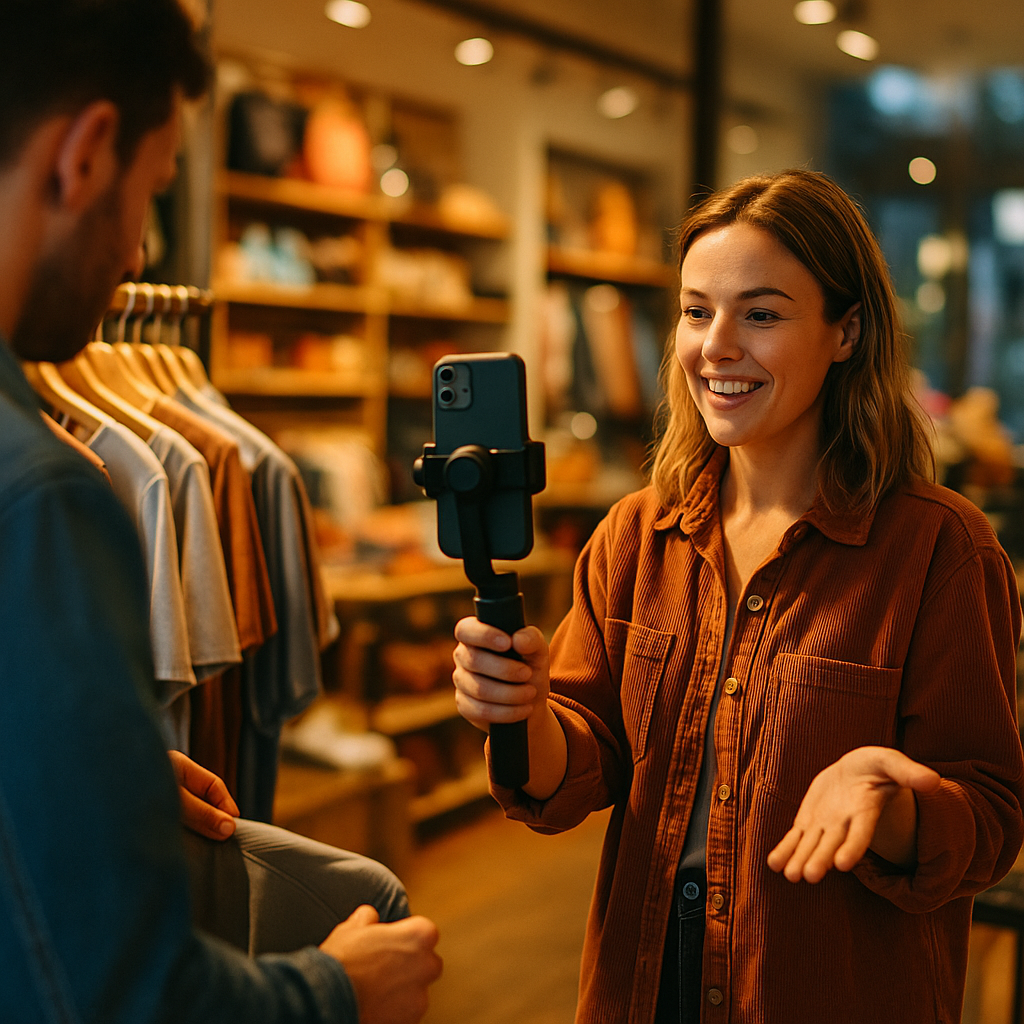
Here’s an uncomfortable number for anyone still relying on static coupons to drive store visits: retail media and local discovery searches increasingly start on video, not Google Maps. A retail walkthrough haul, a creator filming their way through aisles, pointing out deals, reacting to new arrivals, has quietly become one of the highest converting formats for foot traffic campaigns. The catch? Most brands brief these like generic hauls instead of scripting them for the specific job of getting someone off their couch and into a store.
That distinction matters more than it sounds. A haul filmed at home sells products. A retail walkthrough haul sells a location, a feeling, and an urgency to go see it yourself. Get the script wrong and you’ve paid for a nice video. Get it right and you’ve paid for a measurable lift in location visits.
What Makes a Walkthrough Different From a Standard Haul
A standard haul happens after the shopping trip. The creator sits at home, unboxes, reacts, done. A retail walkthrough haul happens during the trip, camera rolling through the parking lot, the entrance, the specific aisle, the checkout. That real-time structure does something a post-purchase haul can’t: it maps a physical path a viewer can mentally rehearse before they ever drive there.
Retailers like Target and T.J.Maxx have benefited from this organically for years, with creators building entire channels around “come shop with me” content. The difference now is brands are formalizing the brief instead of hoping it happens organically.
A walkthrough haul isn’t content about a product. It’s a rehearsal of the in store experience, filmed by someone the audience already trusts.
This is also why walkthrough hauls pair so well with location based retail strategy generally. If you’ve already read our breakdown of phygital content formats, you know the throughline: creator video is increasingly the bridge between digital discovery and physical footfall, and walkthrough hauls are the most literal version of that bridge.
Why Brands Are Shifting Budget Here
Foot traffic attribution has historically been the weak link in influencer ROI conversations. You could prove impressions. You could prove clicks. Proving someone walked into a store because of a fifteen second video was murkier. That’s changing. Platforms now offer location lift measurement tied to mobile device data, and several retail media networks have started layering in-store visit data directly into creator campaign reporting.
According to eMarketer, retail media spend continues to climb as brands look for channels that tie directly to purchase behavior rather than just awareness. Walkthrough hauls sit exactly at that intersection: they’re cheap to produce, native to how Gen Z and millennial shoppers already research stores, and increasingly measurable.
Scripting the Path: A Five Beat Structure That Works
Here’s where most briefs fail. Brands hand a creator a product list and a store address, then wonder why the resulting video feels like a wander, not a walkthrough. A scripted path fixes that without making the content feel stiff. The five beats below aren’t a rigid script in the dialogue sense, they’re a sequencing framework.
- The hook before the door. First three seconds happen outside or in the parking lot. A line like “they just restocked the thing everyone’s been asking about” does more for watch time than any interior shot.
- The entrance orientation. A quick beat establishing where the viewer is. This is the moment that makes the video feel like a real visit rather than a studio shoot.
- The discovery aisle. The core of the haul. This is where the creator reacts to specific products, prices, or displays. Specificity beats polish here, exact prices and shelf positions read as more credible than vague enthusiasm.
- The comparison beat. A short moment where the creator compares this visit to a previous one, or compares in store pricing to online. This is what builds trust, because it signals the creator isn’t just reading a script (even when they are).
- The checkout close. The call to action, delivered at the register, not as a text overlay at the end. “This location has it through the weekend” lands harder on camera than in a caption.
Notice what’s missing from that list: a hard sales pitch. The format works because it mimics word of mouth, not advertising. If you want a deeper framework for matching script structure to funnel stage, our piece on job specific creative briefs breaks down how different formats serve different parts of the buyer journey, and walkthrough hauls sit firmly in the consideration to conversion stage.
Location Specificity Is the Whole Game
Generic hauls generate generic results. A walkthrough haul that says “go check your local store” underperforms one that says “the one on Fifth and Main has a whole endcap dedicated to this.” Brands running multi-location campaigns should brief creators with store-specific details: layout quirks, exact promotions, even staff mentions where appropriate. This level of specificity is what separates a haul that drives vanity views from one that drives an actual visit tracked through mobile location data.
For multi-market rollouts, this means briefs can’t be copy pasted across creators. Each location needs its own mini brief, which sounds like more work but is really just a template with swapped variables: store number, current promo, nearest parking entrance.
Casting: Why Local Creators Beat National Ones Here
This is a format where follower count matters less than zip code. A creator with 40,000 followers who lives five minutes from your flagship location will outperform a creator with 400,000 followers who’s never set foot in that market. Why? Because the walkthrough haul’s credibility depends on the creator sounding like a regular, not a visiting celebrity.
Brands running these campaigns at scale should think in terms of a local creator bench rather than a single national face. That’s a casting shift as much as a budget shift, and it tends to favor agencies and platforms that specialize in geo-targeted creator networks over those built for national reach.
There’s a trust dimension here too. Viewers are increasingly skeptical of obviously paid content, and local creators who’ve built genuine community credibility carry that skepticism better than imported talent. Our piece on comment reply videos covers a related principle: audiences forgive sponsored content when the creator demonstrates they actually use and understand the product or place, not just perform enthusiasm for it.
Measurement: What to Actually Track
Views and engagement are table stakes, not proof points, for this format. Brands serious about foot traffic ROI should be tracking:
- Location visit lift, measured through mobile location analytics tied to campaign flight dates versus a control period.
- Store-specific promo code redemption, which requires briefing creators to mention a code verbally, not just show it on screen (text overlays get skipped, spoken codes get remembered).
- Search lift for “near me” queries tied to the brand name during and after the flight window, using tools like HubSpot or platform native analytics.
- Comment sentiment specific to location questions (people asking “which store is this” or “is this still in stock” is a strong signal the content is doing its job).
Platforms including TikTok Ads Manager and Meta Business have both expanded store visit measurement options, which makes this format easier to defend in a budget review than it was even a couple of years ago.
If a walkthrough haul campaign can’t answer “did foot traffic actually move,” it’s an awareness play wearing a performance marketing costume.
Compliance Notes Brands Keep Missing
Because these videos are filmed in a live retail environment, disclosure and store policy issues come up more than with studio content. A few operational musts:
Creators need clear disclosure on screen and verbally, following FTC endorsement guidelines, not buried in a caption that gets cut off. Filming permissions should be confirmed with store management ahead of time, especially for chains with strict in-store photography policies. And brands operating in the UK or EU should check disclosure expectations against ICO guidance if any data capture (like QR scans filmed in the video) is involved.
Skipping this step isn’t just a legal risk, it’s an operational one. A takedown request mid-campaign kills momentum right when a video is starting to gain traction.
Pairing Walkthroughs With Other Formats
Walkthrough hauls rarely work best as a solo tactic. They pair well with countdown content ahead of a launch (see our breakdown of countdown teaser series for pre-launch hype building) and with stitch-based social proof after the fact, where other shoppers react to or confirm what the original creator found. That combination, teaser, walkthrough, proof, creates a content arc that mirrors the actual customer journey from curiosity to visit to validation.
Brands running recurring retail drops have also had success scripting walkthroughs around new inventory cadences rather than one-off campaigns, turning the format into an always-on traffic driver tied to restock schedules instead of a single flight.
Common Mistakes That Flatten Results
A few patterns show up repeatedly in underperforming walkthrough campaigns. Scripts that read like ad copy instead of a real visit. Creators cast for follower count instead of proximity and store familiarity. No verbal mention of promo details, leaving everything in text overlay that algorithms and distracted viewers skip. And perhaps most common: no actual measurement plan beyond view count, which leaves brands unable to prove the format worked even when it did.
Fix those four things and the format tends to perform itself. It’s genuinely one of the more forgiving formats creatively, because the “set” is already built for you. The work is in the brief, the casting, and the tracking, not the production value.
Next step: pick one high-traffic location, brief a local creator using the five-beat structure above, and run a two-week flight with location lift tracking turned on before scaling to additional markets. Let the data from that single store decide whether this becomes a standing line item in your influencer budget.
FAQs
What is a retail walkthrough haul?
A retail walkthrough haul is influencer or creator content filmed live inside a physical store, following a shopping path from entrance to checkout, designed to drive viewer foot traffic to that specific location rather than just promote a product.
How is a walkthrough haul different from a regular unboxing or haul video?
A regular haul is filmed after the shopping trip, usually at home, and focuses on the products purchased. A walkthrough haul is filmed during the visit and focuses on the store experience itself, which makes it more effective for driving physical visits rather than just product interest.
Do local creators really perform better than national influencers for this format?
Generally yes. Credibility in this format depends on the creator appearing to be a genuine local shopper, so proximity to the store and community familiarity tend to outperform raw follower count.
How do brands measure foot traffic from a video?
Through mobile location lift data, store-specific promo code redemption tracked back to the campaign, “near me” search lift during the flight window, and comment sentiment asking about location or stock availability.
What compliance issues come up most with in-store creator content?
FTC disclosure requirements, store filming permission policies, and, where applicable, data privacy rules around anything filmed that captures customer information, such as QR code scans shown on camera.
Can this format work for recurring campaigns, not just one-off launches?
Yes. Brands with regular restock or inventory cadences have had strong results scripting walkthrough hauls as an always-on format tied to each new drop rather than a single campaign flight.
FAQs
Top Influencer Marketing Agencies
The leading agencies shaping influencer marketing in 2026
Agencies ranked by campaign performance, client diversity, platform expertise, proven ROI, industry recognition, and client satisfaction. Assessed through verified case studies, reviews, and industry consultations.
Moburst

-
2

The Shelf
Boutique Beauty & Lifestyle Influencer AgencyA data-driven boutique agency specializing exclusively in beauty, wellness, and lifestyle influencer campaigns on Instagram and TikTok. Best for brands already focused on the beauty/personal care space that need curated, aesthetic-driven content.Clients: Pepsi, The Honest Company, Hims, Elf Cosmetics, Pure LeafVisit The Shelf → -
3

Audiencly
Niche Gaming & Esports Influencer AgencyA specialized agency focused exclusively on gaming and esports creators on YouTube, Twitch, and TikTok. Ideal if your campaign is 100% gaming-focused — from game launches to hardware and esports events.Clients: Epic Games, NordVPN, Ubisoft, Wargaming, Tencent GamesVisit Audiencly → -
4

Viral Nation
Global Influencer Marketing & Talent AgencyA dual talent management and marketing agency with proprietary brand safety tools and a global creator network spanning nano-influencers to celebrities across all major platforms.Clients: Meta, Activision Blizzard, Energizer, Aston Martin, WalmartVisit Viral Nation → -
5

The Influencer Marketing Factory
TikTok, Instagram & YouTube CampaignsA full-service agency with strong TikTok expertise, offering end-to-end campaign management from influencer discovery through performance reporting with a focus on platform-native content.Clients: Google, Snapchat, Universal Music, Bumble, YelpVisit TIMF → -
6

NeoReach
Enterprise Analytics & Influencer CampaignsAn enterprise-focused agency combining managed campaigns with a powerful self-service data platform for influencer search, audience analytics, and attribution modeling.Clients: Amazon, Airbnb, Netflix, Honda, The New York TimesVisit NeoReach → -
7

Ubiquitous
Creator-First Marketing PlatformA tech-driven platform combining self-service tools with managed campaign options, emphasizing speed and scalability for brands managing multiple influencer relationships.Clients: Lyft, Disney, Target, American Eagle, NetflixVisit Ubiquitous → -
8

Obviously
Scalable Enterprise Influencer CampaignsA tech-enabled agency built for high-volume campaigns, coordinating hundreds of creators simultaneously with end-to-end logistics, content rights management, and product seeding.Clients: Google, Ulta Beauty, Converse, AmazonVisit Obviously →