


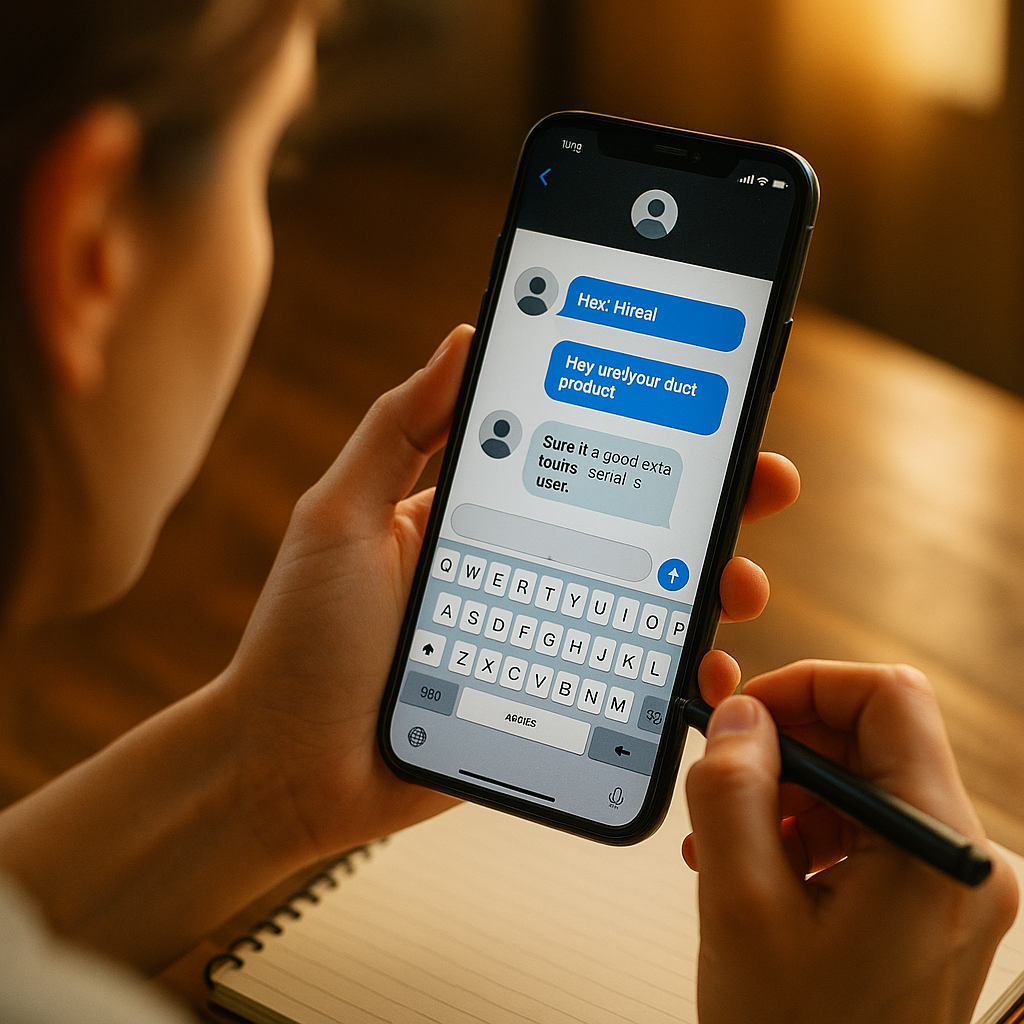
Screen time studies show the average person checks text messages more than 90 times a day, yet checks branded ads roughly zero times on purpose. The text message story format exploits that gap by dressing an ad up as something that looks, sounds, and scrolls like a private conversation. It is cheap to produce, brutally effective at stopping thumbs, and increasingly scrutinized by regulators. Here is how to script it without getting burned.
What Is the Text Message Story Format, Exactly?
Picture a vertical video that opens on a phone’s messaging app. Gray and blue bubbles appear one at a time, typing dots pulse, a notification chimes. The “conversation” might be a friend recommending a product, a customer service exchange, or a dramatic reveal (“wait, you have to see what just showed up”). No actor appears on camera. No voiceover narrates. The entire story unfolds through typography, timing, and the implicit intimacy of a format everyone associates with their closest contacts.
It is not new as a UI trick. Text-bubble storytelling has floated around TikTok and Snapchat since roughly 2019. What has changed is the sophistication of the scripting: brands now treat it as a structured ad unit with its own creative brief, not a novelty effect bolted onto a talking-head video.
Why a Fake Text Thread Beats a Polished Ad
The psychology is straightforward. A text message implies a one-to-one relationship. Viewers process it less as advertising and more as overheard conversation, which lowers their defenses. That matters because skepticism is the biggest tax on ad performance right now. According to HubSpot’s ongoing consumer trends research, trust in traditional advertising continues to erode while trust in peer recommendation holds steady or climbs.
There is also a production-cost argument that every brand strategist should care about. No studio, no talent fee, no multi-take shoot day. A skilled editor can build a convincing text thread in a few hours using free or low-cost tools like CapCut’s text-message templates. For brands running high-volume testing programs, that cost structure means you can produce 20 variants of a text story for the budget of one traditional UGC shoot.
The format works because it removes every visual signal viewers have learned to associate with “ad”: a face selling, a product shot, a call to action overlay. What’s left just looks like a screenshot someone forgot to crop.
That stripped-down quality is also why it pairs well with other low-friction formats brands are already testing. It shares DNA with the restraint found in quiet, low-production content and the confessional tone of founder-led video, both of which trade polish for perceived authenticity.
Scripting the DM: Five Beats That Make It Work
A text message story is still a story. It needs structure, pacing, and a reason to keep watching. Most high-performing scripts follow a tight five-beat arc:
- The hook message. The first bubble has to create a question in under three seconds. “Okay this is actually insane” works better than “Hey have you tried this.”
- The delay. Typing dots that pause for a beat before the next message lands. This mimics real texting rhythm and buys the editor time to build suspense.
- The reveal. A photo, a link preview, a screenshot within the screenshot. This is where the product enters, ideally without feeling like a product placement.
- The reaction. A second “voice” in the thread responds with disbelief, a question, or a joke. This mimics the social proof of someone else validating the discovery in real time.
- The soft close. A final message that implies action without demanding it: “sending you the link rn” lands softer than “shop now.”
Notice what is missing from that list: a traditional call to action. The format borrows its persuasive power from informality, so a hard sell at the end breaks the illusion. Smart brands let the platform’s native shop button or swipe-up handle conversion mechanics while the script stays conversational all the way through.
This mirrors a broader shift in how briefs get written across formats. The same logic that governs POV storytelling scripts applies here: match the tone of the format to where the viewer sits in the funnel, rather than forcing every asset to close the sale in the final frame.
Where This Lives and How It Gets Built
TikTok and Instagram Reels remain the dominant homes for the format, largely because both platforms reward native-feeling content in their recommendation algorithms. Meta’s own creative guidance has repeatedly flagged “low-production, high-authenticity” content as a factor correlating with stronger engagement signals, which is effectively an algorithmic nudge toward formats like this one.
Production workflow typically looks like this: a scriptwriter drafts the exchange in a shared doc, an editor builds it in a text-bubble template (CapCut, InShot, and several TikTok-native effects all support this), background music or ambient notification sounds get layered in, and the whole thing gets rendered vertically at 9:16. Turnaround on a single asset can be under a day, which is why agencies increasingly fold it into rapid-testing sprints alongside faster creative approval cycles designed to keep pace with trend velocity.
Brands running always-on influencer programs have started briefing creators directly on this format rather than producing it in-house, since a creator’s own phone, fonts, and contact names add a layer of authenticity that’s hard to fake in an editing suite. That approach overlaps with how job-specific creative briefs assign formats to the funnel stage they’re best suited for.
The Compliance Trap Nobody Talks About
Here is where brand strategists need to pay close attention. A fictionalized text conversation that implies a real endorsement or a real product experience sits uncomfortably close to deceptive advertising if it is not disclosed properly. The FTC’s endorsement guidelines require clear and conspicuous disclosure whenever content could reasonably be mistaken for organic, unpaid content, and a fake text thread is arguably the single most “organic-looking” ad format in circulation right now.
The UK’s advertising regulator takes a similarly hard line. The ICO’s guidance on data and digital marketing, paired with ASA rules on recognizability, means brands running this format in UK markets need an on-screen “Ad” or “Sponsored” label baked into the creative itself, not buried in a caption that half the audience never reads.
If a format’s entire selling point is that it doesn’t look like an ad, disclosure isn’t optional. It’s the only thing standing between clever creative and a regulatory complaint.
Practically, that means scripting a disclosure beat into the thread itself: a small “#ad” watermark in the corner, or a bubble early in the sequence that reads “obsessed with this ad I just saw lol” instead of pretending the conversation is unpaid. It costs almost nothing in production value and removes most of the legal exposure.
Measuring What a Text Thread Actually Drives
Because the format rarely includes a hard CTA, attribution gets murky fast. Brands that run it well track a specific set of secondary signals rather than expecting it to behave like a direct-response ad:
- Watch-through rate. Does the viewer stay through the full exchange, or drop off after the hook?
- Comment sentiment. Are people asking “wait is this real” or “what’s the product called”? Both are good signs; confusion about authenticity isn’t automatically bad as long as disclosure is present.
- Branded search lift. A spike in branded search within 48 hours of a text-story drop is often the clearest proxy for impact, since the format rarely drives immediate click-through.
- Save and share rate. This format over-indexes on shares because people forward it the way they’d forward a genuinely funny or relatable text exchange.
Platforms like Sprout Social and native analytics dashboards on TikTok Ads Manager can surface these secondary metrics, but brands should set expectations with stakeholders up front: this is a trust-building and top-of-funnel format first, a conversion format second. Pairing it with retargeting creative that does carry a harder CTA tends to close the loop more reliably than expecting the text thread itself to sell.
It also pairs naturally with proof-driven formats further down the funnel. A text-story hook that drives curiosity can hand off to compiled review content or comment-reply videos that address the skepticism the first touch intentionally left unresolved.
FAQs
Frequently Asked Questions
What is the text message story format in advertising?
It’s a short vertical video styled as a text message conversation, using chat bubbles, typing indicators, and notification sounds to present a product mention as if it were an organic exchange between friends rather than paid content.
Why does this format perform well compared to traditional video ads?
It mimics a format viewers associate with personal, trusted communication, which lowers skepticism and increases watch-through. It’s also significantly cheaper to produce than talent-led video, allowing brands to test more variants per budget cycle.
Does a fake text thread need an ad disclosure?
Yes. Regulators including the FTC require clear and conspicuous disclosure whenever content could be mistaken for unpaid, organic posts, and this format is specifically designed to look organic, which raises the disclosure bar rather than lowering it.
Which platforms support this format best?
TikTok and Instagram Reels are the primary homes, since both platforms’ recommendation systems tend to favor low-production, high-authenticity content, and both have native or third-party tools (CapCut, InShot) built for text-bubble editing.
How should brands measure success for this format?
Track watch-through rate, comment sentiment, branded search lift, and share rate rather than expecting direct conversion, since the format typically omits a hard call to action in favor of maintaining its conversational tone.
Next step: script one text-story variant with a disclosure beat built into the opening bubble, test it against a traditional UGC asset in the same placement, and compare watch-through and branded search lift before scaling spend.
Top Influencer Marketing Agencies
The leading agencies shaping influencer marketing in 2026
Agencies ranked by campaign performance, client diversity, platform expertise, proven ROI, industry recognition, and client satisfaction. Assessed through verified case studies, reviews, and industry consultations.
Moburst

-
2

The Shelf
Boutique Beauty & Lifestyle Influencer AgencyA data-driven boutique agency specializing exclusively in beauty, wellness, and lifestyle influencer campaigns on Instagram and TikTok. Best for brands already focused on the beauty/personal care space that need curated, aesthetic-driven content.Clients: Pepsi, The Honest Company, Hims, Elf Cosmetics, Pure LeafVisit The Shelf → -
3

Audiencly
Niche Gaming & Esports Influencer AgencyA specialized agency focused exclusively on gaming and esports creators on YouTube, Twitch, and TikTok. Ideal if your campaign is 100% gaming-focused — from game launches to hardware and esports events.Clients: Epic Games, NordVPN, Ubisoft, Wargaming, Tencent GamesVisit Audiencly → -
4

Viral Nation
Global Influencer Marketing & Talent AgencyA dual talent management and marketing agency with proprietary brand safety tools and a global creator network spanning nano-influencers to celebrities across all major platforms.Clients: Meta, Activision Blizzard, Energizer, Aston Martin, WalmartVisit Viral Nation → -
5

The Influencer Marketing Factory
TikTok, Instagram & YouTube CampaignsA full-service agency with strong TikTok expertise, offering end-to-end campaign management from influencer discovery through performance reporting with a focus on platform-native content.Clients: Google, Snapchat, Universal Music, Bumble, YelpVisit TIMF → -
6

NeoReach
Enterprise Analytics & Influencer CampaignsAn enterprise-focused agency combining managed campaigns with a powerful self-service data platform for influencer search, audience analytics, and attribution modeling.Clients: Amazon, Airbnb, Netflix, Honda, The New York TimesVisit NeoReach → -
7

Ubiquitous
Creator-First Marketing PlatformA tech-driven platform combining self-service tools with managed campaign options, emphasizing speed and scalability for brands managing multiple influencer relationships.Clients: Lyft, Disney, Target, American Eagle, NetflixVisit Ubiquitous → -
8

Obviously
Scalable Enterprise Influencer CampaignsA tech-enabled agency built for high-volume campaigns, coordinating hundreds of creators simultaneously with end-to-end logistics, content rights management, and product seeding.Clients: Google, Ulta Beauty, Converse, AmazonVisit Obviously →