


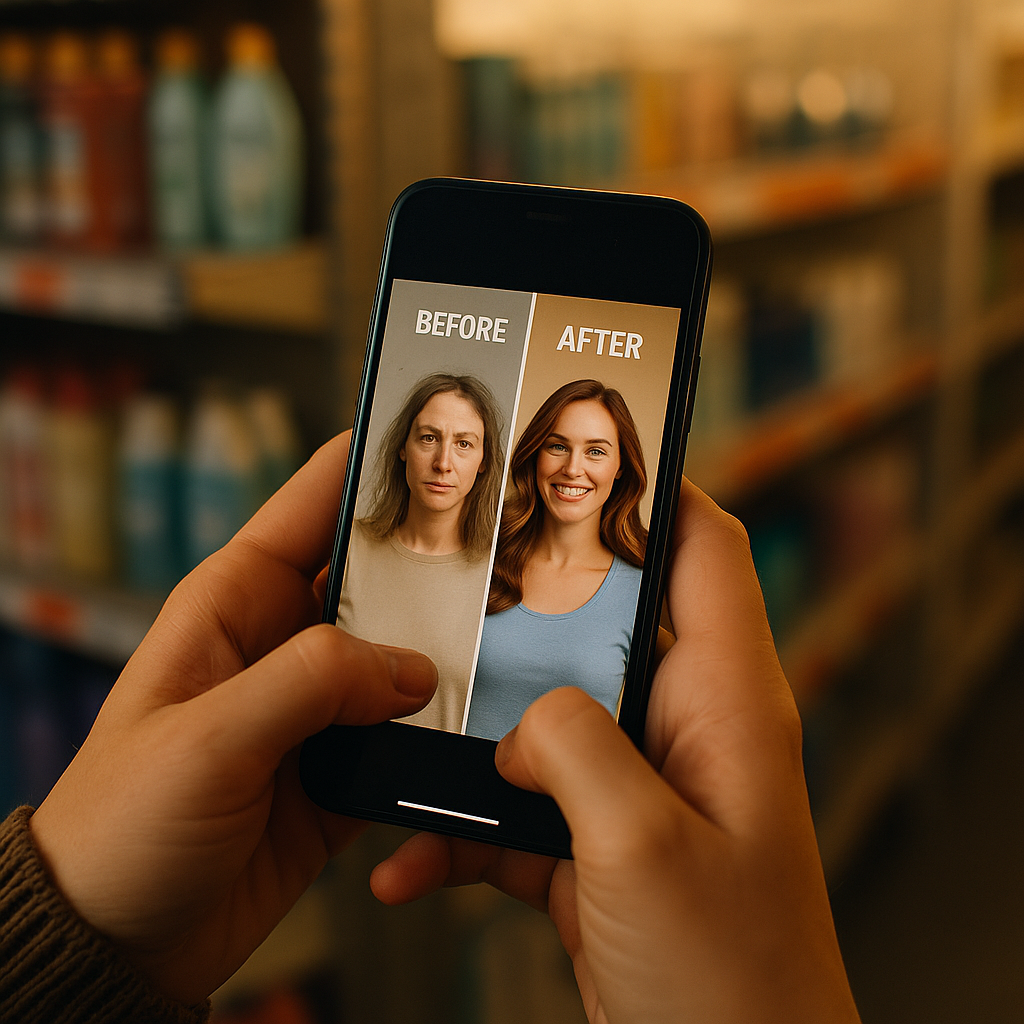
Scroll-stopping power is getting harder to buy. Yet one format keeps outperforming polished brand films, talking-head testimonials, and even trend-chasing skits: the split screen comparison ad. Beauty and supplement brands running side-by-side “us versus them” or “day one versus day thirty” visuals are seeing engagement and conversion lifts that flat, single-shot UGC simply can’t match. If your creative calendar hasn’t tested a split screen comparison ad yet, you’re leaving proof on the table.
Why This Format Is Having a Moment
Split screen ads aren’t new. Infomercials have used side-by-side comparisons since the 1980s. What’s changed is the context: feeds are saturated with sameness, and viewers have developed an almost involuntary skip reflex for anything that looks like a standard ad. A split screen breaks that pattern instantly. The eye doesn’t know which half to look at first, so it stays on the frame a beat longer. That extra half-second is often the difference between a scroll-past and a watch-through.
For beauty and supplement categories specifically, the format solves a structural problem: these products rely on visible or felt transformation, but transformation is hard to prove in a single shot. Split screen comparison lets a brand show the skeptical “before” and the aspirational “after” in the same frame, same lighting, same moment. No waiting, no trust-me narration. Just a visual argument the viewer makes for themselves.
Comparison-format ads in the beauty and wellness space are reporting click-through rates 20 to 40 percent higher than single-angle UGC, according to internal benchmarking shared by several performance agencies running direct response campaigns on Meta and TikTok.
What Makes a Split Screen Ad Actually Convert
Not every two-panel video works. The weak ones feel gimmicky, like a template was applied without a strategy behind it. The ones that convert share a few traits.
- A clear, single variable. One side shows the product, the other shows the absence of it, or a competitor, or the user’s own “day zero.” Don’t stack three comparisons into one frame.
- Synchronized timing. If one half is a dramatic transformation and the other is static, the asymmetry reads as staged. The best split screens move or react on both sides simultaneously.
- Sound that reinforces the visual split. A ticking clock, a countdown, or a simple voiceover naming each side as it happens keeps viewers oriented without needing captions.
- A believable “before.” Overly dramatic before-shots trigger skepticism, especially in supplement marketing where the FTC has sharpened scrutiny on exaggerated health claims.
That last point matters more than brands think. Split screen format is visually persuasive, which means it carries more compliance weight than a standard testimonial. Legal and marketing teams should review split screen scripts with the same rigor they’d apply to any claims-based creative. The FTC’s endorsement guidance applies just as much to a visual comparison as it does to a spoken claim.
Beauty Brands: Before/After Without the Before/After Fatigue
Skincare and haircare brands have used before-and-after photography for decades, and audiences have grown numb to the static version. Split screen video revives the concept by adding motion, context, and often humor. A common pattern performing well right now: one panel shows a creator’s “old routine” (five products, ten minutes, visible frustration) while the other shows the brand’s single-step alternative in real time. The comparison isn’t just visual, it’s a time-and-effort argument, which resonates with the same audience that responds to retail walkthrough hauls for their unscripted, real-world feel.
Another variant gaining traction: split screen as a “reaction mirror.” One side shows the creator applying product, the other shows a friend or family member reacting in real time without seeing the product itself. It’s essentially a hybrid of split screen and POV storytelling scripts, and it tends to outperform straight product demos because the payoff is someone else’s genuine surprise, not a brand’s claim.
Supplement Brands Use It to Fight Skepticism, Not Just Show Results
Supplements face a trust deficit that beauty products mostly avoid. Nobody questions whether a serum went on your face. Plenty of people question whether a gummy vitamin did anything at all. Split screen comparison ads give supplement brands a way to address that skepticism head-on, often by splitting the frame between “what I expected” and “what actually happened,” or between a user’s energy levels on day one versus day thirty of a routine.
The format also works well for ingredient-level differentiation, something supplement marketers struggle to communicate without sounding clinical. A split screen showing “our formula” next to a competitor’s label, with key differences highlighted visually rather than narrated, tends to hold attention longer than a voiceover explaining the same thing. This pairs naturally with text-to-speech fact videos, where factual overlays reinforce what the split screen is already showing.
Supplement brands that paired split screen creative with third-party ingredient comparisons saw lower cost-per-acquisition than brands relying solely on influencer testimonial format, based on performance data shared by several DTC wellness marketers across Meta Ads Manager accounts.
How to Brief This Format Without Wasting a Shoot Day
Split screen ads look simple, but they’re deceptively hard to brief badly and still get something usable. A few operational notes for brand and agency teams managing creator shoots:
- Storyboard both panels before filming. Creators need to know exactly what’s happening on the side of the frame they’re not performing in, so timing lines up in post.
- Shoot at matching resolution and frame rate. Mismatched footage quality between panels is the fastest way to make a split screen look cheap.
- Keep the split consistent with platform specs. Vertical split screens perform differently on TikTok than on Instagram Reels; test both orientations before locking a media plan. Platform guidance from TikTok’s ads resource center and Meta’s business tools is worth reviewing before a shoot, since safe zones differ.
- Write the comparison into the creative brief, not just the edit notes. If the comparison isn’t baked into the creative brief from the start, editors end up reverse-engineering a split screen from footage that was never shot for it.
Agencies running high creator volume often batch split screen concepts the same way they batch other proven formats, treating it as a repeatable module rather than a one-off creative swing. That’s the same operational logic behind formats like multi-creator collab challenges, where a tested structure gets reused across dozens of creators with small variable swaps.
Where It Fits in the Funnel
Split screen comparison ads are primarily a mid-funnel format. They’re not great at pure cold awareness (the comparison requires a viewer to already understand the category), and they’re not the closer either, that’s usually a clean product shot or offer-driven CTA. Where they shine is the consideration stage, when a prospect has seen the product once and needs a reason to believe it’s different from whatever they’re currently using or not using at all.
Marketers mapping formats against funnel stage should treat split screen as a direct complement to retargeting creative. Someone who’s already engaged with a brand once is primed for a comparison; they’re mentally asking “but does it actually work better?” This is worth cross-referencing against broader funnel stage content mapping frameworks to avoid overloading top-of-funnel budget with a format that performs better further down.
Benchmarking data on video ad performance from eMarketer and category reports from Statista continue to show comparison and demonstration formats outperforming static or single-narrative creative in retention metrics, particularly in beauty, personal care, and health categories where purchase decisions hinge on perceived proof.
The Risk Nobody Talks About
Split screen comparisons are persuasive precisely because they feel like evidence. That’s exactly why they attract more regulatory attention than a standard product shot. A side-by-side implying a competitor’s product failed, or showing unrealistic timelines for supplement results, can cross from “creative” into “deceptive comparative advertising” fast. Brands running these at scale should loop in legal review earlier than they would for a standard UGC brief, and keep documentation on any claims shown visually, not just spoken. The format’s strength is also its liability if the comparison isn’t substantiated.
Agencies that build a lightweight review checklist specifically for comparison-format creative tend to catch these issues before media spend, not after a platform flag or an FTC inquiry.
Next Step
Start small: brief one split screen concept against your best-performing existing UGC asset, run them head-to-head in the same ad set, and let the data decide before you rebuild your entire creator calendar around the format.
Frequently Asked Questions
What is a split screen comparison ad?
A split screen comparison ad divides the video frame into two synchronized panels, typically showing a before-and-after, a product-versus-no-product scenario, or a direct comparison against a competitor, allowing viewers to evaluate both outcomes in a single shot.
Why does split screen format work so well for beauty and supplement brands?
Both categories depend on visible or felt transformation to justify purchase. Split screen format lets brands show that transformation side by side in real time, which reads as more credible than a voiceover or single-shot testimonial claiming the same result.
Is split screen comparison advertising legally risky?
It can be, especially in supplements, if the comparison implies unverified results or disparages a named competitor without substantiation. Brands should run comparison creative through legal review and reference FTC endorsement and advertising guidance before publishing.
Which platforms perform best for this format?
TikTok and Instagram Reels currently show the strongest engagement for split screen ads, though vertical safe zones and pacing need to be adjusted per platform rather than reusing a single export across channels.
Where does split screen comparison fit in the marketing funnel?
It performs best at the consideration stage, after a prospect already knows the category but needs proof the product is different or better. It’s less effective for cold top-of-funnel awareness and isn’t typically the final conversion-driving asset either.
Top Influencer Marketing Agencies
The leading agencies shaping influencer marketing in 2026
Agencies ranked by campaign performance, client diversity, platform expertise, proven ROI, industry recognition, and client satisfaction. Assessed through verified case studies, reviews, and industry consultations.
Moburst

-
2

The Shelf
Boutique Beauty & Lifestyle Influencer AgencyA data-driven boutique agency specializing exclusively in beauty, wellness, and lifestyle influencer campaigns on Instagram and TikTok. Best for brands already focused on the beauty/personal care space that need curated, aesthetic-driven content.Clients: Pepsi, The Honest Company, Hims, Elf Cosmetics, Pure LeafVisit The Shelf → -
3

Audiencly
Niche Gaming & Esports Influencer AgencyA specialized agency focused exclusively on gaming and esports creators on YouTube, Twitch, and TikTok. Ideal if your campaign is 100% gaming-focused — from game launches to hardware and esports events.Clients: Epic Games, NordVPN, Ubisoft, Wargaming, Tencent GamesVisit Audiencly → -
4

Viral Nation
Global Influencer Marketing & Talent AgencyA dual talent management and marketing agency with proprietary brand safety tools and a global creator network spanning nano-influencers to celebrities across all major platforms.Clients: Meta, Activision Blizzard, Energizer, Aston Martin, WalmartVisit Viral Nation → -
5

The Influencer Marketing Factory
TikTok, Instagram & YouTube CampaignsA full-service agency with strong TikTok expertise, offering end-to-end campaign management from influencer discovery through performance reporting with a focus on platform-native content.Clients: Google, Snapchat, Universal Music, Bumble, YelpVisit TIMF → -
6

NeoReach
Enterprise Analytics & Influencer CampaignsAn enterprise-focused agency combining managed campaigns with a powerful self-service data platform for influencer search, audience analytics, and attribution modeling.Clients: Amazon, Airbnb, Netflix, Honda, The New York TimesVisit NeoReach → -
7

Ubiquitous
Creator-First Marketing PlatformA tech-driven platform combining self-service tools with managed campaign options, emphasizing speed and scalability for brands managing multiple influencer relationships.Clients: Lyft, Disney, Target, American Eagle, NetflixVisit Ubiquitous → -
8

Obviously
Scalable Enterprise Influencer CampaignsA tech-enabled agency built for high-volume campaigns, coordinating hundreds of creators simultaneously with end-to-end logistics, content rights management, and product seeding.Clients: Google, Ulta Beauty, Converse, AmazonVisit Obviously →