


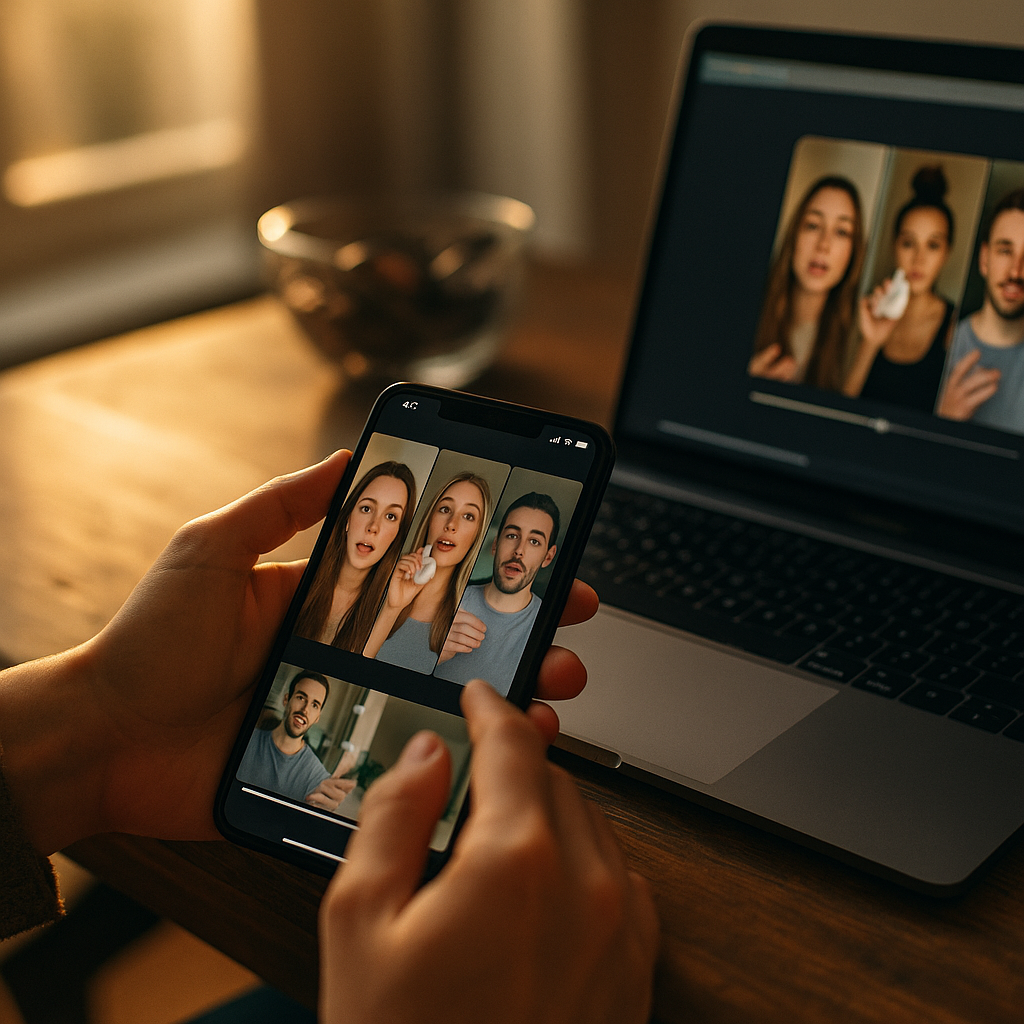
One TikTok stitch compilation review can replace what used to take six separate testimonial shoots, three rounds of legal review, and a month of coordination. Stitch compilation reviews are quietly becoming the highest-leverage proof format in influencer marketing, and most brands still aren’t using them on purpose.
Scattered mentions of your product are sitting on creator accounts right now, unpaid, unrequested, and mostly ignored. That’s a wasted asset. Stitched together with intent, those clips become something closer to a courtroom of independent witnesses than a single paid endorsement, and buyers notice the difference.
What Is a Stitch Compilation Review, Exactly?
A stitch compilation review strings together multiple short clips, often from different creators, each reacting to or reviewing the same product, into one continuous video. TikTok’s native stitch feature (and the duet-style equivalents on Reels and Shorts) makes the format technically easy. The strategic part is curation: picking clips that build a narrative arc rather than just repeating the same five-second reaction over and over.
Think of it as a highlight reel of independent opinions. One creator shows the unboxing. Another shows the skeptical first use. A third shows the “okay, I get it now” moment three weeks later. Stitched in sequence, the compilation mimics the arc of a buyer’s own decision journey, which is exactly why it converts better than any single testimonial can.
A single polished testimonial reads as marketing. Six unpolished reactions stitched together read as consensus, and consensus is what actually moves skeptical buyers.
Why This Format Is Having a Moment
Trust in advertising has been sliding for years, and paid-media fatigue is real. According to eMarketer’s consumer trust research, peer recommendations and user-generated content consistently outperform brand-produced ads on credibility metrics. Stitch compilations exploit that gap directly. They don’t ask viewers to trust one voice; they ask viewers to trust a pattern.
There’s also a cost argument that CFOs actually care about. Commissioning five separate testimonial videos from five creators can run into five-figure territory once you factor in briefing, usage rights, and editing. A stitch compilation built from existing organic mentions, with proper rights secured, can cost a fraction of that. You’re not creating new content. You’re curating proof that already exists.
Platforms are rewarding the format too. TikTok’s algorithm tends to favor stitches because they signal cross-creator engagement, and Instagram has been pushing Remix features that work similarly. Meta’s own creator tools documentation at business.meta.com notes that collaborative content formats see measurably higher watch-through rates than single-creator posts, which matters if you’re running paid amplification behind organic winners.
Where It Fits in the Funnel
Stitch compilations aren’t a top-of-funnel awareness play, and they’re not quite bottom-funnel conversion copy either. They live in the consideration stage, where a buyer already knows your category and is weighing whether your product specifically is worth the money. That’s the exact moment when “other people like me already tried this and here’s what happened” carries the most weight. If you’re mapping formats against buyer stages, this one slots in alongside the frameworks covered in funnel stage content mapping.
It also pairs well with retargeting. Someone who added to cart and abandoned is a prime candidate to see a 30-second stitch compilation showing five other buyers having the same hesitation and then converting anyway.
Sourcing Clips Without Creating a Legal Headache
Here’s where a lot of brand teams get sloppy. Finding a great organic clip is easy. Having the right to repurpose it commercially is not automatic, and this is the step most marketing teams skip because it feels slow.
- Always secure explicit usage rights before stitching a creator’s clip into branded content, even if the clip was already public and tagged your product.
- Use platform-native rights request tools where available. TikTok and Instagram both have mechanisms for requesting content usage directly through the app, which creates a documented trail.
- Offer compensation or product credit even for unsolicited mentions. It costs little and dramatically reduces the odds of a takedown request after you’ve already spent ad dollars behind the compilation.
- Disclose paid amplification clearly if you’re boosting the compilation as an ad. The FTC’s endorsement guidelines apply to compiled content the same way they apply to single-creator posts, and regulators don’t care that the clips were originally organic.
If you’re operating in the UK or EU, the ICO’s guidance on data and consent is worth a read too, particularly if any clip includes identifiable bystanders or location data you didn’t anticipate using commercially.
Building a Rights-Cleared Pipeline
Smart teams set up an always-on sourcing workflow rather than scrambling every time they need a new compilation. That usually means a social listening tag for branded mentions, a lightweight rights-request template, and a shared drive where cleared clips get dropped the moment usage is confirmed. It’s not glamorous work, but it’s the difference between publishing a compilation in 48 hours and publishing one in three weeks.
Editing Principles That Actually Matter
Not every stitch compilation performs the same, and the difference usually comes down to pacing and sequencing rather than production polish. A few things that consistently separate the ones that convert from the ones that get scrolled past:
- Lead with the most skeptical reaction, not the most enthusiastic one. Viewers trust doubt before they trust praise. Open with someone who almost didn’t buy, and the payoff lands harder.
- Keep each clip under four seconds unless the moment earns more. Compilations die when any single segment overstays its welcome.
- Vary the creator type. Mixing a micro-creator, a niche expert, and an everyday customer reads as broader social proof than three similar-looking influencers saying the same thing.
- End on a specific, concrete result. “This actually worked” is weak. “My skin cleared up in nine days” is a stitch-worthy close.
This is also where sound design earns its keep. A compilation that mutes platform-native audio and replaces it with a flat voiceover loses the authenticity that made the clips valuable in the first place. The guidance in vertical video sound design applies directly here: let each creator’s original audio breathe, and use music sparingly as connective tissue between clips rather than a wall-to-wall backing track.
If you’re assembling these in-house rather than through an agency, the editing stack matters less than the sequencing logic, but tools built for fast vertical cuts speed up the process considerably. Teams already using AI-assisted editing workflows can usually turn a rough cut around same-day.
Where Stitch Compilations Outperform Single-Creator Content
It’s not that single-creator UGC is bad. It’s that single-creator content asks viewers to extend trust based on one person’s judgment, and skeptical buyers (the ones who’ve been burned by influencer hype before) discount that automatically. Compilations distribute the trust burden across multiple independent sources, which is harder to dismiss as “just one paid post.”
Sprout Social’s research on audience trust, referenced on sproutsocial.com, points to a consistent pattern: audiences weight peer consensus more heavily than individual authority, especially in categories with high purchase risk like skincare, supplements, or financial products. Stitch compilations are a direct mechanical response to that psychology.
If your category has a trust problem (beauty, wellness, finance, anything with a history of influencer hype gone wrong) a stitch compilation does more credibility repair per dollar than almost any other format available right now.
There’s also a practical production angle. Brands running multi-creator roster campaigns often end up with a graveyard of unused footage once the primary deliverables are posted. Stitch compilations give that footage a second life instead of letting it rot in a shared drive. Similarly, brands sitting on footage from live event content capture can mine attendee reactions for months of compilation material without booking a single new creator.
A Quick Gut Check Before You Publish
Before pushing a compilation live, ask whether it would survive a stranger fact-checking it. Can every claim in the stitched clips be substantiated? Would a regulator reading the disclosure find it adequate? If the answer to either is “probably not,” the compilation needs another editing pass before it goes anywhere near paid spend.
Measuring Whether It’s Actually Working
Standard video metrics undersell this format. Watch-through rate matters, but the number that actually tells you whether a stitch compilation is doing its job is the lift in add-to-cart or conversion rate among viewers who watched past the halfway mark, compared to a baseline single-creator ad. HubSpot’s guidance on content performance benchmarking is a reasonable starting framework if you don’t already have an internal model.
Comment sentiment is the other signal worth tracking closely. Compilations that are working well tend to generate comments naming specific creators featured (“wait that’s the same girl from my FYP last week”) which indicates the social proof mechanism is actually registering rather than just being watched passively.
Getting Started Without a Full Production Budget
You don’t need a quarter-long rollout plan to test this. Pull ten existing organic mentions of your product, secure usage rights on the five strongest, and cut a 25-second compilation this week. Run it against your current best-performing single-creator ad for two weeks and compare cost per acquisition. The format either earns its place in your content mix on its own evidence, or it doesn’t, and either way you’ll know within a sprint.
Frequently Asked Questions
Do I need permission from every creator featured in a stitch compilation?
Yes. Even if a clip was posted publicly and tagged your brand, commercial repurposing in a branded compilation requires explicit usage rights from the original creator. Platform-native rights request tools make this process faster and create a documented record.
How many clips should a stitch compilation include?
Most high-performing compilations run between four and eight clips. Fewer than four feels thin and doesn’t establish consensus; more than eight tends to drag and lose viewer attention before the strongest clip even appears.
Can stitch compilations be used as paid ads?
Yes, and they often perform well as paid amplification once an organic version proves itself. Just make sure disclosure requirements under FTC guidelines are met, since paid distribution of compiled creator content still falls under endorsement rules.
What’s the ideal length for a stitch compilation review?
Between 20 and 45 seconds for most feed placements. Longer cuts can work for YouTube Shorts or as landing page embeds, but anything over a minute risks losing the pacing that makes the format effective in the first place.
How is this different from a regular UGC montage?
A generic UGC montage often just stacks similar clips together for volume. A stitch compilation review is sequenced deliberately, usually moving from skepticism to resolution, to mirror a buyer’s actual decision-making arc rather than just repeating the same sentiment multiple times.
Frequently Asked Questions
Do I need permission from every creator featured in a stitch compilation?
Yes. Even if a clip was posted publicly and tagged your brand, commercial repurposing in a branded compilation requires explicit usage rights from the original creator. Platform-native rights request tools make this process faster and create a documented record.
How many clips should a stitch compilation include?
Most high-performing compilations run between four and eight clips. Fewer than four feels thin and doesn’t establish consensus; more than eight tends to drag and lose viewer attention before the strongest clip even appears.
Can stitch compilations be used as paid ads?
Yes, and they often perform well as paid amplification once an organic version proves itself. Just make sure disclosure requirements under FTC guidelines are met, since paid distribution of compiled creator content still falls under endorsement rules.
What’s the ideal length for a stitch compilation review?
Between 20 and 45 seconds for most feed placements. Longer cuts can work for YouTube Shorts or as landing page embeds, but anything over a minute risks losing the pacing that makes the format effective in the first place.
How is this different from a regular UGC montage?
A generic UGC montage often just stacks similar clips together for volume. A stitch compilation review is sequenced deliberately, usually moving from skepticism to resolution, to mirror a buyer’s actual decision-making arc rather than just repeating the same sentiment multiple times.
Pull five rights-cleared clips you already have sitting in a folder somewhere, cut a 25-second compilation this week, and run it against your current top ad. The data will tell you faster than any planning deck whether this format deserves a permanent line in your content calendar.
Top Influencer Marketing Agencies
The leading agencies shaping influencer marketing in 2026
Agencies ranked by campaign performance, client diversity, platform expertise, proven ROI, industry recognition, and client satisfaction. Assessed through verified case studies, reviews, and industry consultations.
Moburst

-
2

The Shelf
Boutique Beauty & Lifestyle Influencer AgencyA data-driven boutique agency specializing exclusively in beauty, wellness, and lifestyle influencer campaigns on Instagram and TikTok. Best for brands already focused on the beauty/personal care space that need curated, aesthetic-driven content.Clients: Pepsi, The Honest Company, Hims, Elf Cosmetics, Pure LeafVisit The Shelf → -
3

Audiencly
Niche Gaming & Esports Influencer AgencyA specialized agency focused exclusively on gaming and esports creators on YouTube, Twitch, and TikTok. Ideal if your campaign is 100% gaming-focused — from game launches to hardware and esports events.Clients: Epic Games, NordVPN, Ubisoft, Wargaming, Tencent GamesVisit Audiencly → -
4

Viral Nation
Global Influencer Marketing & Talent AgencyA dual talent management and marketing agency with proprietary brand safety tools and a global creator network spanning nano-influencers to celebrities across all major platforms.Clients: Meta, Activision Blizzard, Energizer, Aston Martin, WalmartVisit Viral Nation → -
5

The Influencer Marketing Factory
TikTok, Instagram & YouTube CampaignsA full-service agency with strong TikTok expertise, offering end-to-end campaign management from influencer discovery through performance reporting with a focus on platform-native content.Clients: Google, Snapchat, Universal Music, Bumble, YelpVisit TIMF → -
6

NeoReach
Enterprise Analytics & Influencer CampaignsAn enterprise-focused agency combining managed campaigns with a powerful self-service data platform for influencer search, audience analytics, and attribution modeling.Clients: Amazon, Airbnb, Netflix, Honda, The New York TimesVisit NeoReach → -
7

Ubiquitous
Creator-First Marketing PlatformA tech-driven platform combining self-service tools with managed campaign options, emphasizing speed and scalability for brands managing multiple influencer relationships.Clients: Lyft, Disney, Target, American Eagle, NetflixVisit Ubiquitous → -
8

Obviously
Scalable Enterprise Influencer CampaignsA tech-enabled agency built for high-volume campaigns, coordinating hundreds of creators simultaneously with end-to-end logistics, content rights management, and product seeding.Clients: Google, Ulta Beauty, Converse, AmazonVisit Obviously →