


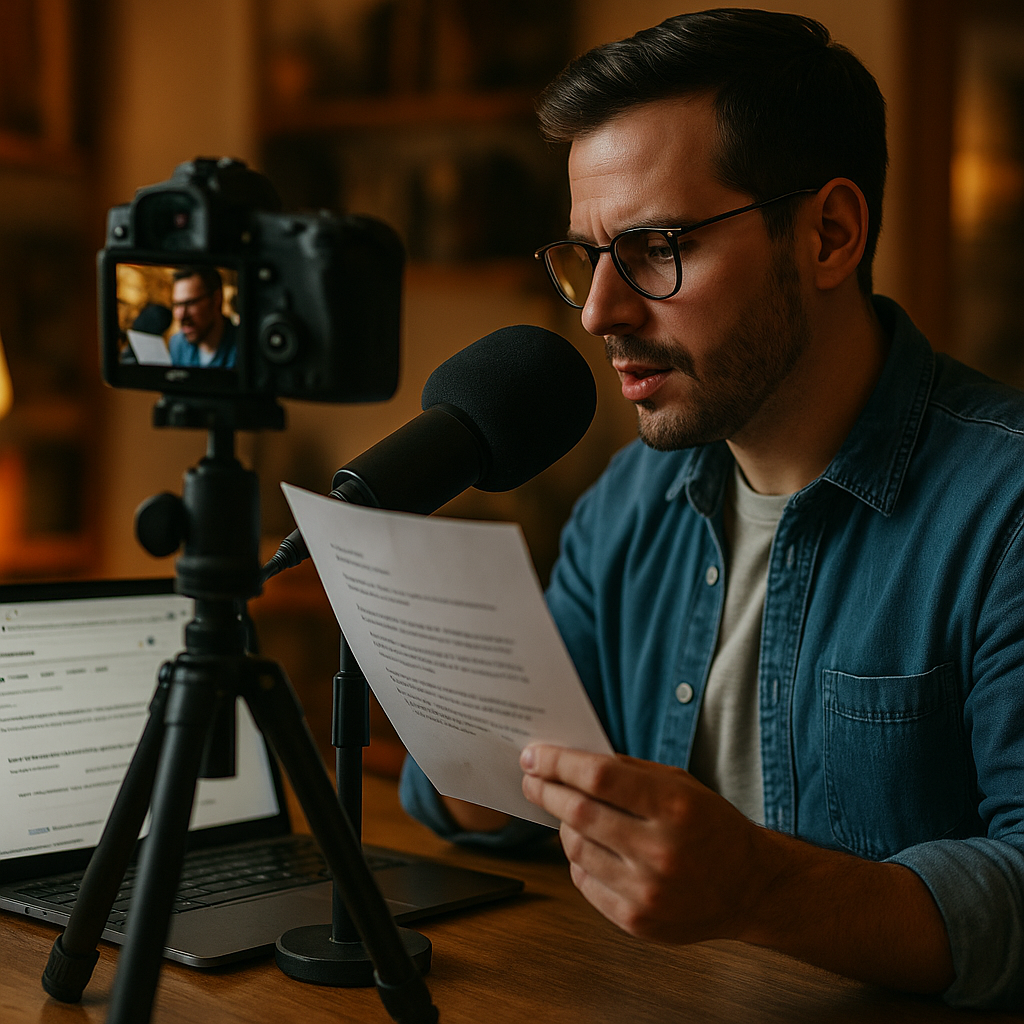
ChatGPT and Google AI Overviews now answer product questions that used to send traffic to blogs and brand pages, and the sources they cite are increasingly creator videos, not articles. If your influencer scripts still read like ad copy, you’re invisible to the machines doing the recommending. Generative Engine Optimization (GEO) for video is the fix, and it starts long before the camera rolls.
This isn’t about chasing another algorithm. It’s about recognizing that large language models parse transcripts, captions, and structured claims, then quote the clearest, most specific answer they can find. A creator mumbling “this stuff is amazing” gets ignored. A creator saying “this retinol serum reduced my fine lines in six weeks at 0.3% concentration” gets cited by name.
Why Creator Video Is Becoming an AI Overview Source
AI Overviews and chat assistants pull from a blended index of web pages, video transcripts, and structured data. Google has been increasingly surfacing YouTube timestamps and TikTok captions directly inside AI Overview answers, especially for “how to,” “best,” and comparison queries. That means the creator video your team funded for reach is now competing for citation real estate against Reddit threads and review sites.
The practitioners who win here treat scripting as an SEO discipline, not a creative afterthought. That’s a mindset shift for brand teams used to measuring views and engagement rate. Now you’re also measuring whether an LLM can lift a clean, attributable sentence out of the transcript.
If an LLM can’t extract a clear claim, a source, and a timestamp from your creator video, it will cite a competitor’s instead, even if your product is better.
The Core Problem With Most Influencer Scripts
Most creator briefs optimize for watch time and vibe, not extractability. Hooks are vague (“you NEED this”), claims are unsourced (“dermatologist approved” with no citation), and structure is loose, jumping between product features without clear delineation. That’s great for retention on TikTok’s For You page. It’s terrible for a language model trying to summarize “what does this serum actually do.”
Think about how AI Overviews construct answers: they favor content with clear question-answer pairs, specific numbers, and named entities. A script that never names the product, brand, or category by its searchable term simply won’t get matched to the query in the first place.
A Practical GEO Framework for Scripting Creator Videos
Here’s the structure we recommend to brand teams building creator briefs for citation-worthy content. It works across TikTok, Instagram Reels, and YouTube Shorts, though YouTube’s longer transcript indexing gives it the most citation upside.
1. Open With the Query, Not the Hook
Traditional creator hooks chase scroll-stopping curiosity. GEO-ready hooks state the question a user might type into ChatGPT or Google. “What’s the best budget ring light for video calls” beats “wait til you see this.” Both can still be entertaining, but the second version gives an LLM nothing to match against a search query.
2. Name Entities Early and Often
Brand name, product name, category, and key specification should appear in the first fifteen seconds, and again in the caption. LLMs weight proximity and repetition. A creator who says “this Anker power bank” once and then “it” for the rest of the video is harder to cite than one who repeats the product name three or four times naturally.
3. Structure Claims as Answerable Statements
Instead of “this changed my skin,” script for “this reduced redness in about two weeks for combination skin.” Specificity is what gets lifted into an AI Overview snippet. Vague enthusiasm gets summarized as “some creators liked this product,” which is a citation nobody wants: no brand name, no link, no value.
4. Build in a Comparison Beat
AI Overviews love comparative framing because it mirrors how people ask questions (“X vs Y,” “best alternative to X”). A 5 to 10 second segment where the creator contrasts your product against a known competitor, on a specific attribute, gives the model a clean comparison sentence to extract. This is also where structured data on brand pages can reinforce the same comparison in text form, doubling your citation surface.
5. Timestamp the Video Like a Chapter List
YouTube’s chapter markers and description timestamps are effectively a table of contents for LLMs. Script segments that map cleanly to timestamps (“00:32 unboxing,” “01:15 durability test,” “02:40 final verdict”) so the transcript has natural break points a model can cite alongside a specific claim.
6. Close With a Recap Sentence
Scripted outros that summarize the verdict in one sentence (“Overall, this is the best budget option under $50 for most home offices”) function almost like a meta description for the video. It’s often the exact sentence an AI Overview will lift verbatim.
None of this requires creators to sound robotic. The best-performing scripts we’ve reviewed still feel conversational. The difference is precision under the personality, not personality replaced by precision.
Disclosure and Compliance Still Come First
None of this GEO scripting work matters if the video gets flagged or throttled for disclosure violations. The FTC’s endorsement guidance requires clear, unambiguous disclosure of paid partnerships, and platforms are adding their own labeling requirements on top. TikTok’s newer AI labeling rules and the broader trend toward AI disclosure labels affecting reach mean brand teams need to build compliance checks into the same brief that carries the GEO script. Check current guidance at the FTC’s endorsement resources before finalizing any script template.
Skipping this step doesn’t just risk a fine. It risks the platform suppressing the very video you scripted for citation, which defeats the entire exercise.
Measuring Whether It’s Working
Here’s the uncomfortable part: most attribution stacks weren’t built to tell you when ChatGPT or an AI Overview cited your creator content. Standard GA4 referral data undercounts this badly, since a lot of AI-driven traffic arrives looking like direct or unattributed sessions. That’s the exact problem covered in why AI assistant traffic hides in your direct channel, and it’s worth reading before you present GEO results to a CMO who’s expecting clean referral logs.
If your team is choosing between analytics platforms to track this, the comparison in Parse.ly vs GA4 for AI referral tracking is a useful starting point. For a broader diagnostic on whether your team is even set up to act on AI-driven signals, the four pillar AI readiness framework is worth benchmarking against before you scale a GEO scripting program across your whole creator roster.
You cannot optimize for AI Overview citations if your analytics stack can’t even tell you when a citation happened. Fix measurement before you scale the scripting program.
In practice, most brands start by manually querying ChatGPT, Perplexity, and Google AI Overviews with their target category questions once a month, checking whether creator content shows up in the answer, and tracking which script elements (entity naming, comparison beats, recap sentences) correlate with citations. It’s manual, it’s imperfect, and it’s still better than flying blind. Tools built for structured intelligence on AI use cases, like those evaluated in this vetting scorecard for AI use case platforms, are starting to automate some of this tracking, but the space is young.
Where This Fits Inside a Broader Content Governance Model
GEO scripting shouldn’t live in a silo separate from your existing creator content review process. Bad claims, unsupported comparisons, or sloppy fact-checking get amplified, not filtered, once an LLM starts quoting them as fact. That’s precisely the failure mode described in AI content governance committees built to stop slop before it ships. Any brand scaling GEO-scripted creator content across dozens of partners needs a review layer checking claims for accuracy, not just brand safety.
Consider running scripts through a lightweight fact-check pass before creators film. It’s a small operational cost, and it protects you from a language model repeating an inflated claim to thousands of users who never watched the actual video.
For teams benchmarking their creator marketing maturity more broadly, industry data from eMarketer and Sprout Social consistently shows brands under-investing in measurement relative to content production. GEO scripting adds another layer to that gap unless it’s built in from the start.
FAQs
Frequently Asked Questions
What is GEO in the context of creator video content?
GEO, or Generative Engine Optimization, is the practice of structuring content so AI systems like ChatGPT, Perplexity, and Google AI Overviews can extract and cite it accurately in generated answers. For creator video, this means scripting clear claims, named entities, and structured segments rather than optimizing purely for watch time or engagement.
Do AI Overviews actually cite video content or just written articles?
AI Overviews increasingly cite video transcripts and captions alongside written pages, particularly for YouTube content with clear timestamps and descriptions. TikTok and Instagram captions can also surface in AI-generated answers when they contain specific, well-structured claims.
How is scripting for GEO different from scripting for engagement?
Engagement-focused scripts prioritize curiosity hooks and pacing to hold attention. GEO-focused scripts prioritize naming entities early, stating specific and answerable claims, and structuring content in a question-answer format that language models can extract cleanly.
Does disclosure labeling affect whether AI systems cite a video?
Disclosure labels themselves don’t directly block citation, but platforms that suppress reach on inadequately disclosed content reduce the video’s overall visibility and indexing, which lowers the odds an AI system encounters it in the first place.
How do brands measure whether their creator videos are getting cited by AI tools?
Most teams currently run manual spot checks by querying AI Overviews, ChatGPT, and Perplexity with target category questions and noting whether their creator content appears. Standard analytics platforms undercount AI-referred traffic, so manual monitoring combined with server log analysis is currently the most reliable method.
Should every creator video be scripted for GEO, or only high-priority content?
Prioritize GEO scripting for evergreen, high-search-intent categories like product comparisons, tutorials, and reviews, since these are the query types AI Overviews answer most often. Purely entertainment-driven or trend-based content sees less benefit from this level of structure.
Next step: Take one existing creator brief template and rewrite the hook, entity naming, and outro sections using this framework, then run the resulting script through a manual AI Overview check before it ships to your next campaign.
Top Influencer Marketing Agencies
The leading agencies shaping influencer marketing in 2026
Agencies ranked by campaign performance, client diversity, platform expertise, proven ROI, industry recognition, and client satisfaction. Assessed through verified case studies, reviews, and industry consultations.
Moburst

-
2

The Shelf
Boutique Beauty & Lifestyle Influencer AgencyA data-driven boutique agency specializing exclusively in beauty, wellness, and lifestyle influencer campaigns on Instagram and TikTok. Best for brands already focused on the beauty/personal care space that need curated, aesthetic-driven content.Clients: Pepsi, The Honest Company, Hims, Elf Cosmetics, Pure LeafVisit The Shelf → -
3

Audiencly
Niche Gaming & Esports Influencer AgencyA specialized agency focused exclusively on gaming and esports creators on YouTube, Twitch, and TikTok. Ideal if your campaign is 100% gaming-focused — from game launches to hardware and esports events.Clients: Epic Games, NordVPN, Ubisoft, Wargaming, Tencent GamesVisit Audiencly → -
4

Viral Nation
Global Influencer Marketing & Talent AgencyA dual talent management and marketing agency with proprietary brand safety tools and a global creator network spanning nano-influencers to celebrities across all major platforms.Clients: Meta, Activision Blizzard, Energizer, Aston Martin, WalmartVisit Viral Nation → -
5

The Influencer Marketing Factory
TikTok, Instagram & YouTube CampaignsA full-service agency with strong TikTok expertise, offering end-to-end campaign management from influencer discovery through performance reporting with a focus on platform-native content.Clients: Google, Snapchat, Universal Music, Bumble, YelpVisit TIMF → -
6

NeoReach
Enterprise Analytics & Influencer CampaignsAn enterprise-focused agency combining managed campaigns with a powerful self-service data platform for influencer search, audience analytics, and attribution modeling.Clients: Amazon, Airbnb, Netflix, Honda, The New York TimesVisit NeoReach → -
7

Ubiquitous
Creator-First Marketing PlatformA tech-driven platform combining self-service tools with managed campaign options, emphasizing speed and scalability for brands managing multiple influencer relationships.Clients: Lyft, Disney, Target, American Eagle, NetflixVisit Ubiquitous → -
8

Obviously
Scalable Enterprise Influencer CampaignsA tech-enabled agency built for high-volume campaigns, coordinating hundreds of creators simultaneously with end-to-end logistics, content rights management, and product seeding.Clients: Google, Ulta Beauty, Converse, AmazonVisit Obviously →