


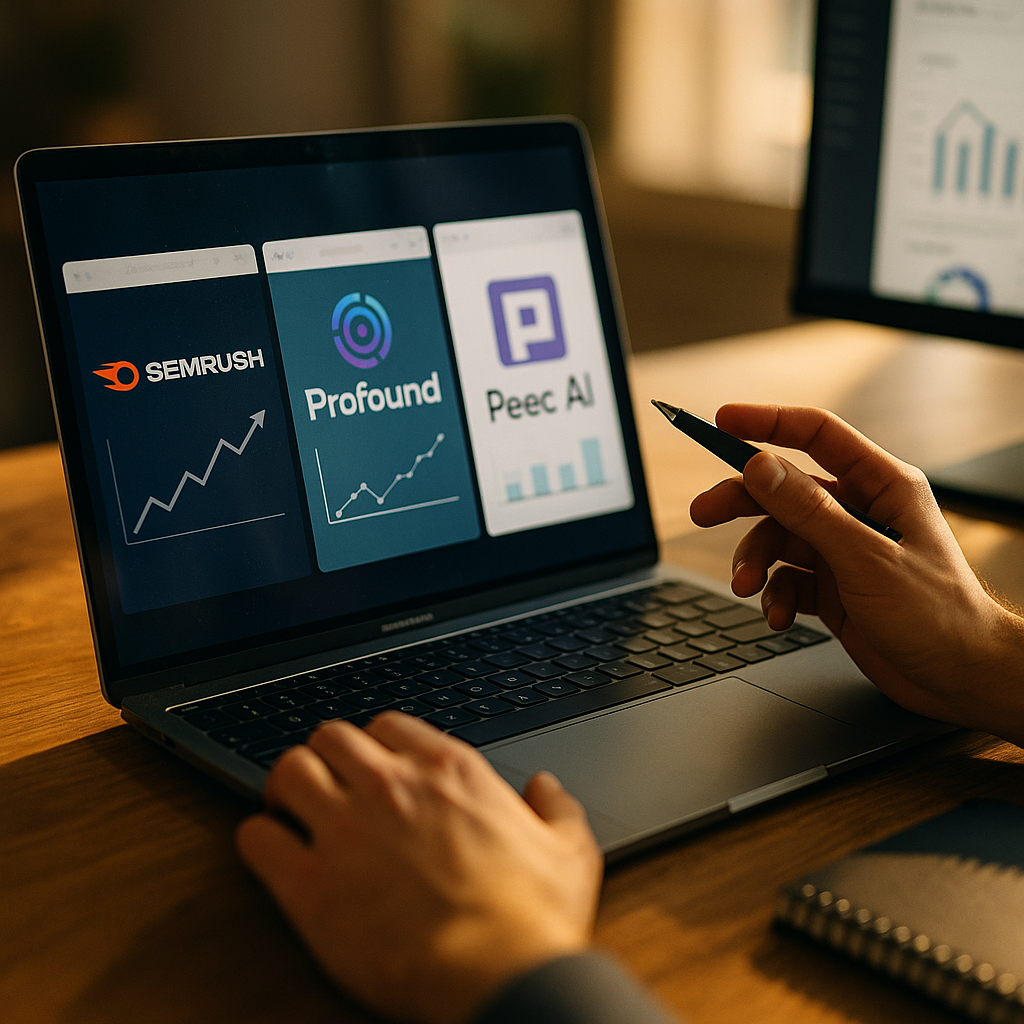
Nearly 60% of Google searches now end without a click, and a growing share of those queries get answered entirely inside AI Overviews or a chatbot window. If your brand isn’t showing up in those answers, you’re invisible to a customer who never even hit your website. That’s the problem driving demand for an AI visibility toolkit, and it’s why three vendors — Semrush, Profound, and Peec AI — are suddenly competing for a line item in every enterprise marketing budget.
This isn’t a hypothetical future problem. It’s a Q1 budget conversation happening right now in marketing ops meetings. So let’s break down what these three platforms actually do, where they diverge, and which one fits which kind of team.
Why Brand Citation Tracking Suddenly Matters
Traditional SEO measured rankings on a results page. Generative engine optimization (GEO) measures something messier: whether an AI model mentions your brand at all, how it frames you relative to competitors, and whether it cites your content as a source. There’s no fixed SERP to screenshot. Answers change based on prompt phrasing, user location, and model version. Track it manually and you’ll burn a full-time analyst’s week just to get a partial snapshot.
That volatility is exactly why purpose-built tracking tools exist. Marketers need something that samples prompts at scale, logs citation frequency, and flags sentiment shifts before a competitor’s product starts dominating ChatGPT’s answer to “best CRM for small business” or whatever query maps to your category.
The brands winning in AI search aren’t the ones with the biggest content libraries — they’re the ones who can prove, with data, exactly where and how often they get cited.
Semrush AI Visibility Toolkit: The Familiar Face With New Tricks
Semrush’s play here is continuity. If your team already lives in Semrush for keyword research, backlink audits, and competitive gap analysis, the AI Visibility Toolkit slots into that same dashboard rather than forcing a new login and a new mental model. That matters more than it sounds — tool sprawl is a real cost center, and something we’ve covered in detail in our martech stack audit framework.
The toolkit tracks brand mentions across ChatGPT, Google AI Overviews, and Perplexity, then ties those citations back to the same domains and keywords you’re already monitoring in traditional search. That correlation is genuinely useful: you can see whether a page ranking on page one organically also gets pulled into an AI answer, or whether AI models are citing a completely different source than Google’s algorithm favors.
The tradeoff? Depth. Semrush’s AI tracking feels like a strong add-on bolted onto a mature SEO suite, not a tool built from scratch for this specific problem. Prompt volume and historical trend granularity lag behind the dedicated players. For teams that want AI visibility as one signal among many in a broader search strategy, that’s fine. For teams that need AI citation tracking as the primary deliverable, it can feel thin.
Profound: Built for the Enterprise Reporting Grind
Profound positions itself as the enterprise answer engine optimization platform, and the pricing and sales motion reflect that. This is a tool built for teams that need to defend AI visibility spend to a CMO or a board, with dashboards designed for that exact conversation.
What sets Profound apart is its citation-to-source mapping. It doesn’t just tell you that ChatGPT mentioned your brand — it tells you which specific page, press release, or third-party review site the model pulled that citation from. That’s the difference between “we got mentioned” and “here’s the content asset driving the mention, and here’s how we replicate it.” For brands running content programs at scale, that traceability is the whole point.
Profound also tracks share-of-voice against named competitors across models, which turns AI visibility into a competitive intelligence exercise rather than just a brand health check. If you’re a category leader worried about a challenger brand quietly winning AI answer real estate, this is the kind of monitoring that catches it early.
The catch is cost and complexity. Profound is priced and packaged for enterprise accounts, and the onboarding lift is heavier than a self-serve tool. If your team doesn’t have a dedicated analyst to own the platform, you risk paying for depth you never fully use — a pattern we’ve flagged before when evaluating no-code AI agent platforms and similar emerging categories where sophistication outpaces team readiness.
Peec AI: Lean, Fast, and Built for a Narrower Job
Peec AI takes the opposite approach from Profound: narrow scope, faster setup, lower price point. It focuses specifically on tracking how brands appear across ChatGPT, Perplexity, and Google AI Overviews, with clean visualizations of mention frequency, sentiment, and competitive positioning.
The appeal for mid-market teams and agencies is speed to insight. You’re not wading through a sprawling enterprise suite — you set up brand and competitor tracking, define your prompt set, and get readable reports within days, not weeks. For agencies managing AI visibility monitoring across multiple client accounts, that efficiency compounds fast.
Peec AI’s limitation is exactly what you’d expect from a leaner tool: less integration with broader SEO or paid media data, and a smaller library of historical benchmarks compared to Profound’s enterprise depth. It’s a specialist tool, not a platform you build an entire search strategy around. But for teams whose primary need is “tell me where and how often we show up in AI answers, clearly and fast,” it does that job well without the overhead.
Head-to-Head: What Actually Differs
- Data breadth: Semrush wins on integration with traditional SEO data; Profound wins on citation-source traceability; Peec AI wins on setup speed and clarity.
- Pricing model: Semrush bundles AI tracking into existing subscription tiers, Profound is enterprise-quoted, Peec AI offers more accessible mid-market pricing.
- Best team fit: Semrush suits teams already invested in its ecosystem; Profound suits enterprise brands with dedicated GEO analysts; Peec AI suits agencies and lean in-house teams needing fast, digestible reporting.
- Competitive intelligence depth: Profound leads here, with named competitor share-of-voice tracking that goes beyond simple mention counts.
- Reporting for leadership: Profound and Semrush both offer polished executive dashboards; Peec AI is more operator-focused, less boardroom-polished.
None of these three is objectively “best.” The right pick depends on whether you’re solving for integration (Semrush), depth and defensibility (Profound), or speed and cost-efficiency (Peec AI). That’s a familiar calculus if you’ve evaluated identity resolution or attribution vendors before — the tradeoffs mirror what we saw comparing Acxiom, LiveRamp, and Epsilon for identity resolution: no single vendor wins every category, so the buying decision comes down to matching tool capability to team maturity.
The Compliance Angle Nobody’s Talking About Enough
Here’s a wrinkle worth flagging before you sign a contract: AI citation tracking sits adjacent to disclosure and content authenticity rules that are tightening fast. If your brand shows up in an AI Overview because a sponsored creator post got scraped and cited, you need to know that — both for competitive strategy and because disclosure requirements from the FTC increasingly extend to how AI-surfaced content represents paid relationships.
This is the same governance thinking we’ve applied to Meta’s ad disclosure requirements and to TikTok’s AI content tagging rules. None of the three vendors here handle disclosure compliance directly — that’s not their job. But smart brands are pairing AI visibility tracking with a parallel compliance check: if you’re getting cited, is the underlying content properly disclosed? That’s a gap your legal and comms teams should close before it becomes a headline.
What This Means for Budget Planning
None of these tools replace SEO or paid search spend. They’re additive, and right now, still maturing. Data from eMarketer shows AI-driven search interactions climbing fast enough that ignoring the channel is riskier than overinvesting early. The practical move: pilot one tool for a quarter against a defined KPI (citation frequency, share-of-voice change, sentiment trend), then scale based on what actually moved the needle.
If your team is already stretched thin managing platform sprawl, this is worth folding into a broader stack review rather than bolting on as an isolated purchase. The same audit discipline that applies to evaluating agentic AI readiness across your martech stack applies here: does this tool integrate, or does it just add another dashboard nobody checks after month two?
Frequently Asked Questions
What is an AI visibility toolkit used for?
An AI visibility toolkit tracks how often and how accurately a brand gets mentioned or cited by generative AI tools like ChatGPT, Google AI Overviews, and Perplexity, helping marketing teams measure and improve their presence in AI-generated answers.
Is Semrush AI Visibility Toolkit worth it if we already use Semrush?
Yes, for most existing Semrush users it’s a low-friction way to add AI citation tracking without a new vendor relationship, though teams needing deep GEO analysis may eventually need a specialist tool alongside it.
How is Profound different from a standard SEO tool?
Profound maps AI citations back to specific source content and tracks competitive share-of-voice across AI models, functioning more like a competitive intelligence platform than a traditional rank tracker.
Is Peec AI a good fit for agencies?
Yes, Peec AI’s faster setup and clearer reporting make it well suited for agencies managing AI visibility tracking across multiple client brands without enterprise-level overhead.
Do these tools help with AI content disclosure compliance?
No, none of the three vendors handle disclosure compliance directly. Brands should pair citation tracking with separate compliance checks against FTC guidance and platform-specific disclosure rules.
How much does AI citation tracking typically cost?
Pricing varies widely: Semrush bundles it into existing subscription tiers, Peec AI offers accessible mid-market pricing, and Profound is generally enterprise-quoted based on account scope and usage volume.
Don’t buy on brand recognition alone. Run a 90-day pilot with one clearly defined KPI — citation frequency or share-of-voice shift — before committing budget across your whole content team.
Top Influencer Marketing Agencies
The leading agencies shaping influencer marketing in 2026
Agencies ranked by campaign performance, client diversity, platform expertise, proven ROI, industry recognition, and client satisfaction. Assessed through verified case studies, reviews, and industry consultations.
Moburst

-
2

The Shelf
Boutique Beauty & Lifestyle Influencer AgencyA data-driven boutique agency specializing exclusively in beauty, wellness, and lifestyle influencer campaigns on Instagram and TikTok. Best for brands already focused on the beauty/personal care space that need curated, aesthetic-driven content.Clients: Pepsi, The Honest Company, Hims, Elf Cosmetics, Pure LeafVisit The Shelf → -
3

Audiencly
Niche Gaming & Esports Influencer AgencyA specialized agency focused exclusively on gaming and esports creators on YouTube, Twitch, and TikTok. Ideal if your campaign is 100% gaming-focused — from game launches to hardware and esports events.Clients: Epic Games, NordVPN, Ubisoft, Wargaming, Tencent GamesVisit Audiencly → -
4

Viral Nation
Global Influencer Marketing & Talent AgencyA dual talent management and marketing agency with proprietary brand safety tools and a global creator network spanning nano-influencers to celebrities across all major platforms.Clients: Meta, Activision Blizzard, Energizer, Aston Martin, WalmartVisit Viral Nation → -
5

The Influencer Marketing Factory
TikTok, Instagram & YouTube CampaignsA full-service agency with strong TikTok expertise, offering end-to-end campaign management from influencer discovery through performance reporting with a focus on platform-native content.Clients: Google, Snapchat, Universal Music, Bumble, YelpVisit TIMF → -
6

NeoReach
Enterprise Analytics & Influencer CampaignsAn enterprise-focused agency combining managed campaigns with a powerful self-service data platform for influencer search, audience analytics, and attribution modeling.Clients: Amazon, Airbnb, Netflix, Honda, The New York TimesVisit NeoReach → -
7

Ubiquitous
Creator-First Marketing PlatformA tech-driven platform combining self-service tools with managed campaign options, emphasizing speed and scalability for brands managing multiple influencer relationships.Clients: Lyft, Disney, Target, American Eagle, NetflixVisit Ubiquitous → -
8

Obviously
Scalable Enterprise Influencer CampaignsA tech-enabled agency built for high-volume campaigns, coordinating hundreds of creators simultaneously with end-to-end logistics, content rights management, and product seeding.Clients: Google, Ulta Beauty, Converse, AmazonVisit Obviously →