


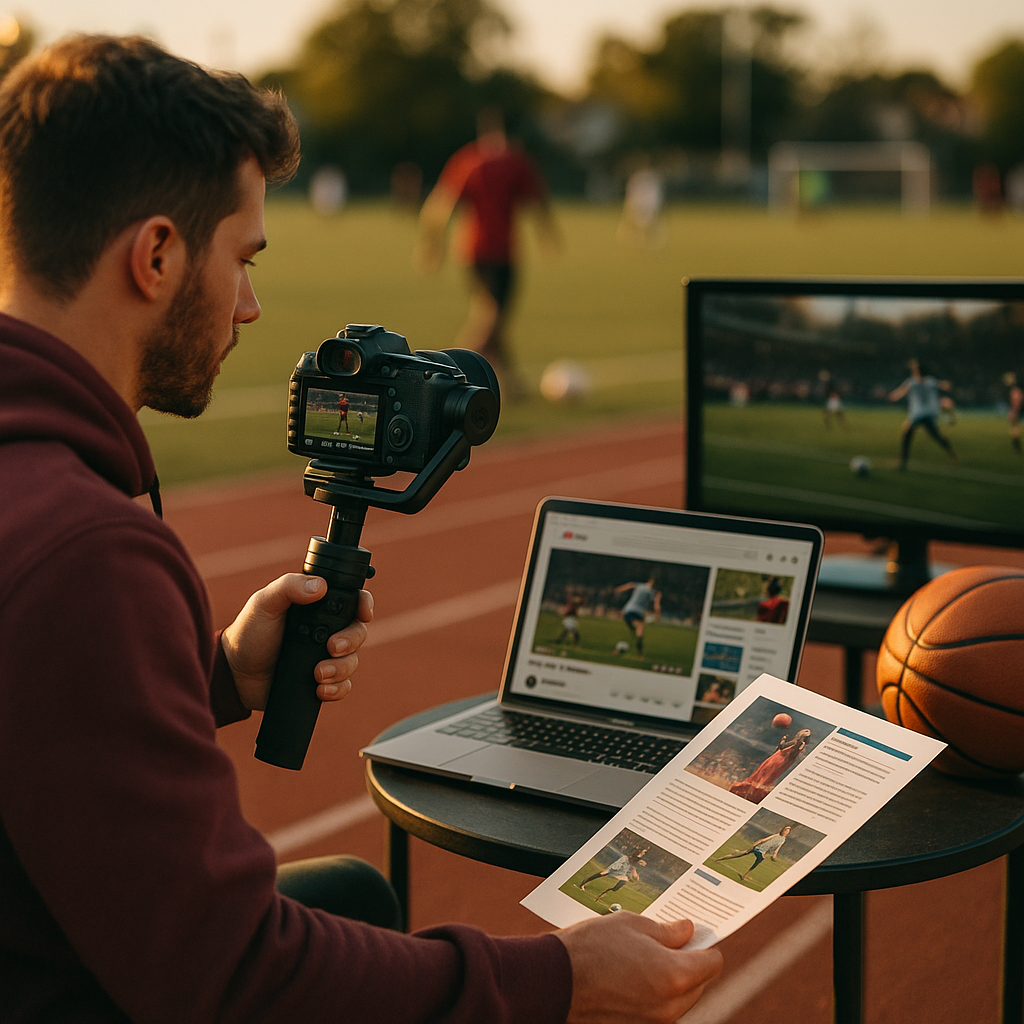
Sports fans don’t consume content on one screen. They never did. Yet most brands still brief creators for a single platform and scramble to repurpose footage afterward, burning budget and losing quality at every step. Sports creator campaigns across YouTube, CTV, and premium publishers can run from one unified brief — if you build that brief correctly from the start.
Why Sports Content Is Uniquely Positioned for Multi-Platform Efficiency
Sports content has a structural advantage that most verticals don’t: it’s inherently episodic, emotionally charged, and contextually elastic. A creator capturing pre-game energy, live reaction, or post-match analysis can serve every stage of the fan journey — awareness, consideration, and conversion — without being forced into a single format. The raw material is already rich.
The scale of the opportunity is significant. eMarketer data projects CTV ad spend continuing to climb steeply, with sports content driving outsized engagement on streaming platforms. Meanwhile, YouTube remains the dominant long-form sports destination, with fans spending significant session time on creator-led game analysis, highlight reactions, and athlete vlogs. Premium publishers including ESPN Digital, The Athletic, and Bleacher Report are actively building creator integration programs that accept third-party video assets.
The brand implication: a well-briefed sports creator can generate assets that populate all three environments. The obstacle is almost never production capability. It’s the brief.
The Brief Is the Budget
Most production inefficiency in creator campaigns doesn’t happen on set. It happens in the brief. When a brand sends a sports creator a brief optimized for a single YouTube video, that’s exactly what they’ll get. The 15-second CTV cut, the :06 pre-roll, the editorial-style asset for a premium publisher partnership — all of those require a separate conversation, a separate deliverable list, and usually a separate invoice.
The fix is upstream. Build the brief so the creator shoots with format variety as the default, not the afterthought. This means specifying capture requirements (horizontal AND vertical), defining key moments that must be isolated for short-form extraction, and flagging clean-audio segments for broadcast-quality repurposing. None of this costs the creator extra time on camera. It costs you one well-constructed brief.
When brands brief for one platform, they pay to repurpose. When brands brief for all platforms upfront, they pay once and distribute everywhere. The brief is the most leveraged document in your production budget.
For a deeper look at how this plays out technically, the mobile to CTV asset pipeline framework covers the exact capture specifications that make single-shoot, multi-platform delivery viable.
Mapping the Fan Journey to Content Moments
Before writing a single brief section, map the fan journey against your campaign window. Sports campaigns typically have three distinct phases: pre-event anticipation, live or near-live reaction, and post-event analysis. Each phase maps to a different platform behavior and a different creative register.
- Pre-event (anticipation): Long-form YouTube analysis, premium publisher editorial integrations, and mid-roll CTV spots that build brand association before the game. Creator tone here is analytical, credible, forward-looking.
- Live/near-live (reaction): Short-form social content that feeds YouTube Shorts, Instagram Reels, and TikTok. High-emotion, rapid-fire, authenticity-forward. This is where fans share and algorithms reward.
- Post-event (analysis): Long-form YouTube recaps, premium publisher companion content, and CTV placements in highlights packages. Creator tone shifts to perspective-driven commentary. Brand integration here is softer and more editorial.
Each of these moments requires a slightly different creative direction, but the same underlying footage can serve all three if the creator is briefed to capture it. The brief must explicitly call out which moments correspond to which fan journey phase — and what the brand’s role is in each one. Vague briefs produce vague assets.
What the Framework Actually Looks Like
A sports creator brief built for multi-platform performance has six core sections. This is not a template you fill in generically. Each section requires real decisions before the brief is issued.
1. Campaign objective by platform (not a single unified objective). YouTube drives brand association and search discoverability. CTV drives reach and frequency against a lean-back audience. Premium publishers drive contextual credibility. Write a one-sentence objective for each. If you can’t, you haven’t done the strategy work yet.
2. Capture specifications. Mandate horizontal primary capture (for YouTube and CTV), with simultaneous vertical framing where possible. Specify minimum resolution (4K preferred for CTV), clean audio requirements, and any broadcast compliance rules relevant to your category (alcohol, gambling, supplements). Include a shot list of “must-capture” moments: clean product placement window, standalone voiceover segment, crowd reaction B-roll.
3. Asset deliverable matrix. Map every deliverable to its platform destination. A :90 YouTube integration, a :30 CTV-ready cut, a :15 pre-roll, a :06 bumper, a vertical :15 for social, and a static thumbnail. The creator sees exactly what they’re building. No ambiguity.
4. Brand voice anchors by format. CTV audiences won’t tolerate the same energy as a TikTok reaction. Define the tone for each format explicitly. “Authoritative and credible” for CTV. “High-energy and reactive” for short-form social. “Conversational and analytical” for YouTube. The creator adjusts register accordingly.
5. Rights and usage terms. Specify upfront that all assets are licensed for paid media distribution across YouTube, CTV, and publisher networks. Don’t negotiate this after delivery. The creator needs to know whether they’re capturing for organic-only or full paid amplification, because it affects what they’re willing to appear in and what their rate should reflect. The UGC-to-CTV rights framework covers the licensing nuances in detail.
6. Performance feedback loop. Define the KPIs the creator will receive post-campaign. View-through rate on CTV, watch time on YouTube, engagement rate on social. When creators see how their assets perform across platforms, their next brief becomes self-optimizing. This also builds creator loyalty at scale.
This kind of multi-format thinking is also relevant beyond sports specifically. The principles behind omnichannel creator briefs apply directly when your campaign touches both streaming and social surfaces simultaneously.
Premium Publisher Integration: The Often-Ignored Channel
Brands overinvest in YouTube and CTV briefing and consistently underinvest in briefing for premium publisher placements. This is a strategic gap. Publishers like The Athletic, Front Office Sports, and CBS Sports Digital have native content programs that accept creator-sourced video assets. The creative standards are different from social, but the audience quality is exceptional.
When briefing for premium publisher compatibility, flag two requirements explicitly. First, the creator must avoid any graphics, overlays, or audio that would violate publisher editorial guidelines (this includes certain music and competitor brand mentions). Second, the asset must hold up without captions in a muted autoplay environment — something most social-first creators don’t naturally optimize for. A clean, visually communicative opening 3 seconds is non-negotiable.
FTC disclosure requirements also apply differently in publisher environments versus social platforms. Brief your creators on the specific disclosure placement required for each format — this is not a detail to leave to post-production.
Keeping Authenticity Intact Across Formats
The risk with multi-platform briefing is over-specification. Push too hard on deliverable volume and creative constraints, and you strip the creator of what makes their sports content valuable: genuine expertise and real fan credibility. The brief must protect creative latitude even as it defines technical requirements.
One practical technique: separate the “must-haves” from the “nice-to-haves” explicitly in the brief. Must-haves include capture specs, asset matrix, rights terms, and mandatory brand messaging. Nice-to-haves include preferred shot angles, tone references, and any creative suggestions from the brand team. Creators respond to briefs that trust their judgment. The multi-creator brand consistency framework is useful here, especially when running multiple sports creators across the same campaign.
A brief that over-specifies creative direction produces technically correct but emotionally flat content. Give creators the what and the why. Let them own the how.
It’s also worth considering how YouTube’s creator ecosystem has evolved — the platform actively promotes authentic creator voice in its algorithm, which means over-produced, brand-controlled content consistently underperforms against creator-native formats even in paid placements.
For campaigns where multiple sports creators are producing assets simultaneously, the brief structure for social and CTV without separate production budgets covers the governance layer that keeps quality consistent without creating a production bottleneck.
Measurement Architecture Before the Campaign Launches
Attribution across YouTube, CTV, and premium publishers requires different measurement frameworks that must be established before creative goes live. On YouTube, view-through attribution and Brand Lift studies via Google Ads are standard. On CTV, pixel-based measurement through platforms like The Trade Desk or directly through network partners enables household-level reach frequency reporting. Premium publisher placements often require custom tracking URLs and UTM structures negotiated in the partnership agreement.
Define this measurement architecture in the brief. Not because the creator needs to implement it, but because it forces internal alignment on what success looks like per channel before the brief is issued. Campaigns that define channel-specific KPIs upfront produce creative that’s optimized for those outcomes. Campaigns that define a single vanity metric get a single type of content.
The next step is concrete: pull your last sports creator brief, identify which of the six framework sections are missing or underdeveloped, and rewrite those sections before your next campaign window opens. The production budget you save on repurposing will fund your next creator partnership.
FAQs
Can a single sports creator realistically produce assets for YouTube, CTV, and premium publishers from one shoot?
Yes, but only if the brief specifies the technical capture requirements upfront. Creators need to know they should shoot horizontal primary with vertical framing, capture clean-audio standalone segments, and avoid graphics that won’t translate to broadcast environments. When these instructions are in the brief, a single shoot day can yield all the necessary raw material for multi-platform post-production.
What’s the biggest mistake brands make when briefing sports creators for multi-platform campaigns?
Writing a brief optimized for one platform and treating other formats as an afterthought. This forces either expensive reshoots or low-quality repurposing from footage that wasn’t captured with other formats in mind. The fix is defining every deliverable and its platform destination before the creator starts production.
How do you maintain creator authenticity when the brief has strict technical requirements?
By separating technical requirements (must-haves) from creative direction (nice-to-haves) explicitly in the brief. Creators are professionals who can work within technical constraints — resolution, clean audio, horizontal capture — without losing their voice. The error is conflating technical specs with creative over-direction. Brief the former tightly; hold the latter loosely.
Do FTC disclosure rules apply differently across YouTube, CTV, and premium publishers?
Yes. The FTC’s guidelines require clear and conspicuous disclosure regardless of platform, but what counts as “conspicuous” varies by format. On YouTube, a verbal disclosure and description tag are standard. On CTV, an on-screen super is typically required. Premium publishers often have their own editorial disclosure standards that may differ from FTC minimums. Brief your creator on the specific disclosure format required for each deliverable.
What measurement approach works best for sports creator campaigns running across all three channels?
A layered approach works best: YouTube Brand Lift studies for awareness and recall metrics, household-level reach/frequency reporting via a DSP for CTV, and custom UTM tracking with publisher partners for premium placements. The key is establishing this measurement architecture before the campaign launches, not after. Define channel-specific KPIs in the brief itself so creative execution aligns with the outcomes you’re measuring.
Top Influencer Marketing Agencies
The leading agencies shaping influencer marketing in 2026
Agencies ranked by campaign performance, client diversity, platform expertise, proven ROI, industry recognition, and client satisfaction. Assessed through verified case studies, reviews, and industry consultations.
Moburst

-
2

The Shelf
Boutique Beauty & Lifestyle Influencer AgencyA data-driven boutique agency specializing exclusively in beauty, wellness, and lifestyle influencer campaigns on Instagram and TikTok. Best for brands already focused on the beauty/personal care space that need curated, aesthetic-driven content.Clients: Pepsi, The Honest Company, Hims, Elf Cosmetics, Pure LeafVisit The Shelf → -
3

Audiencly
Niche Gaming & Esports Influencer AgencyA specialized agency focused exclusively on gaming and esports creators on YouTube, Twitch, and TikTok. Ideal if your campaign is 100% gaming-focused — from game launches to hardware and esports events.Clients: Epic Games, NordVPN, Ubisoft, Wargaming, Tencent GamesVisit Audiencly → -
4

Viral Nation
Global Influencer Marketing & Talent AgencyA dual talent management and marketing agency with proprietary brand safety tools and a global creator network spanning nano-influencers to celebrities across all major platforms.Clients: Meta, Activision Blizzard, Energizer, Aston Martin, WalmartVisit Viral Nation → -
5

The Influencer Marketing Factory
TikTok, Instagram & YouTube CampaignsA full-service agency with strong TikTok expertise, offering end-to-end campaign management from influencer discovery through performance reporting with a focus on platform-native content.Clients: Google, Snapchat, Universal Music, Bumble, YelpVisit TIMF → -
6

NeoReach
Enterprise Analytics & Influencer CampaignsAn enterprise-focused agency combining managed campaigns with a powerful self-service data platform for influencer search, audience analytics, and attribution modeling.Clients: Amazon, Airbnb, Netflix, Honda, The New York TimesVisit NeoReach → -
7

Ubiquitous
Creator-First Marketing PlatformA tech-driven platform combining self-service tools with managed campaign options, emphasizing speed and scalability for brands managing multiple influencer relationships.Clients: Lyft, Disney, Target, American Eagle, NetflixVisit Ubiquitous → -
8

Obviously
Scalable Enterprise Influencer CampaignsA tech-enabled agency built for high-volume campaigns, coordinating hundreds of creators simultaneously with end-to-end logistics, content rights management, and product seeding.Clients: Google, Ulta Beauty, Converse, AmazonVisit Obviously →