


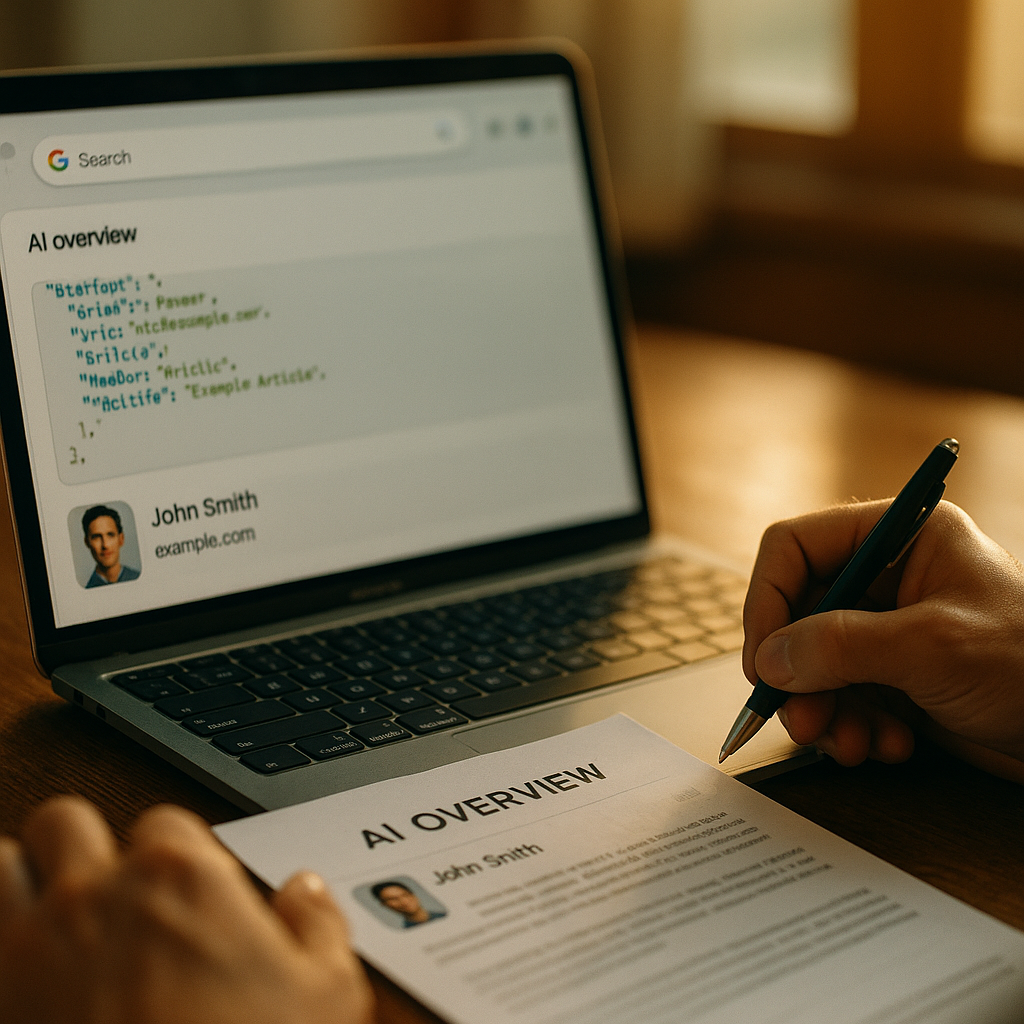
Google’s AI Overviews now appear on an estimated 60% of searches that include a question, and most brands have no idea whether they’re being cited or silently skipped. The deciding factor usually isn’t backlinks or keyword density anymore. It’s whether your content is structured for machines to parse and whether your expertise can actually be verified. Structured data and verified expertise are quietly becoming the new ranking currency, and most marketing teams are still optimizing for a search engine that no longer behaves the way it used to.
AI Overviews Don’t Rank Pages, They Extract Facts
Traditional SEO rewarded pages that climbed to position one. AI Overviews work differently: Google’s generative layer scans multiple sources, extracts discrete claims, and stitches them into a synthesized answer. Your page doesn’t need to “win” the SERP anymore. It needs to be the source a language model trusts enough to quote.
That shift matters enormously for B2B marketers managing influencer programs, martech stacks, and brand content at scale. If your blog post buries the useful claim in paragraph twelve, wrapped in vague marketing language, a crawler model has to work harder to extract it, and it probably won’t bother. Clear, structured, attributable statements get pulled. Fluff gets ignored.
AI Overviews don’t reward the best-written page. They reward the most extractable one, and extractability is a structural property, not a stylistic one.
Structured Data Is the Machine-Readable Trust Layer
Schema markup used to be a technical SEO checkbox, something a developer bolted on and forgot. In the AI Overview era, it’s closer to a translation layer between your content and the model deciding whether to cite you. Article schema, Organization schema, Person schema for authors, and FAQPage schema all give Google’s systems explicit signals about who said what, when, and under what authority.
Think about it from the model’s perspective. It has to make a confidence judgment in milliseconds about whether a claim is reliable enough to surface to millions of users. Structured data removes ambiguity. It tells the system, unambiguously, “this is a question, this is the answer, this is who answered it, and here’s proof they’re qualified to.” Pages without that scaffolding force the model to infer structure from prose, which is slower, riskier, and far more likely to get passed over in favor of a competitor who did the labeling work.
- Article and NewsArticle schema establishes publication date, author, and publisher, which AI systems weigh heavily for recency and accountability.
- Person schema links an author to credentials, social profiles, and prior work, building a verifiable identity graph.
- FAQPage and HowTo schema package answers in the exact question-and-answer format AI Overviews prefer to lift.
- Organization schema ties content back to a brand entity Google already recognizes, which matters for citation consistency across a content library.
Google’s own structured data documentation has expanded steadily to cover more of these cases, which is a reasonably direct signal about where the company expects publishers to invest.
Why This Isn’t Just a Technical SEO Problem Anymore
Marketing leaders tend to delegate schema implementation to developers and move on. That worked when structured data mostly influenced rich snippets. It doesn’t work now, because the business decisions, which claims to publish, which experts to credit, how often to update data, all happen upstream of the markup. A dev team can tag a page perfectly and still get zero citations if the underlying content lacks a verifiable author or a confidently stated fact. This is now a cross-functional problem that touches content strategy, PR, and brand governance, the same convergence that’s reshaping how AI agents access brand data across the marketing stack.
Verified Expertise: The EEAT Factor AI Models Actually Check
Google has talked about EEAT (Experience, Expertise, Authoritativeness, Trustworthiness) for years, but AI Overviews have operationalized it in a way classic search algorithms never did. The model isn’t just checking if your domain has backlinks. It’s cross-referencing whether the named author has a consistent, verifiable footprint: a LinkedIn profile, prior bylines, cited credentials, maybe a Wikipedia mention or industry recognition.
This is where a lot of B2B content operations quietly fail. Ghostwritten posts with no named author, generic “admin” bylines, or AI-generated articles published under vague brand voices all lack the identity signals that verified expertise requires. If there’s no human behind the claim, there’s nothing for the model to verify, and unverifiable claims get deprioritized in favor of sources that pass the check.
Brands running influencer and creator programs should recognize the parallel immediately. This is the exact same trust equation used to vet creator authenticity before a campaign launches. Verification isn’t a nice-to-have anymore, for creators or for the authors behind your owned content. It’s the gatekeeping mechanism deciding who gets surfaced and who gets filtered out.
An unnamed author publishing an unverifiable claim is, functionally, the same risk profile as an unvetted creator posting an undisclosed sponsorship. Neither passes a trust check built for machine consumption.
What “Verified” Actually Means in Practice
Verification isn’t about adding a bio box at the bottom of a post. It requires a consistent digital identity that search systems can corroborate across multiple touchpoints.
- Author bylines linked to a persistent author page with credentials and publishing history.
- Consistent naming and affiliation across your site, LinkedIn, and any third-party citations.
- Dates and update logs that show content is actively maintained, not published once and abandoned.
- Original data, proprietary research, or firsthand case studies that can’t be found verbatim elsewhere.
That last point deserves emphasis. Generic, aggregated takes on industry trends get treated as commodity content, even with perfect schema. Original data and firsthand operational insight are what actually earn a citation, because the model has nowhere else to pull that specific fact from.
The Brand Risk of Getting This Wrong
There’s a budget conversation hiding inside all of this. Every dollar spent on content that never gets surfaced in an AI Overview is a dollar spent on invisible marketing. For brands already stretching thin content and influencer budgets across more channels, that’s not a rounding error, it’s a measurable efficiency loss.
There’s also a compliance angle marketing leaders shouldn’t ignore. As AI systems increasingly synthesize brand claims without a human reading the original source, inaccurate or unverifiable statements can get amplified at scale, faster than legal or compliance teams can catch them. That’s the same dynamic already playing out with synthetic testimonials slipping past pre-air review. If your own structured data and author verification aren’t airtight, you’re ceding control over how your brand’s claims get represented to an AI system you don’t govern.
This is increasingly relevant for e-commerce and DTC brands too, since AI shopping agents already parse creator reviews to make purchase recommendations. The same extraction logic applies: structured, verifiable, attributable content wins the citation. Vague brand copy loses it.
Building a Citation-Ready Content System
None of this requires a platform migration. It requires discipline and a short list of operational changes most teams can implement within a quarter.
- Audit existing schema coverage. Most sites have inconsistent or outdated markup. Start with Article, Person, and FAQPage schema on your highest-traffic content.
- Standardize author identity. Every published piece needs a named, credentialed author with a consistent bio and cross-platform presence.
- Prioritize original data. Proprietary research, surveys, or case studies get cited more often than synthesized commentary, because they’re the primary source.
- Keep content dated and updated. Stale pages with no visible update history signal lower trust to freshness-sensitive AI systems.
- Track citations directly. Monitor branded mentions inside AI Overviews and tools like Perplexity the same way you’d track share of voice, as outlined in recent coverage of how AI shopping audits decide brand visibility.
Benchmarking data from eMarketer and Statista consistently shows AI-driven search behavior growing faster than traditional query volume, which makes this a now problem, not a someday problem. Teams that treat structured data and verified expertise as a governance function, not a one-off SEO project, are the ones building durable visibility instead of chasing it campaign by campaign. For marketing operations teams already building audit trails around AI tools, this fits naturally alongside existing AI governance practices rather than requiring an entirely separate workflow.
The brands winning AI Overview citations right now aren’t necessarily the ones with the biggest content budgets. They’re the ones who made their claims machine-readable and their experts verifiable long before competitors realized it mattered. Start with an audit of your top twenty pages this month: check schema coverage, confirm every author is a real, verifiable person, and flag any content making claims with no clear original source. That single exercise will tell you more about your AI visibility risk than another twelve months of traditional rank tracking.
FAQs
What exactly are Google AI Overviews citing when they pull content?
They’re citing specific, extractable claims, not entire pages. A well-structured answer to a direct question, backed by a verifiable author and clean schema markup, is far more likely to be lifted than a vague paragraph buried in long-form prose.
Does structured data guarantee a citation in AI Overviews?
No. Schema markup makes content easier for AI systems to parse and trust, but it doesn’t guarantee inclusion. Original data, verified authorship, and clear factual claims all factor into whether a source gets surfaced.
How is verified expertise different from standard EEAT signals?
Verified expertise requires a consistent, cross-referenced identity for the author, not just a bio on the page. AI systems check whether that person’s credentials and publishing history hold up across multiple sources before treating their claims as trustworthy.
Can small or mid-sized brands compete for AI Overview citations against larger publishers?
Yes, especially with original data or firsthand case studies that larger publishers haven’t covered. AI systems favor the most specific, verifiable source for a claim, not necessarily the biggest domain.
How should marketing teams measure success here?
Track branded citations inside AI Overviews and tools like Perplexity or ChatGPT search, alongside traditional organic metrics. A drop in click-through rate paired with stable or growing citation visibility often signals the AI layer is doing its job, just without the click.
Top Influencer Marketing Agencies
The leading agencies shaping influencer marketing in 2026
Agencies ranked by campaign performance, client diversity, platform expertise, proven ROI, industry recognition, and client satisfaction. Assessed through verified case studies, reviews, and industry consultations.
Moburst

-
2

The Shelf
Boutique Beauty & Lifestyle Influencer AgencyA data-driven boutique agency specializing exclusively in beauty, wellness, and lifestyle influencer campaigns on Instagram and TikTok. Best for brands already focused on the beauty/personal care space that need curated, aesthetic-driven content.Clients: Pepsi, The Honest Company, Hims, Elf Cosmetics, Pure LeafVisit The Shelf → -
3

Audiencly
Niche Gaming & Esports Influencer AgencyA specialized agency focused exclusively on gaming and esports creators on YouTube, Twitch, and TikTok. Ideal if your campaign is 100% gaming-focused — from game launches to hardware and esports events.Clients: Epic Games, NordVPN, Ubisoft, Wargaming, Tencent GamesVisit Audiencly → -
4

Viral Nation
Global Influencer Marketing & Talent AgencyA dual talent management and marketing agency with proprietary brand safety tools and a global creator network spanning nano-influencers to celebrities across all major platforms.Clients: Meta, Activision Blizzard, Energizer, Aston Martin, WalmartVisit Viral Nation → -
5

The Influencer Marketing Factory
TikTok, Instagram & YouTube CampaignsA full-service agency with strong TikTok expertise, offering end-to-end campaign management from influencer discovery through performance reporting with a focus on platform-native content.Clients: Google, Snapchat, Universal Music, Bumble, YelpVisit TIMF → -
6

NeoReach
Enterprise Analytics & Influencer CampaignsAn enterprise-focused agency combining managed campaigns with a powerful self-service data platform for influencer search, audience analytics, and attribution modeling.Clients: Amazon, Airbnb, Netflix, Honda, The New York TimesVisit NeoReach → -
7

Ubiquitous
Creator-First Marketing PlatformA tech-driven platform combining self-service tools with managed campaign options, emphasizing speed and scalability for brands managing multiple influencer relationships.Clients: Lyft, Disney, Target, American Eagle, NetflixVisit Ubiquitous → -
8

Obviously
Scalable Enterprise Influencer CampaignsA tech-enabled agency built for high-volume campaigns, coordinating hundreds of creators simultaneously with end-to-end logistics, content rights management, and product seeding.Clients: Google, Ulta Beauty, Converse, AmazonVisit Obviously →