


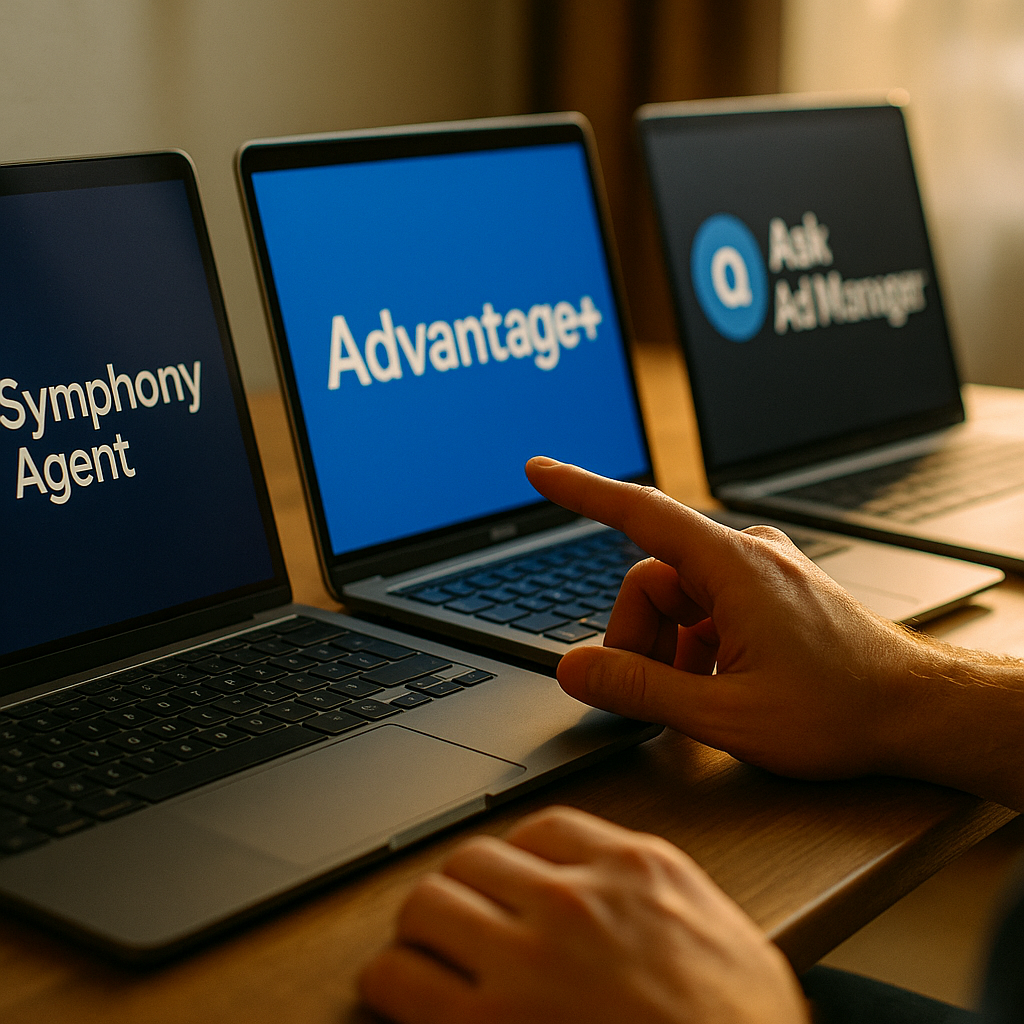
Three platforms now let you type a sentence and get a fully-targeted, fully-budgeted, fully-creative-tested ad campaign in return. No media buyer required. That’s not a pitch deck promise anymore — it’s the default workflow for a growing share of the roughly $700+ billion in global digital ad spend tracked by eMarketer. The question isn’t whether AI ad assistants work. It’s which one you should trust with your budget.
This is an update to our earlier breakdown of TikTok Symphony vs Meta Advantage+, expanded now that Google’s Ask Ad Manager has matured past beta. Late 2026 is the first moment all three tools are genuinely comparable — full-funnel, agentic, and fighting for the same marketing budget line.
Why This Comparison Matters Now
A year ago, these were three different animals. Symphony Agent generated creative variants. Advantage+ automated targeting and bidding. Ask Ad Manager was a chatbot bolted onto Google Ads that mostly answered “why did my CPA spike” questions. Now all three do the full job: strategy input, audience modeling, creative generation, budget pacing, and optimization, with minimal human sign-off.
That convergence changes the buying decision. You’re no longer picking a feature. You’re picking an operating philosophy for how much control you’re willing to hand over, and to whom.
The real differentiator in late 2026 isn’t ad quality — it’s how much visibility each platform gives you into why the AI made the decisions it made.
TikTok Symphony Agent: Creative-First, Still Opaque
Symphony Agent’s strength remains creative generation. Feed it a product feed, brand guidelines, and a handful of top-performing organic clips, and it produces dozens of native-feeling variants — voiceovers, captions, pacing adjustments — tuned for TikTok’s algorithm specifically. For brands running influencer-seeded content, Symphony Agent now ingests creator UGC directly and remixes it into paid variants without a separate editing pass.
The catch? Reporting on why Symphony chose a particular audience segment or bid strategy is still thin compared to Google’s offering. You get outcomes, not reasoning. For brands under scrutiny from finance or legal, that’s a real limitation.
- Best for: DTC and beauty/fashion brands with strong organic creator content already in rotation.
- Setup time: Fast — often live within a day once the product catalog and pixel are connected.
- Weak spot: Cross-channel attribution and audit trails.
If you’re leaning on influencer content as fuel for paid, this pairs well with tighter creator vetting practices upstream, since Symphony will happily amplify whatever content you feed it, fraud signals included.
Meta Advantage+: The Control-Freak’s Nightmare, The Scaler’s Dream
Advantage+ has leaned harder into full automation than either competitor. Advantage+ Suite now defaults to combining audiences, placements, and creative into a single automated campaign type, and Meta has made it structurally harder to run fully manual campaigns alongside it. That’s a deliberate push, and it’s working: Meta reported in recent earnings calls that a majority of advertiser spend now runs through Advantage+ campaign types.
What’s genuinely improved late this year is budget reallocation speed. Advantage+ now shifts spend between creative variants and placements in near real time, reacting to signal within hours rather than the 3-day learning windows that frustrated buyers previously. For brands running always-on programs, that’s meaningful efficiency.
The tradeoff is the same one we flagged in our breakdown of who actually controls your ad budget: Advantage+ optimizes toward Meta’s definition of success, which isn’t always your definition of success. Brand safety exclusions and frequency caps require manual overrides, and those overrides get quietly relaxed over time if you’re not checking.
Advantage+ campaigns now represent the majority of Meta ad spend, according to Meta’s own investor disclosures — which means “manual control” is increasingly the exception, not the default.
- Best for: Performance marketers with large catalogs and high SKU counts (retail, ecommerce, apps).
- Setup time: Moderate — requires clean catalog feeds and pixel/CAPI hygiene to perform well.
- Weak spot: Brand safety guardrails erode without active monitoring.
Google Ask Ad Manager: The Analyst You Always Wanted
Ask Ad Manager was the laggard in this category through most of last year. It’s caught up, and in some respects overtaken the other two — specifically on transparency. You can ask it, in plain language, “why did you increase bids on this segment Tuesday,” and it returns an actual causal explanation tied to auction data, not a vague summary.
That matters enormously for teams that need to justify spend to finance or defend decisions in a compliance review.
Google has also connected Ask Ad Manager more tightly to DV360’s creative testing pipeline, so cross-channel campaigns spanning Search, YouTube, and Performance Max can now be queried and adjusted from one conversational interface. If your media mix spans multiple Google properties, that consolidation alone is worth the switch for a lot of teams.
Where it still lags: creative generation quality. Ask Ad Manager writes decent search ad copy and passable YouTube scripts, but it doesn’t match Symphony’s native-feel video output. Google seems to know this — recent updates lean into orchestration and explanation rather than trying to out-create TikTok.
- Best for: Multi-channel advertisers needing audit-ready decision logs, especially regulated industries.
- Setup time: Slower — benefits from clean first-party data and Google Analytics 4 configuration.
- Weak spot: Creative output still trails Symphony and even some third-party generative tools.
Feature-by-Feature: Where Each One Actually Wins
Strip away the marketing language and the differences boil down to five things brands actually care about: creative quality, targeting precision, budget control, explainability, and cross-platform reporting.
- Creative generation: Symphony Agent wins outright, particularly for short-form video.
- Audience targeting depth: Advantage+ still has the richest signal graph, given Meta’s identity data advantage.
- Budget pacing intelligence: Roughly tied — Advantage+ reacts fastest, Ask Ad Manager explains its reactions best.
- Explainability and audit trail: Ask Ad Manager, no contest.
- Cross-platform reporting: None of the three natively reports well outside their own ecosystem — you’ll still need a share-of-model dashboard or similar layer to compare performance across all three.
That last point deserves emphasis. Every one of these vendors will show you glowing in-platform metrics. None of them will tell you, unprompted, that a competitor did better with the same budget. That’s structurally true of walled gardens, and it’s not changing.
Governance and Compliance: The Part Vendors Don’t Lead With
Handing budget authority to an AI agent raises real governance questions, and regulators are paying attention. The FTC has continued scrutinizing automated ad decisioning for discriminatory targeting outcomes, and UK advertisers should keep an eye on ICO guidance on automated decision-making, particularly if any campaign touches personalization based on inferred characteristics.
Before you hand any of these three full autonomy, run the same checklist you’d apply to any AI vendor: what data feeds the model, who can override it, and what happens when it makes a costly mistake at 2am while nobody’s watching.
Our AI vendor consolidation checklist is a reasonable starting point if you haven’t formalized this internally yet.
One more wrinkle: server-side tracking accuracy directly affects how well these agents optimize. Garbage signal in, garbage bidding out. If your tracking setup predates last year’s cookie deprecation push, it’s worth revisiting our server-side tracking comparison before you blame the AI for underperformance that’s actually a data problem.
So Which One Should You Actually Use?
Most mid-market and enterprise brands running influencer-driven programs will end up using two of these three, not one. Symphony Agent for TikTok-native creative and amplification. Either Advantage+ or Ask Ad Manager as the performance backbone, depending on whether your media mix skews social or search/video.
The teams struggling most right now are the ones trying to force a single vendor to do everything, or worse, trying to manually override agentic systems designed to run without constant intervention. Pick your battles: decide upfront which decisions you’ll always review manually (budget caps, brand safety lists, creative approval) and let the rest run.
Set a recurring 30-minute review with whoever owns your paid media stack, pull the explainability logs from Ask Ad Manager alongside Advantage+ performance data, and confirm the AI’s spending logic still matches your actual brand goals — not just the platform’s definition of a conversion.
FAQs
Which AI ad assistant is best for influencer-driven campaigns?
TikTok Symphony Agent currently produces the strongest native creative from influencer and UGC source material, making it the best fit if creator content drives your paid strategy. Pair it with Meta Advantage+ or Google Ask Ad Manager for broader distribution and budget optimization.
Can these AI tools run campaigns with zero human oversight?
Technically yes, but it’s not advisable. All three platforms allow full autonomous operation, but brands should maintain manual review points for budget caps, brand safety exclusions, and creative approval to avoid compliance or reputational risk.
Does Google Ask Ad Manager work well for social-first brands?
It’s strongest for brands with significant Search, YouTube, or Performance Max spend. Its explainability features are excellent, but its creative generation still trails Symphony Agent for short-form video content typical of social-first strategies.
How do these tools handle data privacy and compliance?
Each platform operates within its own privacy framework, but automated decisioning has drawn regulatory attention. Brands should review FTC and ICO guidance on automated ad targeting and maintain internal audit processes regardless of platform.
Is it worth using all three platforms simultaneously?
Most brands with multi-channel budgets end up using at least two. Running all three adds reporting complexity, since none natively compares performance against competitors, so a unified dashboard layer is usually necessary.
Visible FAQ Section
See above — displayed inline per platform requirements.
Top Influencer Marketing Agencies
The leading agencies shaping influencer marketing in 2026
Agencies ranked by campaign performance, client diversity, platform expertise, proven ROI, industry recognition, and client satisfaction. Assessed through verified case studies, reviews, and industry consultations.
Moburst

-
2

The Shelf
Boutique Beauty & Lifestyle Influencer AgencyA data-driven boutique agency specializing exclusively in beauty, wellness, and lifestyle influencer campaigns on Instagram and TikTok. Best for brands already focused on the beauty/personal care space that need curated, aesthetic-driven content.Clients: Pepsi, The Honest Company, Hims, Elf Cosmetics, Pure LeafVisit The Shelf → -
3

Audiencly
Niche Gaming & Esports Influencer AgencyA specialized agency focused exclusively on gaming and esports creators on YouTube, Twitch, and TikTok. Ideal if your campaign is 100% gaming-focused — from game launches to hardware and esports events.Clients: Epic Games, NordVPN, Ubisoft, Wargaming, Tencent GamesVisit Audiencly → -
4

Viral Nation
Global Influencer Marketing & Talent AgencyA dual talent management and marketing agency with proprietary brand safety tools and a global creator network spanning nano-influencers to celebrities across all major platforms.Clients: Meta, Activision Blizzard, Energizer, Aston Martin, WalmartVisit Viral Nation → -
5

The Influencer Marketing Factory
TikTok, Instagram & YouTube CampaignsA full-service agency with strong TikTok expertise, offering end-to-end campaign management from influencer discovery through performance reporting with a focus on platform-native content.Clients: Google, Snapchat, Universal Music, Bumble, YelpVisit TIMF → -
6

NeoReach
Enterprise Analytics & Influencer CampaignsAn enterprise-focused agency combining managed campaigns with a powerful self-service data platform for influencer search, audience analytics, and attribution modeling.Clients: Amazon, Airbnb, Netflix, Honda, The New York TimesVisit NeoReach → -
7

Ubiquitous
Creator-First Marketing PlatformA tech-driven platform combining self-service tools with managed campaign options, emphasizing speed and scalability for brands managing multiple influencer relationships.Clients: Lyft, Disney, Target, American Eagle, NetflixVisit Ubiquitous → -
8

Obviously
Scalable Enterprise Influencer CampaignsA tech-enabled agency built for high-volume campaigns, coordinating hundreds of creators simultaneously with end-to-end logistics, content rights management, and product seeding.Clients: Google, Ulta Beauty, Converse, AmazonVisit Obviously →