


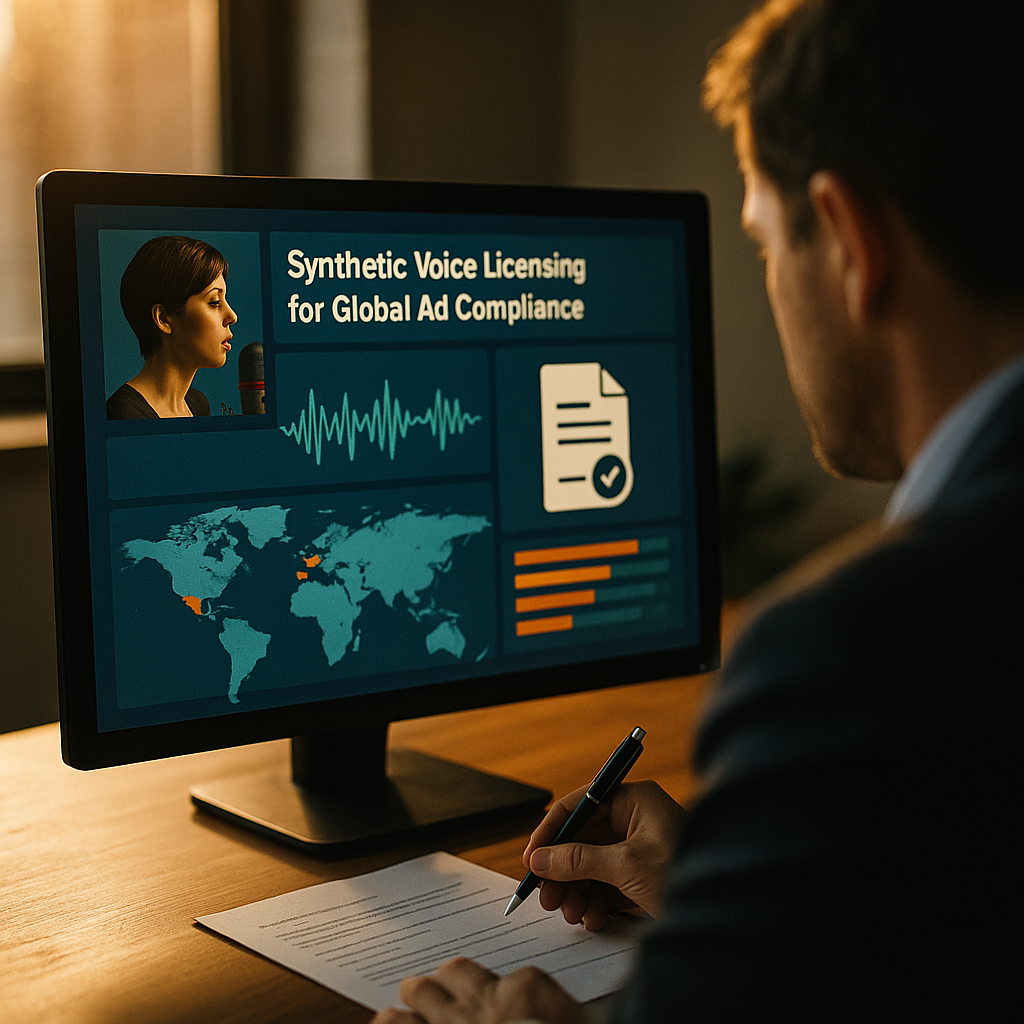
In 2025, advertisers want speed, consistency, and legal certainty when scaling multilingual campaigns. This review of synthetic voice licensing platforms for global ad voiceovers explains how licensing really works, where the risks hide, and which features matter most for broadcast, digital, and social delivery. If you are choosing a platform today, the differences are practical, not cosmetic—so what should you check first?
Key licensing terms for synthetic voice ads
Synthetic voice technology is easy to demo and deceptively hard to license correctly for advertising. The core question is not “Can the tool generate audio?” but “Do I have a provable right to use this voice, in this territory, for this ad, for this long?”
When comparing platforms, look for licensing language that explicitly covers advertising and commercial promotion. Some vendors position their terms for “content creation” broadly, but still restrict paid media, political ads, regulated categories, or broadcast.
Terms you should expect to see clearly defined:
- Usage scope: paid ads vs. organic social vs. internal training; inclusion of broadcast, OTT/CTV, radio, in-store, and out-of-home.
- Territory: worldwide rights vs. a limited set of countries; whether “global” includes local legal carve-outs.
- Duration: perpetual use, fixed campaign term, or annual renewal; what happens to finished spots after expiration.
- Exclusivity: whether competitors can use the same synthetic voice; whether you can reserve a voice for a brand or category.
- Attribution requirements: some agreements require disclosure that the voice is synthetic; others leave it to local law and platform policy.
- Derivatives and edits: permission to localize, re-cut, remix, or combine with music/SFX; restrictions on altering a voice to mimic a real person.
- Indemnities and liability: whether the vendor defends you if a rights claim arises; limitations on damages that may not match ad spend risk.
Practical takeaway: treat licensing as a procurement and compliance decision, not just a creative one. Your shortlist should shrink fast if a provider cannot supply unambiguous ad-use rights in writing.
Global ad voiceover compliance and brand safety
Global campaigns add two layers of complexity: local legal regimes and platform-specific ad policies. Even if your vendor grants worldwide rights, you still need a compliance path that covers consent, disclosure, and impersonation safeguards.
What “brand-safe” synthetic voice licensing looks like in practice:
- Documented voice origin: the platform can explain whether a voice is (a) a licensed voice actor model, (b) a custom voice built from your recordings, or (c) a generic synthetic voice with unclear provenance. For ads, avoid unclear provenance.
- Consent and chain-of-rights: for actor-based voices, the vendor should confirm the actor’s consent for commercial use and provide a summary of permitted categories and territories.
- Anti-impersonation controls: policies and technical controls to prevent cloning of public figures or private individuals without authorization; reporting and takedown mechanisms.
- Regulated categories support: guidance for pharma, finance, alcohol, gambling, and political messaging. Many platforms exclude or tightly restrict these.
- Data handling for custom voices: if you upload recordings to create a brand voice, you need retention limits, deletion controls, and clear statements on whether your audio can train shared models.
Answering the common follow-up question: “Is disclosure required?” It depends. Some jurisdictions and publishers require it, and many brands choose disclosure to reduce reputational risk. Your platform should not block disclosure workflows (for example, by locking metadata or limiting ad copy options) and should provide guidance that aligns with your media plan.
Best synthetic voice platforms for advertising workflows
The “best” platform depends on what you ship: short-form social variants, broadcast spots, dynamic audio ads, or multilingual product explainers. Instead of ranking vendors by hype, evaluate them by fit across creative, legal, and operational needs.
Platform archetypes you will encounter in 2025:
- Enterprise TTS providers: strong reliability, APIs, and security; licensing may be stricter or less flexible for ads without an enterprise agreement. Best for scale, automation, and localization pipelines.
- Creator-forward voice studios: fast UI, strong voice selection, and simple collaboration; licensing is often packaged per project or per seat. Best for agile creative teams producing many variants.
- Voice-actor marketplace + synthetic rights: voices tied to professional talent with clearer consent models and optional exclusivity. Best when brand reputation demands transparent sourcing and human-like performance.
- Custom brand voice providers: build a unique synthetic voice for a brand, with tighter governance and potential exclusivity. Best for long-term brand assets and consistent sonic identity across regions.
Features that matter specifically for global advertising:
- Accents and locale control: not just “Spanish,” but Spanish by region; the ability to lock pronunciation dictionaries for product names.
- Pronunciation tools: IPA/SSML support, custom lexicons, and repeatable voice direction settings for consistency across markets.
- Collaboration: approval workflows, version history, and role-based access for agencies, in-house teams, and localization vendors.
- Performance controls: pace, emphasis, pauses, emotional style (where allowed), and consistent loudness targets for broadcast specs.
- Deliverables: WAV standards, sample rates, loudness normalization options, and batch export for hundreds of cut-downs.
How to decide quickly: run a pilot that mirrors a real campaign—one hero spot, ten cut-downs, and three languages. Require the vendor to provide a written licensing confirmation for that exact usage. If they hesitate, move on.
Synthetic voice licensing costs and contract models
Pricing is rarely apples-to-apples because “license” can mean different things. One provider may bundle rights into a subscription; another may charge per voice, per territory, per media channel, or per impressions.
Common contract models in 2025:
- Seat-based subscriptions: predictable budgeting for creative teams; watch for limits on commercial usage, exports, or languages.
- Usage-based (characters/seconds): scalable for API-driven production; ensure the license still covers ads and does not restrict paid distribution.
- Per-project licensing: simple for campaigns; confirm whether revisions and cut-downs count as new projects.
- Voice-specific licensing: fees tied to premium voices or talent-backed models; can include category restrictions or options for exclusivity.
- Enterprise agreements: include security, SLAs, and tailored ad rights; best when synthetic audio is a core production dependency.
Cost drivers that surprise teams:
- Territory expansion: “global” may require add-ons for certain regions or broadcasters.
- Broadcast and cinema: some licenses cover web and social but exclude linear broadcast without an upgrade.
- Exclusivity: reserving a voice for a brand or category can materially increase costs, but may reduce confusion and competitive adjacency risk.
- Custom voice creation: upfront build fees plus ongoing hosting, governance, and re-training costs.
Procurement-ready advice: ask for a one-page “rights summary” that states: media channels, territories, term, whether finished renders remain usable after term, and any restricted categories. Make the vendor sign off on it. This reduces misunderstandings between legal, marketing, and agencies.
Due diligence checklist for enterprise voice licensing
Global ads amplify risk because distribution is wide and takedowns are expensive. Due diligence should be systematic and repeatable, not dependent on one person reading terms once.
Use this checklist before committing:
- Rights provenance: request documentation describing how each voice is sourced and licensed; prefer talent-consented or custom voices with clear chain-of-rights.
- Explicit ad-use permission: the contract should state that paid advertising is permitted, including your intended channels (CTV, radio, OOH, paid social).
- Territory and language coverage: verify local availability and whether certain languages/accents are restricted or in beta with different terms.
- Exclusivity options: if you need differentiation, confirm whether exclusivity is possible, what it covers (voice, language, category), and how it is enforced.
- Indemnity and remedies: understand what protection you actually have if a claim arises; align liability caps with campaign spend and reputational exposure.
- Security and privacy: SSO, audit logs, encryption, retention controls, and guarantees that your uploads will not train shared models unless you opt in.
- Governance: internal controls that prevent unauthorized voice cloning, including admin approvals, watermarking (if available), and usage monitoring.
- Operational continuity: SLAs, uptime commitments, export guarantees, and what happens if the vendor deprecates a voice you used in a long-running campaign.
Answering a frequent concern: “Can we keep using the spot forever?” Only if your license says so. Some agreements allow perpetual use of rendered outputs while restricting future generation after termination; others require renewing the right to keep distributing. Clarify this before launch, not after the campaign is in market.
FAQs about synthetic voice licensing for global ad voiceovers
Do synthetic voice platforms allow paid advertising by default?
No. Many allow general commercial use but still restrict specific ad channels, regulated categories, or broadcast. Treat “commercial” and “advertising” as separate permissions and confirm ad-use rights in writing for your media plan.
Can we use one synthetic voice worldwide across all languages?
You can use one brand voice globally if the platform supports multilingual output for that voice and your license covers all territories. In practice, brands often use a consistent “voice identity” while selecting region-specific accents for authenticity and better performance.
Is it safer to license a talent-backed synthetic voice than a generic voice?
Usually, yes. Talent-backed voices can offer clearer consent and usage boundaries, which reduces legal ambiguity. Generic voices can be safe too if the provider documents provenance and grants explicit ad rights, but you should verify chain-of-rights either way.
What is the difference between licensing the tool and licensing the voice?
The tool license covers access to software and generation features. Voice licensing covers the rights to use a specific voice model in content and distribute that content. You need both aligned; a valid tool subscription does not automatically grant ad rights for every voice in the library.
Can we make a custom synthetic voice from our founder or spokesperson?
Yes, but you should obtain clear, written consent that covers advertising, territories, term, and what happens if the relationship ends. You also need strict controls to prevent misuse, plus contractual assurances on data retention and model ownership.
How do we handle disclosure that a voice is AI-generated?
Create a policy based on your brand standards, publisher requirements, and local laws in your target markets. Choose platforms that support consistent metadata, approvals, and documentation so disclosure decisions remain auditable and repeatable.
Choosing a synthetic voice licensing platform is a rights-and-workflow decision, not a voice demo contest. In 2025, the safest path is clear ad-use permission, documented voice provenance, strong governance, and deliverables that match real media specs. Run a campaign-style pilot, require a written rights summary, and align legal with production early. That is how you scale global voiceovers without surprise restrictions.
Top Influencer Marketing Agencies
The leading agencies shaping influencer marketing in 2026
Agencies ranked by campaign performance, client diversity, platform expertise, proven ROI, industry recognition, and client satisfaction. Assessed through verified case studies, reviews, and industry consultations.
Moburst

-
2

The Shelf
Boutique Beauty & Lifestyle Influencer AgencyA data-driven boutique agency specializing exclusively in beauty, wellness, and lifestyle influencer campaigns on Instagram and TikTok. Best for brands already focused on the beauty/personal care space that need curated, aesthetic-driven content.Clients: Pepsi, The Honest Company, Hims, Elf Cosmetics, Pure LeafVisit The Shelf → -
3

Audiencly
Niche Gaming & Esports Influencer AgencyA specialized agency focused exclusively on gaming and esports creators on YouTube, Twitch, and TikTok. Ideal if your campaign is 100% gaming-focused — from game launches to hardware and esports events.Clients: Epic Games, NordVPN, Ubisoft, Wargaming, Tencent GamesVisit Audiencly → -
4

Viral Nation
Global Influencer Marketing & Talent AgencyA dual talent management and marketing agency with proprietary brand safety tools and a global creator network spanning nano-influencers to celebrities across all major platforms.Clients: Meta, Activision Blizzard, Energizer, Aston Martin, WalmartVisit Viral Nation → -
5

The Influencer Marketing Factory
TikTok, Instagram & YouTube CampaignsA full-service agency with strong TikTok expertise, offering end-to-end campaign management from influencer discovery through performance reporting with a focus on platform-native content.Clients: Google, Snapchat, Universal Music, Bumble, YelpVisit TIMF → -
6

NeoReach
Enterprise Analytics & Influencer CampaignsAn enterprise-focused agency combining managed campaigns with a powerful self-service data platform for influencer search, audience analytics, and attribution modeling.Clients: Amazon, Airbnb, Netflix, Honda, The New York TimesVisit NeoReach → -
7

Ubiquitous
Creator-First Marketing PlatformA tech-driven platform combining self-service tools with managed campaign options, emphasizing speed and scalability for brands managing multiple influencer relationships.Clients: Lyft, Disney, Target, American Eagle, NetflixVisit Ubiquitous → -
8

Obviously
Scalable Enterprise Influencer CampaignsA tech-enabled agency built for high-volume campaigns, coordinating hundreds of creators simultaneously with end-to-end logistics, content rights management, and product seeding.Clients: Google, Ulta Beauty, Converse, AmazonVisit Obviously →