


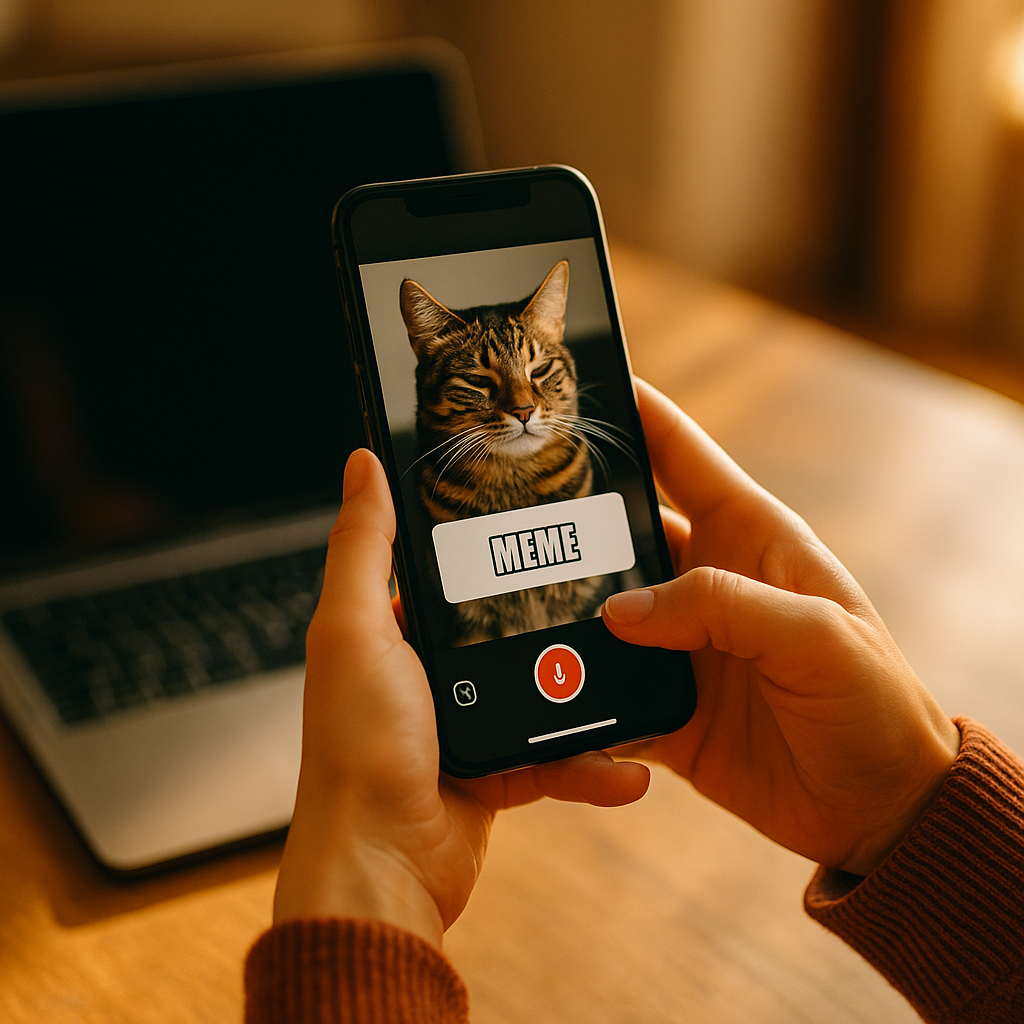
Roughly 60% of Gen Z internet users can’t name where a meme originated but will screenshot and share it within seconds, according to research cited by Sprout Social. That’s the paradox of the text-overlay meme format: it’s the most portable humor structure on the internet, and also the easiest way for a brand to look like a substitute teacher trying to rap. So how do marketing teams borrow the format’s punch without losing the voice they’ve spent years building?
This isn’t a “should brands do memes” debate anymore. That ship sailed. The question now is operational: how do you brief it, approve it, and measure it without triggering the internet’s finely tuned cringe detector.
What Makes Text-Overlay Memes Work in the First Place
The text-overlay meme format is deceptively simple: a static or looping image, paired with bold, often centered text that delivers a setup and punchline in one glance. Think the “distracted boyfriend,” “drake hotline bling,” or the endless parade of relatable-office-chaos templates that circulate on X, Instagram, and TikTok stills. The format works because it strips humor down to its rawest mechanic: recognition plus timing.
There’s no production value required. No voiceover, no music licensing, no edit timeline. That’s precisely why it spreads faster than almost any other creative unit. A well-timed text-overlay meme can outperform a $50,000 video campaign in organic reach, purely because it asks nothing of the viewer’s attention span.
The format’s biggest advantage for brands isn’t reach. It’s speed. A meme can go from internal Slack joke to published post in under an hour, which is exactly the kind of agility most brand approval processes are not built for.
Why Brands Keep Getting It Wrong
Marketing teams love the idea of memes until they see the draft. Then the notes start: “can we make the logo bigger,” “this doesn’t sound like us,” “is this too edgy for the CFO.” The result is a sanded-down, focus-grouped version of a format whose entire value proposition is that it feels unfiltered.
The core mistake is treating the meme like an ad unit instead of a conversation. Internet humor operates on shared context. When a brand inserts itself into a meme template without understanding the layers of irony already baked into that template, it reads as intrusion, not participation. Wendy’s Twitter account gets away with roasting people because it has spent nearly a decade establishing a consistent, sharp-tongued voice. A financial services brand cannot borrow that same energy overnight and expect the same reception.
- Chasing trends too late. By the time a meme format clears legal review, it’s already dead on the platform where it started.
- Over-branding the punchline. Slapping a logo on the image turns a joke into an ad, and audiences can smell the difference instantly.
- Ignoring tone mismatch. A format built for sarcasm doesn’t translate well to a brand voice built on trust and reassurance.
- Skipping the compliance check. Meme formats often originate from copyrighted stills, and brands rarely ask who owns the source image.
Building a Voice Filter Before You Post
The fix isn’t avoiding memes. It’s building a filter that lets teams move fast without abandoning brand identity. Think of it as a three-question gate every meme draft has to pass before publishing:
- Would our brand say this in a normal conversation? If the joke requires a persona shift too extreme from your established tone, skip it.
- Does the humor land without the logo? If the joke only works because it’s obviously an ad, it’s not actually using the format correctly.
- Is the reference still culturally live? Meme formats have short shelf lives. Posting a stale template signals a brand that’s out of touch, which is worse than not posting at all.
This is similar to the discipline brands already apply to caption-driven ad formats, where the words carry more weight than the visual. Text-overlay memes demand the same precision: every word has to earn its place, because there’s no music or motion to distract from a weak line.
The Approval Bottleneck Nobody Talks About
Legal and compliance teams are often the real blocker, not creative teams. Meme culture moves in hours; brand approval processes move in days. That mismatch kills more meme campaigns than bad jokes do.
Smart marketing orgs are solving this by pre-approving tone guardrails rather than individual posts. Instead of routing every meme through full legal review, they establish a documented “voice boundary” (what topics are off-limits, what level of sarcasm is acceptable, which competitors can never be referenced) and let social teams operate within that boundary without a sign-off bottleneck. This mirrors the operational logic behind pre-cleared ad creative specs, where speed comes from clear rules set in advance, not from skipping review altogether.
Case in Point: When Borrowed Humor Backfires
A regional QSR chain once tried adapting a trending “expectation vs. reality” meme template to promote a new menu item. The internal team found it hilarious. The public did not, mostly because the joke relied on a format tied to a very specific and unrelated cultural moment that the brand clearly didn’t understand. The post got ratio’d within an hour and pulled by end of day.
Compare that to a skincare brand that used the same “expectation vs. reality” structure but grounded it in an actual product truth: expected glow in three days, actual results in three weeks. That version worked because the humor served the product claim instead of hijacking an unrelated cultural reference. It’s the same lesson found in before-and-after skincare content: humor and proof work best when they’re pointed at the same target.
The safest meme format for a brand is one that mocks the category’s own conventions, not one that borrows unrelated internet drama for attention.
Where Memes Fit in the Broader Content Mix
Text-overlay memes shouldn’t carry an entire content calendar. They work best as a connective layer between more polished formats: a quick, low-lift post that keeps a brand’s feed feeling human between bigger campaign moments. Brands running season-long ambassador arcs or transformation reel campaigns often use memes as the palate cleanser between heavier, high-production drops.
This layered approach echoes the logic in the three-layer content stack framework: top-of-funnel humor to catch attention, mid-funnel proof to build trust, bottom-funnel conversion assets to close. Memes live almost exclusively in that top layer. Treating them as anything more sets unrealistic ROI expectations.
Measuring Success Without Overcomplicating It
Don’t run memes through the same KPI framework as a paid conversion campaign. Track:
- Share rate relative to your account’s baseline (this is the format’s real strength)
- Comment sentiment, not just comment volume
- Save rate, which signals the joke resonated enough to revisit
- Follower growth in the 48 hours post-publish
If a meme underperforms on shares but overperforms on comments arguing about the brand’s tone, that’s a signal worth escalating, not ignoring. Platforms like Meta Business Suite and native TikTok analytics make this kind of sentiment tracking straightforward if teams actually look past top-line reach numbers.
Legal Corners Brands Keep Cutting
Meme templates often originate from copyrighted photos, film stills, or someone’s personal social post that went viral without consent. Brands assume “everyone uses this format” equals legal safety. It doesn’t. The FTC has increasingly scrutinized branded content for both disclosure and rights issues, and a meme is still an image with an owner, viral status notwithstanding.
Before publishing, confirm:
- Whether the source image is licensed stock, a public domain still, or someone’s personal photo
- Whether your usage counts as commercial (it almost always does, since it’s promoting a brand)
- Whether a disclosure is needed if a creator or influencer is the one posting the meme on the brand’s behalf
This is the same diligence teams already apply when adapting duet and stitch trend formats, where borrowed content always carries borrowed risk.
FAQs
Frequently Asked Questions
What is the text-overlay meme format in marketing?
It’s a creative format where bold text is placed over a static image or short clip to deliver a joke, observation, or relatable moment, commonly borrowed by brands from organic internet culture to boost social engagement.
Why do brand memes often fail to land?
Most fail because the brand inserts itself into a cultural reference it doesn’t fully understand, over-brands the joke with heavy logo placement, or reacts too slowly for the trend to still feel relevant.
How can a brand use memes without sounding off-voice?
Run every meme draft through a simple filter: check if the brand would naturally say the line in conversation, confirm the joke works without the logo, and verify the reference is still culturally current before posting.
Are there legal risks with using meme templates?
Yes. Many meme templates originate from copyrighted images or personal photos, and commercial use by a brand can carry licensing and disclosure obligations, particularly under FTC guidance on branded content.
How should brands measure meme performance?
Focus on share rate relative to baseline, comment sentiment, save rate, and short-term follower growth, rather than applying conversion-focused KPIs meant for paid campaigns.
Where do memes fit in a broader content strategy?
Memes work best as a light, top-of-funnel layer that keeps a brand’s feed feeling current between larger, more polished campaign formats, not as a standalone growth strategy.
The brands winning with text-overlay memes aren’t the funniest ones in the room. They’re the ones who built a voice filter, moved fast within clear guardrails, and treated humor as a layer in the content stack rather than the whole strategy.
Top Influencer Marketing Agencies
The leading agencies shaping influencer marketing in 2026
Agencies ranked by campaign performance, client diversity, platform expertise, proven ROI, industry recognition, and client satisfaction. Assessed through verified case studies, reviews, and industry consultations.
Moburst

-
2

The Shelf
Boutique Beauty & Lifestyle Influencer AgencyA data-driven boutique agency specializing exclusively in beauty, wellness, and lifestyle influencer campaigns on Instagram and TikTok. Best for brands already focused on the beauty/personal care space that need curated, aesthetic-driven content.Clients: Pepsi, The Honest Company, Hims, Elf Cosmetics, Pure LeafVisit The Shelf → -
3

Audiencly
Niche Gaming & Esports Influencer AgencyA specialized agency focused exclusively on gaming and esports creators on YouTube, Twitch, and TikTok. Ideal if your campaign is 100% gaming-focused — from game launches to hardware and esports events.Clients: Epic Games, NordVPN, Ubisoft, Wargaming, Tencent GamesVisit Audiencly → -
4

Viral Nation
Global Influencer Marketing & Talent AgencyA dual talent management and marketing agency with proprietary brand safety tools and a global creator network spanning nano-influencers to celebrities across all major platforms.Clients: Meta, Activision Blizzard, Energizer, Aston Martin, WalmartVisit Viral Nation → -
5

The Influencer Marketing Factory
TikTok, Instagram & YouTube CampaignsA full-service agency with strong TikTok expertise, offering end-to-end campaign management from influencer discovery through performance reporting with a focus on platform-native content.Clients: Google, Snapchat, Universal Music, Bumble, YelpVisit TIMF → -
6

NeoReach
Enterprise Analytics & Influencer CampaignsAn enterprise-focused agency combining managed campaigns with a powerful self-service data platform for influencer search, audience analytics, and attribution modeling.Clients: Amazon, Airbnb, Netflix, Honda, The New York TimesVisit NeoReach → -
7

Ubiquitous
Creator-First Marketing PlatformA tech-driven platform combining self-service tools with managed campaign options, emphasizing speed and scalability for brands managing multiple influencer relationships.Clients: Lyft, Disney, Target, American Eagle, NetflixVisit Ubiquitous → -
8

Obviously
Scalable Enterprise Influencer CampaignsA tech-enabled agency built for high-volume campaigns, coordinating hundreds of creators simultaneously with end-to-end logistics, content rights management, and product seeding.Clients: Google, Ulta Beauty, Converse, AmazonVisit Obviously →