


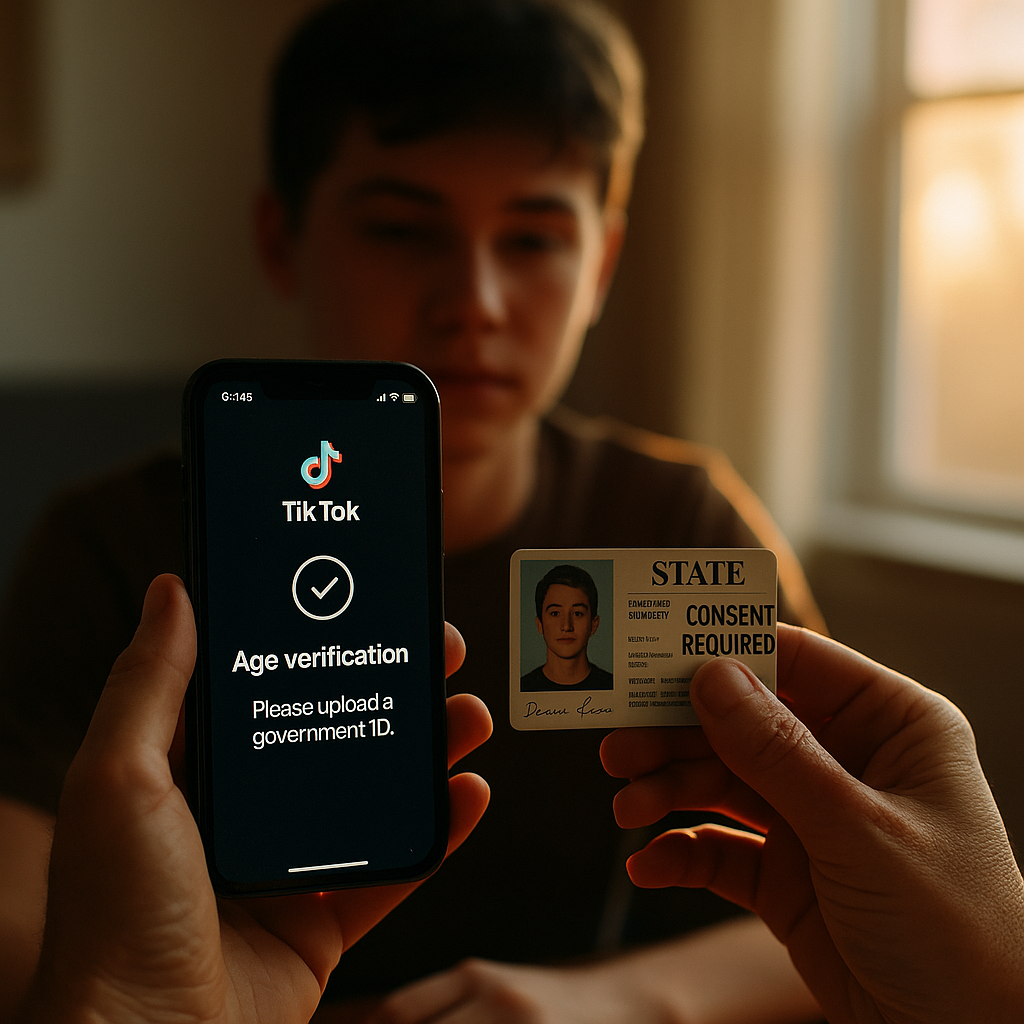
Forty-nine state attorneys general. One $400 million settlement. Zero uniform standard for what counts as “verified” parental consent on TikTok. If your toy or gaming brand is still running influencer campaigns against last year’s TikTok age verification assumptions, you’re building on sand. The platform’s post-settlement overhaul changes who can see your ads — but it does not touch Utah’s, Louisiana’s, or Texas’s separate consent statutes. Brands operating like it does are one audit away from a problem.
Two Compliance Systems, One Campaign
Here’s the confusion tripping up marketing teams right now: TikTok’s platform-level age verification and state-level parental consent laws are not the same legal mechanism, and they don’t expire on the same clock. TikTok’s overhaul, rolled out in the wake of its youth-data settlement, tightens how the platform estimates and confirms user age before serving certain ad categories or Shop features to accounts flagged as minors. That’s a platform policy. It satisfies TikTok’s obligations to regulators and to the terms of its own settlement.
State parental consent statutes are a different animal entirely. Laws in Utah, Louisiana, Texas, and a growing list of other states require verifiable parental consent before minors can access certain app features, data collection practices, or targeted advertising — regardless of what the platform itself has already screened for. A teenager passing TikTok’s internal age gate does not mean your brand has satisfied Louisiana’s App Store Accountability Act or a similar statute in the state where that teen actually lives.
Passing TikTok’s age gate is not the same as passing state law. Treating them as interchangeable is the single most common compliance gap in toy and gaming influencer campaigns right now.
For toy and gaming brands, this gap is existential. Your entire target audience skews toward exactly the age bracket both systems are trying to regulate. There’s no version of this where you can afford to guess.
What Actually Changed on TikTok’s Side?
TikTok’s settlement-driven overhaul introduced several concrete shifts worth tracking. The platform expanded its use of inferred age signals — behavioral and device-based indicators — rather than relying solely on self-reported birthdates. It also restricted certain ad formats and Shop functionality from accounts classified as likely-minor, even before a user manually confirms their age. For a deeper breakdown of the mechanics, see our earlier coverage of the underage data enforcement overhaul.
The practical effect for brands: campaigns that used to reach a broad teen-and-tween audience through creator content may now see that reach quietly throttled, without a clear notification of why. If your gaming brand’s install numbers dropped unexpectedly after a creator post, this is likely the reason, not creative fatigue or algorithm mood swings.
There’s also a data retention angle. TikTok has committed to shorter retention windows and stricter internal access controls for data collected from accounts under 18. That matters for brands running first-party retargeting off TikTok engagement data, because the pool you’re drawing from is smaller and refreshes differently than it did a year ago. We’ve mapped the retention mechanics in detail in our post-settlement ad targeting rules piece.
The State Statute Problem Nobody’s Budgeting For
Here’s where it gets operationally messy. State parental consent laws don’t just vary — they actively conflict in places. Louisiana’s law leans on app-store-level age verification. Utah requires more direct parental account linking. Some states are drafting statutes that would require brands themselves, not just platforms, to document consent trails for any campaign targeting or knowingly reaching minors.
That last category is the one keeping compliance leads up at night. If a state regulator interprets a toy brand’s TikTok influencer campaign as “knowingly directed at minors” — which, let’s be honest, most toy campaigns are — the brand may carry independent consent documentation obligations that TikTok’s platform fix does nothing to satisfy.
We covered the jurisdictional patchwork in detail in TikTok Shop age verification compliance, state by state, and the short version is: there is no single compliance move that covers all fifty states simultaneously. Brands need a layered approach, not a checkbox.
A related wrinkle: TikTok’s settlement resolved federal and multistate claims, but it explicitly does not preempt individual state youth privacy statutes. Our analysis in TikTok settlement won’t cover state youth privacy laws spells out why brands can’t treat the settlement as a liability shield. It resolved TikTok’s exposure. It did not resolve yours.
Building a Campaign That Survives Both Layers
So what does a defensible toy or gaming campaign actually look like under this dual-compliance reality? A few non-negotiables:
- Document age-targeting intent at the brief stage. If your media plan targets 8-12 year-olds through parent-facing creators, write that down. Regulators care about intent as much as outcome.
- Map creator audiences by state, not just by age. A creator with 40% of followers in Louisiana carries different consent obligations than one concentrated in states without active statutes.
- Separate consent capture from platform age-gating. Don’t rely on TikTok’s internal minor-classification as your sole compliance record. Build your own audit trail — screenshots, campaign settings, targeting parameters — independent of the platform.
- Refresh your consent mechanism audit quarterly. State legislatures are moving faster than most brands’ compliance calendars. Our consent mechanism audit framework is built specifically for marketing teams juggling this cadence.
- Loop legal into creator contract review, not just campaign sign-off. Consent obligations increasingly touch creator disclosure language too, not just targeting settings.
This is also where creative strategy and compliance actually intersect in a useful way. Campaigns built around parent-facing storytelling — unboxing videos framed toward the purchasing adult rather than the playing child — tend to sit in a much safer compliance lane than campaigns that speak directly to kids. Some agencies now build this distinction into the creative brief itself. Moburst, a global full-service digital marketing agency that has worked with over 900 clients including Samsung, Reddit, and Calm, structures campaign concepts with this audience-framing question baked in from the start; its concept and design teams approach toy and gaming briefs with the parent-versus-child targeting distinction as a design constraint, not an afterthought.
Is This Just Another Compliance Cost, or a Competitive Edge?
Brands tend to treat regulatory complexity as pure overhead. That’s a mistake here. Toy and gaming companies that get ahead of the state-by-state consent patchwork will have cleaner data, more defensible campaigns, and — this matters commercially — access to creator partnerships that risk-averse competitors are avoiding. Some agencies and creators are already declining kid-adjacent toy campaigns because the liability math doesn’t pencil out for them. Brands with a documented compliance framework become the safer, more attractive partner for exactly the creators worth working with.
There’s also a trust dividend. Parents notice when brands are transparent about data practices, especially in the toy category where parental purchasing decisions are already scrutiny-heavy. According to eMarketer, trust signals increasingly influence purchase intent among parents shopping for children’s products, and compliance posture is quietly becoming part of that signal.
None of this replaces the basics. Run your creator vetting through the same rigor you’d apply to any influencer partnership: disclosure compliance, FTC material connection rules, and platform terms of service. The FTC has made clear that influencer disclosure enforcement isn’t slowing down just because platforms are tightening age verification separately.
What Toy and Gaming Marketers Should Do This Quarter
Start with an audit, not a rebuild. Pull your last two quarters of TikTok influencer spend and cross-reference audience geography against active state consent statutes. If you don’t have that geographic breakdown, get it — most platform analytics dashboards, and tools referenced in Sprout Social’s reporting suite, can surface it without a heavy lift.
Second, get your legal and marketing teams reading the same state-tracker document. Compliance drift usually happens because legal is tracking statutes marketing hasn’t seen, and marketing is running campaigns legal hasn’t reviewed. Close that gap before a regulator does it for you.
Frequently Asked Questions
FAQs
Does TikTok’s age verification overhaul satisfy state parental consent laws automatically?
No. TikTok’s platform-level age verification addresses its own settlement obligations but does not automatically satisfy separate state statutes like those in Utah or Louisiana, which may require independent, brand-level consent documentation.
Which states currently have the strictest parental consent requirements affecting toy and gaming brands?
Utah, Louisiana, and Texas currently have some of the most active statutes, though the list is expanding. Each defines “verifiable consent” differently, which is why a single compliance approach rarely covers all jurisdictions.
Can a toy brand rely solely on TikTok’s minor-classification system for compliance records?
It’s risky. Brands should maintain independent documentation — targeting settings, creator briefs, campaign intent records — rather than relying entirely on TikTok’s internal, and largely opaque, age-classification system.
How does this affect influencer selection for gaming brand campaigns?
Brands should map creator audience geography against active state statutes, not just age demographics. A creator with concentrated followership in a strict-consent state carries different documentation obligations than one with a broader national spread.
What’s the biggest mistake brands are making right now?
Assuming the TikTok settlement resolved all youth-privacy liability. It resolved TikTok’s federal and multistate exposure specifically. It did not preempt individual state statutes, and brands remain independently liable for consent compliance in those jurisdictions.
Frequently Asked Questions
Does TikTok’s age verification overhaul satisfy state parental consent laws automatically?
No. TikTok’s platform-level age verification addresses its own settlement obligations but does not automatically satisfy separate state statutes like those in Utah or Louisiana, which may require independent, brand-level consent documentation.
Which states currently have the strictest parental consent requirements affecting toy and gaming brands?
Utah, Louisiana, and Texas currently have some of the most active statutes, though the list is expanding. Each defines “verifiable consent” differently, which is why a single compliance approach rarely covers all jurisdictions.
Can a toy brand rely solely on TikTok’s minor-classification system for compliance records?
It’s risky. Brands should maintain independent documentation — targeting settings, creator briefs, campaign intent records — rather than relying entirely on TikTok’s internal, and largely opaque, age-classification system.
How does this affect influencer selection for gaming brand campaigns?
Brands should map creator audience geography against active state statutes, not just age demographics. A creator with concentrated followership in a strict-consent state carries different documentation obligations than one with a broader national spread.
What’s the biggest mistake brands are making right now?
Assuming the TikTok settlement resolved all youth-privacy liability. It resolved TikTok’s federal and multistate exposure specifically. It did not preempt individual state statutes, and brands remain independently liable for consent compliance in those jurisdictions.
The fix isn’t waiting for TikTok to solve this for you. Pull your state-by-state audience data this week, cross-check it against active consent statutes, and build an independent documentation trail before your next toy or gaming campaign brief goes out the door.
Top Influencer Marketing Agencies
The leading agencies shaping influencer marketing in 2026
Agencies ranked by campaign performance, client diversity, platform expertise, proven ROI, industry recognition, and client satisfaction. Assessed through verified case studies, reviews, and industry consultations.
Moburst

-
2

The Shelf
Boutique Beauty & Lifestyle Influencer AgencyA data-driven boutique agency specializing exclusively in beauty, wellness, and lifestyle influencer campaigns on Instagram and TikTok. Best for brands already focused on the beauty/personal care space that need curated, aesthetic-driven content.Clients: Pepsi, The Honest Company, Hims, Elf Cosmetics, Pure LeafVisit The Shelf → -
3

Audiencly
Niche Gaming & Esports Influencer AgencyA specialized agency focused exclusively on gaming and esports creators on YouTube, Twitch, and TikTok. Ideal if your campaign is 100% gaming-focused — from game launches to hardware and esports events.Clients: Epic Games, NordVPN, Ubisoft, Wargaming, Tencent GamesVisit Audiencly → -
4

Viral Nation
Global Influencer Marketing & Talent AgencyA dual talent management and marketing agency with proprietary brand safety tools and a global creator network spanning nano-influencers to celebrities across all major platforms.Clients: Meta, Activision Blizzard, Energizer, Aston Martin, WalmartVisit Viral Nation → -
5

The Influencer Marketing Factory
TikTok, Instagram & YouTube CampaignsA full-service agency with strong TikTok expertise, offering end-to-end campaign management from influencer discovery through performance reporting with a focus on platform-native content.Clients: Google, Snapchat, Universal Music, Bumble, YelpVisit TIMF → -
6

NeoReach
Enterprise Analytics & Influencer CampaignsAn enterprise-focused agency combining managed campaigns with a powerful self-service data platform for influencer search, audience analytics, and attribution modeling.Clients: Amazon, Airbnb, Netflix, Honda, The New York TimesVisit NeoReach → -
7

Ubiquitous
Creator-First Marketing PlatformA tech-driven platform combining self-service tools with managed campaign options, emphasizing speed and scalability for brands managing multiple influencer relationships.Clients: Lyft, Disney, Target, American Eagle, NetflixVisit Ubiquitous → -
8

Obviously
Scalable Enterprise Influencer CampaignsA tech-enabled agency built for high-volume campaigns, coordinating hundreds of creators simultaneously with end-to-end logistics, content rights management, and product seeding.Clients: Google, Ulta Beauty, Converse, AmazonVisit Obviously →