


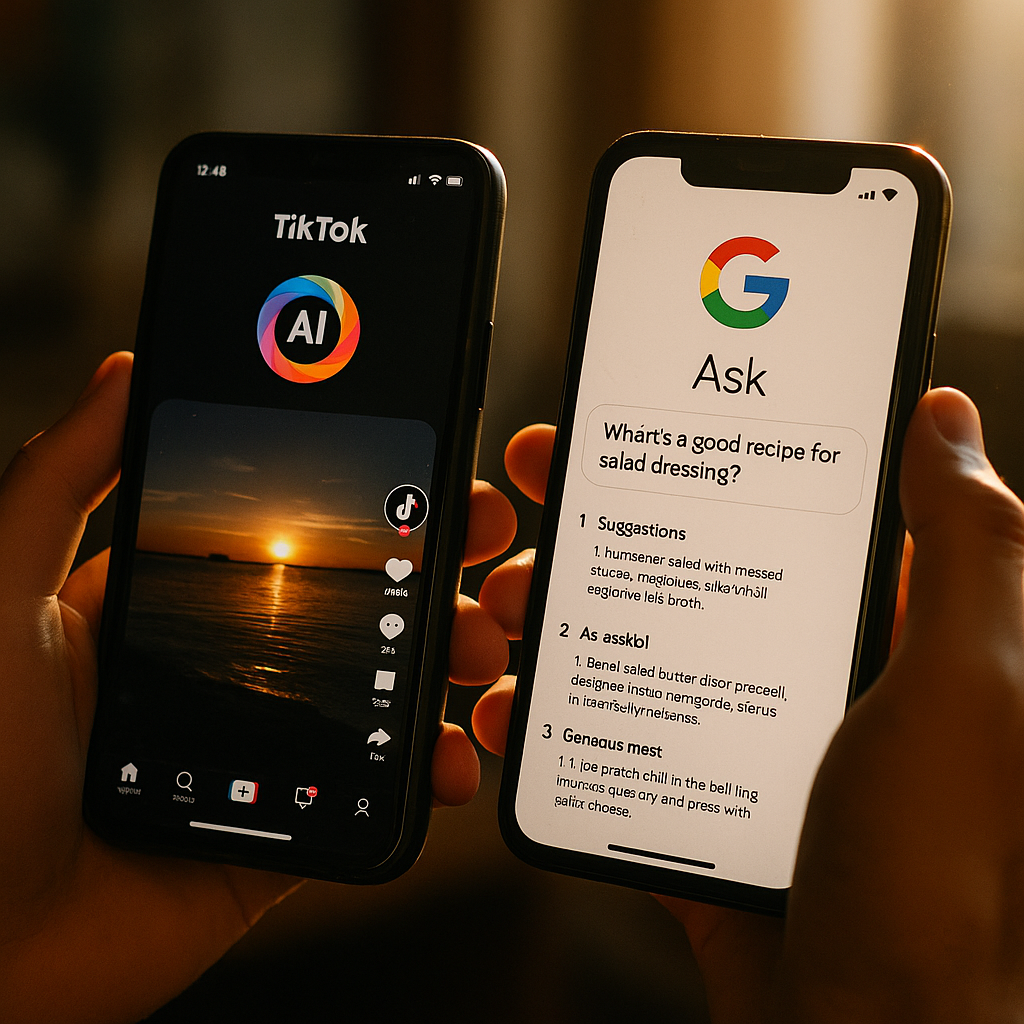
Sixty percent of Gen Z now starts product research on TikTok before ever opening Google. That single stat should terrify any media buyer still running search and social as separate line items. Between TikTok’s AI-curated feed and Google’s new Ask Ad Manager, the wall between discovery and intent is collapsing in real time, and brands clinging to old platform playbooks are about to get expensive lessons in irrelevance.
Two Giants, One Convergence Point
For years, the media buying logic was simple: TikTok for awareness, Google for intent-capture. Different budgets, different KPIs, different teams. That separation made sense when TikTok’s feed was purely entertainment-driven and Google Ads lived inside a keyword-bid auction. Neither assumption holds anymore.
TikTok’s AI-curated feed has evolved well past “For You” novelty. It’s now a predictive commerce engine that blends behavioral signals, purchase history, and creator trust scores to surface product content before users even search for it. Meanwhile, Google’s Ask Ad Manager — its conversational, AI-driven interface for campaign setup and optimization — lets buyers query performance data and adjust targeting using natural language, pulling in cross-channel signals that increasingly include social commerce behavior.
The result? Two platforms that used to sit at opposite ends of the funnel are now competing for the same moment: the instant a consumer moves from scrolling to buying.
When discovery platforms start predicting intent and intent platforms start absorbing discovery data, the traditional upper-funnel/lower-funnel media plan stops being useful. Buyers need a unified signal strategy, not two separate ones.
What TikTok’s AI Feed Actually Optimizes For Now
Here’s the uncomfortable truth for brands still buying TikTok like it’s 2022: reach-based planning is dead. TikTok’s algorithm has shifted decisively toward trust and watch-time signals over raw volume, meaning a creator with a smaller but highly engaged audience often outperforms a mega-influencer with vanity metrics. We covered this shift in depth in our piece on how the trust-based distribution algorithm is forcing a full brand vetting overhaul.
Practically, this means media buyers need to evaluate creators the way they’d evaluate a publisher: audience retention, comment sentiment, repeat engagement. The watch-time algorithm shift has already tanked briefs built around punchy 15-second hooks with no substance behind them. TikTok’s feed now rewards content that keeps people watching, not content that just gets impressions.
Layer in TikTok Shop’s commerce integration and the feed becomes something closer to a shoppable, AI-curated catalog. Products get surfaced based on predicted purchase intent, not just engagement history. That’s a fundamentally different creative brief than “make something that goes viral.”
Local and Geolocation Signals Are Now Part of the Equation
Add geolocation data into the mix and the targeting gets even more granular. TikTok’s local discovery features mean the AI feed can prioritize content based on proximity to physical retail, turning a creator video into a foot-traffic driver. Our local feed playbook breaks down how brands are using this to convert scroll-time into store visits, and the geolocation discovery shift means local creator vetting now matters as much as national reach.
Google’s Ask Ad Manager: Search Buying Gets Conversational
Google’s Ask Ad Manager is arguably the biggest shift to search campaign management since Performance Max launched. Instead of navigating nested menus and manual bid adjustments, buyers can now ask plain-language questions — “why did conversion rate drop for this ad group last week?” — and get AI-generated diagnostics plus recommended actions.
That sounds like a UX upgrade. It’s actually a strategic one. Ask Ad Manager pulls from a broader pool of signals than traditional search campaigns, including audience overlap data increasingly informed by social and video engagement patterns. Google has been public about expanding its AI tooling across Google Ads support resources, and the direction is unmistakable: less manual lever-pulling, more natural-language strategy conversations with an AI layer that’s already ingested your account history.
For media buyers, this changes the skill set required. Keyword research and manual bid strategy matter less. Prompt literacy and signal interpretation matter more. If you can’t ask Ask Ad Manager the right diagnostic question, you’re leaving optimization on the table that a competitor’s team is already capturing.
Why These Two Systems Are Now Talking to Each Other (Sort Of)
Neither TikTok nor Google has announced a formal data-sharing partnership, and buyers shouldn’t expect one. But the behavioral overlap is undeniable. Consumers research on TikTok, then search-confirm on Google before purchasing, or vice versa. Google’s AI models are increasingly trained to recognize social-driven search intent (branded searches spiking after a viral TikTok moment, for instance), and TikTok’s commerce algorithm is optimizing for the same purchase-ready signals Google has chased for two decades.
Industry data backs this up. eMarketer’s research has repeatedly shown rising cross-platform path-to-purchase behavior, particularly among younger consumers who treat social search and traditional search as interchangeable entry points. Statista’s consumer behavior tracking shows similar trends across global social commerce data, with social-originated purchase journeys climbing year over year.
The brands winning right now aren’t choosing between TikTok and Google. They’re building attribution models that assume both platforms touch the same customer within a 48-hour window — because they usually do.
The Operational Playbook: What Media Buyers Should Actually Change
Theory is fine. Here’s what needs to happen inside your media buying operation this quarter.
- Merge your reporting cadence. If TikTok and Google campaign performance are reviewed in separate meetings by separate teams, you’re missing the cross-platform intent signals that matter most. Weekly joint reviews, minimum.
- Rebrief creators for retention, not reach. TikTok’s AI feed rewards watch-time and trust signals. Briefs need to specify pacing, hook structure, and content depth, not just deliverable counts. Our guide on the creator trust ranking update has specific brief templates worth adapting.
- Train your team on conversational AI querying. Ask Ad Manager rewards buyers who ask precise diagnostic questions. This is a real skill gap. Treat it like onboarding, not a footnote in a platform update email.
- Build cross-platform attribution windows. Stop measuring TikTok and Google in isolation. Model a 48-72 hour cross-touch window and see how much conversion credit you’ve been misattributing.
- Audit vetting criteria for local and niche creators. Both platforms are rewarding specificity and trust over scale. Reach Is Dead as a strategy — our piece on how discovery-over-reach ranking works now lays out exactly why.
Budget Reallocation Isn’t Optional
If you’re still splitting budget 70/30 between “awareness” and “performance” channels based on old platform definitions, you’re misallocating spend. TikTok Shop’s checkout speed and shoppable feed features mean a chunk of what used to be pure awareness budget is now performance budget, and it should be measured accordingly. Our breakdown of checkout speed forcing creative changes is a useful diagnostic if you haven’t audited this yet.
Meanwhile, Google’s AI-driven campaign management means performance budgets need less manual oversight but more strategic input on audience definition, since Ask Ad Manager is only as good as the signals and context you feed it.
Compliance and Risk: The Part Nobody Wants to Talk About
AI-curated feeds and AI-driven ad management both raise disclosure and data questions that brand legal teams should already be asking. If TikTok’s algorithm is surfacing creator content based on predicted purchase intent, are FTC disclosure requirements being met consistently across every surfaced variant of a sponsored post? The FTC’s endorsement guidance hasn’t changed, but enforcement scrutiny on AI-amplified content is only going to increase.
Similarly, as Ask Ad Manager ingests more behavioral and cross-platform signals, data governance questions multiply. Brands operating in regulated markets should keep an eye on guidance from bodies like the UK’s Information Commissioner’s Office, particularly around consent and profiling when AI systems are making increasingly autonomous targeting decisions.
This isn’t a reason to slow down adoption. It’s a reason to get your compliance team in the room before the marketing team signs off on new automated targeting features, not after.
What This Means for Platform Selection Going Forward
The old model of picking a “primary platform” per campaign is losing relevance. When TikTok’s feed behaves more like a search engine and Google’s ad manager behaves more like a conversational strategist reading social signals, the smarter move is building integrated campaigns that treat both as entry points into the same customer journey.
That doesn’t mean every brand needs to be everywhere. It means the selection criteria has changed. Instead of asking “should we be on TikTok or investing more in Google Search,” ask “where does our specific customer’s research-to-purchase path actually start, and which platform’s AI is best positioned to catch them there?” For some categories, that’s still overwhelmingly TikTok. For high-consideration B2B purchases, LinkedIn’s own trust-weighted discovery changes (detailed in our B2B creator vetting guide) matter more than either.
FAQs
Frequently Asked Questions
What is TikTok’s AI-curated feed, and how is it different from the original For You algorithm?
TikTok’s AI-curated feed builds on the original For You algorithm but weighs trust signals, watch-time depth, and predicted purchase intent far more heavily than raw engagement or reach. It increasingly functions like a discovery-commerce engine rather than a pure entertainment feed.
What is Google’s Ask Ad Manager?
Ask Ad Manager is Google’s conversational AI interface for campaign management, letting media buyers query performance data and request optimizations using natural language instead of manually navigating campaign settings.
Do TikTok and Google actually share data with each other?
No formal data-sharing partnership exists between the two platforms. However, both are independently building AI systems that recognize overlapping consumer behavior, particularly social-driven search intent and cross-platform purchase paths.
How should media buyers change attribution modeling because of this shift?
Buyers should build cross-platform attribution windows (roughly 48-72 hours) that account for a customer touching both TikTok and Google before converting, rather than measuring each platform’s performance in isolation.
Does this change require a bigger budget, or just reallocation?
For most brands it’s reallocation, not necessarily new spend. The key shift is recognizing that TikTok Shop’s shoppable features now function as performance channels, while Google’s AI tools require more strategic input on audience context rather than manual bid management.
What compliance risks should brands watch for?
FTC disclosure consistency across AI-surfaced sponsored content variants, and data governance around AI-driven targeting and profiling, particularly in regulated markets under frameworks like those enforced by the ICO.
The next step isn’t picking a side between TikTok and Google. It’s auditing your current attribution model this week to see how many conversions you’re misattributing because you’re still measuring these platforms in silos.
Top Influencer Marketing Agencies
The leading agencies shaping influencer marketing in 2026
Agencies ranked by campaign performance, client diversity, platform expertise, proven ROI, industry recognition, and client satisfaction. Assessed through verified case studies, reviews, and industry consultations.
Moburst

-
2

The Shelf
Boutique Beauty & Lifestyle Influencer AgencyA data-driven boutique agency specializing exclusively in beauty, wellness, and lifestyle influencer campaigns on Instagram and TikTok. Best for brands already focused on the beauty/personal care space that need curated, aesthetic-driven content.Clients: Pepsi, The Honest Company, Hims, Elf Cosmetics, Pure LeafVisit The Shelf → -
3

Audiencly
Niche Gaming & Esports Influencer AgencyA specialized agency focused exclusively on gaming and esports creators on YouTube, Twitch, and TikTok. Ideal if your campaign is 100% gaming-focused — from game launches to hardware and esports events.Clients: Epic Games, NordVPN, Ubisoft, Wargaming, Tencent GamesVisit Audiencly → -
4

Viral Nation
Global Influencer Marketing & Talent AgencyA dual talent management and marketing agency with proprietary brand safety tools and a global creator network spanning nano-influencers to celebrities across all major platforms.Clients: Meta, Activision Blizzard, Energizer, Aston Martin, WalmartVisit Viral Nation → -
5

The Influencer Marketing Factory
TikTok, Instagram & YouTube CampaignsA full-service agency with strong TikTok expertise, offering end-to-end campaign management from influencer discovery through performance reporting with a focus on platform-native content.Clients: Google, Snapchat, Universal Music, Bumble, YelpVisit TIMF → -
6

NeoReach
Enterprise Analytics & Influencer CampaignsAn enterprise-focused agency combining managed campaigns with a powerful self-service data platform for influencer search, audience analytics, and attribution modeling.Clients: Amazon, Airbnb, Netflix, Honda, The New York TimesVisit NeoReach → -
7

Ubiquitous
Creator-First Marketing PlatformA tech-driven platform combining self-service tools with managed campaign options, emphasizing speed and scalability for brands managing multiple influencer relationships.Clients: Lyft, Disney, Target, American Eagle, NetflixVisit Ubiquitous → -
8

Obviously
Scalable Enterprise Influencer CampaignsA tech-enabled agency built for high-volume campaigns, coordinating hundreds of creators simultaneously with end-to-end logistics, content rights management, and product seeding.Clients: Google, Ulta Beauty, Converse, AmazonVisit Obviously →