


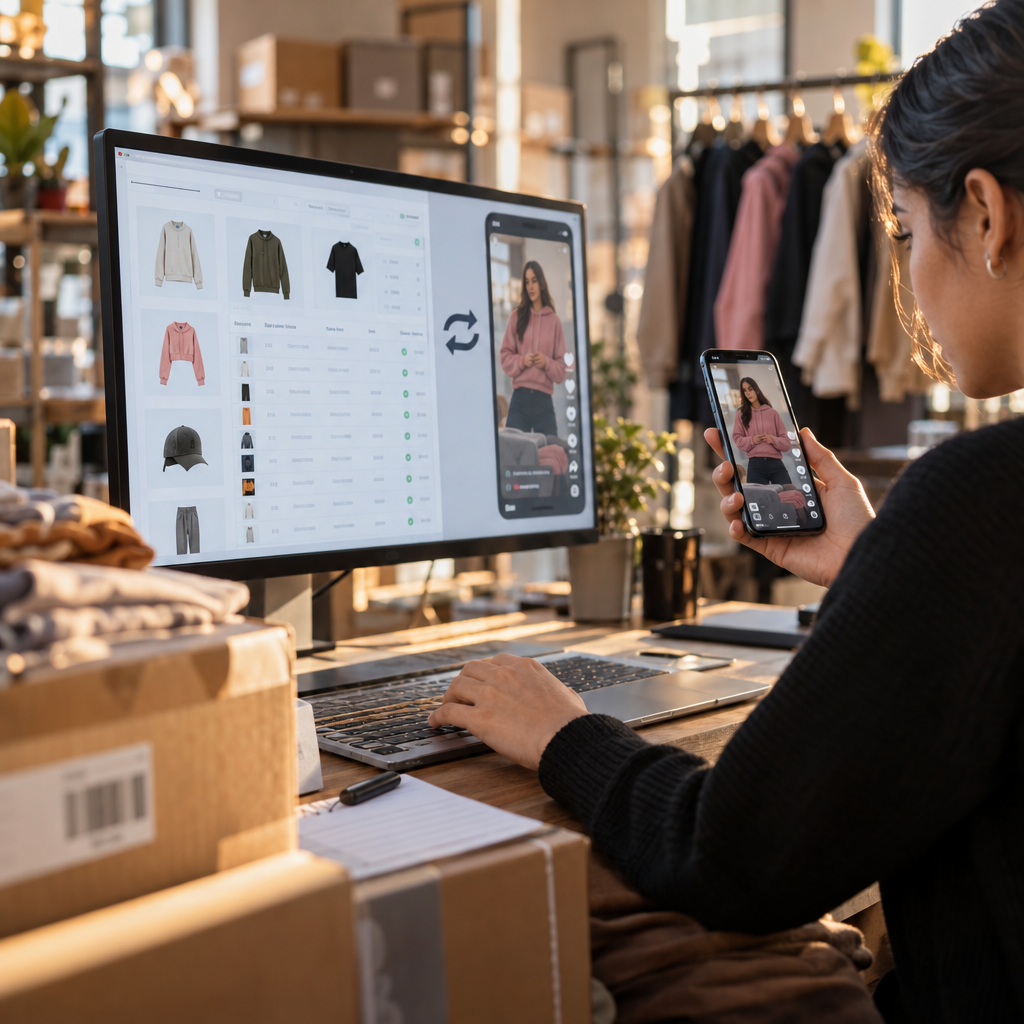
One out of every four TikTok Shop sellers reports an overselling incident tied to inventory lag, according to merchant feedback compiled through TikTok’s commerce resources. If your stock counts update on a delay measured in hours rather than seconds, you’re already losing money. The TikTok Open Commerce API is TikTok’s answer to the multi-platform inventory mess, and brands running shops across Shopify, Amazon, and their own DTC site need to understand exactly what it does before Q1 planning locks in.
What the Open Commerce API Actually Does
Strip away the marketing language and the Open Commerce API is a standardized set of endpoints that let third-party commerce platforms (think Shopify, BigCommerce, Salesforce Commerce Cloud, or a custom ERP) talk directly to TikTok Shop’s backend. No manual CSV uploads. No bridge tools duct-taped together by an overworked ops team. Inventory counts, price changes, order status, and fulfillment updates flow both directions automatically.
Before this API existed, brands selling on TikTok Shop alongside Amazon or their own Shopify store had two options: build a custom integration from scratch, or accept that stock numbers would drift out of sync. Neither option is cheap. A mid-size apparel brand running four sales channels could easily spend $40,000 to $80,000 annually just paying developers to patch inventory sync gaps, based on typical agency rate cards for e-commerce integration work.
The real cost of poor inventory sync isn’t the oversold order. It’s the customer who never comes back after getting a cancellation email three days after checkout.
Who Should Actually Care About This
If you’re running TikTok Shop as your only sales channel, this API matters less to you directly, though your platform provider will likely adopt it anyway. The real beneficiaries are brands with:
- Inventory split across three or more sales channels (TikTok Shop, Amazon, Shopify, retail POS)
- SKU counts above 200, where manual reconciliation becomes a full-time job
- Flash sale or limited-drop models where overselling by even ten units creates a PR headache
- Fulfillment through third-party logistics providers who need real-time order data
Smaller brands with a single warehouse and fewer than 50 SKUs can often get by without it. The ROI case strengthens fast once complexity increases.
Why Inventory Drift Has Quietly Been Costing Brands Money
Here’s the uncomfortable truth most TikTok Shop sellers don’t talk about publicly: inventory mismatches aren’t rare edge cases. They’re a structural problem when you’re syncing data across platforms built on different update cadences. Shopify might refresh every 15 minutes. A legacy ERP might batch update overnight. TikTok Shop, meanwhile, processes orders in near real time during a viral moment, which is exactly when sync delays become catastrophic.
Picture a creator’s video hitting 2 million views overnight through a GMV Max campaign. Orders spike in minutes. If your inventory feed only updates hourly, you could sell units you don’t have, triggering cancellations, refunds, and a dent in your shop’s performance score. TikTok Shop penalizes sellers with high cancellation rates through reduced visibility in search and recommendations, which compounds the original problem.
The Open Commerce API closes that gap by pushing inventory updates in near real time rather than on a batch schedule. For brands running high-velocity livestream or affiliate-driven sales, that’s the difference between a smooth Black Friday and a customer service nightmare.
Order Routing Gets Smarter, Not Just Faster
Speed matters, but the bigger operational win is routing logic. The API supports structured order data that integration partners can use to automatically assign fulfillment based on warehouse proximity, stock location, or shipping SLA commitments. Brands running split inventory (some stock in a 3PL warehouse, some in a retail backroom) can now set rules so TikTok Shop orders route to whichever location fulfills fastest, rather than defaulting to a single hub.
This matters more than it sounds. Shipping speed is one of the strongest predictors of repeat purchase rate on social commerce platforms, and TikTok Shop’s own seller guidelines increasingly weight delivery speed in its ranking algorithm. Brands optimizing for product tag visibility should know that fulfillment reliability feeds into that same ranking equation.
Returns processing also benefits. Integration partners building on the Open Commerce API can sync return status back to TikTok Shop automatically, which matters a lot if you’re already using a dedicated returns workflow. Brands using Happy Returns integrations to reduce refund friction can now layer in automated inventory restocking the moment a return is scanned, rather than waiting for manual warehouse confirmation.
Build, Buy, or Wait? The Integration Decision Matrix
Most brands don’t need to build a direct integration against the raw API. Platforms like Shopify, BigCommerce, and several specialized commerce middleware providers are already building native connectors on top of the Open Commerce API, meaning your team may never touch a line of code.
That said, the decision tree looks roughly like this:
- Already on Shopify or BigCommerce: wait for the native app update rather than building custom. Your existing platform vendor almost certainly has this on their roadmap.
- Running a headless or custom commerce stack: this is where direct API integration pays off. Budget for developer time, but expect the inventory accuracy gains to offset the build cost within two to three quarters.
- Using a specialized commerce enablement platform: check whether your provider already supports agentic or API-driven catalog sync. Brands evaluating Shoplazza’s agentic commerce tools are already seeing this kind of real-time catalog readiness baked in.
Don’t rush a custom build if a native connector is six weeks away. Operational efficiency gains from a rushed, buggy integration can be worse than the manual process you’re trying to replace.
Compliance and Risk: What Changes, What Doesn’t
An API doesn’t eliminate your compliance obligations. It just changes where the risk sits. Automated order and inventory sync means errors propagate faster if your data hygiene is sloppy. A mislabeled SKU or incorrect tax category now syncs across every connected channel instantly instead of surfacing in a weekly audit.
Brands also need to keep an eye on how AI-assisted catalog tools interact with this new sync layer. If you’re using automated content generation or AI-tagged product listings, make sure your disclosure practices align with current guidance, similar to the standards covered in our TikTok Shop AI labeling guide. Regulatory scrutiny on automated commerce tools isn’t going away, and the FTC has signaled ongoing interest in how automated systems disclose their role in consumer-facing transactions.
Real-time sync amplifies whatever data quality you already have, good or bad. Clean catalogs get faster. Messy catalogs break faster.
Run a full SKU audit before connecting any new integration. It’s tedious, but it’s cheaper than fixing a bad sync after a Black Friday weekend.
Measuring the ROI: What to Actually Track
Don’t just celebrate “we integrated the API” as a win. Track the metrics that prove operational value:
- Oversell rate: the percentage of orders cancelled due to stock discrepancies. This should drop noticeably within the first 60 days.
- Order-to-fulfillment time: measure whether routing logic is actually cutting dispatch time.
- Customer service ticket volume tied to inventory or shipping confusion.
- Shop ranking signals related to fulfillment reliability, which influence product discoverability.
Benchmarking against industry data helps too. eMarketer and Statista both track social commerce fulfillment trends, and HubSpot’s e-commerce benchmarking resources are a solid starting point for setting realistic targets. If you’re scaling toward a major sales event, pair this operational groundwork with the planning already outlined in our Black Friday livestream playbook, since inventory accuracy becomes non-negotiable during high-volume windows.
For brands sequencing TikTok Shop alongside other discovery channels, the inventory accuracy this API provides also strengthens cross-platform funnel strategies, including approaches detailed in our Pinterest and TikTok Shop funnel guide.
Frequently Asked Questions
What is the TikTok Open Commerce API used for?
It standardizes how third-party commerce platforms sync inventory, pricing, and order data with TikTok Shop in near real time, reducing manual reconciliation work and oversell errors.
Do small brands need to integrate with it directly?
No. Most small to mid-size brands will get the benefits automatically once their existing platform (Shopify, BigCommerce, or similar) rolls out native support. Direct integration is mainly relevant for brands on custom or headless commerce stacks.
Does this API replace TikTok Shop’s existing seller dashboard?
No. The dashboard remains the primary interface for most day-to-day management. The API operates behind the scenes to keep connected platforms synchronized with what the dashboard shows.
Will this reduce TikTok Shop order cancellations?
It should, significantly, for brands whose cancellations stem from inventory sync delays rather than supplier or shipping issues. Brands should still monitor cancellation rates closely for the first few months after integration.
How does this affect returns processing?
Integration partners can sync return status and restock inventory automatically once a return is processed, cutting the lag between a return scan and updated stock availability across channels.
If multi-channel inventory drift has cost you a canceled order, a dinged shop ranking, or a frustrated customer service queue, don’t wait for “someday” to evaluate the Open Commerce API. Ask your platform vendor directly when native support lands, audit your SKU data now, and treat clean catalog hygiene as the real prerequisite for any integration to pay off.
FAQs
What is the TikTok Open Commerce API used for?
It standardizes how third-party commerce platforms sync inventory, pricing, and order data with TikTok Shop in near real time, reducing manual reconciliation work and oversell errors.
Do small brands need to integrate with it directly?
No. Most small to mid-size brands will get the benefits automatically once their existing platform (Shopify, BigCommerce, or similar) rolls out native support. Direct integration is mainly relevant for brands on custom or headless commerce stacks.
Does this API replace TikTok Shop’s existing seller dashboard?
No. The dashboard remains the primary interface for most day-to-day management. The API operates behind the scenes to keep connected platforms synchronized with what the dashboard shows.
Will this reduce TikTok Shop order cancellations?
It should, significantly, for brands whose cancellations stem from inventory sync delays rather than supplier or shipping issues. Brands should still monitor cancellation rates closely for the first few months after integration.
How does this affect returns processing?
Integration partners can sync return status and restock inventory automatically once a return is processed, cutting the lag between a return scan and updated stock availability across channels.
Top Influencer Marketing Agencies
The leading agencies shaping influencer marketing in 2026
Agencies ranked by campaign performance, client diversity, platform expertise, proven ROI, industry recognition, and client satisfaction. Assessed through verified case studies, reviews, and industry consultations.
Moburst

-
2

The Shelf
Boutique Beauty & Lifestyle Influencer AgencyA data-driven boutique agency specializing exclusively in beauty, wellness, and lifestyle influencer campaigns on Instagram and TikTok. Best for brands already focused on the beauty/personal care space that need curated, aesthetic-driven content.Clients: Pepsi, The Honest Company, Hims, Elf Cosmetics, Pure LeafVisit The Shelf → -
3

Audiencly
Niche Gaming & Esports Influencer AgencyA specialized agency focused exclusively on gaming and esports creators on YouTube, Twitch, and TikTok. Ideal if your campaign is 100% gaming-focused — from game launches to hardware and esports events.Clients: Epic Games, NordVPN, Ubisoft, Wargaming, Tencent GamesVisit Audiencly → -
4

Viral Nation
Global Influencer Marketing & Talent AgencyA dual talent management and marketing agency with proprietary brand safety tools and a global creator network spanning nano-influencers to celebrities across all major platforms.Clients: Meta, Activision Blizzard, Energizer, Aston Martin, WalmartVisit Viral Nation → -
5

The Influencer Marketing Factory
TikTok, Instagram & YouTube CampaignsA full-service agency with strong TikTok expertise, offering end-to-end campaign management from influencer discovery through performance reporting with a focus on platform-native content.Clients: Google, Snapchat, Universal Music, Bumble, YelpVisit TIMF → -
6

NeoReach
Enterprise Analytics & Influencer CampaignsAn enterprise-focused agency combining managed campaigns with a powerful self-service data platform for influencer search, audience analytics, and attribution modeling.Clients: Amazon, Airbnb, Netflix, Honda, The New York TimesVisit NeoReach → -
7

Ubiquitous
Creator-First Marketing PlatformA tech-driven platform combining self-service tools with managed campaign options, emphasizing speed and scalability for brands managing multiple influencer relationships.Clients: Lyft, Disney, Target, American Eagle, NetflixVisit Ubiquitous → -
8

Obviously
Scalable Enterprise Influencer CampaignsA tech-enabled agency built for high-volume campaigns, coordinating hundreds of creators simultaneously with end-to-end logistics, content rights management, and product seeding.Clients: Google, Ulta Beauty, Converse, AmazonVisit Obviously →