


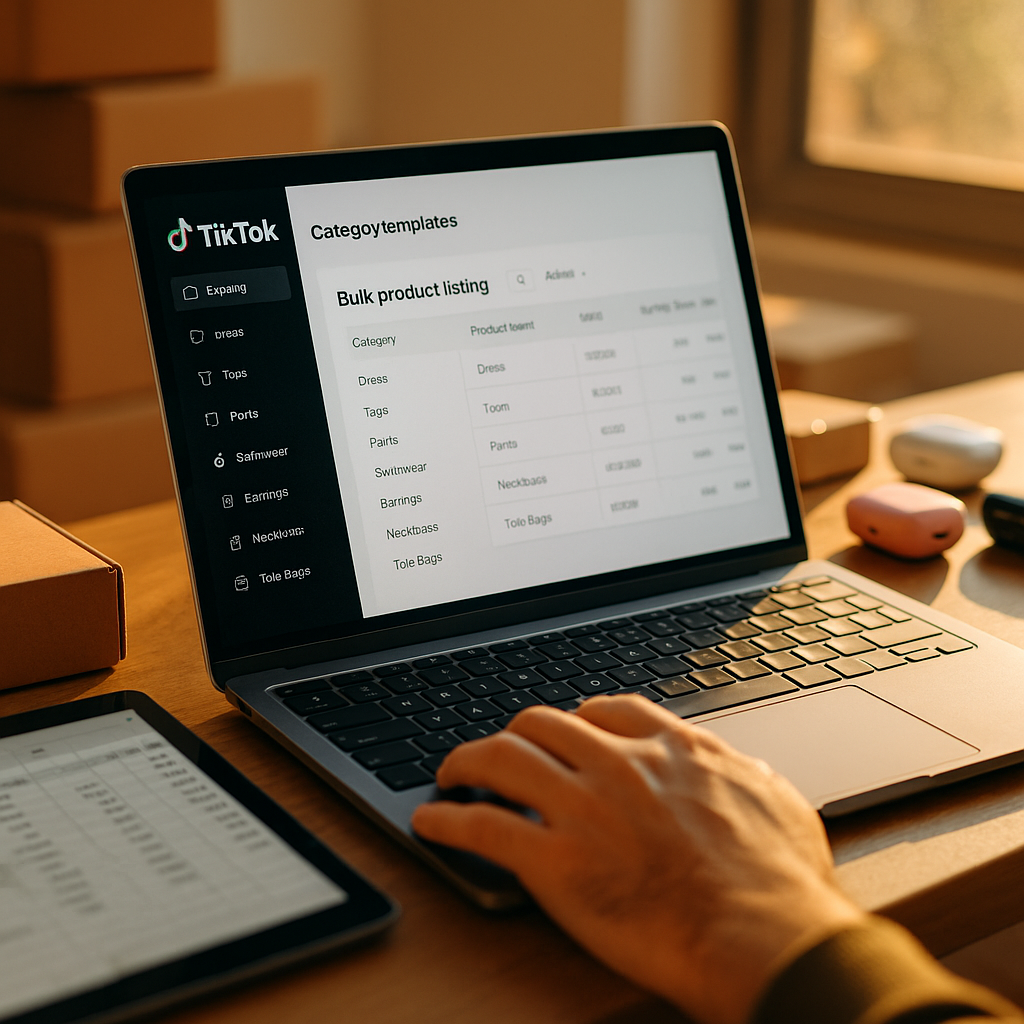
Merchants with 500-SKU catalogs are onboarding TikTok Shop affiliates in days, not months. The difference isn’t headcount. It’s a TikTok Shop category template system that turns bulk-listing from a spreadsheet nightmare into a repeatable production line. If your product feed still gets built one listing at a time, you’re bleeding creator interest before a single sample ships.
Why Bulk-Listing Speed Decides Who Wins Creator Attention
Creators don’t wait. A beauty affiliate scrolling TikTok Shop’s Creator Marketplace will move past your brand in seconds if your catalog looks thin, mismatched, or incomplete. Commission rates matter, sure, but so does the friction of finding a product worth pitching to their audience.
Here’s the uncomfortable truth: most merchants lose affiliate interest not because their products are bad, but because their listings are inconsistent. Missing attributes. Mismatched categories. Product titles that read like internal SKU codes instead of something a creator would actually say on camera. Fix the template, fix the funnel.
Brands using standardized category templates report onboarding affiliates up to 3x faster than those manually reviewing each product page — because creators can evaluate commission potential and content angles in one glance.
This isn’t just a listing hygiene issue. It’s a direct revenue lever. TikTok Shop’s algorithm favors complete, well-categorized listings in both organic discovery and the affiliate marketplace search. A sloppy feed doesn’t just slow onboarding, it actively suppresses reach, similar to how TikTok’s discovery-first ranking now punishes weak content signals across the platform.
What a Category Template Actually Is (And Why Most Merchants Skip It)
A category template is a standardized attribute map for a product type: apparel, skincare, supplements, home goods, whatever your catalog spans. It defines every field TikTok Shop requires, plus every field creators actually care about, and locks them into a repeatable structure you can apply across hundreds of SKUs in one bulk upload.
Most merchants skip this step because it feels like busywork upfront. Then they spend three times longer fixing rejected listings, correcting mismatched attributes, and manually answering creator DMs asking “wait, what does this product even do?”
- Category-specific required fields: material, size, ingredient list, certification tags (organic, cruelty-free, FDA-registered where applicable).
- Creator-facing fields: use-case description, target demographic, seasonal relevance, bundle eligibility.
- Commission and sample logistics: default affiliate commission tier, sample availability flag, minimum follower threshold if you’re gating access.
- Content prompts: a one-line “hook angle” suggestion baked into the product notes field, so creators aren’t starting from zero.
Build this once per category, and every new SKU addition becomes a copy-paste-adjust exercise instead of a from-scratch listing project.
The Bulk Upload Mechanics Nobody Explains Well
TikTok Shop’s Seller Center supports CSV-based bulk uploads, but the platform’s own documentation assumes you already know how to structure category-specific attribute sheets. Most merchants find out the hard way, after their first bulk upload gets partially rejected for mismatched taxonomy codes.
The fix: pull the category attribute requirements directly from Seller Center before building your master template. Every category, from “Women’s Dresses” to “Vitamins & Dietary Supplements,” has its own mandatory field set. Miss one and the whole row fails silently or gets flagged for manual review, which can add days to your launch timeline.
Build your master spreadsheet with locked columns for platform-required fields and separate columns for creator-facing enrichment. Keep them visually distinct. Your ops team touches one set, your affiliate marketing lead touches the other. Nobody steps on each other’s work.
Speed Up Creator Onboarding by Front-Loading Content Angles
Here’s what most merchants miss: bulk-listing isn’t just an operations task, it’s a creator briefing exercise in disguise. Every field you fill in with intention saves a creator a DM, a clarifying question, or worse, a pass on your product entirely.
Think about what a creator actually needs to say yes to an affiliate partnership. They need to know: what’s the hook, who’s the audience, what’s the commission, and is there a sample available. If your category template answers all four inside the product listing itself, you’ve just eliminated the single biggest bottleneck in affiliate recruitment — manual back-and-forth.
Merchants who embed a suggested content angle directly in product metadata see meaningfully higher affiliate application rates than those relying on generic product descriptions alone.
This mirrors what’s happening across other platforms. YouTube’s shopping affiliate program works the same way, brands that pre-load creator-friendly context into their affiliate brief templates see faster creator sign-off. TikTok Shop just compresses that briefing process into the product page itself.
Don’t Ignore the Symphony AI Layer
TikTok’s Symphony AI tools are increasingly used to match creators to products based on catalog metadata, not just manual creator outreach. A thin or generic listing gives Symphony’s matching algorithm less to work with, which means fewer creator recommendations surfacing your products in the first place. Merchants building templates now should treat the metadata as machine-readable creator bait, not just a checkbox exercise. For a deeper look at how this matching works, the Symphony AI playbook breaks down how the system weighs product signals against creator profiles.
Category-by-Category Template Priorities
Not every vertical needs the same template weight. Some categories carry regulatory or compliance baggage that changes what “complete” even means.
- Beauty and skincare: ingredient disclosures, allergen warnings, and “cruelty-free” or “vegan” claims need airtight backing, since creators will get called out in comments if claims don’t hold up.
- Supplements and wellness: FTC-relevant substantiation matters here. Any health claim embedded in your template needs a defensible basis, not just marketing copy repurposed from an old landing page.
- Alcohol and age-restricted goods: this category needs its own compliance layer entirely, distinct from standard bulk templates, given the added verification requirements. If you’re operating in this space, the age verification playbook lays out the three-stage process merchants need before creator onboarding even starts.
- Apparel: size charts and fit notes reduce return-driven refund disputes, which matter more in affiliate-driven sales because creators’ audiences trust their sizing recommendations at face value.
Building category-specific templates upfront means your compliance team reviews policy once per category, not once per SKU. That’s the operational leverage most merchants underestimate.
Contracts, Commission Tiers, and the Payout Question
A bulk-listing template isn’t complete without a default commission structure baked in. Creators evaluating your catalog want to know the payout before they invest time in content. Ambiguity kills conversion.
Decide upfront: flat commission across a category, or tiered by follower count and historical GMV performance? Increasingly, merchants are blending upfront fees with performance-based payouts, similar to the structures outlined in hybrid payout contract models. Whatever you choose, bake the default tier into your category template so it’s consistent across every SKU in that vertical. Inconsistent commission structures across similar products confuse creators and slow down your affiliate application review queue.
One more thing worth flagging: TikTok Shop’s commission structure interacts with your overall margin math differently across categories. A 20% commission on a $15 impulse-buy skincare item behaves very differently than 20% on a $120 supplement bundle. Build margin thresholds into your template logic before you scale bulk listings, not after your finance team flags a quarter of unprofitable affiliate sales.
Measuring Whether the Template Actually Worked
Track time-to-first-content per SKU category after template rollout. If a beauty listing built with your new template gets its first creator video within 5 days versus 15 days for legacy listings, that’s your ROI proof point. Track it by category, not just in aggregate, since some verticals will onboard faster than others regardless of template quality.
Other metrics worth watching: affiliate application rate per listing, percentage of listings rejected on first bulk upload attempt, and average creator commission negotiation cycles. All three should trend down as your template matures.
According to eMarketer’s social commerce research, social commerce platforms with streamlined merchant onboarding consistently outperform on creator-driven GMV, largely because friction reduction compounds across every stage of the funnel, from listing to first sale.
Building the Template: A Practical Starting Sequence
- Pull TikTok Shop’s required attribute fields for your top three product categories from Seller Center.
- Layer in creator-facing fields: hook angle, use case, target demo, seasonal tag.
- Set default commission tiers per category, with margin thresholds documented internally.
- Build your master CSV with locked platform fields and editable enrichment fields clearly separated.
- Run a pilot bulk upload of 20-30 SKUs before scaling to your full catalog.
- Review rejection rates and creator application data after two weeks, then refine the template.
Small pilot first. Full rollout second. Merchants who skip the pilot step tend to discover taxonomy errors at the worst possible scale, across thousands of SKUs instead of dozens.
For brands managing multi-platform affiliate strategy, it’s also worth benchmarking how Sprout Social’s commerce research frames creator-driven catalog optimization across networks, since TikTok Shop’s approach increasingly resembles what’s happening in Threads shopping tag eligibility requirements: metadata completeness gates creator access more than platform tenure does.
Next step: pick your highest-GMV product category, build one category template using the sequence above, and pilot it against 20 SKUs this week. Measure time-to-first-creator-content before scaling further, and let that number, not gut feel, decide whether you roll the template out catalog-wide.
FAQs
What is a TikTok Shop category template?
It’s a standardized attribute structure for a specific product category (like skincare or apparel) that combines TikTok’s required platform fields with creator-facing metadata, allowing merchants to bulk-list products consistently and speed up affiliate onboarding.
How does bulk-listing affect creator affiliate recruitment?
Complete, well-structured listings help creators quickly evaluate commission potential and content angles without needing manual outreach, which reduces onboarding friction and speeds up time-to-first-content significantly.
Does TikTok Shop require different fields for different product categories?
Yes. Each category in TikTok Shop’s Seller Center has its own mandatory attribute set, and missing fields can cause bulk upload rows to fail or get flagged for manual review.
How does Symphony AI factor into product listing quality?
TikTok’s Symphony AI tools use product metadata to match creators with relevant products. Thin or generic listings give the algorithm less signal to work with, reducing the odds your products surface in creator recommendations.
What commission structure works best for bulk-listed products?
Many merchants use category-level default commission tiers, sometimes blended with hybrid payout models, to keep expectations consistent across similar SKUs and avoid slowing down affiliate application reviews.
How long should a pilot bulk upload be before scaling?
A pilot of 20-30 SKUs is generally enough to surface taxonomy errors, attribute mismatches, and creator response patterns before committing the full catalog to a new template.
Top Influencer Marketing Agencies
The leading agencies shaping influencer marketing in 2026
Agencies ranked by campaign performance, client diversity, platform expertise, proven ROI, industry recognition, and client satisfaction. Assessed through verified case studies, reviews, and industry consultations.
Moburst

-
2

The Shelf
Boutique Beauty & Lifestyle Influencer AgencyA data-driven boutique agency specializing exclusively in beauty, wellness, and lifestyle influencer campaigns on Instagram and TikTok. Best for brands already focused on the beauty/personal care space that need curated, aesthetic-driven content.Clients: Pepsi, The Honest Company, Hims, Elf Cosmetics, Pure LeafVisit The Shelf → -
3

Audiencly
Niche Gaming & Esports Influencer AgencyA specialized agency focused exclusively on gaming and esports creators on YouTube, Twitch, and TikTok. Ideal if your campaign is 100% gaming-focused — from game launches to hardware and esports events.Clients: Epic Games, NordVPN, Ubisoft, Wargaming, Tencent GamesVisit Audiencly → -
4

Viral Nation
Global Influencer Marketing & Talent AgencyA dual talent management and marketing agency with proprietary brand safety tools and a global creator network spanning nano-influencers to celebrities across all major platforms.Clients: Meta, Activision Blizzard, Energizer, Aston Martin, WalmartVisit Viral Nation → -
5

The Influencer Marketing Factory
TikTok, Instagram & YouTube CampaignsA full-service agency with strong TikTok expertise, offering end-to-end campaign management from influencer discovery through performance reporting with a focus on platform-native content.Clients: Google, Snapchat, Universal Music, Bumble, YelpVisit TIMF → -
6

NeoReach
Enterprise Analytics & Influencer CampaignsAn enterprise-focused agency combining managed campaigns with a powerful self-service data platform for influencer search, audience analytics, and attribution modeling.Clients: Amazon, Airbnb, Netflix, Honda, The New York TimesVisit NeoReach → -
7

Ubiquitous
Creator-First Marketing PlatformA tech-driven platform combining self-service tools with managed campaign options, emphasizing speed and scalability for brands managing multiple influencer relationships.Clients: Lyft, Disney, Target, American Eagle, NetflixVisit Ubiquitous → -
8

Obviously
Scalable Enterprise Influencer CampaignsA tech-enabled agency built for high-volume campaigns, coordinating hundreds of creators simultaneously with end-to-end logistics, content rights management, and product seeding.Clients: Google, Ulta Beauty, Converse, AmazonVisit Obviously →