


Most Creator Video Budgets Are Built for the Wrong Output
TikTok’s own data shows that shoppable ad formats on TikTok Shop convert at rates up to 1.7x higher than standard in-feed ads. Yet most brands are still commissioning creator content as if its only destination is organic posting. That mismatch is costing real revenue, and TikTok Symphony Agent is now the clearest argument for fixing it.
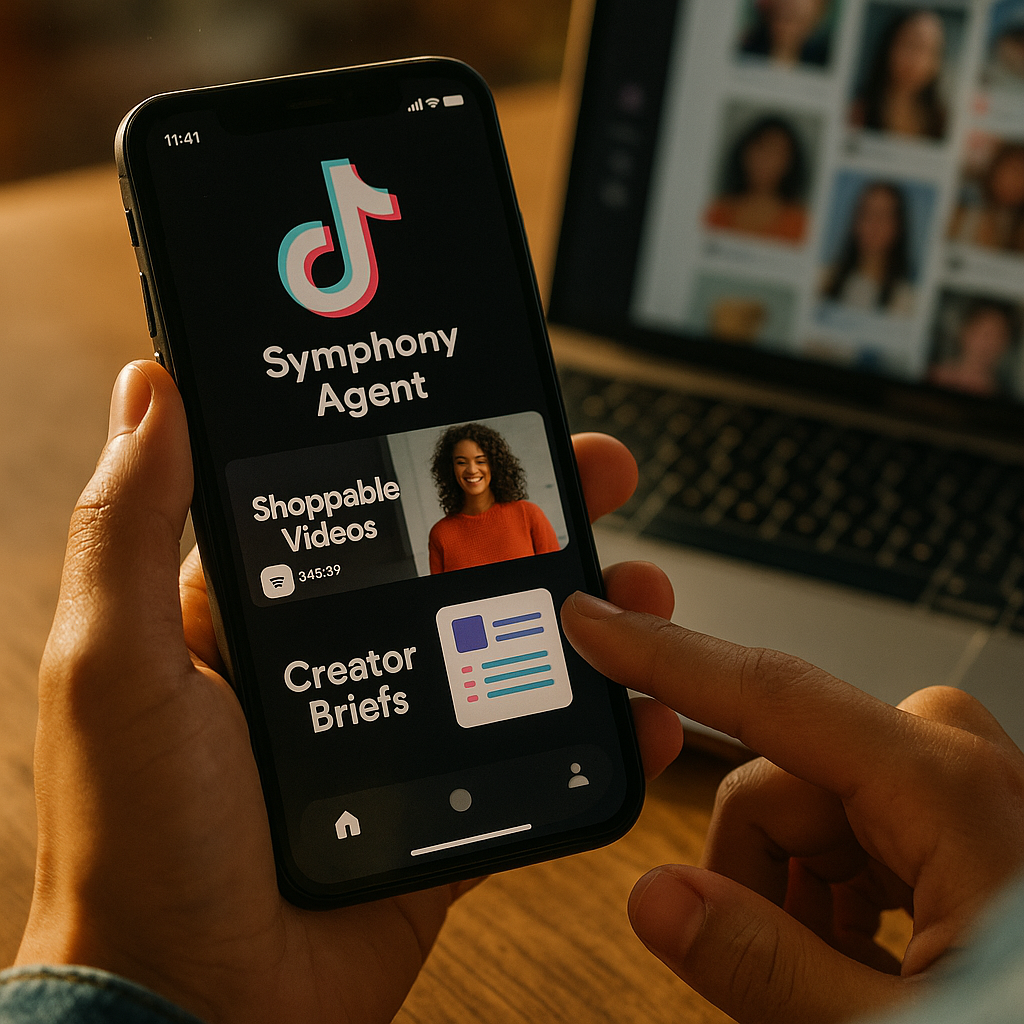
Symphony Agent is TikTok’s AI-powered creative operations layer inside TikTok Ads Manager. Among its most commercially significant features: automated caption removal, AI dubbing for multilingual adaptation, and the ability to convert existing brand videos into shoppable ad formats. Together, these three capabilities create a conversion pipeline that fundamentally changes the ROI math on creator asset production — if brands structure their original shoots with it in mind.
The Three Features That Actually Matter for Commerce Teams
Caption Removal. Creator content almost always carries burned-in text: product callouts, trending overlays, personal branding. That content can’t be repurposed into paid placements without visual cleanup. Symphony Agent’s caption removal uses generative inpainting to strip those elements cleanly, leaving a neutralized video layer that can accept new overlaid text, product cards, or call-to-action modules without obvious editing artifacts.
AI Dubbing. This is where scale enters the equation. A single creator video in English can now be dubbed into over 10 languages, with lip-sync adjustment, in a fraction of the time and cost of traditional localization. For brands running cross-market campaigns or testing category entry in new geographies, this compresses the creator content localization cycle from weeks to hours.
Brand-Video-to-Shoppable-Ad Conversion. This feature ingests existing brand footage (TV spots, campaign films, even creator-made organic posts) and outputs shoppable ad-ready versions: product tags, clickable overlays, Shop tab linkage, and checkout integration. The conversion isn’t purely cosmetic. Symphony Agent also analyzes the video for product visibility windows and recommends optimal overlay placement, so the commerce layer doesn’t obscure the creative’s most persuasive moments.
The commercial logic is simple: if your creative asset can’t be converted into a shoppable format in under 24 hours, you’re leaving a conversion layer on the table every time that content is produced.
Why This Changes the Brief, Not Just the Post-Production Process
Here’s what most brands get wrong: they treat Symphony Agent as a post-production tool. It’s not. Or rather, it shouldn’t be used that way if you want to maximize its value.
Caption removal works better when creators haven’t embedded text over the product’s face, label, or packaging. AI dubbing produces more natural output when dialogue is recorded with clean audio separation from background music. Shoppable ad conversion performs best when product visibility is sustained for a minimum of three to five seconds in a single frame. None of these conditions happen by accident on a creator shoot. They require deliberate brief construction.
The implication is structural. Your creator briefs need a new section: Commerce Adaptability Requirements. This isn’t about restricting creator expression. A creator can still build their hook any way they want, use whatever overlays resonate with their audience, and deliver the organic performance metrics you’re paying for. But the brief should specify that product visibility windows meet minimum durations, that caption placement avoids the lower-third product zone, and that raw audio files are delivered alongside the final cut.
Brands already investing in TikTok Shop creator networks are ahead of the curve here. They understand that creator content isn’t a one-destination asset. Every piece of high-performing organic video is a candidate for paid amplification, and paid amplification on TikTok increasingly routes through shoppable formats.
The Localization Angle Brands Are Sleeping On
AI dubbing deserves its own strategic treatment because the localization use case is routinely undervalued in initial Symphony Agent rollouts.
Consider the math. A mid-market beauty brand produces a creator video with a $15,000 production budget. Traditional localization into three additional languages (Spanish, French, Portuguese) would historically require $8,000 to $12,000 in studio fees, voice talent, and post-production time. Symphony Agent’s dubbing compresses that cost dramatically and, more importantly, compresses the timeline. A brand that can localize and launch a shoppable ad campaign into a new market in 48 hours instead of three weeks has a fundamentally different competitive posture.
The quality threshold matters here. Symphony Agent’s dubbing is not yet flawless, particularly for creators with strong regional accents or rapid speech. Quality assurance review by a native speaker remains necessary before any paid spend goes live. Build that review step into your localization workflow explicitly. Don’t assume the AI output clears compliance or accuracy standards without a human check.
For external benchmarking on multilingual creative performance standards, eMarketer and Sprout Social have both published research on the engagement lift associated with localized versus translated (non-dubbed) video content — the gap consistently favors dubbed formats for viewer retention past the five-second mark.
Restructuring Asset Delivery Contracts With Creators
If Symphony Agent features are now part of your paid activation strategy, your creator contracts need to catch up. Most standard influencer agreements cover usage rights for the finished deliverable in specific formats. They don’t explicitly cover AI-modified derivatives, dubbed versions, or shoppable-format conversions. That’s a legal exposure most brand procurement teams haven’t addressed.
The fix is relatively straightforward but requires proactive language. Contracts should specify that raw footage, isolated audio tracks, and unedited exports are included in deliverables. Usage rights should explicitly cover AI-assisted modification for paid placements, including dubbed versions in specified languages and shoppable ad format conversions. This matters both for compliance and for creator relationships — creators who feel their voice (literally, in the dubbing case) is being commercially exploited without their knowledge will become a reputational liability fast.
The FTC’s endorsement guidelines don’t yet have specific provisions for AI-dubbed creator content, but material connection disclosure requirements still apply to any paid placement derived from creator video, regardless of the format it’s been adapted into. Build that disclosure logic into your shoppable ad templates before launch, not after a compliance review flags the gap.
Connecting This to Your Broader Paid Distribution Architecture
Symphony Agent’s conversion features don’t operate in isolation. The shoppable ads they produce feed into TikTok’s broader commerce ecosystem: TikTok Shop, LIVE Shopping, and the platform’s product discovery algorithm. Brands that have structured their creator briefs for AI discovery and checkout will find Symphony Agent outputs slot directly into that system with minimal additional configuration.
The sequencing logic matters too. Consider how a Symphony Agent-converted shoppable ad can function as a mid-funnel unit after a creator’s organic video has already built awareness. You’re not duplicating the creative — you’re extending its commercial lifespan. Brands already running creative sequencing strategies on TikTok will recognize this immediately: the organic post seeds intent, the shoppable ad converts it.
Creator content that isn’t designed for commerce adaptability from the brief stage is being under-monetized at every subsequent stage of its distribution lifecycle.
For brands also managing cross-platform commerce programs, similar asset-adaptation thinking applies elsewhere. The Pinterest AI Ads and Shopify integration framework shares structural parallels: content produced for one platform context often needs deliberate upstream production choices to translate into shoppable formats on another. The operational principle is the same even when the tools differ.
Symphony Agent’s capabilities are documented on TikTok’s ads platform, but the practical application strategy is what most brands are still working out. For a research baseline on AI creative tool adoption rates in paid social, HubSpot’s marketing research provides useful benchmarking data on where brand teams currently sit on the AI tooling adoption curve.
The next brief your creative team writes for a TikTok creator should have commerce adaptability requirements built into the first draft. Not added after the content is already delivered.
FAQ
What is TikTok Symphony Agent and how does it help with shoppable ads?
TikTok Symphony Agent is an AI-powered creative operations tool inside TikTok Ads Manager. It includes features for caption removal, AI dubbing, and converting existing brand videos into shoppable ad formats. These capabilities allow brands to repurpose creator content for paid commerce placements without requiring full re-shoots, significantly reducing production costs and time-to-market for shoppable campaigns.
How should brands change their creator briefs to account for Symphony Agent?
Briefs should include a Commerce Adaptability Requirements section specifying minimum product visibility durations (ideally three to five seconds in a clear frame), caption placement rules that keep the lower-third product zone clear of overlays, and audio delivery requirements (isolated audio tracks alongside the final cut). These specifications enable cleaner caption removal, better dubbing output, and more effective shoppable ad conversion without limiting the creator’s organic storytelling approach.
Does AI dubbing from Symphony Agent meet quality standards for paid placements?
Symphony Agent’s dubbing is capable across more than 10 languages, but it is not error-free, particularly for creators with strong regional accents or rapid speech patterns. A native-speaker quality assurance review should be included in every localization workflow before any paid spend is activated on dubbed content. Brands should also confirm that dubbed versions meet any platform-specific disclosure or compliance requirements for the target market.
What contract language do brands need when using Symphony Agent to modify creator content?
Standard influencer agreements typically cover usage rights for finished deliverables in specified formats, but often do not address AI-modified derivatives. Contracts should explicitly include raw footage and isolated audio in deliverables, and usage rights language should cover AI-assisted modifications for paid placements, including dubbed versions and shoppable format conversions across specified languages and markets. This protects both the brand’s operational flexibility and the creator’s intellectual property expectations.
How does Symphony Agent’s shoppable ad conversion connect to TikTok Shop and LIVE Shopping?
Converted shoppable ads can be integrated directly with TikTok Shop, enabling product tag overlays, clickable product cards, and in-app checkout. They can also support TikTok LIVE Shopping campaigns by providing pre-produced shoppable content for playlist-style distribution. When creator content is originally produced with commerce adaptability in mind, Symphony Agent’s conversion outputs require minimal additional configuration to activate across these commerce surfaces.
Top Influencer Marketing Agencies
The leading agencies shaping influencer marketing in 2026
Agencies ranked by campaign performance, client diversity, platform expertise, proven ROI, industry recognition, and client satisfaction. Assessed through verified case studies, reviews, and industry consultations.
Moburst

-
2

The Shelf
Boutique Beauty & Lifestyle Influencer AgencyA data-driven boutique agency specializing exclusively in beauty, wellness, and lifestyle influencer campaigns on Instagram and TikTok. Best for brands already focused on the beauty/personal care space that need curated, aesthetic-driven content.Clients: Pepsi, The Honest Company, Hims, Elf Cosmetics, Pure LeafVisit The Shelf → -
3

Audiencly
Niche Gaming & Esports Influencer AgencyA specialized agency focused exclusively on gaming and esports creators on YouTube, Twitch, and TikTok. Ideal if your campaign is 100% gaming-focused — from game launches to hardware and esports events.Clients: Epic Games, NordVPN, Ubisoft, Wargaming, Tencent GamesVisit Audiencly → -
4

Viral Nation
Global Influencer Marketing & Talent AgencyA dual talent management and marketing agency with proprietary brand safety tools and a global creator network spanning nano-influencers to celebrities across all major platforms.Clients: Meta, Activision Blizzard, Energizer, Aston Martin, WalmartVisit Viral Nation → -
5

The Influencer Marketing Factory
TikTok, Instagram & YouTube CampaignsA full-service agency with strong TikTok expertise, offering end-to-end campaign management from influencer discovery through performance reporting with a focus on platform-native content.Clients: Google, Snapchat, Universal Music, Bumble, YelpVisit TIMF → -
6

NeoReach
Enterprise Analytics & Influencer CampaignsAn enterprise-focused agency combining managed campaigns with a powerful self-service data platform for influencer search, audience analytics, and attribution modeling.Clients: Amazon, Airbnb, Netflix, Honda, The New York TimesVisit NeoReach → -
7

Ubiquitous
Creator-First Marketing PlatformA tech-driven platform combining self-service tools with managed campaign options, emphasizing speed and scalability for brands managing multiple influencer relationships.Clients: Lyft, Disney, Target, American Eagle, NetflixVisit Ubiquitous → -
8

Obviously
Scalable Enterprise Influencer CampaignsA tech-enabled agency built for high-volume campaigns, coordinating hundreds of creators simultaneously with end-to-end logistics, content rights management, and product seeding.Clients: Google, Ulta Beauty, Converse, AmazonVisit Obviously →