


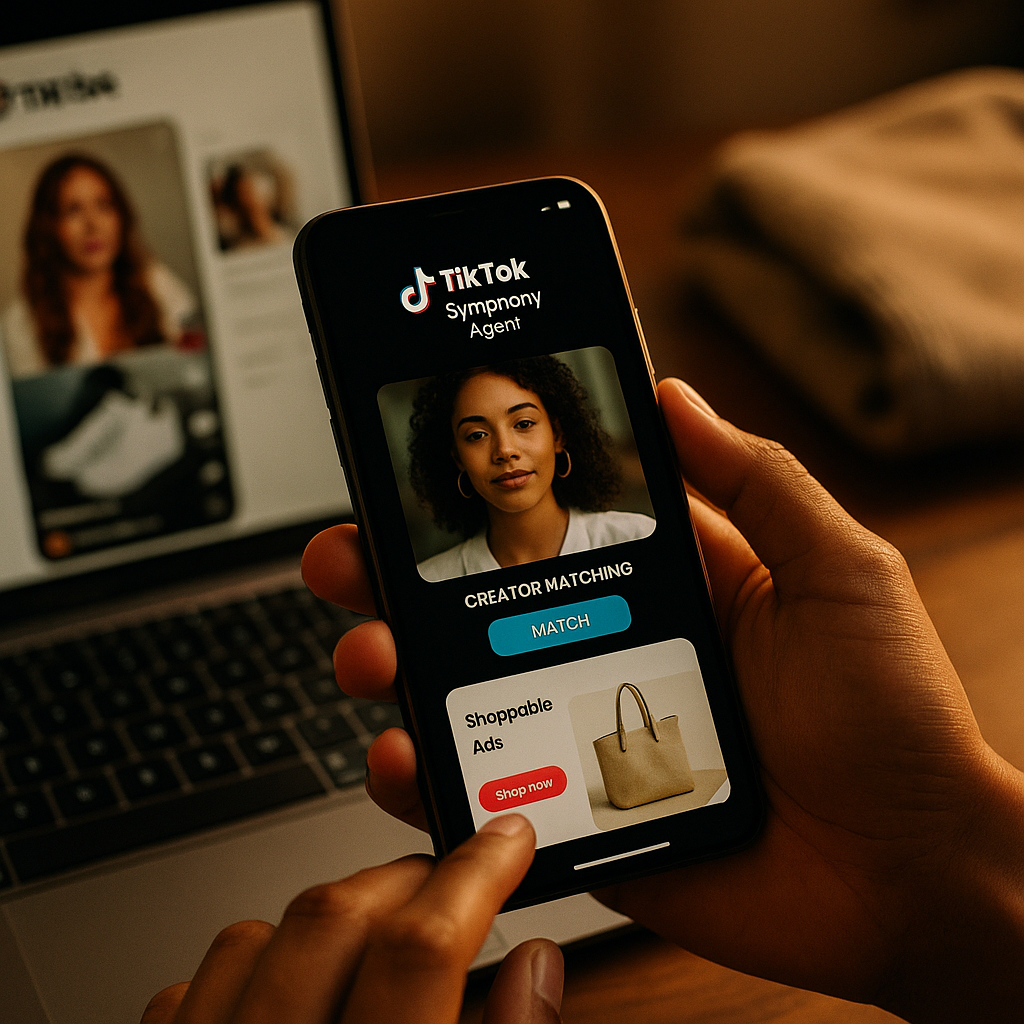
Brands already using TikTok Symphony Agent are reporting meaningful lifts in creator-match efficiency and shoppable ad conversion rates. The real question isn’t whether the tool works — it’s whether your team knows how to deploy it without surrendering creative control or compliance visibility.
What Symphony Agent Actually Does (Beyond the Marketing Deck)
TikTok’s Symphony Agent is the AI orchestration layer sitting inside TikTok Ads Manager. It handles three distinct functions that brands frequently conflate: creator matching, video repurposing for commerce, and custom creator network management.
Creator matching uses behavioral signals, not just follower demographics. Symphony Agent analyzes which creators’ audiences have historically completed purchases on TikTok Shop, cross-referenced against your product category and price point. That’s a fundamentally different approach from keyword-filtered creator directories, and it closes a real gap that has plagued influencer procurement for years.
The video repurposing engine is where most brand teams underestimate the operational lift. Upload a 30-second brand spot, and Symphony Agent can segment it, reframe key product moments, add shoppable overlays, and generate multiple creative variants optimized for different audience segments — all without re-shooting. For brands sitting on libraries of existing brand content, this is immediately practical.
Symphony Agent’s ability to convert existing brand video assets into shoppable TikTok ads means brands can activate their content libraries without incremental production spend — a meaningful budget argument for mid-market teams.
Custom creator network management, exemplified by Starbucks, takes this further. Rather than working through TikTok’s open creator marketplace, Starbucks built a curated, invitation-only network of creators approved to produce Symphony-powered content under brand guidelines. Symphony Agent acts as the brief-delivery, quality-check, and performance-monitoring system within that closed loop.
The Starbucks Model: What It Signals for Enterprise Brands
The Starbucks custom creator network deserves more than a passing reference. It represents a shift from transactional creator relationships toward something closer to a managed content operation, with AI reducing the coordination overhead that would otherwise make such a model cost-prohibitive.
Practically, the architecture looks like this: Starbucks maintains a vetted roster of creators segmented by content style, audience geography, and seasonal relevance. Symphony Agent distributes campaign briefs, monitors incoming content against brand safety parameters, and flags underperforming placements for human review. The brand team focuses on strategy and final approval; the AI handles routing and monitoring.
For enterprise brands, the replicability here is high. For mid-market brands, the investment required to build and maintain a proprietary creator network may not pencil out until you’ve established consistent TikTok Shop volume. Our coverage of TikTok Brand Day strategy outlines how mid-market teams can build toward this kind of program incrementally.
Evaluating Symphony Agent: The Four Questions That Matter
Before committing budget to Symphony Agent integration, brand teams should pressure-test it against four operational realities.
1. Does your current creator brief infrastructure translate to AI delivery? Symphony Agent parses briefs and distributes them at scale. If your briefs are vague, the AI scales that vagueness. Brands that have invested in structured, machine-readable creative briefs will extract meaningfully more value. See how other brands are building TikTok Shop creator briefs optimized for AI workflows.
2. How does Symphony Agent interact with your brand safety configuration? The platform’s keyword filtering capabilities are sophisticated, but they require deliberate setup. Synonym blocking and contextual exclusions don’t configure themselves. If you haven’t already mapped your brand safety parameters inside TikTok’s ecosystem, do that before activating Symphony Agent’s creator matching at scale. The overlap with TikTok’s keyword filter tools is direct and worth resolving in sequence.
3. What’s your attribution model for Symphony-generated shoppable content? Symphony Agent creates multiple creative variants from a single source asset. Without a clear variant-level attribution setup, your performance data will pool across versions, masking which creative treatments actually drove checkout. This is not a Symphony-specific problem, but the platform’s variant-generation speed makes it acute.
4. Who owns final compliance review? AI-matched creators and AI-generated overlays introduce disclosure risks that don’t disappear because a machine generated the content. FTC guidelines on endorsements apply regardless of how the pairing was initiated. Your legal and compliance team needs a defined touchpoint in the Symphony Agent workflow, not an assumption that platform automation handles it.
Shoppable Ad Conversion: Where the Real ROI Lives
The creator-matching headline gets most of the attention, but the shoppable ad conversion engine is where Symphony Agent delivers the clearest, most measurable return for most brands.
TikTok Shop’s integration with Symphony means that product links, inventory sync, and checkout flows are embedded directly into the ad creative rather than requiring a redirect. According to eMarketer, social commerce conversion rates consistently outperform standard social click-to-site benchmarks when checkout friction is removed. Symphony Agent’s overlay system is designed to minimize that friction.
The practical implication: brand teams should audit which existing video assets show strong organic engagement but weak click-through, then prioritize those for Symphony’s repurposing engine. High-engagement content with purchase-intent audiences that never converted is precisely the use case this tool was built to solve.
Pair this with a TopView-to-checkout sequencing strategy and you’re building a full-funnel TikTok architecture rather than running isolated placements.
The AI Authorship Question Every Brand Team Should Ask
Symphony Agent can generate creative content, not just distribute it. That capability introduces a compliance and authenticity tension that many brand teams haven’t yet formalized a policy around.
TikTok’s own platform data has shown suppressed distribution for content flagged as AI-generated without proper disclosure. Our analysis of AI-generated video suppression on TikTok covers this in detail, but the short version for Symphony users is this: if Symphony Agent is generating or significantly modifying content that will run under a creator’s handle, your team needs a clear policy on how that content is labeled and whether the creator’s audience would understand who actually made it.
This isn’t a hypothetical concern. Audience trust in creator authenticity directly affects conversion rates on TikTok Shop. A creator-matched ad that feels machine-generated undermines the social proof mechanism that makes creator content convert better than brand ads in the first place.
Platform Dependency and Negotiation Leverage
One underappreciated risk of deep Symphony Agent integration is platform lock-in. The deeper your creator network, brief infrastructure, and creative assets are embedded in TikTok’s AI tooling, the more friction exists in redistributing that spend to other platforms.
This doesn’t mean avoid Symphony Agent. It means build platform-agnostic creator relationships in parallel. Creators activated through Symphony’s matching should also have direct relationships with your brand team documented outside TikTok’s system. That way, if platform dynamics shift (and they have, repeatedly), you retain continuity.
For brands exploring multi-platform creator strategies, the structural principles used in multi-surface creator campaigns apply here: don’t let a single platform’s tooling become the only connective tissue in your creator program.
The Sprout Social Index consistently shows that brands with diversified creator activation across platforms outperform single-platform concentrations on both reach and resilience metrics.
Deep integration with any single platform’s AI tooling is a competitive advantage until the platform changes its terms. Build your creator relationships to survive a platform pivot.
The Practical Next Step
Run a Symphony Agent pilot on your three highest-performing existing brand videos, measure variant-level conversion against your current TikTok Shop baseline, and use that data to make the network infrastructure investment decision. Don’t build the Starbucks model without proof of the conversion mechanics first.
Frequently Asked Questions
What is TikTok Symphony Agent?
TikTok Symphony Agent is an AI-powered assistant within TikTok Ads Manager that handles creator matching, video repurposing for shoppable commerce, and custom creator network management. It uses behavioral purchase data and audience signals to recommend creators and can convert existing brand videos into multi-variant shoppable ad formats.
How does Symphony Agent match brands with creators?
Symphony Agent analyzes creators based on their audiences’ historical purchase behavior on TikTok Shop, product category fit, and price-point alignment — not just follower demographics. This behavioral matching approach is designed to prioritize conversion potential over reach metrics.
What is the Starbucks custom creator network model?
Starbucks built an invitation-only network of pre-vetted creators managed through Symphony Agent. The AI system distributes campaign briefs, monitors content for brand safety compliance, and tracks performance — allowing the brand team to focus on strategy and final approvals rather than operational coordination.
What are the main compliance risks with Symphony Agent?
The primary compliance risks involve FTC endorsement disclosure requirements for AI-matched creator content, brand safety gaps if keyword filters and contextual exclusions aren’t configured before activation, and AI authorship transparency issues if Symphony-generated content runs under a creator’s handle without adequate disclosure.
Can mid-market brands use Symphony Agent effectively?
Yes, particularly the video repurposing and creator-matching features. Building a full custom creator network like Starbucks requires significant investment and established TikTok Shop volume. Mid-market brands should start with Symphony’s shoppable ad conversion tools and creator matching before attempting proprietary network infrastructure.
How should brands measure ROI from Symphony Agent?
Brands should set up variant-level attribution before activating Symphony’s creative generation features, since the tool produces multiple ad variants from a single source asset. Measuring conversion rate, cost-per-acquisition, and TikTok Shop checkout completion per variant against a baseline of existing placements provides the clearest ROI signal.
Top Influencer Marketing Agencies
The leading agencies shaping influencer marketing in 2026
Agencies ranked by campaign performance, client diversity, platform expertise, proven ROI, industry recognition, and client satisfaction. Assessed through verified case studies, reviews, and industry consultations.
Moburst

-
2

The Shelf
Boutique Beauty & Lifestyle Influencer AgencyA data-driven boutique agency specializing exclusively in beauty, wellness, and lifestyle influencer campaigns on Instagram and TikTok. Best for brands already focused on the beauty/personal care space that need curated, aesthetic-driven content.Clients: Pepsi, The Honest Company, Hims, Elf Cosmetics, Pure LeafVisit The Shelf → -
3

Audiencly
Niche Gaming & Esports Influencer AgencyA specialized agency focused exclusively on gaming and esports creators on YouTube, Twitch, and TikTok. Ideal if your campaign is 100% gaming-focused — from game launches to hardware and esports events.Clients: Epic Games, NordVPN, Ubisoft, Wargaming, Tencent GamesVisit Audiencly → -
4

Viral Nation
Global Influencer Marketing & Talent AgencyA dual talent management and marketing agency with proprietary brand safety tools and a global creator network spanning nano-influencers to celebrities across all major platforms.Clients: Meta, Activision Blizzard, Energizer, Aston Martin, WalmartVisit Viral Nation → -
5

The Influencer Marketing Factory
TikTok, Instagram & YouTube CampaignsA full-service agency with strong TikTok expertise, offering end-to-end campaign management from influencer discovery through performance reporting with a focus on platform-native content.Clients: Google, Snapchat, Universal Music, Bumble, YelpVisit TIMF → -
6

NeoReach
Enterprise Analytics & Influencer CampaignsAn enterprise-focused agency combining managed campaigns with a powerful self-service data platform for influencer search, audience analytics, and attribution modeling.Clients: Amazon, Airbnb, Netflix, Honda, The New York TimesVisit NeoReach → -
7

Ubiquitous
Creator-First Marketing PlatformA tech-driven platform combining self-service tools with managed campaign options, emphasizing speed and scalability for brands managing multiple influencer relationships.Clients: Lyft, Disney, Target, American Eagle, NetflixVisit Ubiquitous → -
8

Obviously
Scalable Enterprise Influencer CampaignsA tech-enabled agency built for high-volume campaigns, coordinating hundreds of creators simultaneously with end-to-end logistics, content rights management, and product seeding.Clients: Google, Ulta Beauty, Converse, AmazonVisit Obviously →