


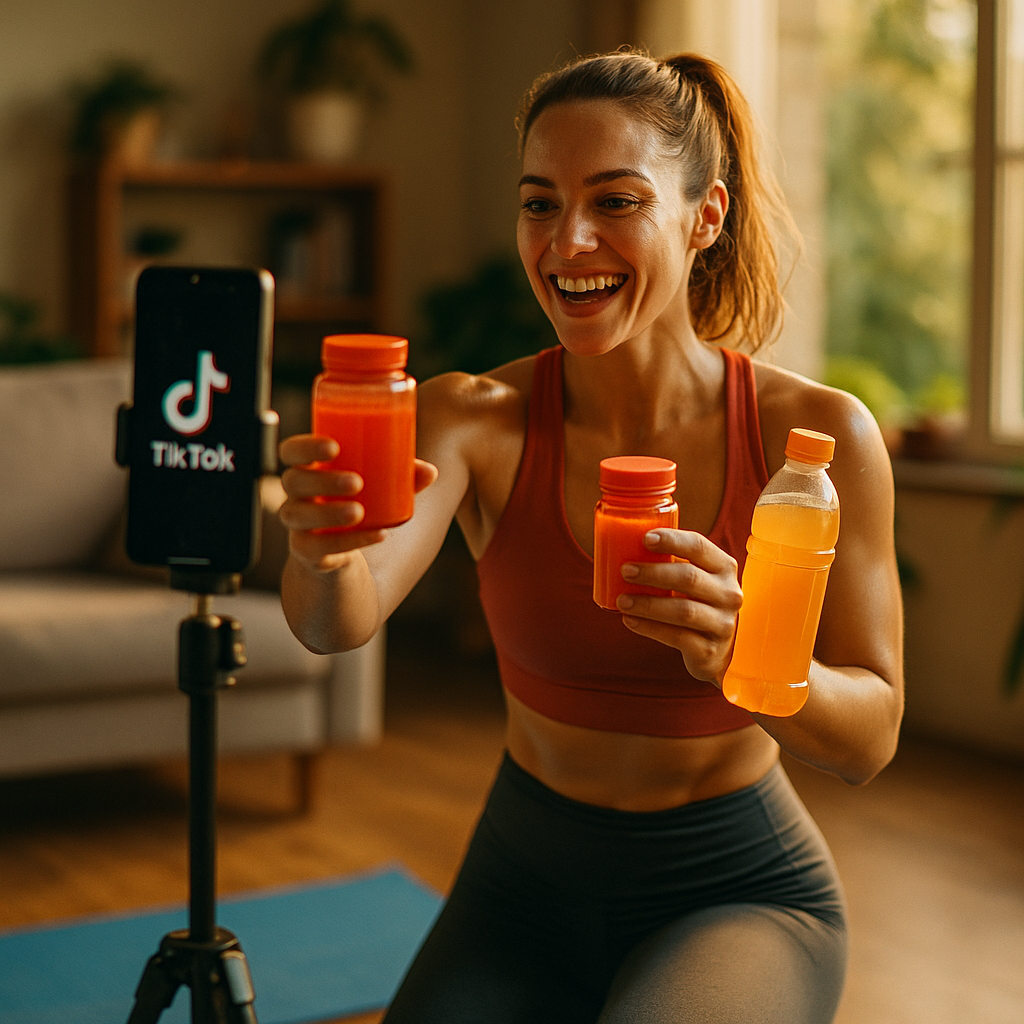
Scroll TikTok Shop for ten minutes and you’ll notice a pattern: the winners aren’t the polished ones. They’re loud, fast, physical. A creator dropping a scoop of collagen into a glass, shaking it, chugging it, gasping. This isn’t accidental. TikTok Shop has a measurable bias toward high-energy, wellness-adjacent content, and brands that don’t structure demos around it are leaving discovery-feed reach on the table.
Why the Feed Rewards Kinetic Content
TikTok’s recommendation system optimizes for watch-through and rewatch signals, not just likes. Wellness and supplement content happens to generate both, almost by accident. A creator biting into a gummy, wincing at a tart flavor, or timing a “does this actually work” reveal creates micro-cliffhangers every two to three seconds. That’s the format the algorithm was built to reward.
Compare that to a static beauty tutorial or a slow-panned skincare routine. Same engagement potential on paper, far weaker completion rates in practice. The Shop tab’s discovery feed leans harder on completion and shares than the main For You feed does, because commerce content needs to prove intent, not just interest.
Wellness content doesn’t win because TikTok favors the category — it wins because the category naturally produces the physical, fast-cut energy the ranking model already prioritizes.
We’ve covered how this plays out in supplement conversion data, and the pattern holds across adjacent verticals: energy drinks, pre-workout, gut health, even pet supplements. If your product category isn’t “wellness” on paper but can borrow its pacing, you’re already ahead of competitors still filming like it’s a QVC segment.
The Anatomy of a High-Energy Demo That Actually Converts
Forget “hook, problem, solution, CTA.” That’s a script structure, not a pacing structure. TikTok Shop’s top-performing demos follow a rhythm closer to this:
- Second 0-1: Physical action starts immediately — no intro, no “hey guys.” Hands are already moving.
- Second 1-3: A visual disruption. Something spills, fizzes, changes color, or makes noise.
- Second 3-6: Reaction shot. Real or performed, it doesn’t matter — the face sells the product more than the voiceover.
- Second 6-10: Fast cut to a second use case or angle. This resets attention before the algorithm’s drop-off window kicks in.
- Second 10-15: Product-in-hand shot with on-screen price or offer text, timed to when Shop’s overlay UI typically appears.
That’s a fifteen-second arc doing the work most brands try to stretch across sixty. Shorter isn’t lazier here — it’s harder to execute well, because every second has to earn the next one.
Sound Design Isn’t Optional Anymore
Native audio — the fizz, the crunch, the gasp — now outperforms trending music overlays in Shop-tagged content, according to creator agencies tracking TikTok Shop’s own performance dashboards. The platform’s algorithm appears to weight ambient product sound as a stronger relevance signal than licensed audio, likely because it correlates with authentic, unscripted use. If your demo videos are still leaning on trending sounds instead of raw product audio, you’re optimizing for the wrong era of the platform.
What “Wellness Bias” Actually Means for Non-Wellness Brands
Here’s the uncomfortable part for brand teams outside health and beauty: you don’t get a pass. Home goods, tech accessories, even apparel brands are seeing better Shop discovery performance when they borrow wellness pacing — quick physical proof, visible transformation, audible feedback — rather than sticking to category-standard demo styles.
A phone case brand demonstrating drop resistance benefits from the same kinetic energy as a skincare brand showing a serum absorb. The mechanism is identical: fast visual proof, immediate reaction, no dead air. Checkout speed changes on TikTok Shop have already forced brands to compress their creative timelines — this is the next layer of that compression, applied to pacing rather than just video length.
According to eMarketer, social commerce sales in the US are projected to keep outpacing overall ecommerce growth, and TikTok Shop remains one of the primary drivers of that gap. Brands slow to adapt their creative format aren’t just underperforming — they’re actively losing share of a fast-growing channel to competitors who read the room.
Compliance Doesn’t Slow You Down — Sloppy Compliance Does
High-energy doesn’t mean loose with disclosure. Wellness and supplement categories carry some of the strictest scrutiny on the platform, and for good reason. The FTC’s endorsement guidance still applies at full force regardless of how fast your cuts are, and TikTok’s own TikTok Ads policies flag unsubstantiated health claims aggressively, especially in Shop-linked content.
Brands running supplement or health-adjacent campaigns should treat compliance review as a pre-production step, not a post-edit checkbox. We’ve broken down the specific risk areas in supplement marketing compliance, and the short version is: claims like “cures,” “eliminates,” or “instantly fixes” get content throttled or removed, no matter how strong the watch-through rate is upstream.
A viral demo that gets pulled for a compliance flag on day three has generated zero durable ROI — energy without guardrails is just risk with better production value.
Paid partnership labeling matters here too. If creators are being compensated, disclosure isn’t optional, and getting it wrong has direct reach consequences. TikTok’s paid partnership labeling rules now actively throttle unlabeled sponsored content, which undercuts the exact discovery-feed placement you’re trying to win with high-energy pacing.
Briefing Creators for This Format Without Killing Authenticity
The mistake most brand teams make: they hand creators a shot list built for TV commercials and wonder why the resulting video feels stiff. High-energy TikTok Shop content works because it feels unscripted, even when it’s tightly directed. The brief needs to specify pacing and beats, not exact dialogue.
A workable brief structure looks like this:
- State the required opening action (product already in motion, no verbal intro).
- Specify the reaction beat — genuine or performed, timed to land within the first five seconds.
- Require at least one native sound moment (pour, crunch, snap, fizz) unmasked by music.
- Leave the CTA phrasing open, but require the on-screen price or offer overlay timing.
- Cap total runtime at 15-21 seconds unless testing a longer-format variant.
This is closer to directing a stunt than writing a script. Creators who’ve built followings on wellness or fitness content usually already know this rhythm instinctively — it’s why brands are increasingly routing budget toward nano creator amplification rather than one-off macro influencer deals. Smaller creators iterate faster and tend to have a more native feel for this pacing because they’ve been producing in this format organically, without agency polish getting in the way.
Testing Cadence: How Often Should You Refresh Creative?
TikTok Shop’s discovery feed has a shorter creative half-life than the main feed. Content that performs for two weeks on a standard product page might fatigue within four to six days when it’s Shop-linked and driving purchase intent. This ties into the platform’s purchase-intent routing changes, which now weight recency and freshness more heavily for commerce-tagged videos than for standard organic posts.
Practically, that means brands need a rolling content calendar producing new demo variants weekly, not monthly. Not full reshoots — variations on the same beat structure with different creators, different props, different reaction styles. Think of it as A/B testing pacing rather than testing entirely new concepts.
Where This Fits in the Broader Platform Strategy
None of this happens in a vacuum. Brands running TikTok and paid media rollouts together need the high-energy demo format to feed both organic discovery and paid amplification simultaneously — the same fifteen-second clip that wins the Shop discovery feed organically can usually be repurposed as a Spark Ad with minimal editing, since the pacing that works organically also performs well as paid creative.
It’s also worth benchmarking against other platforms attempting similar shoppable formats. TikTok Shop, Instagram Shopping, and YouTube Shopping each reward different pacing conventions, and treating them identically is a common, costly mistake. What wins on TikTok Shop’s discovery feed can feel jarring and off-brand on Instagram, where the algorithm still gives some weight to aesthetic consistency. Data from Statista shows TikTok’s user base skews younger and more likely to make impulse purchases directly from video content, which reinforces why kinetic, fast-payoff demos outperform here specifically, rather than being a universal creative law.
The takeaway for brand teams building Q1 creative calendars: stop briefing TikTok Shop content like polished commercials, and start briefing it like a fifteen-second stunt with a reaction beat, native sound, and a visible price tag before the viewer’s attention resets. Test weekly, disclose properly, and let the pacing — not the production budget — do the converting.
FAQs
Why does TikTok Shop favor wellness and supplement-style content?
Wellness content naturally produces fast physical actions, audible reactions, and visible transformations — the exact signals TikTok’s recommendation model uses to predict watch-through and rewatch behavior. It’s a byproduct of pacing, not a deliberate category preference.
Can non-wellness brands use the same high-energy demo structure?
Yes. Any product category can borrow the pacing — fast opening action, an audible or visual disruption, a genuine reaction shot, and a quick second-use cutaway — even if the product itself isn’t health or beauty related.
How long should a TikTok Shop demo video be?
Most top-performing demos run 15 to 21 seconds. Longer formats can work for education-heavy products, but the core discovery-feed win comes from tight, fast-paced clips that front-load action within the first second.
How often should brands refresh their TikTok Shop creative?
Weekly is a safer cadence than monthly. Shop-linked, commerce-tagged content fatigues faster than standard organic posts because the platform weights recency more heavily for purchase-intent content.
What compliance risks apply specifically to high-energy wellness demos?
Unsubstantiated health claims, missing paid partnership disclosures, and exaggerated before/after framing are the most common flags. FTC endorsement guidelines and TikTok’s own ad policies apply regardless of how fast or engaging the edit is.
Top Influencer Marketing Agencies
The leading agencies shaping influencer marketing in 2026
Agencies ranked by campaign performance, client diversity, platform expertise, proven ROI, industry recognition, and client satisfaction. Assessed through verified case studies, reviews, and industry consultations.
Moburst

-
2

The Shelf
Boutique Beauty & Lifestyle Influencer AgencyA data-driven boutique agency specializing exclusively in beauty, wellness, and lifestyle influencer campaigns on Instagram and TikTok. Best for brands already focused on the beauty/personal care space that need curated, aesthetic-driven content.Clients: Pepsi, The Honest Company, Hims, Elf Cosmetics, Pure LeafVisit The Shelf → -
3

Audiencly
Niche Gaming & Esports Influencer AgencyA specialized agency focused exclusively on gaming and esports creators on YouTube, Twitch, and TikTok. Ideal if your campaign is 100% gaming-focused — from game launches to hardware and esports events.Clients: Epic Games, NordVPN, Ubisoft, Wargaming, Tencent GamesVisit Audiencly → -
4

Viral Nation
Global Influencer Marketing & Talent AgencyA dual talent management and marketing agency with proprietary brand safety tools and a global creator network spanning nano-influencers to celebrities across all major platforms.Clients: Meta, Activision Blizzard, Energizer, Aston Martin, WalmartVisit Viral Nation → -
5

The Influencer Marketing Factory
TikTok, Instagram & YouTube CampaignsA full-service agency with strong TikTok expertise, offering end-to-end campaign management from influencer discovery through performance reporting with a focus on platform-native content.Clients: Google, Snapchat, Universal Music, Bumble, YelpVisit TIMF → -
6

NeoReach
Enterprise Analytics & Influencer CampaignsAn enterprise-focused agency combining managed campaigns with a powerful self-service data platform for influencer search, audience analytics, and attribution modeling.Clients: Amazon, Airbnb, Netflix, Honda, The New York TimesVisit NeoReach → -
7

Ubiquitous
Creator-First Marketing PlatformA tech-driven platform combining self-service tools with managed campaign options, emphasizing speed and scalability for brands managing multiple influencer relationships.Clients: Lyft, Disney, Target, American Eagle, NetflixVisit Ubiquitous → -
8

Obviously
Scalable Enterprise Influencer CampaignsA tech-enabled agency built for high-volume campaigns, coordinating hundreds of creators simultaneously with end-to-end logistics, content rights management, and product seeding.Clients: Google, Ulta Beauty, Converse, AmazonVisit Obviously →