


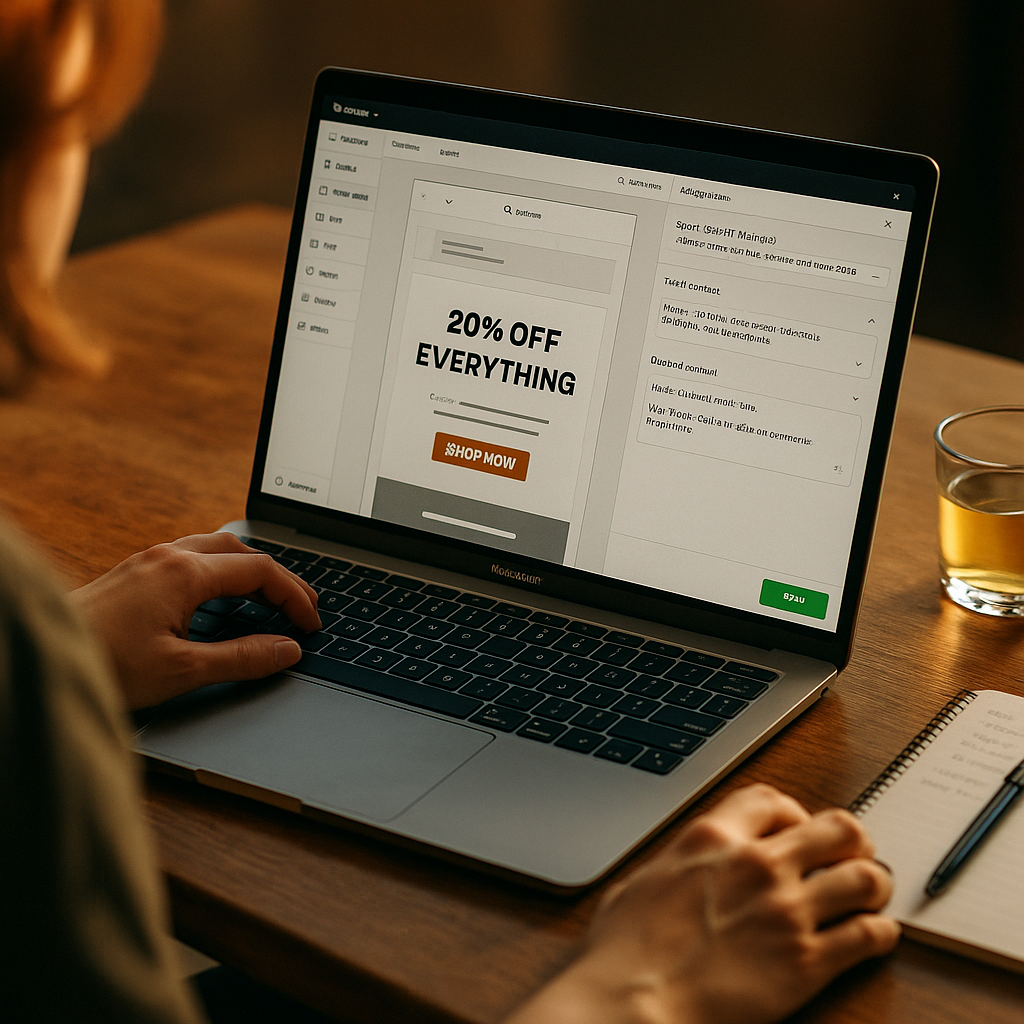
Sixty percent. That’s how much production time a mid-size DTC skincare brand shaved off its email calendar after handing repetitive drafting work to an AI assistant. If you’re still hand-building every campaign brief inside Klaviyo, you’re paying a tax nobody budgets for: Klaviyo Composer Assistant was built to eliminate exactly that tax, and this case study shows how one lean team used it to scale creator-linked SMS without adding headcount.
The Bottleneck Nobody Flags in the Budget Meeting
The brand in question — a body-care DTC company doing roughly $18M in annual revenue, which we’ll call Meridian for confidentiality — had a familiar problem. Two email marketers, one lifecycle manager, and an ever-growing backlog of creator partnerships that needed to be translated into campaigns. Every affiliate drop, every UGC video, every TikTok Shop moment needed a matching email and SMS push. Fast.
The team was stretched thin long before Composer Assistant entered the picture. Drafting a single promotional email — subject line variants, body copy, CTA testing, segment-specific tweaks — took an average of 3.5 hours per campaign. Multiply that across 12-15 sends a month, plus SMS variants, and you’re looking at a marketer spending more time typing than strategizing.
Sound familiar? It’s the same operational strain we’ve seen play out across creator-driven brands, from Chamberlain Coffee’s retail push to Solo Stove’s year-round seeding engine. More creator activity means more downstream content demand. Something has to give.
What Klaviyo Composer Assistant Actually Does
Composer Assistant is Klaviyo’s generative AI layer built directly into the email and SMS editor. Instead of starting from a blank canvas, marketers feed it a prompt — brand voice guidelines, campaign goal, product details, creator content links — and it generates a structured first draft: subject lines, preview text, body copy, and CTA options.
It’s not a novelty. Klaviyo has been investing heavily in AI tooling across its platform, and eMarketer data shows retention marketing teams increasingly prioritize AI-assisted content generation as email volume climbs. The differentiator here isn’t that it writes copy — plenty of tools do that. It’s that Composer Assistant sits inside the same workflow where segmentation, flows, and SMS automation already live, so there’s no context-switching between a chatbot and the ESP.
The real ROI of an in-platform AI assistant isn’t the copy it generates — it’s the hours it removes from the handoff between strategy and execution.
For Meridian’s team, that meant creator briefs and UGC assets could go straight into a Composer prompt, skip the manual first-draft stage entirely, and land in front of a human editor within minutes instead of hours.
The Workflow Before and After
Before Composer Assistant, Meridian’s process looked like this: creator content lands in Slack, marketer manually pulls key talking points, drafts email copy from scratch, sends to brand lead for review, revises, schedules. Average cycle time: two to three days per campaign.
After integrating Composer Assistant into the workflow, the process compressed dramatically:
- Creator content and campaign brief get dropped into a shared prompt template
- Composer Assistant generates three subject line variants and a full draft in under two minutes
- A human editor tightens tone, injects specific creator quotes or hooks, and finalizes CTAs
- SMS variant gets generated from the same prompt, adjusted for character limits and urgency
- Campaign moves to QA and scheduling same day
That’s the 60% time reduction in practice: not magic, just removing the blank-page problem and the back-and-forth drafting cycle that used to eat entire afternoons.
Scaling Creator-Linked SMS Without Breaking the Team
Here’s where it gets interesting for anyone running influencer programs. Meridian didn’t just want faster email production — they wanted to scale SMS campaigns tied directly to creator drops, something most lean teams avoid because SMS requires tighter copy, faster turnaround, and stricter compliance review.
Creator-linked SMS is a different beast than a standard promotional text. Every message referencing a specific creator, discount code, or TikTok Shop live needs to be timed precisely, compliant with FTC disclosure norms, and personalized enough to avoid feeling like spam. Brands like Grind Coffee have shown how tightly scripted, time-sensitive creator moments convert — but only when the follow-up marketing keeps pace.
Meridian used Composer Assistant to generate SMS drafts tied to each creator activation, then layered in manual compliance checks before send. The result: SMS campaign volume tied to creator content increased 3x quarter-over-quarter, without adding a single new team member. That’s the operational efficiency story brand leaders actually want to hear in a budget review — growth without headcount inflation.
The Numbers That Mattered to Leadership
Production time wasn’t the only metric that moved. Here’s what Meridian tracked over a two-quarter window post-implementation:
- Email production time: down 60%, from ~3.5 hours to roughly 90 minutes per campaign
- Creator-linked SMS sends: increased from 4 per month to 12 per month
- Time-to-send after creator content delivery: reduced from 48 hours to under 12 hours
- Email revenue per recipient: up 14% quarter-over-quarter, attributed partly to faster response to trending creator moments
- Team headcount: unchanged
Klaviyo’s own benchmark data, published via its marketing reports, has long shown that brands sending more frequent, relevant campaigns see stronger revenue per recipient — the constraint has always been production capacity, not demand. Composer Assistant removed the capacity constraint.
Where Human Judgment Still Wins
Let’s be honest about the limits. AI drafting is not the same as AI strategy. Meridian’s team was explicit that Composer Assistant handles the first 70% of a campaign — structure, tone matching, subject line options — but the last 30% still requires a human who understands the brand’s voice, the creator’s actual audience, and what claims are legally defensible.
This matters enormously in the influencer and creator space right now. The FTC’s endorsement guidelines require clear disclosure language, and AI-generated copy has no inherent understanding of which claims cross a compliance line. Brands that skip human review on AI drafts are gambling with exactly the kind of risk we’ve covered in Ollie’s approach to FTC-safe creator content and Chubbies’ compliance-first creator drops.
Meridian built a lightweight review checklist specifically for AI-assisted, creator-linked campaigns: verify disclosure language, confirm product claims match approved marketing language, and check that creator names/handles are spelled and tagged correctly. Small friction, big risk reduction.
Is This Repeatable for Other DTC Brands?
The obvious question every reader will have: does this only work for brands already deep into Klaviyo, or can a mid-size team replicate it starting from scratch?
The honest answer is that Composer Assistant delivers the most value to teams that already have clean segmentation and a reasonably mature flow structure. If your Klaviyo account is a mess of untagged lists and inconsistent flows, AI-generated copy won’t fix the underlying data problem. Garbage segmentation in, garbage-targeted campaigns out — no assistant changes that math.
But for teams with the fundamentals in place, the playbook Meridian used is straightforward to replicate:
- Build a standard prompt template that pulls creator name, content link, offer details, and brand tone notes
- Assign one editor to own the human-review layer, not the whole team, to keep tone consistent
- Set a compliance checklist specific to creator-linked sends
- Track time-to-send as a KPI, not just open rate or CTR
- Review AI drafts weekly to refine prompts based on what needed the most manual editing
Teams running high-frequency creator programs — think the cadence seen with Chewy’s nano-creator subscription engine or Whoop’s ambassador army — stand to gain the most, simply because volume is the whole problem AI drafting solves.
What This Means for Budget Planning
For brand leaders building next year’s marketing ops budget, the Meridian case offers a specific argument: AI copy assistants aren’t a “nice to have” creative tool, they’re a capacity multiplier that changes the math on creator program scale. If your creator partnerships are growing faster than your lifecycle team can turn content into campaigns, that gap is costing you revenue every week it persists.
Tools like HubSpot and other marketing platforms are racing to build similar AI drafting layers, which suggests this isn’t a Klaviyo-specific advantage for long. The brands that build the operational muscle now — clean prompts, clear review processes, tracked time-to-send metrics — will be positioned to scale creator programs faster than competitors still stuck manually drafting every send.
The Takeaway
Cutting email production time in half doesn’t come from working faster — it comes from removing the blank-page problem entirely and reserving human time for judgment calls AI can’t make. Start by auditing how many hours your team spends drafting versus reviewing; if drafting dominates, that’s your Composer Assistant business case already written.
Frequently Asked Questions
What is Klaviyo Composer Assistant?
Klaviyo Composer Assistant is an AI-powered drafting tool built into Klaviyo’s email and SMS editor. It generates subject lines, body copy, and CTA options based on a marketer’s prompt, reducing the time needed to produce a campaign from scratch.
How much time can Composer Assistant actually save?
Results vary by team maturity, but the case study brand reduced average email production time from 3.5 hours to roughly 90 minutes per campaign, a 60% reduction, by using AI drafts as a starting point rather than building from blank templates.
Does using AI for email copy create compliance risk with creator campaigns?
It can, if brands skip human review. AI tools don’t inherently understand FTC disclosure requirements or brand-approved product claims, so a manual compliance checklist remains essential for any creator-linked send.
Is Composer Assistant only useful for large enterprise teams?
No. It’s arguably more valuable for lean, mid-size teams that lack the headcount to draft every campaign manually. The main prerequisite is having reasonably clean segmentation and flow structure already in place in Klaviyo.
Can this approach scale SMS campaigns tied to creator content?
Yes. The case study brand used Composer Assistant to draft SMS variants tied to specific creator activations, tripling creator-linked SMS volume quarter-over-quarter without adding staff, while keeping a manual compliance review step before sending.
Top Influencer Marketing Agencies
The leading agencies shaping influencer marketing in 2026
Agencies ranked by campaign performance, client diversity, platform expertise, proven ROI, industry recognition, and client satisfaction. Assessed through verified case studies, reviews, and industry consultations.
Moburst

-
2

The Shelf
Boutique Beauty & Lifestyle Influencer AgencyA data-driven boutique agency specializing exclusively in beauty, wellness, and lifestyle influencer campaigns on Instagram and TikTok. Best for brands already focused on the beauty/personal care space that need curated, aesthetic-driven content.Clients: Pepsi, The Honest Company, Hims, Elf Cosmetics, Pure LeafVisit The Shelf → -
3

Audiencly
Niche Gaming & Esports Influencer AgencyA specialized agency focused exclusively on gaming and esports creators on YouTube, Twitch, and TikTok. Ideal if your campaign is 100% gaming-focused — from game launches to hardware and esports events.Clients: Epic Games, NordVPN, Ubisoft, Wargaming, Tencent GamesVisit Audiencly → -
4

Viral Nation
Global Influencer Marketing & Talent AgencyA dual talent management and marketing agency with proprietary brand safety tools and a global creator network spanning nano-influencers to celebrities across all major platforms.Clients: Meta, Activision Blizzard, Energizer, Aston Martin, WalmartVisit Viral Nation → -
5

The Influencer Marketing Factory
TikTok, Instagram & YouTube CampaignsA full-service agency with strong TikTok expertise, offering end-to-end campaign management from influencer discovery through performance reporting with a focus on platform-native content.Clients: Google, Snapchat, Universal Music, Bumble, YelpVisit TIMF → -
6

NeoReach
Enterprise Analytics & Influencer CampaignsAn enterprise-focused agency combining managed campaigns with a powerful self-service data platform for influencer search, audience analytics, and attribution modeling.Clients: Amazon, Airbnb, Netflix, Honda, The New York TimesVisit NeoReach → -
7

Ubiquitous
Creator-First Marketing PlatformA tech-driven platform combining self-service tools with managed campaign options, emphasizing speed and scalability for brands managing multiple influencer relationships.Clients: Lyft, Disney, Target, American Eagle, NetflixVisit Ubiquitous → -
8

Obviously
Scalable Enterprise Influencer CampaignsA tech-enabled agency built for high-volume campaigns, coordinating hundreds of creators simultaneously with end-to-end logistics, content rights management, and product seeding.Clients: Google, Ulta Beauty, Converse, AmazonVisit Obviously →