


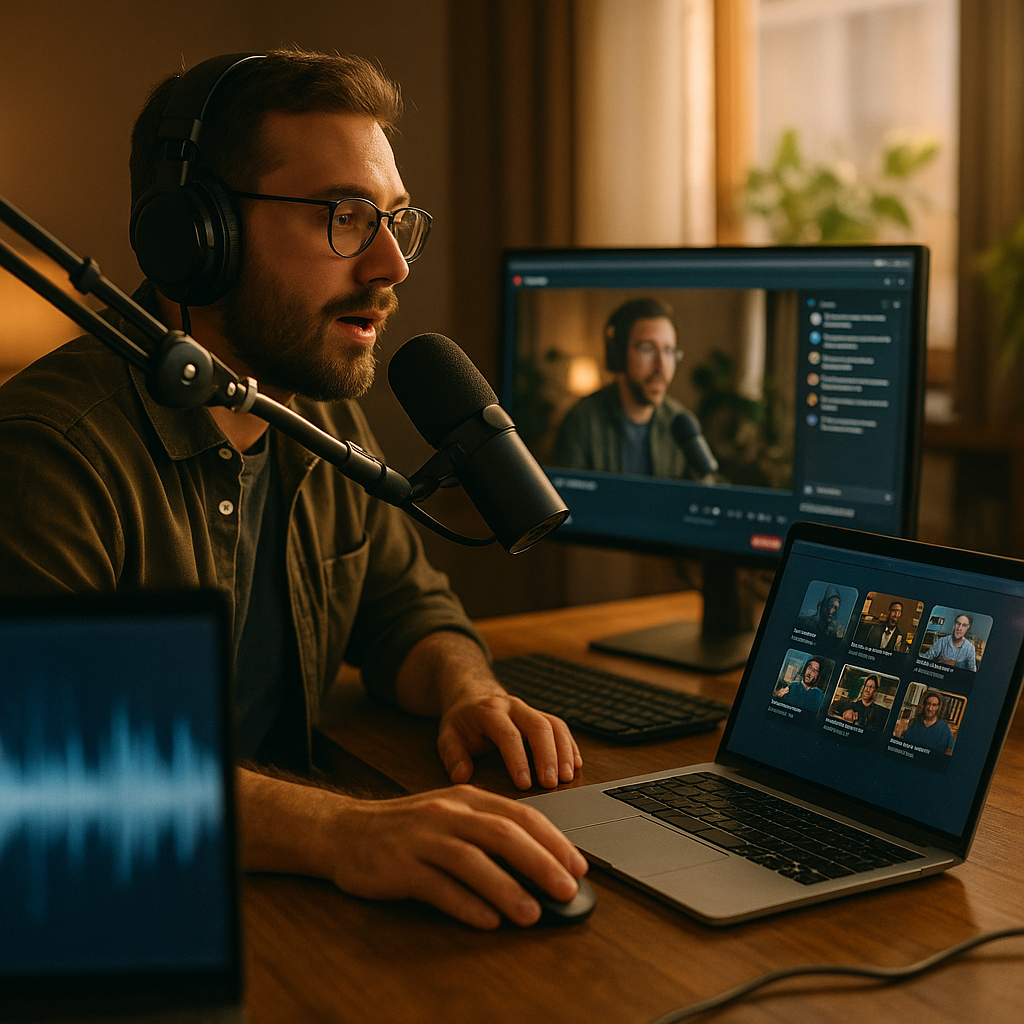
One 90-minute live-shopping stream. Zero extra shoots. A full week of short-form content across TikTok, Instagram, and YouTube Shorts — without hiring a single new editor. That’s the promise of the AI-driven content repurposing engine, and it’s quietly rewriting production budgets for brands that once treated live commerce as a one-off event rather than a content mine.
If your team still treats a livestream as a single-use asset, you’re leaving money on the table. Literally. The clip-worthy moments buried inside a 90-minute stream — the awkward pause before a big reveal, the founder’s off-script joke, the “wait, it does WHAT?” reaction — used to require a human editor scrubbing footage for hours to find. Now AI tools do it in minutes.
Why Live Streams Are Content Goldmines Nobody’s Mining Properly
Live-shopping streams generate an absurd amount of raw footage relative to what brands actually use. A typical QVC-style TikTok Shop stream runs 60 to 120 minutes. Most brands post maybe two or three clips from it, if that. The rest sits in a cloud folder, forgotten.
That’s a waste, and it’s an expensive one. Booking a creator for a live-shopping session already costs real money — talent fees, product seeding, platform promotion. Treating the output as a single Instagram Reel is like buying a whole cow and only eating the tenderloin.
Brands running AI-assisted repurposing workflows are reporting 15-20 short-form assets per live stream, compared to the historical average of 2-4 manually cut clips — without adding headcount.
The shift isn’t really about editing speed, though that’s the part vendors love to demo. It’s about volume economics. Short-form platforms reward posting frequency. TikTok’s own creator guidance has long emphasized consistent posting cadence for algorithmic reach. A brand that posts once a week from a livestream is competing against creators posting daily. AI repurposing closes that gap without burning out your social team.
How the Engine Actually Works
Strip away the marketing language and the workflow looks like this:
- Transcription and speaker separation: Tools like Descript or Riverside ingest the raw stream and generate a searchable transcript, tagging who’s speaking and when.
- Moment detection: AI models scan for spikes — laughter, sudden price reveals, chat comment surges, product holds — and flag timestamps as “high-potential” clips.
- Auto-cropping and reformatting: The flagged segments get reframed from 16:9 to 9:16, with dynamic cropping that follows faces or product placement so nothing gets cut off awkwardly.
- Caption and hook generation: Auto-captioning tools add burned-in text, and increasingly, generative AI suggests hook lines based on what performed well in similar past clips.
- Platform-specific export: The same moment gets rendered three or four different ways — a punchy 15-second TikTok cut, a longer 60-second YouTube Short with more context, a still-image carousel for Instagram.
None of this is science fiction. It’s the same underlying tech stack — computer vision, NLP, generative text — that’s been maturing across the martech stack for a couple of years now. What’s new is the packaging: purpose-built live-commerce repurposing tools that plug directly into TikTok Shop and Shopify Live exports instead of requiring a manual upload-and-hope workflow.
What a Week Actually Looks Like
Say a skincare brand runs a 75-minute live-shopping stream on a Tuesday featuring a dermatologist-creator walking through a new serum launch. Here’s a realistic seven-day content calendar built entirely from that single stream:
- Day 1 (stream day): Full VOD posted to YouTube, plus a 60-second highlight reel pushed same-night to TikTok and Reels.
- Day 2: A “skeptic in the chat asks the hard question” clip — the moment someone in live chat pushed back on an ingredient claim and the creator answered it live. This kind of unscripted pushback-and-resolution moment is exactly the structure covered in the trust-building arc format.
- Day 3: A price-reveal moment repackaged as a standalone clip, similar in spirit to the breakdown structure in the price-per-use format.
- Day 4: Behind-the-scenes B-roll from the stream setup, repurposed as a “get ready with me” style Story sequence.
- Day 5: A silent, text-overlay-only cut of the demo portion for sound-off viewers, echoing the approach in the sound-off playbook.
- Day 6: A reaction compilation pulling from live chat screenshots layered over the demo footage.
- Day 7: A recap carousel driving to the replay or next stream date, closing the loop.
Seven days, one shoot, minimal new production cost. The math on that alone should make any CMO pay attention.
The ROI Case Nobody’s Modeling Correctly
Most brands still calculate live-shopping ROI purely on stream-day conversion. That’s a mistake. It ignores the compounding value of the repurposed tail.
Consider cost-per-asset instead of cost-per-stream. If a stream costs $8,000 in talent, production, and promotion, and it only yields 3 clips, you’re paying roughly $2,700 per asset. Run that same stream through an AI repurposing pipeline yielding 18 usable clips, and the cost-per-asset drops below $450. That’s not a marginal efficiency gain. That’s a fundamentally different unit economics model for content production.
Distribution matters just as much as production cost. A single UGC clip sitting in a shared drive does nothing. The brands seeing real returns are the ones pushing every repurposed clip into a centralized, tagged library that paid social, organic social, and even email teams can pull from — the same logic behind unified content distribution strategies gaining traction across retail marketing teams.
Where This Gets Risky: Compliance Doesn’t Pause for Automation
Here’s the part vendors conveniently leave out of their case studies: FTC disclosure obligations don’t disappear just because a clip was auto-generated. If a creator made a paid or gifted claim during the live stream, every single derivative clip pulled from that stream still needs proper disclosure, per the FTC’s endorsement guidance.
This trips up teams constantly. An AI tool clips a 12-second moment where the creator says “this cleared my skin in a week” — no #ad tag visible, no verbal disclosure in that specific segment, because the disclosure happened at minute 3 of the original stream and the clip is from minute 47. Technically compliant in context. Non-compliant once isolated. That’s a real legal exposure, not a hypothetical one.
Automated clipping tools optimize for engagement signals, not compliance. Someone on your team still has to review every repurposed asset before it goes live — that step doesn’t get automated away.
Build disclosure redundancy into your source stream from the start: recurring on-screen disclosure banners, verbal disclosure repeated every 10-15 minutes, not just once at the top. That way every clip, regardless of timestamp, carries its own compliance coverage. Brands that have wrestled with this same problem in adjacent formats have documented similar guardrails — see how the confession-booth format compliance guide handles recurring disclosure needs, and apply the same logic to live replay clipping.
Picking Tools: What Actually Matters
The repurposing tool market has gotten crowded fast. Opus Clip, Vidyo.ai, Descript’s Underlord, and Riverside’s AI Clips all compete in roughly the same lane. A few things actually differentiate them for live-shopping use cases specifically:
- Native e-commerce platform integration. Can the tool pull directly from TikTok Shop or Shopify Live exports, or are you stuck downloading and re-uploading manually?
- Product-tag persistence. Does the tool preserve shoppable tags and links when it crops and reformats a clip, or do you have to re-add them by hand for every export?
- Brand voice consistency in auto-captions. Generic AI caption suggestions can sound off-brand fast. Check whether the tool allows custom prompt training on your brand’s tone.
- Batch export granularity. Can you generate platform-specific aspect ratios and lengths in one pass, or are you exporting once and manually resizing per channel?
Don’t just buy on the demo reel. Run a pilot with your own footage before committing to an annual contract. According to eMarketer’s ongoing coverage of retail media and creator commerce, live-shopping ad spend continues climbing across US and UK markets, which means the tooling category is only going to get more crowded — and more aggressively marketed — before it consolidates.
Where Second-Screen Behavior Fits Into the Strategy
One underrated repurposing angle: viewers aren’t watching your live stream in isolation. A meaningful chunk are half-watching on a second screen while scrolling elsewhere, which is exactly the behavior explored in co-viewing strategy research. That means the short-form clips you generate afterward aren’t just recap content for people who missed the stream — they’re often the primary touchpoint for viewers who were only half-paying-attention the first time. Design your repurposed clips assuming zero prior context. Every clip should stand alone.
The Practical Next Step
Audit your last three live-shopping streams before running another one. If you extracted fewer than 10 usable clips per stream, you’re under-monetizing production spend you already committed. Fix the repurposing pipeline first — tooling, tagging, compliance review — before booking your next stream.
Frequently Asked Questions
What is AI content repurposing in the context of live-shopping streams?
It’s the use of AI tools to automatically identify, clip, reformat, and caption short-form video segments from a longer live-shopping stream, turning one broadcast into multiple platform-ready assets without manual editing for each one.
How many short-form clips can realistically come from one live stream?
Brands using AI-assisted moment detection commonly extract 15-20 usable clips from a 60-90 minute stream, compared to 2-4 clips produced through fully manual editing.
Do repurposed clips need their own FTC disclosures?
Yes. Each derivative clip must independently meet FTC disclosure requirements if it contains a sponsored or gifted product claim, even if disclosure appeared earlier in the original stream but not within that specific clip’s timestamp.
Which AI tools are commonly used for live-shopping repurposing?
Tools like Opus Clip, Vidyo.ai, Descript, and Riverside’s AI Clips are widely used, with differentiation coming from e-commerce platform integration and shoppable-tag persistence rather than raw editing capability.
Does AI repurposing replace human review entirely?
No. AI handles clipping, cropping, and captioning at scale, but human review remains necessary for brand voice, compliance accuracy, and context checks before publishing.
Visible FAQ (duplicate block per instructions)
What is AI content repurposing in the context of live-shopping streams?
It’s the use of AI tools to automatically identify, clip, reformat, and caption short-form video segments from a longer live-shopping stream, turning one broadcast into multiple platform-ready assets without manual editing for each one.
How many short-form clips can realistically come from one live stream?
Brands using AI-assisted moment detection commonly extract 15-20 usable clips from a 60-90 minute stream, compared to 2-4 clips produced through fully manual editing.
Do repurposed clips need their own FTC disclosures?
Yes. Each derivative clip must independently meet FTC disclosure requirements if it contains a sponsored or gifted product claim, even if disclosure appeared earlier in the original stream but not within that specific clip’s timestamp.
Which AI tools are commonly used for live-shopping repurposing?
Tools like Opus Clip, Vidyo.ai, Descript, and Riverside’s AI Clips are widely used, with differentiation coming from e-commerce platform integration and shoppable-tag persistence rather than raw editing capability.
Does AI repurposing replace human review entirely?
No. AI handles clipping, cropping, and captioning at scale, but human review remains necessary for brand voice, compliance accuracy, and context checks before publishing.
Top Influencer Marketing Agencies
The leading agencies shaping influencer marketing in 2026
Agencies ranked by campaign performance, client diversity, platform expertise, proven ROI, industry recognition, and client satisfaction. Assessed through verified case studies, reviews, and industry consultations.
Moburst

-
2

The Shelf
Boutique Beauty & Lifestyle Influencer AgencyA data-driven boutique agency specializing exclusively in beauty, wellness, and lifestyle influencer campaigns on Instagram and TikTok. Best for brands already focused on the beauty/personal care space that need curated, aesthetic-driven content.Clients: Pepsi, The Honest Company, Hims, Elf Cosmetics, Pure LeafVisit The Shelf → -
3

Audiencly
Niche Gaming & Esports Influencer AgencyA specialized agency focused exclusively on gaming and esports creators on YouTube, Twitch, and TikTok. Ideal if your campaign is 100% gaming-focused — from game launches to hardware and esports events.Clients: Epic Games, NordVPN, Ubisoft, Wargaming, Tencent GamesVisit Audiencly → -
4

Viral Nation
Global Influencer Marketing & Talent AgencyA dual talent management and marketing agency with proprietary brand safety tools and a global creator network spanning nano-influencers to celebrities across all major platforms.Clients: Meta, Activision Blizzard, Energizer, Aston Martin, WalmartVisit Viral Nation → -
5

The Influencer Marketing Factory
TikTok, Instagram & YouTube CampaignsA full-service agency with strong TikTok expertise, offering end-to-end campaign management from influencer discovery through performance reporting with a focus on platform-native content.Clients: Google, Snapchat, Universal Music, Bumble, YelpVisit TIMF → -
6

NeoReach
Enterprise Analytics & Influencer CampaignsAn enterprise-focused agency combining managed campaigns with a powerful self-service data platform for influencer search, audience analytics, and attribution modeling.Clients: Amazon, Airbnb, Netflix, Honda, The New York TimesVisit NeoReach → -
7

Ubiquitous
Creator-First Marketing PlatformA tech-driven platform combining self-service tools with managed campaign options, emphasizing speed and scalability for brands managing multiple influencer relationships.Clients: Lyft, Disney, Target, American Eagle, NetflixVisit Ubiquitous → -
8

Obviously
Scalable Enterprise Influencer CampaignsA tech-enabled agency built for high-volume campaigns, coordinating hundreds of creators simultaneously with end-to-end logistics, content rights management, and product seeding.Clients: Google, Ulta Beauty, Converse, AmazonVisit Obviously →